


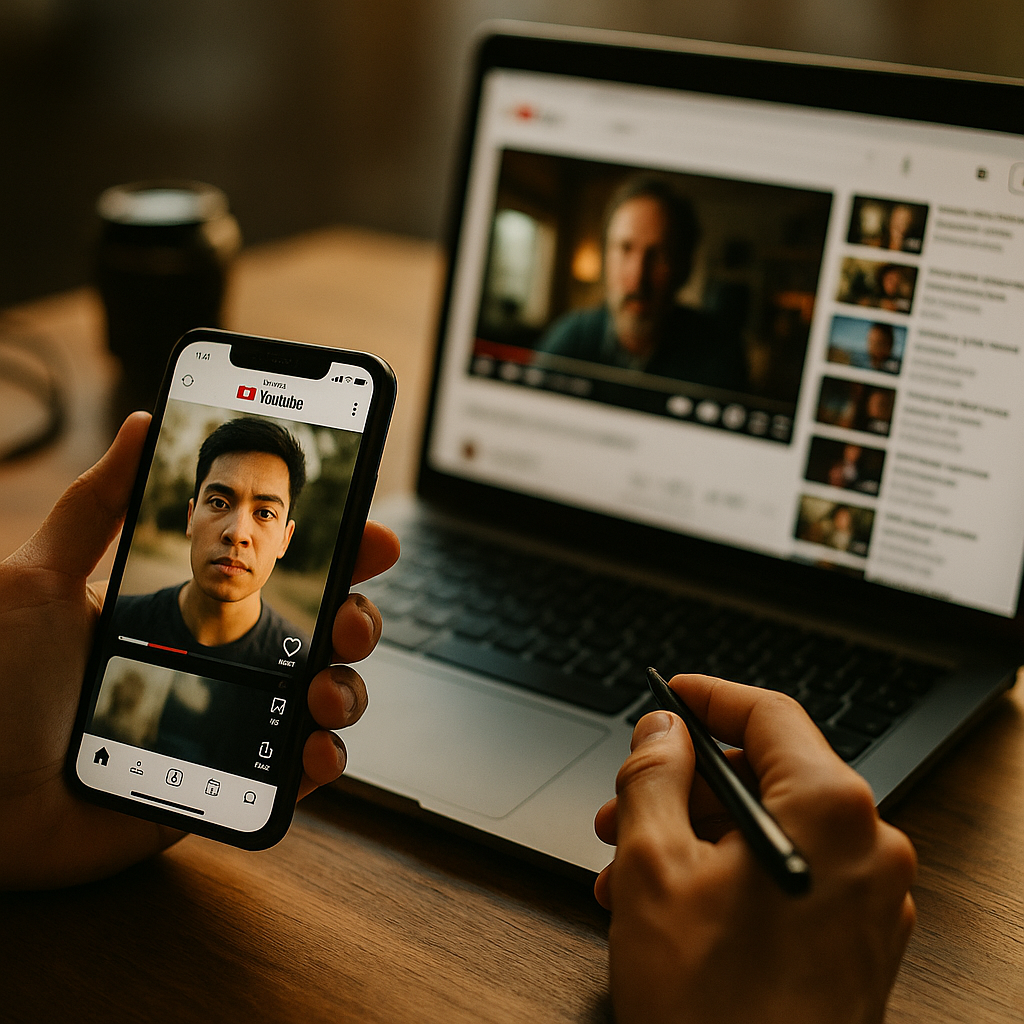
YouTube’s algorithm no longer cares whether your hook lives in a 45-second Short or a 22-minute deep-dive. It cares whether that hook earns watch-time-equivalence — a normalized score that puts a completed Short and a half-watched long-form video on the same distribution ladder. Most brands are still briefing these formats like they’re separate species. That’s costing them reach.
The YouTube watch-time-equivalence algorithm shift, which we first broke down in our earlier analysis of the ranking change, has quietly rewritten the rules for what “good performance” even means. This playbook goes further: how to actually structure hooks, pacing, and retention curves so both formats compete for the same distribution weight instead of cannibalizing each other.
What Watch-Time-Equivalence Actually Measures
Forget raw minutes watched. YouTube’s system now converts every view into a normalized retention percentage, then weights that percentage against format-expected benchmarks. A Short that holds 80% of viewers to the end is scored comparably to a 15-minute video that holds 45% average view duration — because both represent “high relative attention” for their format.
This matters because brands have spent years optimizing Shorts for completion rate and long-form for session time, treating them as separate KPIs reporting to separate stakeholders. That silo is now a liability. YouTube’s recommendation engine pulls from a shared pool of signals, and if your long-form hook underperforms relative to your Shorts hook, the whole channel’s authority score can drag.
Channels that structure Shorts and long-form hooks using the same retention logic are seeing 20-30% more cross-format recommendation pull, according to creator analytics reports circulating among mid-tier YouTube partners.
The Hook Isn’t a Line. It’s an Architecture.
Ask ten marketers to define a “hook” and you’ll get ten answers involving the first five seconds. That’s incomplete. Under watch-time-equivalence scoring, the hook is really a three-beat structure that has to work whether the video is 30 seconds or 30 minutes:
- The disruption (0-3 seconds): A visual or verbal pattern break. No slow logo intros, no “hey guys welcome back.”
- The stakes (3-8 seconds): What the viewer loses by clicking away. This is where most long-form scripts get lazy.
- The proof-of-payoff (8-15 seconds): A glimpse of the result, data point, or transformation that’s coming.
Shorts compress this into roughly six seconds total. Long-form has more room but the same architecture applies — YouTube’s algorithm is now measuring whether that structure exists at all, not just whether it’s long or short.
Why Compression Isn’t Simplification
Here’s the mistake most brand teams make: they think a Shorts hook is just a “smaller” version of a long-form hook. It’s not. It’s a different compression ratio of the same three beats. A supplement brand explaining a sleep-quality study needs to compress “stakes” into a single visual (someone groggy at 3 a.m.) in a Short, while long-form can spend 20 seconds building the stakes with a personal narrative.
Get the compression wrong and you get one of two failure modes: Shorts that feel rushed and confusing, or long-form intros that feel like padded Shorts stretched past their natural length. Both tank retention. Both hurt your equivalence score.
Structuring for Dual-Format Scoring
The operational question every brand strategist actually needs answered: how do you brief creators or in-house teams to produce hooks that score well on both scales simultaneously? Three approaches are working right now.
1. Build the Long-Form Hook First, Then Extract
Counterintuitive, but effective. Write the full long-form hook script (15-20 seconds), then find the single most disruptive 3-5 second segment inside it. That segment becomes your Short. This guarantees narrative consistency, and it means your Short is essentially a trailer for a proven structure rather than a standalone gamble.
2. Match Retention Curve Shapes, Not Just Opening Seconds
YouTube Studio’s retention graphs reveal more than drop-off points. Look at the shape: does retention decline gradually (good) or fall off a cliff at a specific timestamp (bad, usually indicating a broken promise)? Brands should be comparing the curve shape of their Shorts against their long-form videos. If Shorts show smooth decay and long-form shows cliff-drops at the 45-second mark, that’s a structural hook problem, not a content quality problem.
3. Reuse Proof Points Across Formats
If your long-form video’s proof-of-payoff is a before/after result, use the exact same visual asset in the Short’s proof beat. Consistency across formats seems to correlate with stronger cross-recommendation, likely because YouTube’s system is matching visual and topical signals between a channel’s Shorts and long-form catalog when deciding what to surface next.
This isn’t guesswork specific to YouTube either. We’ve seen similar cross-format consistency principles work for Instagram Reels briefs built around saves, where the save-worthy moment in a Reel often mirrors the higher-funnel content on the same account.
Format Selection Isn’t Just a Budget Decision Anymore
Brands have historically treated the Shorts-vs-long-form choice as a budget allocation question — how much do we spend on quick, high-volume Shorts versus fewer, expensive long-form pieces? That framework, covered in depth in our budget framework for Shorts vs long-form, still matters for production cost planning. But watch-time-equivalence adds a second layer: distribution cost.
If your Shorts hook structure is weak, you’re not just wasting production budget on underperforming content. You’re actively suppressing the distribution potential of your long-form catalog, because the algorithm reads weak Shorts performance as a signal about channel-wide hook quality.
For supplement and wellness brands specifically — a vertical we’ve tracked closely because of its unique trust requirements — this is especially high-stakes. Long-form has always won trust for supplement brands, but a channel that can’t also produce disciplined Shorts hooks is now leaving distribution weight on the table that could otherwise boost its long-form reach.
Search Intent Still Matters, Maybe More
None of this replaces the fundamentals. Search-intent tooling for long-form strategy remains critical because watch-time-equivalence scoring only kicks in after a viewer clicks. Get the title and thumbnail wrong, and there’s no hook architecture that saves you. Think of it as a funnel: search intent and thumbnail psychology get the click, hook architecture holds the viewer, and equivalence scoring rewards the hold.
Brands that skip the search-intent step and jump straight to hook optimization are polishing the wrong end of the funnel first.
What to Measure Instead of Views
If you’re reporting to leadership on YouTube performance, views and even watch time in isolation are increasingly poor proxies for algorithmic favor. Track these instead:
- Relative retention percentage — how your video’s average view duration compares to YouTube’s format benchmark, not an absolute number.
- Swipe-away rate on Shorts — the速 speed at which viewers exit before the loop, a stronger signal than raw completion.
- Cross-format click-through — whether Shorts viewers are clicking into your long-form catalog, visible in YouTube Studio’s traffic source breakdown.
- Session continuation — whether your video leads to another video being watched (yours or a competitor’s) immediately after.
These four metrics are far better predictors of algorithmic distribution than subscriber growth or vanity view counts, and they map directly onto how YouTube’s own creator support documentation frames recommendation signals.
A Quick Word on Attribution Risk
Brand teams running influencer programs on YouTube should also flag a compliance angle here. As hook structures get more compressed and more “trailer-like,” there’s growing pressure to blur the line between organic hook and paid promotion, especially when a Short teases a sponsored long-form video. That’s a disclosure issue, not just a creative one. Keep FTC guidance on clear and conspicuous disclosure top of mind, and review the FTC’s endorsement guidelines before greenlighting hook structures that intentionally obscure sponsorship until the payoff beat.
Platforms outside YouTube are dealing with adjacent format-shift pressures too. TikTok’s move toward discovery-over-reach distribution logic and Instagram’s push into algorithmic Reels force-feeding both reward the same underlying discipline: consistent hook architecture across format lengths, not format-specific tricks.
The Takeaway
Stop briefing Shorts and long-form as separate disciplines. Build one hook architecture, compress and expand it across formats, and measure relative retention instead of raw views — that’s what wins equal distribution weight under YouTube’s watch-time-equivalence model. Audit your last ten uploads this week: if your Shorts and long-form hooks don’t share a visible structural DNA, that’s your first fix.
FAQs
What is YouTube’s watch-time-equivalence algorithm?
It’s a scoring system that normalizes retention across Shorts and long-form video into a comparable format, allowing YouTube’s recommendation engine to weigh both against similar distribution criteria instead of treating them as separate ranking pools.
How long should a hook be for a YouTube Short versus a long-form video?
Shorts need the full three-beat hook (disruption, stakes, proof-of-payoff) compressed into roughly 5-6 seconds. Long-form can extend the same structure to 15-20 seconds, giving more room to build stakes before revealing payoff.
Does posting more Shorts hurt long-form performance?
Not inherently, but weak Shorts hooks can suppress channel-wide distribution signals. Since scoring is now cross-format, a pattern of poor Shorts retention may reduce how aggressively YouTube recommends your long-form catalog.
What metrics should brands track instead of total views?
Relative retention percentage against format benchmarks, Shorts swipe-away rate, cross-format click-through from Shorts to long-form, and session continuation are stronger indicators of algorithmic favor than raw view counts.
Is watch-time-equivalence the same as average view duration?
No. Average view duration is a raw number. Watch-time-equivalence normalizes that number against expected benchmarks for the specific format length, so a short clip and a long video can be compared fairly.
FAQs
What is YouTube’s watch-time-equivalence algorithm?
It’s a scoring system that normalizes retention across Shorts and long-form video into a comparable format, allowing YouTube’s recommendation engine to weigh both against similar distribution criteria instead of treating them as separate ranking pools.
How long should a hook be for a YouTube Short versus a long-form video?
Shorts need the full three-beat hook (disruption, stakes, proof-of-payoff) compressed into roughly 5-6 seconds. Long-form can extend the same structure to 15-20 seconds, giving more room to build stakes before revealing payoff.
Does posting more Shorts hurt long-form performance?
Not inherently, but weak Shorts hooks can suppress channel-wide distribution signals. Since scoring is now cross-format, a pattern of poor Shorts retention may reduce how aggressively YouTube recommends your long-form catalog.
What metrics should brands track instead of total views?
Relative retention percentage against format benchmarks, Shorts swipe-away rate, cross-format click-through from Shorts to long-form, and session continuation are stronger indicators of algorithmic favor than raw view counts.
Is watch-time-equivalence the same as average view duration?
No. Average view duration is a raw number. Watch-time-equivalence normalizes that number against expected benchmarks for the specific format length, so a short clip and a long video can be compared fairly.
Top Influencer Marketing Agencies
The leading agencies shaping influencer marketing in 2026
Agencies ranked by campaign performance, client diversity, platform expertise, proven ROI, industry recognition, and client satisfaction. Assessed through verified case studies, reviews, and industry consultations.
Moburst

-
2

The Shelf
Boutique Beauty & Lifestyle Influencer AgencyA data-driven boutique agency specializing exclusively in beauty, wellness, and lifestyle influencer campaigns on Instagram and TikTok. Best for brands already focused on the beauty/personal care space that need curated, aesthetic-driven content.Clients: Pepsi, The Honest Company, Hims, Elf Cosmetics, Pure LeafVisit The Shelf → -
3

Audiencly
Niche Gaming & Esports Influencer AgencyA specialized agency focused exclusively on gaming and esports creators on YouTube, Twitch, and TikTok. Ideal if your campaign is 100% gaming-focused — from game launches to hardware and esports events.Clients: Epic Games, NordVPN, Ubisoft, Wargaming, Tencent GamesVisit Audiencly → -
4

Viral Nation
Global Influencer Marketing & Talent AgencyA dual talent management and marketing agency with proprietary brand safety tools and a global creator network spanning nano-influencers to celebrities across all major platforms.Clients: Meta, Activision Blizzard, Energizer, Aston Martin, WalmartVisit Viral Nation → -
5

The Influencer Marketing Factory
TikTok, Instagram & YouTube CampaignsA full-service agency with strong TikTok expertise, offering end-to-end campaign management from influencer discovery through performance reporting with a focus on platform-native content.Clients: Google, Snapchat, Universal Music, Bumble, YelpVisit TIMF → -
6

NeoReach
Enterprise Analytics & Influencer CampaignsAn enterprise-focused agency combining managed campaigns with a powerful self-service data platform for influencer search, audience analytics, and attribution modeling.Clients: Amazon, Airbnb, Netflix, Honda, The New York TimesVisit NeoReach → -
7

Ubiquitous
Creator-First Marketing PlatformA tech-driven platform combining self-service tools with managed campaign options, emphasizing speed and scalability for brands managing multiple influencer relationships.Clients: Lyft, Disney, Target, American Eagle, NetflixVisit Ubiquitous → -
8

Obviously
Scalable Enterprise Influencer CampaignsA tech-enabled agency built for high-volume campaigns, coordinating hundreds of creators simultaneously with end-to-end logistics, content rights management, and product seeding.Clients: Google, Ulta Beauty, Converse, AmazonVisit Obviously →