


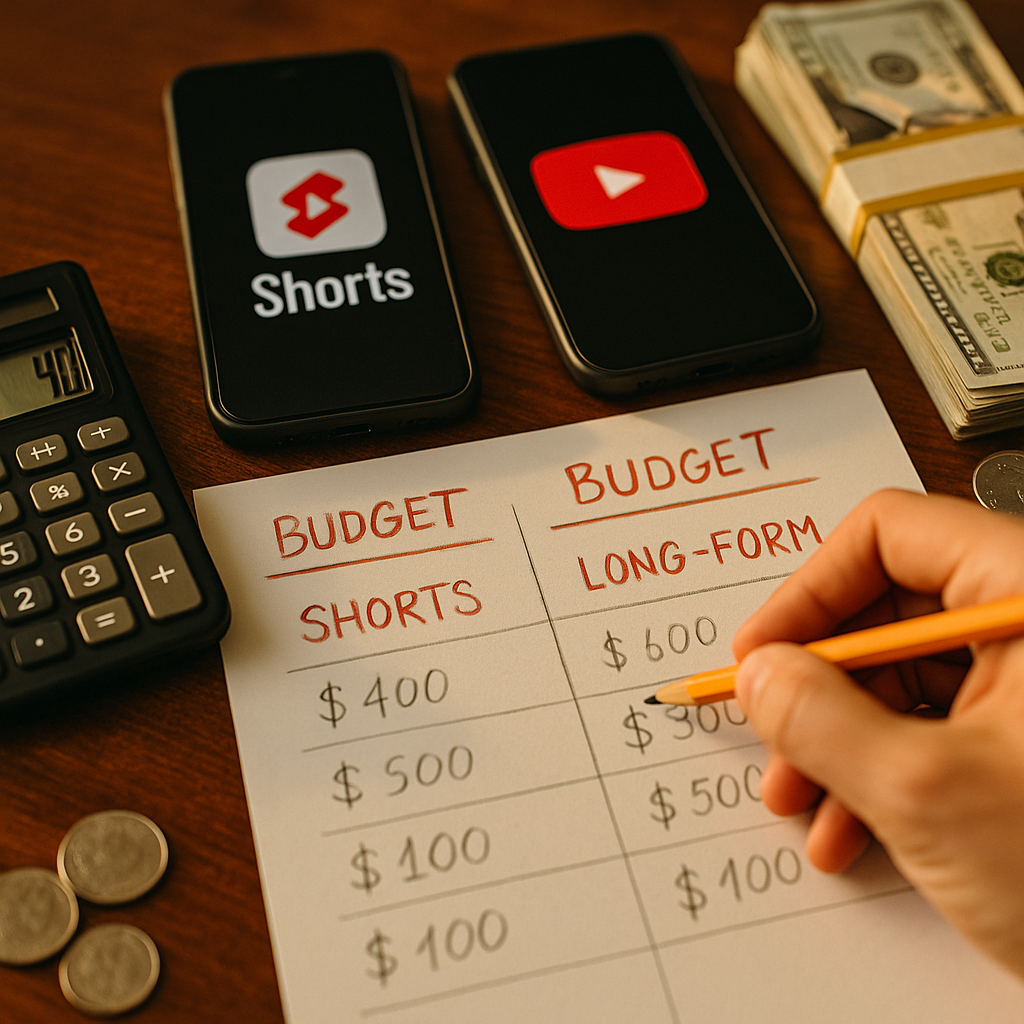
Seventy percent of YouTube’s watch time now starts on a Shorts feed that pays creators less and demands more volume than ever. Meanwhile, long-form video still drives the bulk of ad revenue and search visibility on the platform. If your YouTube Shorts vs long-form budget split hasn’t been revisited this year, you’re likely funding the wrong side of the equation for your actual goals.
This isn’t a “pick one” problem. It’s an allocation problem, and most brands are solving it with gut instinct instead of a framework. Let’s fix that.
Why This Debate Got More Expensive to Get Wrong
YouTube has spent the past two years pushing Shorts aggressively, chasing TikTok’s discovery engine while trying to protect the long-form ecosystem that actually pays its bills. The result is a platform with two distinct algorithms, two distinct monetization models, and two distinct audience behaviors living under one roof.
Shorts is a discovery machine. It’s built for cold reach, rapid testing, and top-of-funnel volume. Long-form is a retention and search machine. It’s where YouTube’s second identity as the internet’s largest video search engine actually pays off. Google itself has confirmed that YouTube functions as a primary search destination for product research, tutorials, and comparison content, which is exactly the kind of intent brands pay a premium to capture elsewhere.
Treating Shorts and long-form as the same content strategy with different aspect ratios is the single most common budget mistake brands make on YouTube right now.
The platforms reward opposite behaviors. Shorts rewards speed, novelty, and loop-ability. Long-form rewards depth, authority, and session duration. Splitting budget without acknowledging that split personality is how brands end up with mediocre performance on both fronts.
What Shorts Is Actually Good For (And What It Isn’t)
Shorts excels at exactly one thing: getting your brand in front of people who have never heard of you. It’s aggressive discovery, full stop. The algorithm doesn’t care about your subscriber count or your brand equity. It cares about whether the first two seconds hold attention.
That’s a feature, not a bug, if you’re using it correctly. Product launches, trend-jacking, quick demos, and testimonial snippets all thrive here. The format punishes slow setups and rewards immediate payoff, which is why the hook design principles brands are using for Shorts pacing at higher playback speeds matter more than production value.
But Shorts is a weak vehicle for consideration-stage or bottom-funnel content. Nobody is comparing SaaS pricing tiers in a 45-second vertical video. Nobody is deciding between two enterprise vendors based on a loop-optimized clip. If your sales cycle involves research, Shorts should be your awareness layer, not your conversion layer.
There’s also a monetization reality worth naming plainly: Shorts RPMs remain a fraction of long-form RPMs for creators, which affects how much leverage you have negotiating branded Shorts placements versus long-form integrations. Creators know this. Expect them to price accordingly, and expect volume-based deals to be more common than premium one-off placements in this format.
Long-Form Still Wins the Search Game
Here’s what gets lost in the Shorts hype cycle: long-form video is still how YouTube functions as a search engine. When someone types “best budgeting apps” or “how to fix a leaking faucet” into YouTube’s search bar, they’re getting long-form results with real watch-time signals, not a Shorts feed.
That search behavior is intent-rich in a way Shorts discovery simply isn’t. Someone scrolling Shorts is passively consuming. Someone searching YouTube is actively solving a problem, comparing options, or researching a purchase. Those are fundamentally different psychological states, and your content mix should reflect that.
Educational long-form content, tutorials, comparison videos, deep dives, and case-study style content compounds over time in a way Shorts rarely does. A well-optimized 12-minute video can keep generating views and search traffic 18 months after publish. A Short’s lifecycle is measured in days.
Long-form isn’t the “boring” half of your YouTube strategy. It’s the half that keeps paying you back after the campaign budget is spent.
This is also where watch-time equivalence changes to creator briefs become relevant. YouTube has been recalibrating how it weighs watch time across formats, which directly affects how creators structure sponsored segments inside long-form videos. If your briefs haven’t been updated to reflect that shift, your sponsored integrations may be underperforming without anyone noticing why.
The Budget Split: A Working Framework
So how should the money actually get divided? There’s no universal ratio, but there is a defensible starting framework based on funnel stage and business type.
- Top-of-funnel, low consideration products (CPG, apparel, beauty): Lean 60/40 toward Shorts. Discovery volume matters more than depth for impulse-adjacent categories.
- Mid-funnel, moderate consideration (fitness, finance apps, home goods): Roughly 50/50, using Shorts to feed awareness and long-form to close consideration gaps via search.
- High-consideration, high-ticket, or B2B: Flip it to 30/70 in favor of long-form. Search-driven educational content does the heavy lifting; Shorts serve mainly as a top-of-funnel teaser or re-engagement tool.
These aren’t fixed rules. They’re starting points you test against your own funnel data. But the underlying logic holds across categories: match the format to the psychological state of the viewer you’re trying to reach, not to whichever format is trending in your LinkedIn feed this month.
One operational note: don’t treat this as two separate campaigns run by two separate teams. The strongest performers are running Shorts as a feeder system into long-form, using vertical clips to tease a longer video and driving click-through via end screens and pinned comments. That kind of format bridging is exactly the same discipline brands are applying to Reels length and pacing decisions on Meta’s platforms, where hook design and format-matching have become inseparable from media strategy.
Creator Selection Changes Depending on the Format
Not every creator is good at both. This is an underrated operational reality. Some creators are exceptional at rapid-fire Shorts hooks but ramble in long-form. Others build incredible 20-minute narrative arcs but can’t compress a message into eight seconds without losing the point.
Audit your creator roster by format-specific performance, not just overall subscriber count or engagement rate. Pull the last 10 Shorts and the last 10 long-form uploads separately. Look at average view duration, not just views. A creator with mediocre Shorts performance but elite long-form retention is exactly who you want for search-driven educational briefs, even if their Shorts numbers look unimpressive on a first pass.
This mirrors a broader shift happening across platforms, where algorithmic changes are forcing brands to rewrite creator briefs entirely rather than reuse old templates. TikTok’s force-feed algorithm changes triggered a similar re-evaluation of creator fit last year, and the same discipline applies here: format-native talent outperforms generalist talent, every time you measure it properly.
Compliance and Disclosure Don’t Change by Format, But Enforcement Might
One thing that doesn’t shift between Shorts and long-form: FTC disclosure obligations. Whether it’s an 8-second Short or a 20-minute tutorial, paid partnerships need clear, unavoidable disclosure per FTC endorsement guidelines. What does shift is how easy it is to bury that disclosure.
Shorts’ compressed runtime makes verbal disclosure harder to fit naturally, which pushes more brands toward relying solely on YouTube’s built-in paid partnership tag. That’s necessary but often not sufficient on its own for full compliance in some jurisdictions. Long-form gives creators room to disclose verbally and in on-screen text without disrupting pacing, but the sheer length increases the odds of disclosure appearing only once and getting buried in a 15-minute runtime.
Build disclosure checkpoints into your brief regardless of format. Don’t assume the platform’s native tools cover your legal exposure completely.
Where the Puck Is Going
YouTube’s own statements and product roadmap suggest continued investment in Shorts monetization tools, including expanded shopping integrations, which parallels what’s happening with Shorts watch-time and shop overlay features reshaping how brands treat the format as a commerce channel, not just a discovery one. Expect that convergence to accelerate. The line between “discovery content” and “conversion content” on Shorts is blurring as shoppable overlays mature.
At the same time, don’t expect long-form’s search advantage to erode. Google’s broader push toward video-rich search results, tracked in ongoing eMarketer video advertising research, keeps reinforcing long-form’s role as the format that actually answers a query rather than just interrupting a scroll.
The practical implication: build your measurement framework now to track Shorts and long-form separately by funnel stage, not blended into one YouTube line item. Tools like Sprout Social’s platform analytics can help separate these performance signals if your internal reporting still lumps all YouTube video together.
Next Step
Pull your last quarter of YouTube spend, tag every video by format and funnel stage, and check whether your budget ratio actually matches your stated marketing objective. If it doesn’t, that mismatch is costing you more than a wasted line item. It’s costing you the compounding search equity long-form builds and the discovery volume Shorts is uniquely built to deliver.
FAQs
What percentage of YouTube budget should go to Shorts versus long-form?
There’s no universal number, but a practical starting point is 60/40 toward Shorts for low-consideration, impulse-driven products, roughly 50/50 for mid-funnel categories, and 30/70 in favor of long-form for high-consideration or B2B products where search-driven education drives conversion.
Does YouTube Shorts help with search visibility the way long-form does?
Not directly. Shorts are surfaced primarily through the discovery feed rather than search results, while long-form video is what typically ranks in YouTube’s search results and Google’s video-rich search features for informational queries.
Should the same creators handle both Shorts and long-form content?
Only if they perform well in both formats. Audit average view duration separately for Shorts and long-form uploads before assuming a creator’s overall popularity translates across formats; many creators excel at one and underperform at the other.
How does FTC disclosure differ between Shorts and long-form sponsored content?
The disclosure requirement itself doesn’t change, but Shorts’ short runtime makes verbal disclosure harder to fit naturally, increasing reliance on platform tags alone. Long-form gives more room for both verbal and on-screen disclosure but raises the risk of a single disclosure getting lost in a longer video.
Is long-form YouTube content still worth the higher production investment?
Yes, particularly for high-consideration purchases. Long-form content compounds over time through search traffic and tends to retain relevance far longer than Shorts, which have a much shorter discovery lifecycle.
FAQs
Top Influencer Marketing Agencies
The leading agencies shaping influencer marketing in 2026
Agencies ranked by campaign performance, client diversity, platform expertise, proven ROI, industry recognition, and client satisfaction. Assessed through verified case studies, reviews, and industry consultations.
Moburst

-
2

The Shelf
Boutique Beauty & Lifestyle Influencer AgencyA data-driven boutique agency specializing exclusively in beauty, wellness, and lifestyle influencer campaigns on Instagram and TikTok. Best for brands already focused on the beauty/personal care space that need curated, aesthetic-driven content.Clients: Pepsi, The Honest Company, Hims, Elf Cosmetics, Pure LeafVisit The Shelf → -
3

Audiencly
Niche Gaming & Esports Influencer AgencyA specialized agency focused exclusively on gaming and esports creators on YouTube, Twitch, and TikTok. Ideal if your campaign is 100% gaming-focused — from game launches to hardware and esports events.Clients: Epic Games, NordVPN, Ubisoft, Wargaming, Tencent GamesVisit Audiencly → -
4

Viral Nation
Global Influencer Marketing & Talent AgencyA dual talent management and marketing agency with proprietary brand safety tools and a global creator network spanning nano-influencers to celebrities across all major platforms.Clients: Meta, Activision Blizzard, Energizer, Aston Martin, WalmartVisit Viral Nation → -
5

The Influencer Marketing Factory
TikTok, Instagram & YouTube CampaignsA full-service agency with strong TikTok expertise, offering end-to-end campaign management from influencer discovery through performance reporting with a focus on platform-native content.Clients: Google, Snapchat, Universal Music, Bumble, YelpVisit TIMF → -
6

NeoReach
Enterprise Analytics & Influencer CampaignsAn enterprise-focused agency combining managed campaigns with a powerful self-service data platform for influencer search, audience analytics, and attribution modeling.Clients: Amazon, Airbnb, Netflix, Honda, The New York TimesVisit NeoReach → -
7

Ubiquitous
Creator-First Marketing PlatformA tech-driven platform combining self-service tools with managed campaign options, emphasizing speed and scalability for brands managing multiple influencer relationships.Clients: Lyft, Disney, Target, American Eagle, NetflixVisit Ubiquitous → -
8

Obviously
Scalable Enterprise Influencer CampaignsA tech-enabled agency built for high-volume campaigns, coordinating hundreds of creators simultaneously with end-to-end logistics, content rights management, and product seeding.Clients: Google, Ulta Beauty, Converse, AmazonVisit Obviously →