


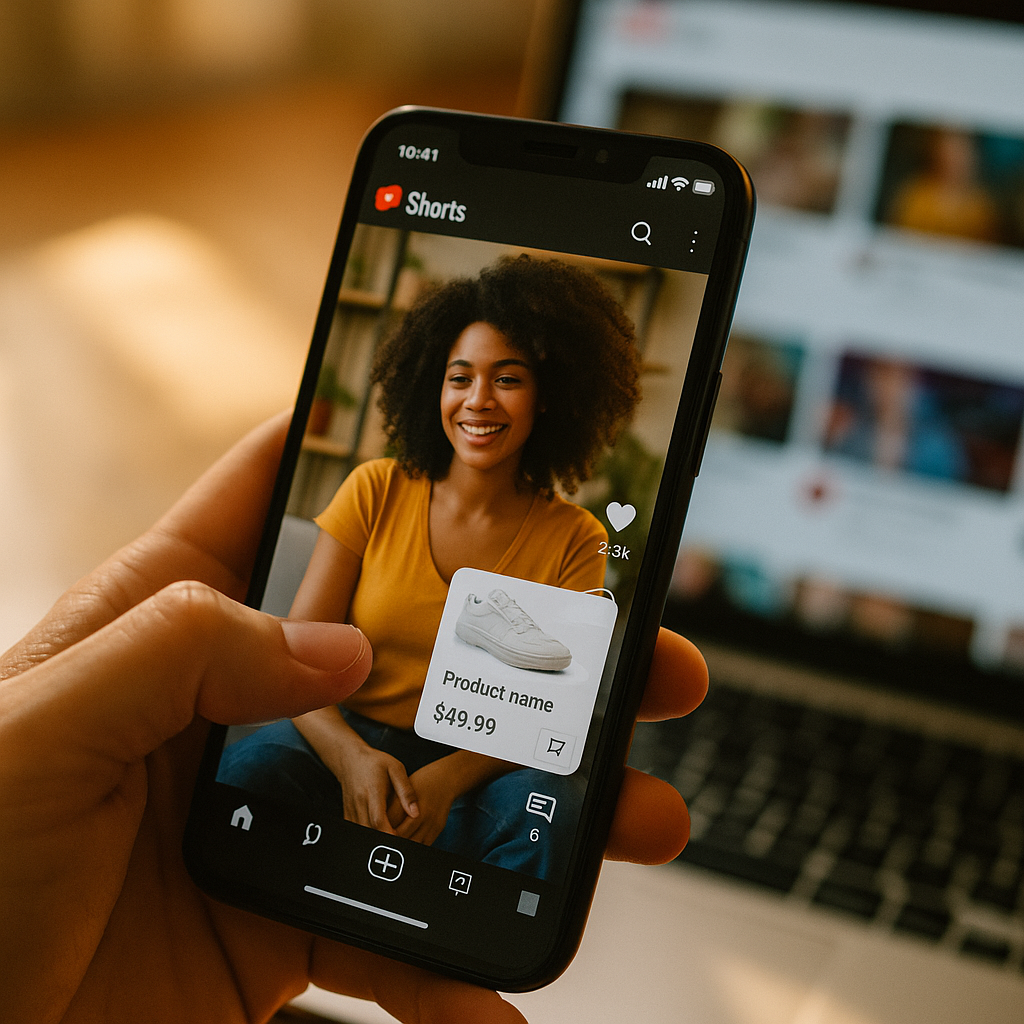
Sixty percent completion used to be a decent Shorts benchmark. Not anymore. YouTube’s watch-time-and-shop-overlay signal now decides whether your brand channel gets surfaced or buried, and most marketing teams haven’t touched their content structure to account for it. The YouTube Shorts watch-time mechanic has quietly become the single biggest lever for algorithmic reach, and it’s tied directly to whether viewers engage with shoppable overlays before they scroll away.
What Actually Changed
YouTube has always weighted watch time. That’s not news. What’s new is the way the platform now correlates retention with shopping overlay interaction, treating the two as a combined ranking signal rather than separate metrics. In practical terms: a Short that holds attention through the overlay’s appearance window, and gets a tap, click, or even a pause-and-look, ranks higher than one that just racks up raw views.
Google has been expanding shoppable formats across Shorts for a while, layering product tags directly into the video feed (see Google’s support documentation on shopping features for creators and brands). What changed recently is the weighting. Overlay engagement now functions almost like a secondary watch-time signal, feeding back into distribution the same way average view duration always has.
If your Short loses viewers right before the shop overlay appears, the algorithm reads that as a failed monetization moment, not just a soft retention dip.
That distinction matters. A brand channel posting pretty product footage with no narrative reason to stick around is now actively penalized twice, once for weak retention, and again for an overlay nobody engaged with.
Why Brand Channels Are Getting Hit Hardest
Creator channels have an advantage here they didn’t ask for: personality-driven hooks naturally hold attention longer. Brand channels, by contrast, tend to front-load product shots and save the “buy now” moment for the last three seconds. That’s exactly backwards under the new signal.
Think about your average 22-second Short. If the overlay pops at second 18 and half your audience has already dropped off, the algorithm doesn’t see a viewing habit issue, it sees a monetization failure. Repeat that pattern across a few dozen uploads and your channel’s distribution ceiling drops, even if your absolute view counts look fine on the surface.
- Overlay timing needs to align with peak retention windows, not just the outro.
- Hooks need to justify watching past the point where the overlay appears.
- Pacing has to account for viewers watching at accelerated speeds, a habit YouTube itself has normalized.
That last point connects to a shift we covered in depth: redesigning hooks and pacing for viewers who watch everything at 2x. If your overlay timing assumes normal playback speed, you’re already misaligned with a meaningful chunk of your audience.
The Restructure: What Brands Need to Build Differently
This isn’t a “post more Shorts” problem. It’s a structural one. Here’s what needs to change at the brief level, not just the edit.
1. Move the value proposition earlier, keep the overlay reveal mid-video. Instead of saving the product reveal for the final beat, structure the Short so the audience already understands what’s being sold by the midpoint. The overlay then reinforces a decision the viewer is already leaning toward, rather than introducing a new ask right as attention drops.
2. Build a retention bridge before the overlay hits. A quick pattern interrupt, a question, a visual switch, right before the overlay appears keeps eyes on screen through the exact window that matters most. Creators do this instinctively. Brand teams often skip it because it feels like it slows down the “sell.”
3. Test overlay placement like you’d test a CTA button. Treat it as a conversion element, not a decorative add-on. Early data from agencies running Shorts-first programs suggests overlay placement between the 40% and 65% mark of total runtime performs best for holding both retention and click-through, though this varies by vertical and video length.
4. Shorten average shot length in the first three seconds. This mirrors what’s happening across short-form platforms broadly. It’s the same logic behind TikTok’s watch-time algorithm shift media buyers have had to adapt to, retention in the opening window predicts everything downstream.
Playlists and Series Structure Now Do Double Duty
Here’s something a lot of brand teams miss: playlist structure directly affects how the algorithm interprets overlay performance across a channel, not just per video. A Short embedded in a coherent playlist with consistent shopping overlays tends to get evaluated with more context, because YouTube can see a pattern of viewer intent across the series rather than judging each clip in isolation.
We’ve written before about how playlist strategy turns views into subscribers, and the same logic extends to shopping performance. A five-part Shorts series building toward a single product launch, each with a consistent overlay style, gives the algorithm a much stronger signal than five unrelated one-off posts.
Channels running Shorts as a disconnected content dump, rather than a structured series, are leaving algorithmic credit on the table.
Hooks Have to Work Twice as Hard Now
Remember the skip button changes YouTube rolled out that forced creators to rethink their opening seconds? That same pressure now compounds with the overlay signal. A weak hook doesn’t just cost you early drop-off, it costs you the shopping engagement downstream because viewers who bail early never even see the overlay. We covered the mechanics of this in how skip button changes forced new hook strategy, and it’s directly relevant here. Brand channels that haven’t updated hook structure since that change are compounding the problem twice over.
Practically, this means your first-line brief note for any Shorts creative shouldn’t be “show the product.” It should be “give the viewer a reason to still be watching in eight seconds.” Product visibility can wait. Retention can’t.
What This Means for Budget and Creator Selection
If you’re running whitelisted or boosted Shorts through creator partnerships, overlay performance should now factor into how you select and brief talent. Creators who naturally build suspense or narrative tension before a reveal will outperform those who lead with product, even if their raw follower count is smaller. This mirrors a broader trend across platforms: relevance and content structure increasingly outweigh audience size, something we’ve also seen play out in LinkedIn’s shift toward relevance over follower count.
For paid media teams managing whitelisting setups, this also affects how you structure contracts. If overlay engagement is now a ranking factor, it deserves its own line in performance reporting, separate from view count or completion rate. Agencies running MCM whitelisting setups should be pushing for overlay click data as a standard deliverable, not an optional add-on.
There’s a budget efficiency angle too. According to eMarketer’s ongoing coverage of short-form video ad spend, brands are pouring increasing budget into vertical video without proportionally increasing measurement rigor. Overlay-specific tracking closes that gap, and it’s cheap to implement if you’re already using YouTube’s native analytics.
Cross-Platform Pattern Recognition
None of this happens in a vacuum. Instagram has been pushing similar logic with its preference for shopping-tagged Reels, a shift we detailed in how Instagram favors shopping-tagged Reels. TikTok Shop’s algorithm rewards a similar blend of watch-time and conversion signal, as covered in structuring videos that convert on TikTok Shop. The pattern across platforms is consistent: retention and commerce are merging into a single ranking input, and brands still briefing these as separate KPIs are structurally behind.
For teams managing budgets across multiple short-form platforms, this is worth flagging to leadership directly. It’s not a YouTube-only shift, it’s a platform-wide recalibration of what “engagement” means. Tools like Sprout Social and HubSpot have both expanded reporting dashboards to capture overlay and shoppable click data, which is a reasonable signal that measurement standards are catching up to the algorithm changes.
Next Step
Audit your last ten Shorts uploads: mark the timestamp where each shop overlay appears, then check the retention graph at that exact second. If viewership has already dropped below 50% by the time the overlay hits, that’s your restructure priority, not your hook, not your CTA, the gap between the two.
FAQs
What is the YouTube Shorts watch-time-and-shop-overlay signal?
It’s a ranking mechanic where YouTube evaluates retention alongside engagement with shoppable overlays, treating strong performance on both as a combined signal for algorithmic distribution.
Why are brand channels underperforming compared to creators under this signal?
Brand channels typically front-load product visuals and delay the shopping moment, which misaligns with retention drop-off points. Creator content tends to use narrative hooks that naturally sustain attention through the overlay window.
Where should the shop overlay appear in a Short for best performance?
Early data suggests placement between roughly 40% and 65% of total runtime tends to balance retention and click-through, though this varies by vertical, video length, and audience behavior.
Does playlist structure affect shopping overlay performance?
Yes. Shorts organized into coherent playlists or series tend to be evaluated with more context by the algorithm, since viewer intent patterns are visible across multiple related videos rather than a single isolated clip.
How should brands adjust creator briefs for this shift?
Briefs should prioritize retention through the overlay window over early product reveals, treat overlay placement as a testable conversion element, and request overlay-specific performance data as a standard reporting metric.
FAQs
What is the YouTube Shorts watch-time-and-shop-overlay signal?
It’s a ranking mechanic where YouTube evaluates retention alongside engagement with shoppable overlays, treating strong performance on both as a combined signal for algorithmic distribution.
Why are brand channels underperforming compared to creators under this signal?
Brand channels typically front-load product visuals and delay the shopping moment, which misaligns with retention drop-off points. Creator content tends to use narrative hooks that naturally sustain attention through the overlay window.
Where should the shop overlay appear in a Short for best performance?
Early data suggests placement between roughly 40% and 65% of total runtime tends to balance retention and click-through, though this varies by vertical, video length, and audience behavior.
Does playlist structure affect shopping overlay performance?
Yes. Shorts organized into coherent playlists or series tend to be evaluated with more context by the algorithm, since viewer intent patterns are visible across multiple related videos rather than a single isolated clip.
How should brands adjust creator briefs for this shift?
Briefs should prioritize retention through the overlay window over early product reveals, treat overlay placement as a testable conversion element, and request overlay-specific performance data as a standard reporting metric.
Top Influencer Marketing Agencies
The leading agencies shaping influencer marketing in 2026
Agencies ranked by campaign performance, client diversity, platform expertise, proven ROI, industry recognition, and client satisfaction. Assessed through verified case studies, reviews, and industry consultations.
Moburst

-
2

The Shelf
Boutique Beauty & Lifestyle Influencer AgencyA data-driven boutique agency specializing exclusively in beauty, wellness, and lifestyle influencer campaigns on Instagram and TikTok. Best for brands already focused on the beauty/personal care space that need curated, aesthetic-driven content.Clients: Pepsi, The Honest Company, Hims, Elf Cosmetics, Pure LeafVisit The Shelf → -
3

Audiencly
Niche Gaming & Esports Influencer AgencyA specialized agency focused exclusively on gaming and esports creators on YouTube, Twitch, and TikTok. Ideal if your campaign is 100% gaming-focused — from game launches to hardware and esports events.Clients: Epic Games, NordVPN, Ubisoft, Wargaming, Tencent GamesVisit Audiencly → -
4

Viral Nation
Global Influencer Marketing & Talent AgencyA dual talent management and marketing agency with proprietary brand safety tools and a global creator network spanning nano-influencers to celebrities across all major platforms.Clients: Meta, Activision Blizzard, Energizer, Aston Martin, WalmartVisit Viral Nation → -
5

The Influencer Marketing Factory
TikTok, Instagram & YouTube CampaignsA full-service agency with strong TikTok expertise, offering end-to-end campaign management from influencer discovery through performance reporting with a focus on platform-native content.Clients: Google, Snapchat, Universal Music, Bumble, YelpVisit TIMF → -
6

NeoReach
Enterprise Analytics & Influencer CampaignsAn enterprise-focused agency combining managed campaigns with a powerful self-service data platform for influencer search, audience analytics, and attribution modeling.Clients: Amazon, Airbnb, Netflix, Honda, The New York TimesVisit NeoReach → -
7

Ubiquitous
Creator-First Marketing PlatformA tech-driven platform combining self-service tools with managed campaign options, emphasizing speed and scalability for brands managing multiple influencer relationships.Clients: Lyft, Disney, Target, American Eagle, NetflixVisit Ubiquitous → -
8

Obviously
Scalable Enterprise Influencer CampaignsA tech-enabled agency built for high-volume campaigns, coordinating hundreds of creators simultaneously with end-to-end logistics, content rights management, and product seeding.Clients: Google, Ulta Beauty, Converse, AmazonVisit Obviously →