


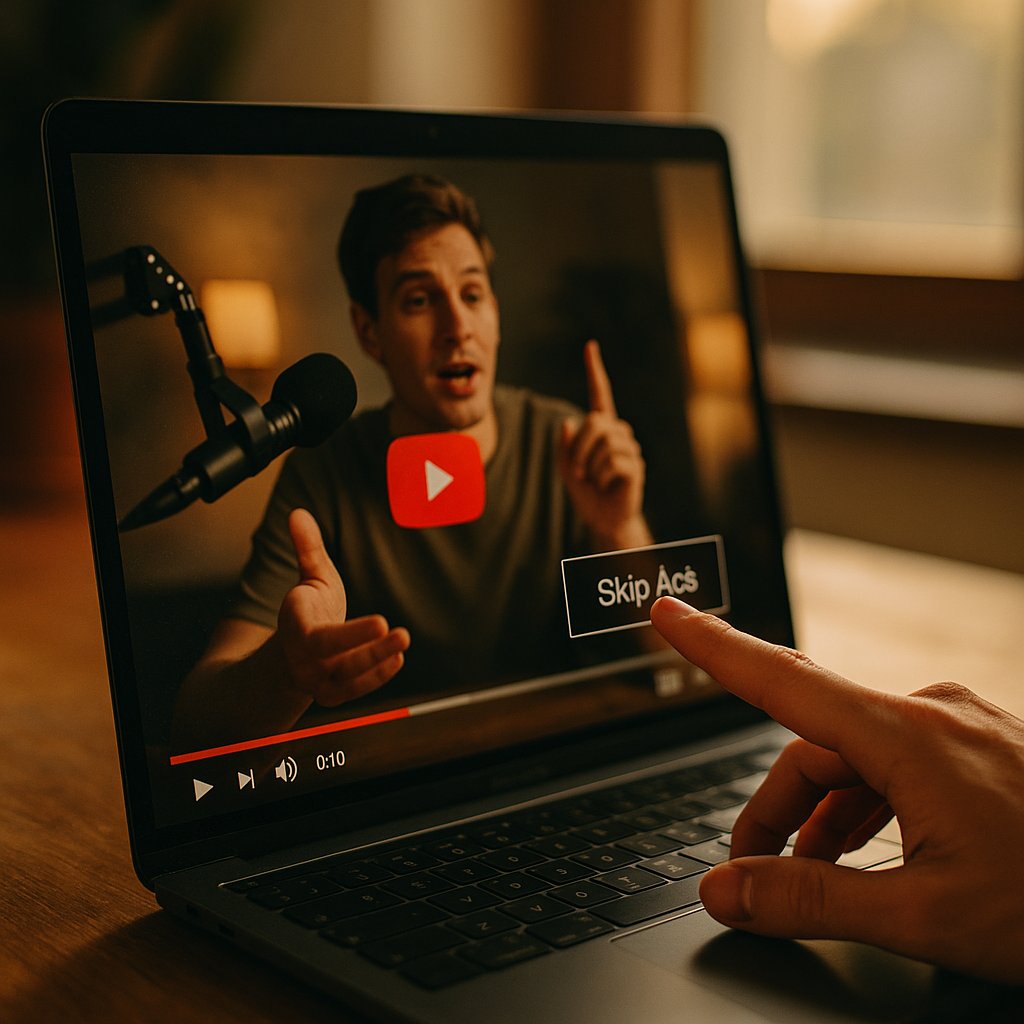
Five seconds. That’s how long a YouTube pre-roll ad has before the skip button turns your carefully produced spot into wallpaper. Except that number isn’t fixed anymore. Google has been quietly testing variable skip windows, adaptive placements, and AI-driven skip predictions that change the math for anyone buying creator-led pre-roll in 2026. The first-five-seconds rule isn’t dead. It’s mutating, and most creator briefs haven’t caught up.
The Skip Button Got Smarter, and So Did Viewers
For over a decade, five seconds was gospel. Advertisers built entire hook frameworks around it: logo in frame by second two, value prop by second four, CTA teed up before the skip window closed. It worked because it was predictable. Everyone knew the rules of the game.
That predictability is gone. YouTube has expanded testing of dynamic skip timing tied to viewer behavior, ad relevance scores, and even device type. Some viewers see skip options at three seconds. Others, especially on connected TV, face longer unskippable pods. Google’s own ad support documentation confirms format flexibility is now a deliberate lever, not a fixed spec advertisers can bank on.
Meanwhile, viewers have gotten faster at deciding. Attention researchers have long noted that audiences form a keep-or-skip judgment almost instantly, but the newer wrinkle is that skip-intent is now measurable in real time. Creators and agencies who treat five seconds as a hard deadline are optimizing for a rule that’s already shifted underneath them.
The old model treated the skip button as a countdown clock. The new model treats it as a live behavioral signal, one that can shorten or lengthen based on how your content performs in the first frames.
Why Hook Architecture, Not Hook Length, Is the Real Variable
Here’s the reframe brands need: it was never really about five seconds. It’s about hook architecture, the sequencing of visual, verbal, and emotional cues that decide whether a viewer’s thumb stays put.
Think of it like this. A weak hook stretched to five seconds still gets skipped at second two. A strong hook compressed into three seconds can carry a viewer through an unskippable pod entirely. Duration is a constraint, not a strategy.
Agencies running creator whitelisting programs are already adapting briefs accordingly. Instead of “keep them for five seconds,” the instruction is becoming “front-load pattern interrupt, delay brand reveal, and let curiosity do the retention work.” That’s a meaningfully different creative problem, and it requires creators who understand pacing at a granular level, not just personality-driven charisma.
This is also why format-specific pacing lessons from short-form are bleeding into pre-roll strategy. Brands running Shorts-style hook pacing are finding those same principles translate directly to long-form pre-roll, because the underlying skill is identical: compress narrative tension into a shrinking window.
What Actually Changed in the Skip Mechanic
- Skip timing now varies by ad relevance score, not a flat five-second rule for every placement.
- Connected TV inventory increasingly defaults to longer unskippable pods, shifting hook strategy toward sustained narrative rather than single punchlines.
- AI-assisted ad matching means the same creative can trigger different skip windows for different audience segments.
- Mobile viewers skip faster on average than CTV viewers, according to industry benchmarking from eMarketer, meaning a single hook edit rarely performs equally across devices.
Building the 2026 Creator Hook Brief
So what does a modern pre-roll brief actually look like? It’s less about scripting the perfect opening line and more about designing three or four retention checkpoints, each engineered for a different skip-window scenario.
Start with the cold open. No logo, no brand name, no “hey guys.” Just a visual or verbal disruption strong enough to override the viewer’s thumb-reflex. Creators who’ve built organic followings understand this instinctively, because it’s the same skill that keeps a TikTok or Reel from being scrolled past. That’s part of why brands are increasingly sourcing pre-roll talent from short-form-native creators rather than traditional video production shops.
Next, build a “second save,” a secondary hook around the two-and-a-half to three-second mark that catches viewers who almost skipped but hesitated. This is the checkpoint most briefs skip entirely, and it’s costing brands retained impressions they’ve already paid for.
Finally, plan for the CTV contingency. If your ad lands in an unskippable slot, does it still hold up as a six- to fifteen-second piece of content, or does it collapse into repetition once the “urgency” of the skip countdown disappears? Many creator-made pre-rolls were never built to survive without that ticking clock.
If your hook only works because a countdown timer is pressuring the viewer, you don’t have a hook. You have a hostage situation, and YouTube just took away the leverage.
Retention Data Is the New Casting Criteria
Brands vetting creators for pre-roll deals are starting to ask for retention curves, not just view counts or engagement rates. A creator whose organic content shows a steep early drop-off is a liability in a skip-sensitive format, regardless of follower size. This mirrors a broader shift already visible in platform algorithm changes, where creator signals are outweighing brand polish in determining what actually performs.
Media buyers running whitelisting setups should be pulling YouTube Analytics retention graphs as part of creator due diligence, the same way they’d pull audience demographics. A creator with strong average view duration on organic long-form content is statistically more likely to produce a pre-roll asset that survives variable skip windows.
The Compliance Angle Nobody’s Talking About
Faster, more aggressive hooks raise an underrated risk: disclosure and claims compliance getting rushed out of the frame. When creators are told to compress everything into two seconds, sponsorship disclosures and required disclaimers sometimes get visually buried or verbally rushed past legibility.
The FTC’s endorsement guidance doesn’t care how tight your hook architecture is. Disclosures still need to be clear and conspicuous, even in a three-second cold open. Brands running high volume creator pre-roll programs should build disclosure timing into the hook brief itself, not treat it as an afterthought bolted onto the edit. This is especially relevant for categories already under scrutiny, similar to the compliance discipline required in livestream urgency claims, where speed and legal clarity constantly compete for the same three seconds of screen time.
What This Means for Budget Allocation
If hook architecture now matters more than raw hook duration, production budgets need to shift too. Fewer dollars on polished thirty-second brand films. More dollars on rapid testing cycles that produce five or six hook variants per creator, each engineered against a different skip-window hypothesis.
This is a production philosophy borrowed from performance marketing, and it’s why some agencies are running pre-roll creative through the same iterative testing loops previously reserved for TikTok Shop conversion testing. The channels are different. The underlying discipline, rapid hook iteration against algorithmic uncertainty, is the same.
Practically, that means:
- Budget for multiple hook cuts per creator asset, not a single “hero” version.
- Test hooks across mobile and CTV separately; a hook built for phone scrolling behavior may fail in a living room context.
- Treat retention data from the first test flight as the real brief, refining before scaling media spend.
- Loop legal/compliance review into the hook-writing stage, not the final cut stage.
Data from Sprout Social’s ongoing social benchmarking work continues to show attention spans compressing across nearly every platform, not just YouTube. That trend line makes hook architecture a durable investment, not a 2026-specific hack.
Next Step
Audit your current pre-roll library against retention data, not skip rates alone, and rebuild your creator brief around a layered hook, cold open, second save, CTV contingency, rather than a single five-second countdown. The brands that adapt their hook architecture now will own the impressions everyone else pays for and loses in the first three seconds.
FAQs
Is the five-second skip rule still accurate for YouTube pre-roll?
Not universally. YouTube now tests variable skip windows based on ad relevance, device type, and viewer behavior, so five seconds is a reference point rather than a fixed rule across all inventory.
How should brands brief creators differently for pre-roll versus Shorts?
Pre-roll briefs need layered hooks built for multiple skip-window scenarios, including a contingency for unskippable CTV placements, whereas Shorts hooks are optimized purely for scroll-past prevention in a single continuous feed.
What metrics should brands use to vet creators for pre-roll campaigns?
Average view duration and audience retention curves from organic content are stronger predictors of pre-roll performance than follower count or engagement rate alone.
Does faster hook pacing create compliance risk?
Yes. Compressed hooks can rush or bury sponsorship disclosures, which still must meet FTC clear-and-conspicuous standards regardless of how tight the creative timing is.
Should brands produce different pre-roll cuts for mobile and connected TV?
In most cases, yes. Mobile viewers tend to make skip decisions faster than CTV viewers, so a single hook edit rarely performs optimally across both environments.
Top Influencer Marketing Agencies
The leading agencies shaping influencer marketing in 2026
Agencies ranked by campaign performance, client diversity, platform expertise, proven ROI, industry recognition, and client satisfaction. Assessed through verified case studies, reviews, and industry consultations.
Moburst

-
2

The Shelf
Boutique Beauty & Lifestyle Influencer AgencyA data-driven boutique agency specializing exclusively in beauty, wellness, and lifestyle influencer campaigns on Instagram and TikTok. Best for brands already focused on the beauty/personal care space that need curated, aesthetic-driven content.Clients: Pepsi, The Honest Company, Hims, Elf Cosmetics, Pure LeafVisit The Shelf → -
3

Audiencly
Niche Gaming & Esports Influencer AgencyA specialized agency focused exclusively on gaming and esports creators on YouTube, Twitch, and TikTok. Ideal if your campaign is 100% gaming-focused — from game launches to hardware and esports events.Clients: Epic Games, NordVPN, Ubisoft, Wargaming, Tencent GamesVisit Audiencly → -
4

Viral Nation
Global Influencer Marketing & Talent AgencyA dual talent management and marketing agency with proprietary brand safety tools and a global creator network spanning nano-influencers to celebrities across all major platforms.Clients: Meta, Activision Blizzard, Energizer, Aston Martin, WalmartVisit Viral Nation → -
5

The Influencer Marketing Factory
TikTok, Instagram & YouTube CampaignsA full-service agency with strong TikTok expertise, offering end-to-end campaign management from influencer discovery through performance reporting with a focus on platform-native content.Clients: Google, Snapchat, Universal Music, Bumble, YelpVisit TIMF → -
6

NeoReach
Enterprise Analytics & Influencer CampaignsAn enterprise-focused agency combining managed campaigns with a powerful self-service data platform for influencer search, audience analytics, and attribution modeling.Clients: Amazon, Airbnb, Netflix, Honda, The New York TimesVisit NeoReach → -
7

Ubiquitous
Creator-First Marketing PlatformA tech-driven platform combining self-service tools with managed campaign options, emphasizing speed and scalability for brands managing multiple influencer relationships.Clients: Lyft, Disney, Target, American Eagle, NetflixVisit Ubiquitous → -
8

Obviously
Scalable Enterprise Influencer CampaignsA tech-enabled agency built for high-volume campaigns, coordinating hundreds of creators simultaneously with end-to-end logistics, content rights management, and product seeding.Clients: Google, Ulta Beauty, Converse, AmazonVisit Obviously →