


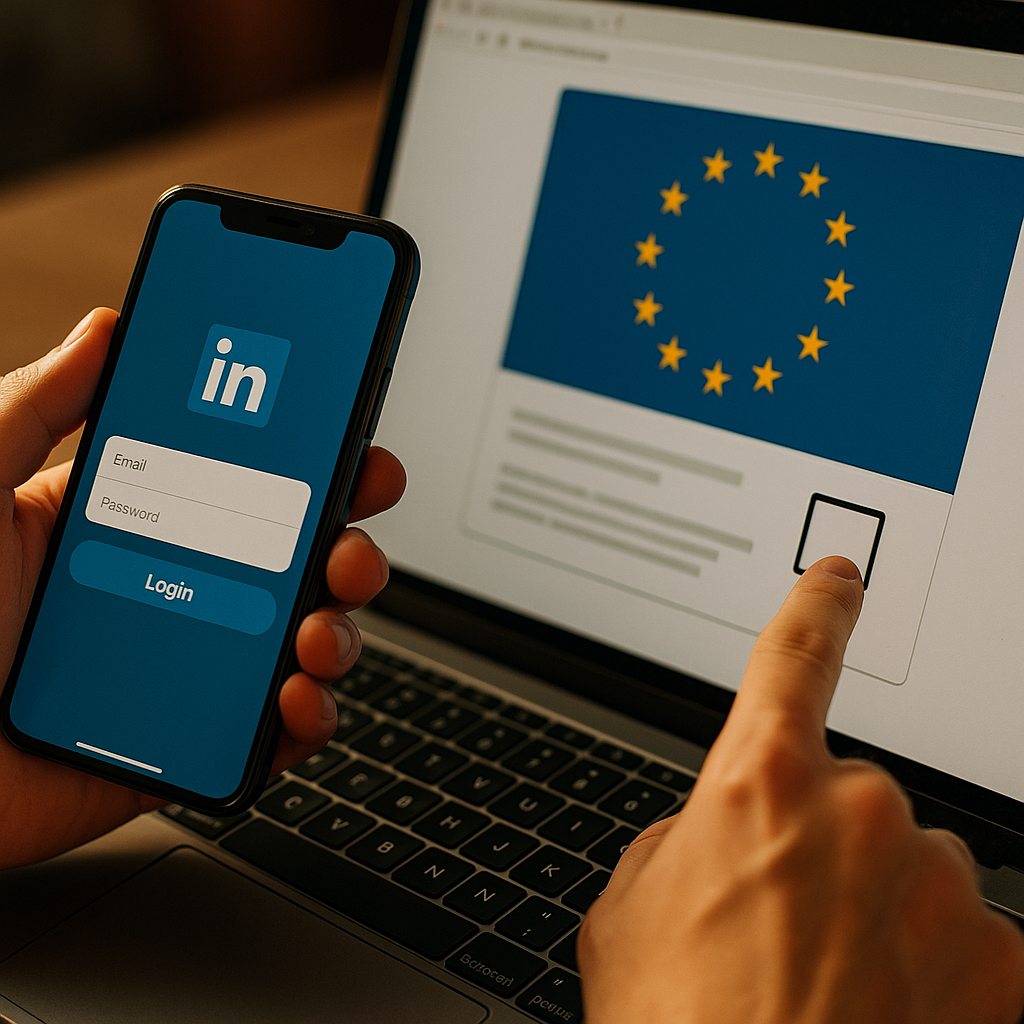
One checkbox change just broke thousands of B2B lead-gen campaigns across Europe. LinkedIn quietly removed the default pre-ticked consent checkbox from its Lead Gen Forms for EU audiences, and marketers who haven’t rebuilt their consent flow are about to see conversion data that makes no sense and compliance exposure that makes even less sense. If your lead capture strategy still assumes that box, it’s time to rebuild before Q1 pipeline reviews turn into uncomfortable conversations.
What Actually Changed
For years, LinkedIn Lead Gen Forms auto-populated a consent checkbox, pre-ticked, sitting quietly beneath the submit button. Users barely noticed it. Marketers loved it. Consent rates hovered near 100% because, frankly, nobody was opting out of something they didn’t see.
That default is gone for EU-based form submissions. LinkedIn’s move follows sustained pressure from European data protection authorities who have long argued that pre-checked consent boxes violate the core requirement of GDPR: consent must be freely given, specific, informed, and unambiguous. A pre-ticked box fails that test on its face. The UK ICO and various EU supervisory authorities have flagged similar patterns across ad platforms for years, and LinkedIn’s parent Microsoft appears to be getting ahead of formal enforcement rather than waiting for a fine.
Now EU users must actively check the box themselves. No default. No pre-fill. Just a genuine opt-in action.
Early benchmarks from agencies running EU LinkedIn campaigns report consent opt-in drops of 30-45% compared to the old pre-ticked baseline. That’s not a form problem — that’s the actual size of your addressable, compliant lead pool.
Why This Isn’t Just a LinkedIn Problem
Treat this as a preview, not an anomaly. Meta faced comparable scrutiny over consent defaults in lead ads years ago. Google has tightened consent mode requirements repeatedly. Regulators across the EU have made clear that “convenient default” and “valid consent” are not the same thing, no matter how many platforms tried to blur the line.
LinkedIn’s checkbox removal is a platform-level compliance correction, but it’s also a signal. If your B2B demand gen program still leans on implied consent anywhere, in any channel, this is your warning shot. The regulatory direction of travel is unambiguous: active, granular, unbundled consent, everywhere personal data changes hands.
For teams already managing disclosure and consent frameworks across creator partnerships, this will feel familiar. We’ve covered similar consent-architecture shifts in Meta’s attribution model changes and in TikTok’s AI remix consent clause. The pattern repeats: platforms shift compliance burden downstream to advertisers, and brands who haven’t built adaptable consent infrastructure end up scrambling.
The Real Cost: Fewer Leads, Better Leads
Here’s the uncomfortable math. If your EU lead volume drops 35% next quarter, is that a crisis or a correction?
Depends who you ask. Sales will see it as a pipeline shortfall. Legal will see it as risk finally matching reality. Both are right, and both need to align before the quarterly forecast conversation happens without context.
The leads you lose under active consent were never truly qualified anyway. A prospect who didn’t notice they’d agreed to marketing contact was never going to engage with your nurture sequence with any real intent. Active opt-in filters for genuine interest. That’s a lead quality signal, not just a volume loss.
Still, finance teams model on volume, not vibes. You’ll need a narrative, and data, to explain why fewer leads at higher intent beats the old baseline. Track conversion-to-opportunity rate and conversion-to-closed-won rate for post-change leads against a trailing cohort. That’s the argument that survives a budget review.
Rebuilding the Form Consent Flow: A Practical Playbook
Don’t just remove the checkbox default and hope. Rebuild the whole flow with intention. Here’s what that looks like in practice.
1. Separate consent from form submission logic
Your CRM and marketing automation platform likely still assume a binary “form submitted = consented” flag. That assumption is now false. Rebuild your lead scoring and routing logic so consent status is captured as its own field, independent of submission status. HubSpot, Marketo, and Salesforce Marketing Cloud all support this natively; the fix is often a workflow rebuild, not a platform migration. Check your HubSpot or equivalent integration settings for how LinkedIn Lead Gen Form data maps into consent fields specifically.
2. Rewrite the consent copy itself
Generic language like “I agree to receive communications” won’t hold up under specific-consent standards. State exactly what the prospect is agreeing to: which brand, what type of content, at what frequency, via which channel. Vague consent copy invites the same scrutiny that killed the checkbox default in the first place.
3. Build a two-tier consent model
Not every lead needs the same consent scope. Separate “contact me about this specific offer” from “add me to ongoing marketing communications.” Bundling these into one checkbox is precisely the pattern regulators object to. A two-tier model protects conversion on the immediate ask while giving prospects a genuine, separate choice on ongoing marketing.
4. Audit your lead routing SLAs
Sales development reps calling on leads within five minutes has been gospel for a decade. But if consent scope is now genuinely opt-in and specific, make sure your SLA doesn’t outrun what the prospect actually agreed to. Contacting someone about a webinar when they consented only to a whitepaper download is its own compliance gap, and it erodes trust fast.
5. Instrument the drop-off, don’t just accept it
Run A/B tests on consent copy placement, checkbox styling, and micro-copy explaining why you’re asking. Small UX changes, like moving the checkbox above the fold or adding a one-line “why we ask” tooltip, can recover meaningful opt-in rate without touching the legal substance of the consent itself.
Teams that rebuilt consent copy with specific, benefit-framed language recovered roughly half the opt-in gap within one quarter, according to early agency case studies circulating on LinkedIn’s own marketing solutions community. Vague legalese underperforms plain, honest language every time.
Where This Intersects With Broader AI and Compliance Workflows
If your team is already using AI tools to qualify or route inbound leads, this change adds another layer. Any AI teammate or lead-scoring model trained on historical LinkedIn lead data now has a consent-labeling problem baked into its training set. Old leads assumed consent by default; new leads require an explicit flag. Retrain or re-audit your qualification models accordingly, or you’ll be scoring non-compliant historical leads the same way as compliant new ones.
We’ve written previously about the compliance stakes of automated lead qualification in AI teammate lead qualification, and the core lesson applies directly here: automation inherits whatever consent assumptions you feed it. Feed it a stale assumption, and it will confidently make the wrong decision at scale, which is worse than a human making the same mistake once.
Marketing teams running LinkedIn video and thought-leadership campaigns alongside lead gen forms should also revisit disclosure practices more broadly. The same regulatory scrutiny driving this checkbox change is adjacent to disclosure enforcement covered in LinkedIn video hooks and FTC compliance. Different regulator, same underlying principle: don’t assume, disclose.
What to Tell Leadership This Quarter
Frame this to your CMO or VP of Demand Gen as a data integrity issue, not a performance failure. Lead volume from EU LinkedIn campaigns will drop. That’s expected, and it’s a direct result of a platform-level compliance correction, not a targeting or creative problem.
The action items are straightforward:
- Audit every EU-facing LinkedIn Lead Gen Form for consent copy specificity within the next two weeks.
- Rebuild CRM consent field mapping before the next campaign refresh.
- Set a new baseline conversion rate using post-change data only, don’t compare against pre-checkbox-removal benchmarks in board reporting.
- Loop in legal or data protection counsel to sign off on new consent copy before it goes live, not after.
Benchmarking against industry data helps here too. eMarketer and Statista both track B2B lead gen conversion trends, useful context when leadership asks whether your numbers are an anomaly or an industry-wide shift.
FAQs
Frequently Asked Questions
Why did LinkedIn remove the default consent checkbox for EU lead gen forms?
LinkedIn removed the pre-ticked default because regulators, including EU data protection authorities and the UK ICO, have consistently held that pre-checked consent boxes fail GDPR’s requirement for freely given, specific, and unambiguous consent. Removing the default reduces LinkedIn’s and advertisers’ regulatory exposure.
Does this change apply outside the EU?
Currently the change targets EU audience form submissions specifically, tied to GDPR enforcement. However, similar scrutiny exists in the UK, and platforms often extend compliance changes globally over time rather than maintaining separate consent architectures per region.
How much will EU lead volume actually drop?
Early agency data suggests opt-in rates have fallen 30-45% compared to the pre-ticked baseline. Actual impact varies by industry, offer type, and how well the consent copy is written.
What should marketers do first?
Audit existing EU-facing LinkedIn Lead Gen Forms immediately, rewrite consent copy to be specific rather than generic, and verify that CRM consent field mapping reflects the new opt-in reality rather than assuming submission equals consent.
Is a lower lead volume actually a problem?
Not necessarily. Leads captured under genuine active consent tend to convert at higher rates through the funnel because the prospect made a deliberate choice. Track conversion-to-opportunity rates for the new cohort before assuming volume loss equals pipeline damage.
Should legal teams be involved in rewriting consent copy?
Yes. Consent language now carries direct regulatory weight, and vague or bundled consent copy can recreate the same compliance risk the checkbox removal was meant to fix. Have data protection counsel review new copy before launch.
Don’t wait for Q1 board reporting to explain a lead volume drop nobody prepared for. Audit your EU LinkedIn forms this week, rebuild consent copy with specificity, and set the new baseline before your next campaign launches.
Top Influencer Marketing Agencies
The leading agencies shaping influencer marketing in 2026
Agencies ranked by campaign performance, client diversity, platform expertise, proven ROI, industry recognition, and client satisfaction. Assessed through verified case studies, reviews, and industry consultations.
Moburst

-
2

The Shelf
Boutique Beauty & Lifestyle Influencer AgencyA data-driven boutique agency specializing exclusively in beauty, wellness, and lifestyle influencer campaigns on Instagram and TikTok. Best for brands already focused on the beauty/personal care space that need curated, aesthetic-driven content.Clients: Pepsi, The Honest Company, Hims, Elf Cosmetics, Pure LeafVisit The Shelf → -
3

Audiencly
Niche Gaming & Esports Influencer AgencyA specialized agency focused exclusively on gaming and esports creators on YouTube, Twitch, and TikTok. Ideal if your campaign is 100% gaming-focused — from game launches to hardware and esports events.Clients: Epic Games, NordVPN, Ubisoft, Wargaming, Tencent GamesVisit Audiencly → -
4

Viral Nation
Global Influencer Marketing & Talent AgencyA dual talent management and marketing agency with proprietary brand safety tools and a global creator network spanning nano-influencers to celebrities across all major platforms.Clients: Meta, Activision Blizzard, Energizer, Aston Martin, WalmartVisit Viral Nation → -
5

The Influencer Marketing Factory
TikTok, Instagram & YouTube CampaignsA full-service agency with strong TikTok expertise, offering end-to-end campaign management from influencer discovery through performance reporting with a focus on platform-native content.Clients: Google, Snapchat, Universal Music, Bumble, YelpVisit TIMF → -
6

NeoReach
Enterprise Analytics & Influencer CampaignsAn enterprise-focused agency combining managed campaigns with a powerful self-service data platform for influencer search, audience analytics, and attribution modeling.Clients: Amazon, Airbnb, Netflix, Honda, The New York TimesVisit NeoReach → -
7

Ubiquitous
Creator-First Marketing PlatformA tech-driven platform combining self-service tools with managed campaign options, emphasizing speed and scalability for brands managing multiple influencer relationships.Clients: Lyft, Disney, Target, American Eagle, NetflixVisit Ubiquitous → -
8

Obviously
Scalable Enterprise Influencer CampaignsA tech-enabled agency built for high-volume campaigns, coordinating hundreds of creators simultaneously with end-to-end logistics, content rights management, and product seeding.Clients: Google, Ulta Beauty, Converse, AmazonVisit Obviously →