


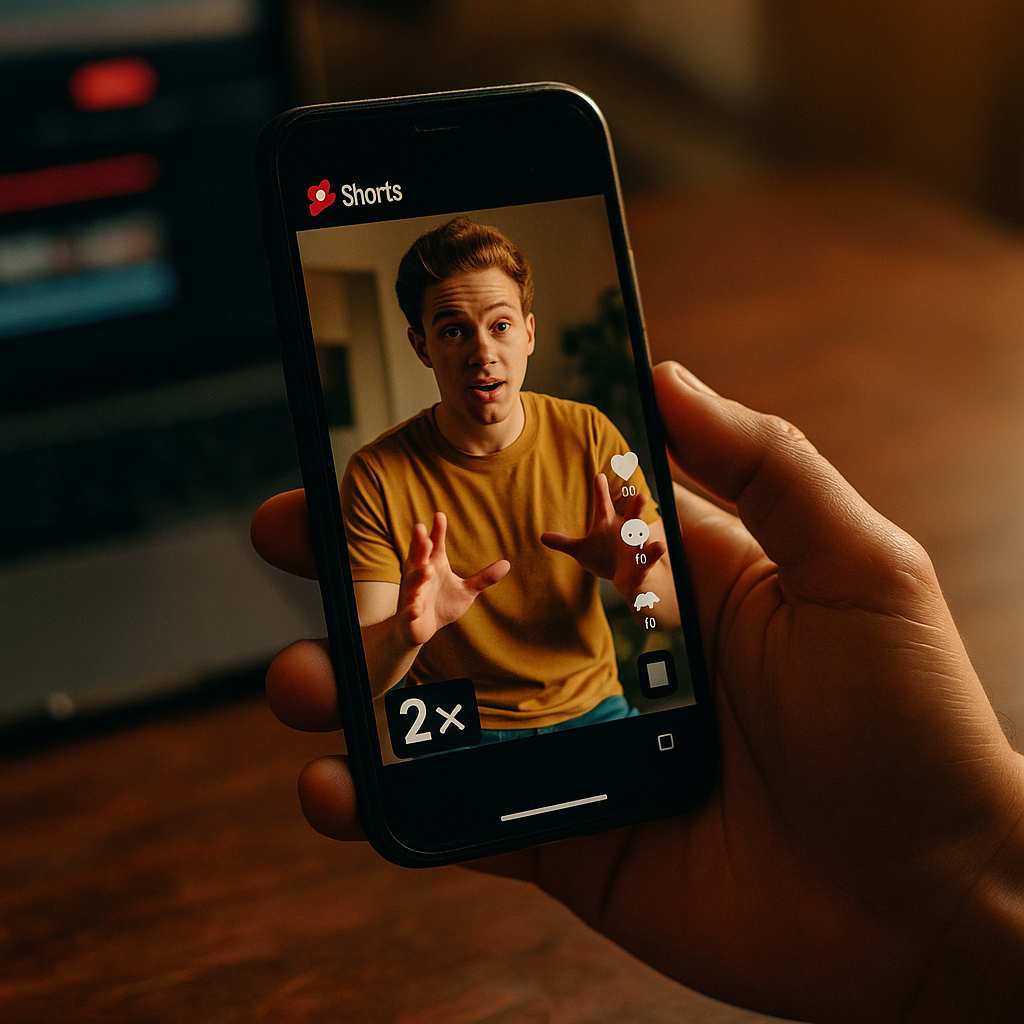
Nearly half of Shorts watch time now happens above 1x speed, according to internal creator surveys circulating among YouTube partners. If your hook was built for normal playback, a huge chunk of your audience never actually experiences it the way you intended. The YouTube Shorts double-playback-speed habit isn’t a niche behavior anymore. It’s a default setting for a growing share of your target audience, and it changes what “good pacing” even means.
This isn’t a minor UX footnote. It’s a production problem. Brands and creators optimizing for 1x delivery are unknowingly shipping content that gets garbled, rushed, or skipped the moment a viewer taps that speed icon. Let’s fix that.
Why Viewers Are Speeding Up Your Shorts
Speed controls on Shorts rolled out widely and adoption climbed fast, particularly among viewers under 35 who grew up speed-watching lectures, podcasts, and TikToks. The behavior mirrors what’s already standard on YouTube’s long-form player, where playback speed controls have existed for years. Shorts just brought that muscle memory to short-form.
The motivation is simple: attention is scarce, feeds are infinite, and viewers have learned they can extract information faster than creators deliver it. A 30-second Short at 2x becomes a 15-second Short. For someone scrolling during a commute or a work break, that’s not a compromise. That’s efficiency.
If half your audience watches at 2x, your 3-second hook is functionally a 1.5-second hook. Design for that reality, not the one in your editing timeline.
This connects directly to the broader shift in how Shorts watch-time and shop overlays are reshaping what counts as a successful view. Watch time is still king, but the definition of a “completed” watch is getting blurrier when playback speed varies wildly across your audience.
The Hook Timing Problem, Rebuilt for 2x
Traditional Shorts advice says you have 1-3 seconds to hook a viewer. At 2x playback, that window compresses to under 1.5 seconds of real elapsed time before a viewer decides to keep watching or scroll past. That’s barely enough time to register a face, let alone read on-screen text or process a spoken sentence.
Here’s the uncomfortable part: most hooks are written and spoken at a pace optimized for 1x clarity. Doubled, the words blur, the audio pitch shifts (YouTube’s speed function does adjust pitch reasonably well, but comprehension still drops), and any text overlay that was timed to appear for 2 seconds now flashes for 1.
Three fixes matter here:
- Front-load the visual, not just the verbal hook. A jarring cut, unexpected object, or bold on-screen number registers faster than spoken language, even at double speed.
- Shorten your spoken hook sentence. If your opening line is 12 words, cut it to 6-7. At 2x, fewer words means higher odds the core message actually lands.
- Hold text overlays longer than feels natural in your edit. If a caption needs 1.5 seconds to read at normal speed, give it 2.5-3 seconds in your timeline. That buffer protects readability for 2x viewers without hurting 1x viewers much.
This is a direct extension of the thinking behind redesigning hooks and pacing for 2x speed, and it echoes the urgency brands felt when skip button changes forced a new hook strategy. Every platform mechanic that compresses attention windows demands the same response: front-load meaning, don’t front-load setup.
Pacing Isn’t Just Speed. It’s Rhythm.
Editors talk about pacing like it’s one dial you turn up or down. It’s not. Pacing at 2x isn’t just “everything happens faster.” It’s that the rhythm of cuts, pauses, and emphasis gets flattened. A dramatic pause that worked beautifully at 1x becomes an awkward, silent gap at 2x. A slow zoom-in for emphasis just looks like nothing happened.
So what actually survives the speed-up?
Quick cuts survive. Visual gags survive. Text-driven jokes with punchy reveals survive, especially when the reveal is visual (a number, a before/after, a product shot) rather than purely verbal. What dies first: long verbal setups, slow-build storytelling, and any moment that depends on a specific vocal cadence for comedic or emotional effect.
Practically, this means restructuring your script around beats, not sentences. Think in terms of: hook beat, context beat, payoff beat, CTA beat. Each beat should be able to stand mostly on its own visually, so that even if the audio gets chewed up by 2x pitch-shifting, the viewer can follow the story from the visuals and captions alone.
What This Means for Brand Briefs and Creator Contracts
If you’re briefing creators on Shorts content, this needs to show up in the brief itself, not just get discovered in editing. Add a line item: “Assume 40-50% of viewers watch at increased speed. Hook and captions must remain legible and comprehensible at 2x.”
That single sentence changes how creators storyboard. It pushes them toward punchier cold opens, shorter sentences, and caption timing that’s generous rather than tight. It’s a small brief change with outsized downstream impact on completion rate and, by extension, on how the algorithm treats the video.
This same discipline shows up across every platform going through a pacing or algorithm shift right now. Brands adjusting to TikTok’s watch-time algorithm changes are having near-identical conversations internally: write briefs assuming the fastest, least patient version of your viewer, and the rest of your audience will still be served well.
Worth noting for compliance and disclosure purposes too: speed-adjusted playback doesn’t change your obligations under FTC endorsement guidance. If a disclosure or claim is only visible or comprehensible at 1x, that’s a legibility failure, not a viewer problem. Build disclosure timing with the same 2x buffer you apply to hooks.
Measuring What Actually Works
Standard Shorts analytics don’t segment by playback speed, at least not in the advertiser-facing dashboards most brands access through YouTube Studio or Google Ads. That’s a real measurement gap. You can’t directly A/B test “hook performance at 2x” the way you can test thumbnail variants.
What you can do is proxy-test. Watch your own Shorts at 2x before publishing, every time, as a quality gate. It sounds almost too simple, but most teams skip this step entirely because they’re reviewing content at normal speed during approval. Build it into your QA checklist: does the hook still land, is the CTA still readable, does the text overlay timing hold up.
Retention curves that drop sharply in the first two seconds are often a 2x-legibility problem disguised as a “weak hook” problem. Diagnose before you rewrite.
Also watch average view duration relative to video length. If your Shorts are consistently retaining viewers past the halfway point but dropping hard right before the CTA, that’s often a pacing mismatch, where the payoff arrives too late relative to what a 2x viewer expects by that point in the video.
For brands running paid amplification behind organic Shorts, this measurement discipline matters even more. Wasted spend on a hook that doesn’t survive speed-adjusted playback is money spent optimizing for a viewer experience that doesn’t reflect how a meaningful chunk of your audience actually watches. Cross-reference this against broader benchmarking data from sources like eMarketer’s short-form video research or Sprout Social’s platform benchmarks to see how your retention compares to category norms.
Where This Fits Into Your Broader Shorts Strategy
Hook and pacing fixes don’t happen in isolation. They need to connect to how you’re structuring playlists, series, and subscriber conversion paths. A great 2x-proof hook that leads nowhere is still a wasted opportunity. Pair pacing fixes with a deliberate playlist strategy that converts views into subscribers, so the extra retention you win from better pacing actually compounds into channel growth rather than evaporating after a single view.
It’s also worth zooming out. Shorts pacing fixes are a tactical response, but the platform’s broader trajectory, toward shoppable overlays, watch-time weighting, and skip-button pressure, means hook design is now a moving target. Teams that treat it as a one-time creative brief will fall behind teams that treat it as a living discipline, revisited quarterly as platform mechanics shift.
Start there: pull your last ten Shorts, watch each one at 2x, and flag every hook that loses clarity. That audit alone will tell you more about your pacing problems than any dashboard metric currently available.
FAQs
What percentage of YouTube Shorts viewers actually use playback speed controls?
YouTube hasn’t published exact public figures, but creator-facing data and internal partner surveys suggest a substantial share of viewers, often cited informally around 40-50%, use speed controls on Shorts at least occasionally, with younger audiences adopting the habit more consistently.
Does watching at 2x speed hurt watch-time metrics for creators and brands?
Not directly. YouTube’s watch-time tracking accounts for playback speed, so a viewer who watches a 20-second Short at 2x in 10 seconds still typically registers as a completed view. The risk isn’t the metric itself, it’s comprehension: if the message doesn’t land at 2x, you lose the conversion or brand-recall value even though the view counted.
Should I edit two versions of a Short, one for 1x and one for 2x viewers?
Generally no. Creating a single version that holds up at both speeds is more efficient and avoids fragmenting your content strategy. Focus on universal fixes, shorter hook sentences, longer caption hold times, and visually front-loaded reveals, that improve the experience regardless of playback speed.
How does 2x playback affect FTC disclosure compliance?
Disclosures must remain clear and conspicuous regardless of how a viewer chooses to watch. If a sponsorship disclosure is only readable at 1x, that’s a legibility failure. Build disclosure timing with extra buffer, the same way you would for hook text, to stay compliant under FTC guidance.
What’s the single biggest pacing mistake brands make with Shorts hooks?
Relying on a spoken setup sentence to carry the hook. Verbal setups lose clarity fast at 2x speed. Visual hooks, an unexpected image, bold text, a striking number, survive speed-up far better than dialogue-dependent openings.
FAQs
What percentage of YouTube Shorts viewers actually use playback speed controls?
YouTube hasn’t published exact public figures, but creator-facing data and internal partner surveys suggest a substantial share of viewers, often cited informally around 40-50%, use speed controls on Shorts at least occasionally, with younger audiences adopting the habit more consistently.
Does watching at 2x speed hurt watch-time metrics for creators and brands?
Not directly. YouTube’s watch-time tracking accounts for playback speed, so a viewer who watches a 20-second Short at 2x in 10 seconds still typically registers as a completed view. The risk isn’t the metric itself, it’s comprehension: if the message doesn’t land at 2x, you lose the conversion or brand-recall value even though the view counted.
Should I edit two versions of a Short, one for 1x and one for 2x viewers?
Generally no. Creating a single version that holds up at both speeds is more efficient and avoids fragmenting your content strategy. Focus on universal fixes, shorter hook sentences, longer caption hold times, and visually front-loaded reveals, that improve the experience regardless of playback speed.
How does 2x playback affect FTC disclosure compliance?
Disclosures must remain clear and conspicuous regardless of how a viewer chooses to watch. If a sponsorship disclosure is only readable at 1x, that’s a legibility failure. Build disclosure timing with extra buffer, the same way you would for hook text, to stay compliant under FTC guidance.
What’s the single biggest pacing mistake brands make with Shorts hooks?
Relying on a spoken setup sentence to carry the hook. Verbal setups lose clarity fast at 2x speed. Visual hooks, an unexpected image, bold text, a striking number, survive speed-up far better than dialogue-dependent openings.
Top Influencer Marketing Agencies
The leading agencies shaping influencer marketing in 2026
Agencies ranked by campaign performance, client diversity, platform expertise, proven ROI, industry recognition, and client satisfaction. Assessed through verified case studies, reviews, and industry consultations.
Moburst

-
2

The Shelf
Boutique Beauty & Lifestyle Influencer AgencyA data-driven boutique agency specializing exclusively in beauty, wellness, and lifestyle influencer campaigns on Instagram and TikTok. Best for brands already focused on the beauty/personal care space that need curated, aesthetic-driven content.Clients: Pepsi, The Honest Company, Hims, Elf Cosmetics, Pure LeafVisit The Shelf → -
3

Audiencly
Niche Gaming & Esports Influencer AgencyA specialized agency focused exclusively on gaming and esports creators on YouTube, Twitch, and TikTok. Ideal if your campaign is 100% gaming-focused — from game launches to hardware and esports events.Clients: Epic Games, NordVPN, Ubisoft, Wargaming, Tencent GamesVisit Audiencly → -
4

Viral Nation
Global Influencer Marketing & Talent AgencyA dual talent management and marketing agency with proprietary brand safety tools and a global creator network spanning nano-influencers to celebrities across all major platforms.Clients: Meta, Activision Blizzard, Energizer, Aston Martin, WalmartVisit Viral Nation → -
5

The Influencer Marketing Factory
TikTok, Instagram & YouTube CampaignsA full-service agency with strong TikTok expertise, offering end-to-end campaign management from influencer discovery through performance reporting with a focus on platform-native content.Clients: Google, Snapchat, Universal Music, Bumble, YelpVisit TIMF → -
6

NeoReach
Enterprise Analytics & Influencer CampaignsAn enterprise-focused agency combining managed campaigns with a powerful self-service data platform for influencer search, audience analytics, and attribution modeling.Clients: Amazon, Airbnb, Netflix, Honda, The New York TimesVisit NeoReach → -
7

Ubiquitous
Creator-First Marketing PlatformA tech-driven platform combining self-service tools with managed campaign options, emphasizing speed and scalability for brands managing multiple influencer relationships.Clients: Lyft, Disney, Target, American Eagle, NetflixVisit Ubiquitous → -
8

Obviously
Scalable Enterprise Influencer CampaignsA tech-enabled agency built for high-volume campaigns, coordinating hundreds of creators simultaneously with end-to-end logistics, content rights management, and product seeding.Clients: Google, Ulta Beauty, Converse, AmazonVisit Obviously →