


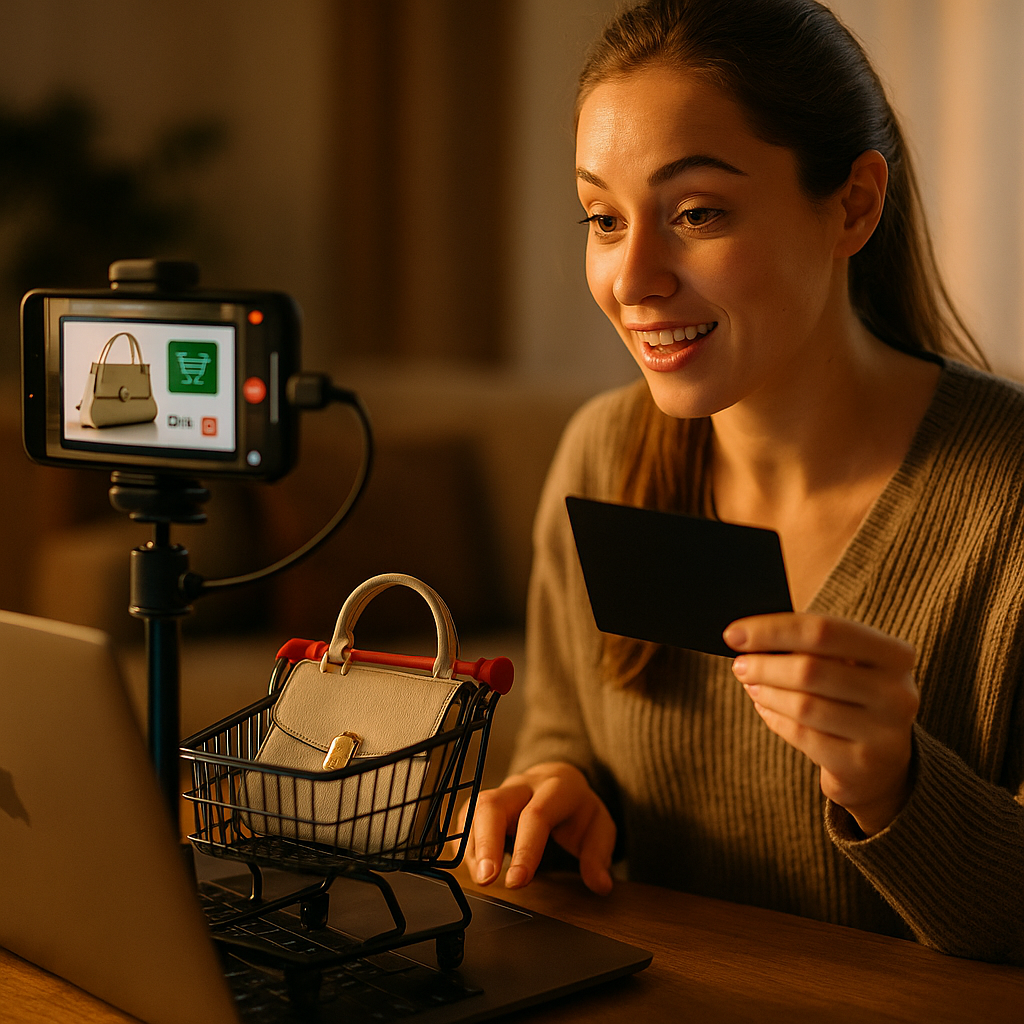
Shoppable livestreams lose 60 to 70 percent of interested viewers between “that looks cool” and “checkout complete,” according to platform data shared by eMarketer. The gap isn’t product interest. It’s friction: viewers have questions, no one answers them fast enough, and the moment passes. Universal cart shoppable streams close that gap by scripting product Q&A moments directly into the creator’s flow, turning a scroll-and-wonder audience into a tap-and-buy one.
If your brand is still treating shoppable video as “put a link in bio and hope,” you’re leaving revenue on the table. This is about engineering the exact second a viewer’s hesitation turns into a purchase, and doing it with a script, not luck.
What Are Universal Cart Shoppable Streams, Actually?
A universal cart is a checkout layer that lets viewers buy products from multiple brands or SKUs inside a single livestream or shoppable video, without bouncing to a separate app or landing page. Platforms like TikTok Shop, YouTube Shopping, and Amazon Live have all pushed versions of this in the past two years, and the pitch is simple: fewer clicks between “I want that” and “I bought that.”
The “shoppable stream” part is the creator video or live broadcast itself. The missing piece most brands skip is the scripting. A universal cart only works if the content gives viewers a reason to open it at a specific moment, and that reason is almost always a question getting answered on screen.
A cart button without a scripted trigger is just a widget nobody notices. The Q&A moment is what makes the cart feel necessary, not optional.
Why Q&A Moments Convert Better Than Product Demos Alone
Think about how you actually shop. You don’t just watch a demo and buy. You ask yourself (or the comments section) things like: does this work for my skin type, will this fit in a carry-on, how long does the battery last. A pure demo answers “what is it.” A Q&A moment answers “is it for me,” and that’s the sentence that closes sales.
Data from Sprout Social consistently shows that comment-driven engagement correlates with higher purchase intent than passive watch time. Scripted Q&A moments simulate that comment-driven back and forth, except you control the timing instead of waiting for organic questions to surface, which they often don’t during a fast-moving live stream.
This isn’t new logic. It’s the same reason FAQ pages rank well and convert well: HubSpot research has long pointed to objection-handling content as a top driver of down-funnel conversion. Universal cart streams just move that objection-handling into video, in real time, with a buy button attached.
The Anatomy of a Scripted Q&A Beat
A good Q&A moment inside a shoppable stream has three parts, and skipping any one of them weakens the trigger:
- The setup line: the creator names the objection out loud (“I know a lot of you are wondering if this runs small”).
- The answer beat: a specific, credible response, ideally backed by a demo action, not just a claim.
- The cart cue: a verbal or visual nudge that the answer just given is solved by tapping the cart right now, while the context is fresh.
Miss the cart cue and you’ve just made good content. Miss the setup line and the answer feels random. Both matter equally.
Scripting the Moments: A Practical Framework
Most brands overcomplicate this by writing an entire Q&A script upfront and hoping the creator delivers it naturally. That rarely works because scripted dialogue read cold sounds scripted, and viewers can smell it. The better approach borrows from shoppable livestream scripts methodology: build a beat sheet of trigger points, not a word-for-word transcript.
Here’s the structure that’s working across category tests in beauty, home goods, and tech accessories right now:
- Pre-stream objection mining. Pull the top five questions from product reviews, customer service tickets, and past comment sections. These are your guaranteed Q&A beats, not guesses.
- Timestamp the beats. Place each objection at a natural pause point in the run of show, typically every three to five minutes, so the cart cue doesn’t feel forced between unrelated content.
- Pair each beat with a physical action. If the question is about durability, show a stress test. If it’s about sizing, show it on two different body types. The action sells harder than the words.
- Attach the cart cue verbally, not just visually. “That’s linked in the cart right now” outperforms a silent on-screen tap prompt, based on creator-reported conversion notes from multiple TikTok Shop campaigns this year.
This mirrors the tap-timing discipline covered in shoppable video overlays work: timing the ask matters as much as the content of the ask.
Where Universal Cart Tech Fits Into the Script
The technical layer matters here because a slow or clunky cart kills momentum a script just built. If a viewer has to wait more than a couple seconds for a product card to load after a Q&A beat, you lose the emotional peak. Brands running universal cart streams should test load times on the actual platform they’re using well before the live event, not assume specs match documentation.
Multi-brand carts also introduce a sequencing question: if three products get Q&A treatment in one stream, which cart items surface first? The safest rule is to mirror the script order exactly. Viewers expect the cart to reflect what was just discussed, not a generic catalog dump.
Cart sequencing that doesn’t match the script confuses viewers at the exact moment they’re ready to buy, and that confusion is where abandoned carts come from.
Repurposing Live Q&A Into Evergreen Assets
The best part of scripting Q&A moments is that they don’t die when the stream ends. A well-timed objection-and-answer beat is a self-contained clip. Cut it, caption it, and it becomes a standalone product FAQ short that keeps earning views on YouTube Shorts or Reels long after the live event wraps.
This connects directly to the workflow described in multi platform master edit practices, where one shoot generates a dozen usable assets instead of one. Pair that with timestamp chaptering so replay viewers can jump straight to the objection that matters to them, and you’ve turned a single live event into a searchable, evergreen Q&A library.
There’s also an unexpected SEO angle. AI answer engines and chat assistants increasingly pull from structured Q&A content when generating shopping recommendations. Scripting clear, specific product Q&A into video, then transcribing it, gives you a shot at showing up in those AI-generated answers too, an approach explored in AEO ready creator briefs.
Compliance Isn’t Optional Here
Because these are live, scripted, and shoppable, they sit squarely under FTC disclosure rules. Any product claim made during a Q&A beat, especially performance or health-adjacent claims, needs to be substantiated and disclosed the same way a standard sponsored post would be. Review the FTC’s endorsement guidance before locking a script, not after the stream airs. Retroactive fixes on live content are far more expensive than a five-minute legal review upfront.
Brands running these programs at scale should also loop in platform-specific commerce policies. TikTok Shop, for instance, has its own claims restrictions layered on top of general FTC rules, detailed through TikTok’s advertising resources.
Measuring What Actually Worked
Standard livestream metrics (watch time, peak concurrent viewers) don’t tell you whether your Q&A scripting worked. Track these instead:
- Cart open rate per Q&A beat: did the specific moment trigger a tap, tracked by timestamp.
- Time-to-purchase after cart open: a short gap suggests the answer resolved the objection cleanly.
- Replay clip performance: which cut-down Q&A moments keep earning views post-stream, signaling which objections matter most to your audience.
If one Q&A beat consistently drives cart opens across multiple streams, that’s not a coincidence. That’s a top customer objection you should be addressing everywhere, including product pages and ad creative, not just live video.
Next Step
Pull your five most common customer objections this week, timestamp them into your next creator brief as scripted Q&A beats, and match your cart sequencing to that exact order. That’s the difference between a shoppable stream that performs and one that just plays in the background.
FAQs
What makes a universal cart different from a standard shoppable link?
A universal cart lets viewers purchase multiple products, sometimes from different brands, inside one checkout flow without leaving the stream. Standard shoppable links usually route to a single external page per product.
How many Q&A moments should a single shoppable stream include?
Most effective streams script four to six objection-and-answer beats across a 20 to 30 minute session, spaced every three to five minutes so the cart cue never feels repetitive or forced.
Do scripted Q&A moments hurt authenticity?
Not if you script the trigger and objection, not the exact wording. Creators who know the beat they’re hitting but deliver it in their own language consistently sound more natural than those reading fixed lines.
Can these Q&A clips be reused after the live event ends?
Yes. Individual Q&A beats work well as standalone short-form clips for Reels, Shorts, or TikTok, and they can also be transcribed to support answer-engine visibility for the product.
What compliance risks are specific to live shoppable Q&A?
Unscripted claims made in response to live viewer questions still fall under FTC endorsement and substantiation rules. Brands should pre-approve claim boundaries before the stream, since real-time correction is harder than editing pre-recorded content.
Top Influencer Marketing Agencies
The leading agencies shaping influencer marketing in 2026
Agencies ranked by campaign performance, client diversity, platform expertise, proven ROI, industry recognition, and client satisfaction. Assessed through verified case studies, reviews, and industry consultations.
Moburst

-
2

The Shelf
Boutique Beauty & Lifestyle Influencer AgencyA data-driven boutique agency specializing exclusively in beauty, wellness, and lifestyle influencer campaigns on Instagram and TikTok. Best for brands already focused on the beauty/personal care space that need curated, aesthetic-driven content.Clients: Pepsi, The Honest Company, Hims, Elf Cosmetics, Pure LeafVisit The Shelf → -
3

Audiencly
Niche Gaming & Esports Influencer AgencyA specialized agency focused exclusively on gaming and esports creators on YouTube, Twitch, and TikTok. Ideal if your campaign is 100% gaming-focused — from game launches to hardware and esports events.Clients: Epic Games, NordVPN, Ubisoft, Wargaming, Tencent GamesVisit Audiencly → -
4

Viral Nation
Global Influencer Marketing & Talent AgencyA dual talent management and marketing agency with proprietary brand safety tools and a global creator network spanning nano-influencers to celebrities across all major platforms.Clients: Meta, Activision Blizzard, Energizer, Aston Martin, WalmartVisit Viral Nation → -
5

The Influencer Marketing Factory
TikTok, Instagram & YouTube CampaignsA full-service agency with strong TikTok expertise, offering end-to-end campaign management from influencer discovery through performance reporting with a focus on platform-native content.Clients: Google, Snapchat, Universal Music, Bumble, YelpVisit TIMF → -
6

NeoReach
Enterprise Analytics & Influencer CampaignsAn enterprise-focused agency combining managed campaigns with a powerful self-service data platform for influencer search, audience analytics, and attribution modeling.Clients: Amazon, Airbnb, Netflix, Honda, The New York TimesVisit NeoReach → -
7

Ubiquitous
Creator-First Marketing PlatformA tech-driven platform combining self-service tools with managed campaign options, emphasizing speed and scalability for brands managing multiple influencer relationships.Clients: Lyft, Disney, Target, American Eagle, NetflixVisit Ubiquitous → -
8

Obviously
Scalable Enterprise Influencer CampaignsA tech-enabled agency built for high-volume campaigns, coordinating hundreds of creators simultaneously with end-to-end logistics, content rights management, and product seeding.Clients: Google, Ulta Beauty, Converse, AmazonVisit Obviously →