


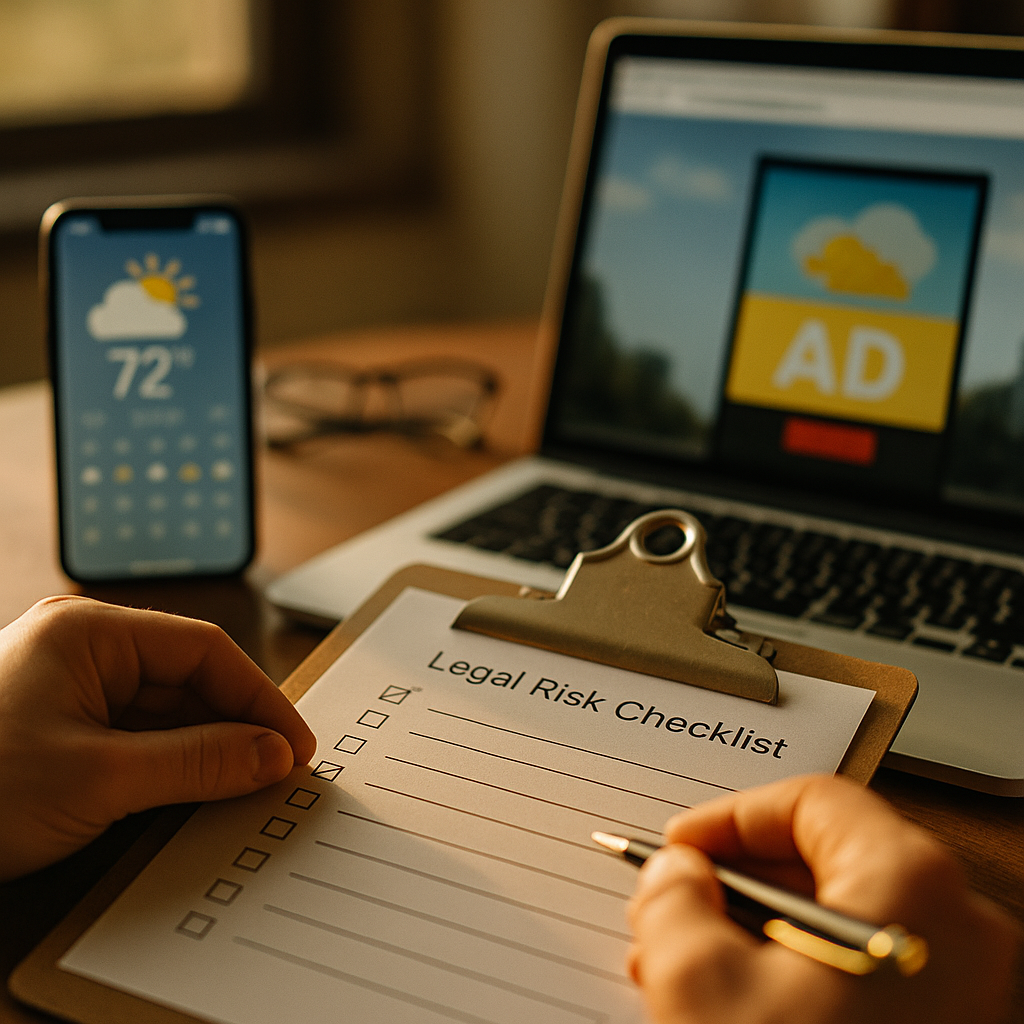
Forty-one states now have some flavor of “unfair or deceptive acts and practices” law that touches automated advertising. Add real-time weather data to a dynamic creative pipeline, and you’ve built a machine that can generate thousands of ad variations before legal ever sees one. That’s the quiet risk behind AI weather-triggered dynamic creative: it’s fast, it’s clever, and it’s almost never reviewed the way a static ad would be.
Marketers love weather-triggered creative because it works. Serve umbrella ads during rain, iced coffee ads during heat spikes, and conversion rates climb. But every one of those triggers is a new, auto-generated claim, price, or urgency cue — and state regulators don’t care that a machine wrote the copy.
Why This Isn’t Just a Media-Buying Problem
Weather-triggered dynamic creative sits at the intersection of adtech and legal exposure most brand teams haven’t mapped. The creative changes based on temperature, precipitation, air quality, even pollen count. The logic sounds harmless: “if rain, show umbrella ad.” But scale that across fifty states, each with its own consumer protection statute, and you get a compliance surface area nobody signed off on.
California’s Unfair Competition Law, New York’s General Business Law Section 349, and similar statutes in states like Texas and Florida all prohibit deceptive or misleading advertising — regardless of whether a human or an algorithm generated it. If your weather API misfires and triggers a “flash flood sale” banner in a state that isn’t flooding, that’s a potential deceptive-practices claim. If your AI model overstates urgency (“last chance before the storm!”) when no storm exists, you’ve got a false-scarcity problem layered on top.
A dynamic creative engine that generates 500 ad variations a week isn’t 500 ads — legally, it’s 500 separate claims that each need to be defensible on their own.
This is the same pattern legal teams have seen with countdown timer compliance issues in livestream commerce. Automation doesn’t reduce legal risk. It multiplies it, then hides it behind a dashboard that shows performance metrics, not legal metrics.
**Building the Checklist: Start With Data Provenance**
Before you write a single line of creative logic, ask where the weather data actually comes from. Most brands license third-party weather APIs (think AccuWeather, Tomorrow.io, or NOAA feeds) and trust the feed blindly. That’s a mistake.
- Confirm the API’s accuracy guarantees and error-rate disclosures in the vendor contract.
- Document who’s liable if inaccurate weather data triggers a misleading ad (the vendor, the ad platform, or the brand).
- Check refresh frequency — a six-hour-old “severe storm” trigger showing on a sunny afternoon is a real deceptive-advertising risk, not a hypothetical one.
- Log every data pull for audit purposes, the same way you would for attribution and ad-tech vendor relationships.
Weather data errors happen more often than vendors admit. NOAA itself acknowledges forecast uncertainty increases substantially beyond 72 hours, per NOAA public guidance. If your creative engine is pulling forecasts (not real-time conditions) to trigger ad copy, you’re building claims on probability, not fact. State regulators generally don’t grant a “the algorithm thought it would rain” defense.
**State-by-State Variance Is the Real Headache**
There’s no federal weather-marketing statute. Instead, you’re navigating a patchwork of state UDAP (unfair and deceptive acts and practices) laws, each with different standards for what counts as a material misrepresentation.
- California applies a “reasonable consumer” standard broadly and allows private rights of action, meaning a single misfired ad could trigger a class action, not just a regulatory letter.
- New York requires the practice be “materially misleading,” giving slightly more room, but still allows consumer suits under GBL 349.
- Texas‘s Deceptive Trade Practices Act carries treble damages potential, raising the financial stakes of any single bad trigger.
- Florida‘s FDUTPA has been used aggressively against automated pricing and urgency claims in recent years.
This means a national weather-triggered campaign isn’t one legal review — it’s potentially four or five, depending on where your media buy runs. Most brands don’t budget legal review time for that level of granularity, which is exactly why it becomes a post-launch fire drill instead of a pre-launch checklist item.
The Checklist Itself
Here’s the core structure legal and marketing teams should build together before any weather-triggered creative goes live. Treat it as a living document, not a one-time form.
- Map every trigger condition to a specific claim. “Rain = umbrella ad” is fine. “Rain = 40% off, today only” needs separate legal sign-off because it combines weather logic with a pricing claim.
- Classify claims by risk tier. Informational triggers (product recommendations) carry lower risk than urgency or scarcity triggers (“stock running out due to demand surge”).
- Pre-approve creative templates, not just final ads. Legal should review the underlying logic tree, not just sample outputs, since the AI will generate combinations nobody manually previews.
- Build a kill switch. If weather data is flagged as stale or inaccurate, creative should default to evergreen copy automatically, not continue running the triggered version.
- Document state-specific exclusions. Some triggers (aggressive urgency language, for instance) may need to be suppressed entirely in states with private rights of action.
- Require a human sign-off matrix for high-risk categories. Similar to the sign-off structures brands are adopting for AI-generated creator scripts, weather-triggered ads touching pricing, health claims, or safety messaging (think air quality index triggers for asthma-related products) need a named human approver.
- Archive every generated variation for at least the statute of limitations period in your most aggressive operating state — typically three to four years for UDAP claims.
If you can’t produce the exact ad variant a consumer saw, on the exact date, in the exact state, you can’t defend it. Weather-triggered creative makes that reconstruction exponentially harder without disciplined logging.
What About the AI Model Itself?
Here’s a wrinkle a lot of legal teams miss: the generative model producing the copy is a separate risk layer from the weather trigger logic. If you’re using an LLM to write the actual ad text (“Storm’s coming — grab yours before it’s gone!”), you’re now dealing with AI-generated claims that a human never drafted or reviewed word-for-word.
This is the same underlying issue explored in auditing AI-assisted scripts for brand liability — the brand remains the speaker under FTC and state law, regardless of who or what wrote the words. The FTC has been explicit that AI doesn’t dilute advertiser responsibility. State attorneys general are following that lead, particularly in California and New York, where AG offices have signaled increased scrutiny of automated ad generation tools.
Practically, this means your checklist needs a language-review layer separate from your trigger-logic layer. Two different risks, two different review paths.
Vendor Contracts Need to Catch Up
Most weather API vendors and dynamic creative optimization (DCO) platforms weren’t built with state consumer protection law in mind. Their contracts focus on uptime, data accuracy SLAs, and licensing — not on indemnification for deceptive advertising claims arising from their data feed.
Before signing or renewing a DCO or weather-data vendor contract, push for:
- Explicit indemnification language covering claims arising from inaccurate or delayed data feeds.
- Audit rights, so your legal team can request logs showing exactly what data triggered a specific ad at a specific time.
- Change-notification clauses requiring the vendor to flag material changes to their data sourcing or refresh cadence.
This mirrors the contract discipline brands are already applying to AI agent spend-cap clauses and other automated systems making decisions on the brand’s behalf. Weather-triggered creative is just another autonomous decision-maker wearing a marketing hat — treat the vendor relationship accordingly.
Industry data backs up the urgency here. eMarketer has tracked steady growth in programmatic and dynamic creative spend, and Statista figures show AI-driven ad personalization adoption climbing across retail and CPG categories. More adoption means more surface area for a state AG or plaintiff’s attorney to find the one bad trigger that got through.
Operationalizing Without Killing Speed
None of this means grinding weather-triggered campaigns to a halt. The goal is a checklist that runs in parallel with creative development, not a bottleneck that kills the “real-time” advantage that makes this tactic valuable in the first place.
Practical fixes that keep speed intact:
- Pre-clear a library of trigger-safe copy templates so legal reviews the framework once, not every output.
- Set automated guardrails in the DCO platform that block certain word combinations (guarantees, urgency-plus-price, health claims) from ever generating without manual review.
- Run a quarterly audit sample — pull fifty random generated ads across states and stress-test them against each state’s UDAP standard.
- Assign a single accountable owner (not a committee) for weather-trigger legal sign-off, similar to how brands are structuring accountability for other AI-driven creative workflows.
Speed and compliance aren’t actually in tension here. The tension is between doing the checklist work up front versus doing discovery and remediation later, under a state AG inquiry, which is slower, more expensive, and far more public.
Next step: pull your current weather-trigger logic tree and map each condition to a specific state consumer protection statute this week — not after the next campaign launches, but before it does.
FAQs
What makes weather-triggered dynamic creative legally risky compared to standard programmatic ads?
Standard programmatic ads typically rotate pre-approved creative based on audience targeting. Weather-triggered creative generates new claims, urgency cues, or pricing messages in real time based on external data feeds, meaning legal often never reviews the specific combination a consumer actually sees.
Which state laws matter most for brands running weather-triggered campaigns nationally?
California’s Unfair Competition Law, New York’s General Business Law Section 349, Texas’s Deceptive Trade Practices Act, and Florida’s FDUTPA are the most frequently cited, largely because several allow private rights of action, increasing exposure beyond regulatory enforcement.
Does using a third-party weather API shift liability away from the brand?
Generally, no. State consumer protection laws focus on the advertiser making the claim to consumers, not the data vendor behind the scenes. Indemnification clauses in vendor contracts can shift financial responsibility, but they don’t eliminate the brand’s regulatory exposure.
How long should brands retain records of AI-generated weather-triggered ad variations?
Match retention to the statute of limitations in your most aggressive operating state, typically three to four years for unfair and deceptive practices claims, and ensure logs can reconstruct exactly which variation ran, when, and in which state.
Can brands automate legal review for high-volume dynamic creative?
Partially. Automated guardrails can block flagged word combinations (guarantees, health claims, urgency-plus-pricing) before generation, but high-risk categories still need a named human approver rather than relying solely on automated filters.
FAQs
What makes weather-triggered dynamic creative legally risky compared to standard programmatic ads?
Standard programmatic ads typically rotate pre-approved creative based on audience targeting. Weather-triggered creative generates new claims, urgency cues, or pricing messages in real time based on external data feeds, meaning legal often never reviews the specific combination a consumer actually sees.
Which state laws matter most for brands running weather-triggered campaigns nationally?
California’s Unfair Competition Law, New York’s General Business Law Section 349, Texas’s Deceptive Trade Practices Act, and Florida’s FDUTPA are the most frequently cited, largely because several allow private rights of action, increasing exposure beyond regulatory enforcement.
Does using a third-party weather API shift liability away from the brand?
Generally, no. State consumer protection laws focus on the advertiser making the claim to consumers, not the data vendor behind the scenes. Indemnification clauses in vendor contracts can shift financial responsibility, but they don’t eliminate the brand’s regulatory exposure.
How long should brands retain records of AI-generated weather-triggered ad variations?
Match retention to the statute of limitations in your most aggressive operating state, typically three to four years for unfair and deceptive practices claims, and ensure logs can reconstruct exactly which variation ran, when, and in which state.
Can brands automate legal review for high-volume dynamic creative?
Partially. Automated guardrails can block flagged word combinations (guarantees, health claims, urgency-plus-pricing) before generation, but high-risk categories still need a named human approver rather than relying solely on automated filters.
Top Influencer Marketing Agencies
The leading agencies shaping influencer marketing in 2026
Agencies ranked by campaign performance, client diversity, platform expertise, proven ROI, industry recognition, and client satisfaction. Assessed through verified case studies, reviews, and industry consultations.
Moburst

-
2

The Shelf
Boutique Beauty & Lifestyle Influencer AgencyA data-driven boutique agency specializing exclusively in beauty, wellness, and lifestyle influencer campaigns on Instagram and TikTok. Best for brands already focused on the beauty/personal care space that need curated, aesthetic-driven content.Clients: Pepsi, The Honest Company, Hims, Elf Cosmetics, Pure LeafVisit The Shelf → -
3

Audiencly
Niche Gaming & Esports Influencer AgencyA specialized agency focused exclusively on gaming and esports creators on YouTube, Twitch, and TikTok. Ideal if your campaign is 100% gaming-focused — from game launches to hardware and esports events.Clients: Epic Games, NordVPN, Ubisoft, Wargaming, Tencent GamesVisit Audiencly → -
4

Viral Nation
Global Influencer Marketing & Talent AgencyA dual talent management and marketing agency with proprietary brand safety tools and a global creator network spanning nano-influencers to celebrities across all major platforms.Clients: Meta, Activision Blizzard, Energizer, Aston Martin, WalmartVisit Viral Nation → -
5

The Influencer Marketing Factory
TikTok, Instagram & YouTube CampaignsA full-service agency with strong TikTok expertise, offering end-to-end campaign management from influencer discovery through performance reporting with a focus on platform-native content.Clients: Google, Snapchat, Universal Music, Bumble, YelpVisit TIMF → -
6

NeoReach
Enterprise Analytics & Influencer CampaignsAn enterprise-focused agency combining managed campaigns with a powerful self-service data platform for influencer search, audience analytics, and attribution modeling.Clients: Amazon, Airbnb, Netflix, Honda, The New York TimesVisit NeoReach → -
7

Ubiquitous
Creator-First Marketing PlatformA tech-driven platform combining self-service tools with managed campaign options, emphasizing speed and scalability for brands managing multiple influencer relationships.Clients: Lyft, Disney, Target, American Eagle, NetflixVisit Ubiquitous → -
8

Obviously
Scalable Enterprise Influencer CampaignsA tech-enabled agency built for high-volume campaigns, coordinating hundreds of creators simultaneously with end-to-end logistics, content rights management, and product seeding.Clients: Google, Ulta Beauty, Converse, AmazonVisit Obviously →