


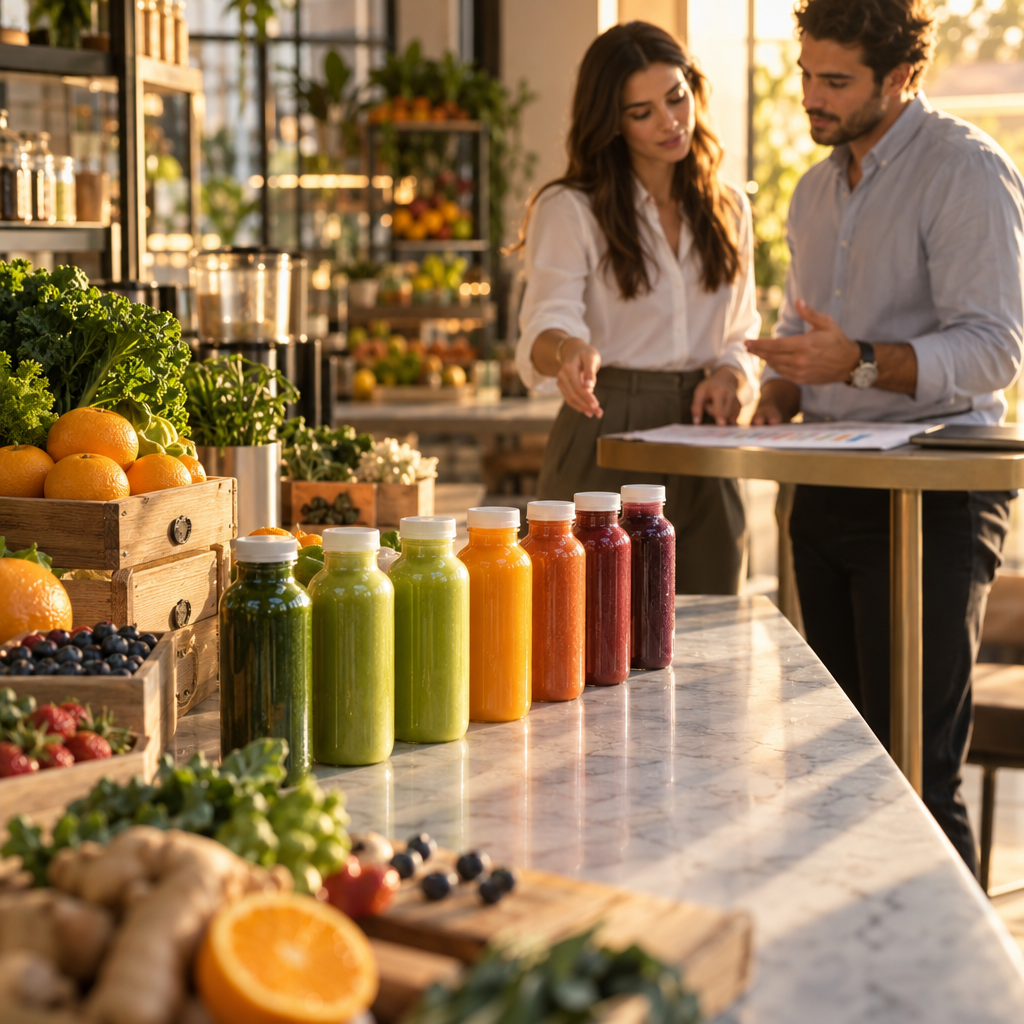
By Highsnobiety’s math, a single $19 smoothie could bring in $760,000 a month. That is the back-of-envelope math Highsnobiety ran on Erewhon’s Hailey Bieber drink, and it explains why Erewhon’s celebrity smoothie collabs have become a case study in viral retail foot traffic. Brands want the playbook. Most copy the celebrity and miss the machine behind it.
The smoothie is the ad, and the store is the set
Erewhon runs about 10 stores in Los Angeles. Its reach is far bigger than that. Highsnobiety reported that executive vice president Vito Antoci said the chain sells about 40,000 Bieber smoothies a month across its 10 locations. Highsnobiety multiplied that volume by the $19 price to reach $760,000 a month from one drink, and it flags that the figure is its own calculation, not one Erewhon has confirmed. Highsnobiety notes the figure is its own calculation and Erewhon has not confirmed it.
The traffic mechanic is simple. You can’t get the drink from a delivery app in Ohio, so fans travel to the building. Antoci described fans flying in from San Francisco to photograph the Beverly Hills storefront and tag the celebrity. The fans make the content, and the content recruits the next wave of fans.
Erewhon itself spends little on conventional promotion. According to Marketing Brew, Antoci said the company does no marketing of its own, beyond posting to its 650,000-plus Instagram and TikTok followers. The celebrity and the customer do the distribution.
Erewhon’s real asset is not the celebrity. It is a physical location people feel compelled to photograph, plus a fan base that treats the visit as content.
How the economics actually work
This is where marketers should pay attention. The smoothie is a media product, an ingredient placement and a retail merchandising play at once.
Highsnobiety found that the add-ins in these drinks are often Erewhon’s own products or third-party brands the store carries. Third-party brands pay to be named on the ingredient list, though the fees are undisclosed and several brands cited confidentiality. Highsnobiety reports that celebrities are paid $1 per smoothie sold and are encouraged to donate that sum to charity. The same Highsnobiety piece adds that Erewhon puts in another $2 per smoothie toward the cause.
Consider the leverage. Barcode’s founder told Highsnobiety that Erewhon was selling probably 7,000 Harlow smoothies in a week, and Barcode is the fitness water used in her Island Glow. Barcode’s CEO also said Erewhon is an investor in the brand, which he said got it a discounted placement fee. Based on conversations with brands whose products appear in the drinks, Highsnobiety estimated that Erewhon could be making upward of $16 million a year on the celebrity line, before placement fees. Treat that as a reporter’s estimate, not audited revenue.
The takeaway for agencies: the celebrity fee is tiny relative to the volume. The money sits in the retailer’s control of the format, the scarcity and the cross-sell.
Not just celebrities: the membership drink model for brands
You don’t need a Hadid or a Bieber. Marketing Brew’s reporting shows a quieter tier of brand-sponsored membership drinks, and the results are specific enough to learn from.
- Salt & Stone (body care) sold a coconut-creme smoothie in October 2024. Salt & Stone’s CMO told Marketing Brew that the collab drove more than 4 million impressions from influencer and UGC content, and that the brand is now the No. 1 body brand at Erewhon.
- A Jolie executive told Marketing Brew that more than 15,000 Spring of Youth drinks sold in April. Its team said Jolie’s sales at Erewhon beat its sales at larger retailers.
- Marketing Brew reports that Boka’s Mint Condition Smile Smoothie costs $11 for nonmembers. The brand is the No. 2 toothpaste at Erewhon, and it paired the launch with LA influencers and activations at sororities and Pilates studios.
Boka’s marketing lead was blunt about the deal structure, calling it pay-to-play. The brand does not see any proceeds from the drink. If more toothpaste sells in store, that is the win.
What the data does not prove
Here is the caveat the hype skips. Nobody has published verified foot traffic data tied to a specific smoothie. No visit counts, no incremental basket size, no repeat rate. What exists is unit sales claims, impression counts, and rank positions that brands self-reported to a trade outlet.
Does that make the model weak? No. It makes it hard to benchmark. When a brand says it became the No. 1 body brand in the store, you can’t tell how much came from the smoothie and how much from shelf placement, store loyalty or timing.
Also, the celebrity asset can expire. Per a KTLA report syndicated on Yahoo, Erewhon quietly removed Bieber’s name from the Strawberry Glaze Skin Smoothie in late 2025. TMZ reported the contract had run its course. The drink stayed on the menu. Erewhon also launched a DIY smoothie kit of the strawberry drink for $100, shipped nationwide, with Bieber’s name notably absent.
Read that as a lesson in IP. The retailer owned the format, so it kept the product when the talent left. If you license a name for a retail collab, define in the contract who keeps the recipe, the content and the name after the term ends.
A measurement plan for your own retail collab
If you are pitching something like this, set up measurement before launch. Otherwise you will end up quoting impressions in the debrief, which proves little.
- Get store-level sell-through data. Ask the retailer for weekly unit sales of your SKUs by location, for eight weeks before and after launch.
- Use a holdout. Compare stores or regions where the drink ran against ones where it did not. At a 10-store chain this is hard, so negotiate for staggered rollout.
- Track UGC with unique cues. Ask creators to tag the brand and use a specific hashtag or location tag. Count posts, not just views.
- Tie it to a trackable offer. A travel-size sample, a code on the cup or a QR link gives you a first-party signal. Boka’s sample tube tactic is a version of this.
- Price the fee against units. If the placement cost is unknown, as it is for Erewhon, model break-even in units of your product the drink must pull through.
The same discipline applies off-platform. Our look at seeded UGC and conversion shows how creator content can be tied to a measurable outcome. And if you want to see another case of a physical or in-feed trigger turning into purchase, see Medicube’s TikTok Shop approach.
Where this model breaks for most brands
Erewhon’s scarcity works because there are only about 10 stores and a loyal, affluent customer base. A national grocer cannot replicate the pilgrimage effect. Scale it, and the exclusivity that drives the travel disappears.
Saturation is another risk. Erewhon launches a limited-edition celebrity drink about once a month, and Highsnobiety noted that most of them come and go quickly. Bieber’s remains the standout, and the Yahoo report says none of the later collabs matched its attention. For a look at what happens when the audience is oversupplied, read our piece on creator saturation and gifting fatigue.
If your brand lacks a destination retailer, look at lower-cost community tests first. A good starting point is how Sephora’s Squad program uses nano creators to drive local, repeatable visits.
FAQs
Do Erewhon celebrity smoothies actually drive foot traffic?
Anecdotal and self-reported evidence says yes, but verified visit data is not public. Erewhon’s executive vice president described fans traveling from San Francisco to buy the Bieber smoothie. Brand partners report sales rank gains. No one has published controlled foot traffic numbers.
How much do celebrities earn from an Erewhon smoothie?
Per Highsnobiety, the payout is $1 for each smoothie sold, and celebrities are encouraged to give that to charity. Any other fees or equity arrangements are not public.
Can a non-celebrity brand collaborate with Erewhon?
Yes. Marketing Brew reports that brands such as Salt & Stone, Jolie and Boka have launched membership drinks without celebrity fronts. They treated it as a paid retail and awareness play, and did not receive drink proceeds.
How should a brand measure the ROI of a retail smoothie collab?
Use store-level unit sales before and after launch, a holdout or staggered rollout where possible, tagged UGC counts and a trackable sample or code. Then compare total placement cost to the incremental units of your product sold.
What happened to Hailey Bieber’s name on the Erewhon smoothie?
Erewhon removed it from the menu listing in late 2025, and the drink is now the Strawberry Glaze Skin Smoothie. Reports say the contract had run its course. Neither side had issued a public statement at the time of the coverage.
Before you sign a retail collab, ask the partner for weekly store-level sell-through data and put post-term ownership of the recipe, name and content in writing. Without those two items, you are renting attention.
Top Influencer Marketing Agencies
The leading agencies shaping influencer marketing in 2026
Agencies ranked by campaign performance, client diversity, platform expertise, proven ROI, industry recognition, and client satisfaction. Assessed through verified case studies, reviews, and industry consultations.
Moburst

-
2

The Shelf
Boutique Beauty & Lifestyle Influencer AgencyA data-driven boutique agency specializing exclusively in beauty, wellness, and lifestyle influencer campaigns on Instagram and TikTok. Best for brands already focused on the beauty/personal care space that need curated, aesthetic-driven content.Clients: Pepsi, The Honest Company, Hims, Elf Cosmetics, Pure LeafVisit The Shelf → -
3

Audiencly
Niche Gaming & Esports Influencer AgencyA specialized agency focused exclusively on gaming and esports creators on YouTube, Twitch, and TikTok. Ideal if your campaign is 100% gaming-focused — from game launches to hardware and esports events.Clients: Epic Games, NordVPN, Ubisoft, Wargaming, Tencent GamesVisit Audiencly → -
4

Viral Nation
Global Influencer Marketing & Talent AgencyA dual talent management and marketing agency with proprietary brand safety tools and a global creator network spanning nano-influencers to celebrities across all major platforms.Clients: Meta, Activision Blizzard, Energizer, Aston Martin, WalmartVisit Viral Nation → -
5

The Influencer Marketing Factory
TikTok, Instagram & YouTube CampaignsA full-service agency with strong TikTok expertise, offering end-to-end campaign management from influencer discovery through performance reporting with a focus on platform-native content.Clients: Google, Snapchat, Universal Music, Bumble, YelpVisit TIMF → -
6

NeoReach
Enterprise Analytics & Influencer CampaignsAn enterprise-focused agency combining managed campaigns with a powerful self-service data platform for influencer search, audience analytics, and attribution modeling.Clients: Amazon, Airbnb, Netflix, Honda, The New York TimesVisit NeoReach → -
7

Ubiquitous
Creator-First Marketing PlatformA tech-driven platform combining self-service tools with managed campaign options, emphasizing speed and scalability for brands managing multiple influencer relationships.Clients: Lyft, Disney, Target, American Eagle, NetflixVisit Ubiquitous → -
8

Obviously
Scalable Enterprise Influencer CampaignsA tech-enabled agency built for high-volume campaigns, coordinating hundreds of creators simultaneously with end-to-end logistics, content rights management, and product seeding.Clients: Google, Ulta Beauty, Converse, AmazonVisit Obviously →