


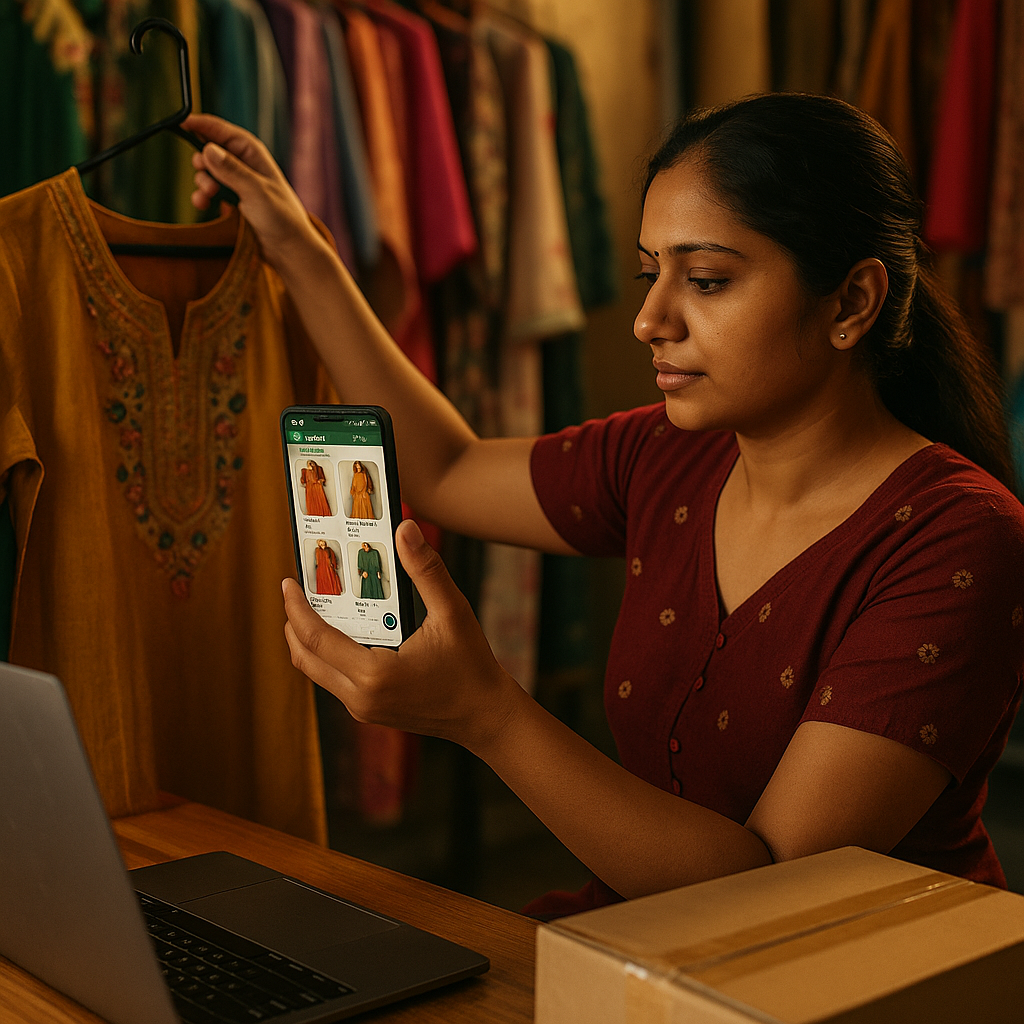
India has over 500 million WhatsApp users, and roughly 60 million businesses already use WhatsApp Business tools to talk to customers. Yet most D2C brands still send creator traffic to a website checkout that bleeds carts by the hour. A WhatsApp Business catalog fixes that gap, if you build the handoff correctly. This is the playbook.
Why Chat Checkout Beats the Link-in-Bio Detour
Think about the journey a customer actually takes. They watch a creator’s unboxing Reel, tap the link in bio, land on a website, wait for it to load on patchy 4G, hunt for the product, add to cart, get hit with a signup wall, then abandon. Every one of those steps is a leak. Baymard Institute’s long-running research puts average cart abandonment near 70% across e-commerce, and mobile-heavy markets like India skew worse.
WhatsApp collapses that funnel. A creator can drop a catalog link or a “Message to Order” button directly in a Reel caption or story sticker. The customer taps, lands inside a chat they already trust, browses a catalog that loads instantly (no app store detour, no password reset), and checks out in the same thread where they just watched the review. No context switch. No cognitive tax.
Every extra tap between a creator’s CTA and checkout costs you conversion. WhatsApp Business catalog removes the tap entirely by turning the DM into the storefront.
This isn’t a novelty play anymore. Meta has been quietly pushing WhatsApp Business API adoption in India hard, and brands like Mamaearth, boAt, and several D2C skincare and jewelry players have run catalog-first campaigns specifically to shortcut the funnel creators built. If your brand still routes every creator link to a generic homepage, you’re leaving money in the DM.
Setting Up the Catalog So Creators Can Actually Sell From It
A catalog is only as useful as its structure. Most brands set one up, upload 40 SKUs with stock photography, and call it done. That’s a missed opportunity. Creators don’t sell SKUs, they sell context: “this shade for oily skin,” “this size runs small,” “this is the one from the video.” Your catalog needs to mirror that.
- Segment by creator campaign, not just product category. Create collections named after the use-case a creator pushed (“Monsoon Hair Kit,” “Festive Glow Combo”) so the link a creator shares drops the customer into a pre-filtered set, not your full 200-SKU range.
- Use the exact product names creators mention on camera. If a creator says “the rose clay mask” and your catalog lists it as “SKU-4471 Clay Mask 100g,” you’ve created friction the customer has to solve manually.
- Keep descriptions scannable. WhatsApp catalog cards show limited text before truncation. Lead with the benefit, not the ingredient list.
- Price transparently, including any bundle discount tied to the creator’s promo code. Ambiguity here kills trust fast in a chat environment where the customer expects a human-level directness.
Meta’s own Meta for Business documentation on WhatsApp catalogs recommends updating collections seasonally, but for creator-driven brands, the cadence should match campaign cycles, not calendar quarters. If a creator’s video is live for six weeks, your catalog collection should exist for exactly that window, then archive.
Briefing Creators to Drive Chat, Not Just Views
Here’s the uncomfortable truth: most creator briefs never mention checkout mechanics. Brands hand over a product, a key message, maybe a discount code, and hope the CTA “link in bio” does the work. It doesn’t, especially when the destination is a slow-loading site instead of an instant chat.
Rewrite the brief. Tell creators explicitly to say “message us on WhatsApp” or “tap the catalog link” on screen and in captions. Test both a QR code overlay (works well in longer YouTube or in-person content) and a direct wa.me link (works better in Instagram and TikTok captions where taps are cheap). Some brands are also testing WhatsApp’s click-to-chat ads directly attributed to specific creator codes, which lets you separate organic creator lift from paid amplification in reporting.
This is the same operational discipline we’ve written about in the Instagram Commerce Manager setup playbook: the platform tooling only pays off if the creator brief and the backend are built to match. A catalog with no creator instruction is just a digital brochure nobody reads.
What This Looks Like in a Real Funnel
Picture a mid-size D2C skincare brand running a micro-influencer sprint across 20 creators in the Rs. 50,000-2 lakh follower range. Instead of sending traffic to a shared Shopify link, each creator gets:
- A unique wa.me link tied to a UTM-style parameter so the brand’s CRM can attribute the chat to that specific creator.
- A catalog collection curated to the 2-3 products featured in that creator’s content.
- A scripted opening message (auto-reply) that references the creator by name: “Hey! Saw you came from [Creator]’s video, here’s the combo she mentioned.”
- A human or chatbot-assisted flow that answers shade/size questions, then pushes a WhatsApp Pay or COD confirmation link.
That personalization step, referencing the creator inside the auto-reply, matters more than brands assume. It signals continuity. The customer doesn’t feel like they’ve left the creator’s recommendation behind; they feel like the brand is in on the same conversation.
The Compliance Layer Brands Skip (And Regret)
Chat commerce moves fast, which is exactly why it needs guardrails. India’s data protection rules and WhatsApp’s own commerce policy both require clear opt-in before you message a customer commercially, and the Advertising Standards Council of India expects the same disclosure standards for chat-driven creator promotions as for any other paid partnership. If a creator is pushing a discount code that routes to your WhatsApp catalog, that’s still a sponsored placement and should be labeled as one, regardless of the channel.
Chat checkout doesn’t exempt you from disclosure rules. If anything, regulators are paying closer attention to conversational commerce precisely because it’s harder to audit than a public feed post.
A few operational musts:
- Never auto-add customers to broadcast lists just because they messaged the catalog once. That’s an opt-in violation waiting to happen.
- Keep a record of which creator link generated which conversation, both for attribution and for compliance audits if a regulator or the FTC-equivalent body in India asks how a sale originated.
- Train customer support staff (or your chatbot vendor) on return/refund scripts specific to creator-promoted products, since these tend to generate higher return rates if sizing or shade expectations weren’t set clearly in the original content.
None of this is glamorous. But brands that skip it end up explaining to a compliance team, or worse a regulator, why a “limited time creator deal” was actually running for four months with no disclosure trail.
Measuring What Actually Moves: Beyond Vanity Chat Volume
A common mistake: brands celebrate “10,000 WhatsApp conversations started” without checking how many converted. Chat volume is not revenue. The metrics that matter for a WhatsApp Business catalog program are narrower and harder to fake:
- Conversation-to-order conversion rate, tracked per creator, not in aggregate.
- Average response time from first message to first human/bot reply. Meta’s own data suggests response speed under five minutes significantly improves conversion, and creator-driven traffic arrives with high intent that decays fast if left waiting.
- Repeat purchase rate through the same chat thread, since WhatsApp’s persistent thread model is arguably its biggest retention advantage over a one-off website checkout.
- Cost per acquired customer by creator tier, comparing macro-influencer catalog referrals against micro and nano cohorts. Anecdotally, several D2C brands running this model in India report nano and micro creators driving cheaper, higher-intent chat conversations than macro names, likely because their audiences already treat them as a trusted recommendation source rather than an ad.
Tools like Sprout Social and various WhatsApp Business Solution Provider dashboards (Gupshup, Haptik, Wati) now offer creator-tagged conversation analytics, which finally makes this kind of attribution possible without manual spreadsheet stitching. If your current MarTech stack can’t tag a WhatsApp conversation back to a specific creator link, that’s the first gap to close before scaling spend.
It’s also worth benchmarking against how other chat and livestream-driven commerce formats are evolving elsewhere. The same funnel-compression logic shows up in TikTok Shop’s regional livestream approach for Tier-2/3 India, and in how Whatnot structures live bidding for CPG brands abroad. The common thread: shrink the distance between “I trust this recommendation” and “I paid for it.”
Where the Format Breaks Down
Chat checkout isn’t free of friction. It struggles for brands with complex configurators (think mattress sizing or customized jewelry) where a webpage’s visual tools still outperform a text thread. It also strains internal ops if you don’t have dedicated headcount or a bot flow built to handle volume; nothing kills a creator campaign faster than a customer messaging at 9pm and getting a reply three days later. And it can obscure attribution if you’re not disciplined about unique links per creator, since generic catalog shares blur into a single undifferentiated bucket in your CRM.
Brands weighing this against broader creator distribution strategy should also look at how CreatorFronts-style upfront buys are consolidating creator inventory purchasing, since chat commerce works best when it’s one coordinated layer in a bigger media plan, not a bolted-on experiment run by a single junior marketer.
The Next Step
Don’t launch a WhatsApp catalog as a side project. Pick your next three creator campaigns, build campaign-specific catalog collections, assign unique wa.me links per creator, and track conversation-to-order conversion for 60 days before deciding whether to scale the channel further.
FAQs
What is a WhatsApp Business catalog and how does it differ from a website store?
A WhatsApp Business catalog is a product listing built inside the WhatsApp Business app or API that customers browse and purchase from directly within a chat thread, without leaving the conversation. Unlike a website store, it requires no page load, login, or app switch, which reduces drop-off for mobile-first, high-intent traffic like creator referrals.
Do Indian D2C brands need the WhatsApp Business API or is the free app enough?
The free WhatsApp Business app works for small catalogs and low message volume, but brands running multiple creator campaigns typically need the WhatsApp Business API through a Solution Provider like Gupshup, Haptik, or Wati for automated replies, per-creator link tracking, and higher message throughput.
How should brands attribute sales back to specific creators using WhatsApp catalog links?
Assign each creator a unique wa.me link or QR code with a distinct parameter, then tag incoming conversations in your CRM or Solution Provider dashboard by that parameter. Without unique links per creator, all catalog traffic blends into one bucket and campaign-level ROI becomes impossible to isolate.
Is a creator promotion that routes to WhatsApp catalog still subject to disclosure rules?
Yes. Sponsored content rules apply regardless of where the checkout happens. If a creator is paid or gifted product to promote a catalog link, that relationship needs the same disclosure treatment required for any other sponsored post under Advertising Standards Council of India guidelines.
What response time should brands target for WhatsApp catalog conversations from creator traffic?
Aim for under five minutes during active campaign windows. Creator-driven traffic arrives with high purchase intent that decays quickly; slow replies waste the exact momentum the creator content generated.
Top Influencer Marketing Agencies
The leading agencies shaping influencer marketing in 2026
Agencies ranked by campaign performance, client diversity, platform expertise, proven ROI, industry recognition, and client satisfaction. Assessed through verified case studies, reviews, and industry consultations.
Moburst

-
2

The Shelf
Boutique Beauty & Lifestyle Influencer AgencyA data-driven boutique agency specializing exclusively in beauty, wellness, and lifestyle influencer campaigns on Instagram and TikTok. Best for brands already focused on the beauty/personal care space that need curated, aesthetic-driven content.Clients: Pepsi, The Honest Company, Hims, Elf Cosmetics, Pure LeafVisit The Shelf → -
3

Audiencly
Niche Gaming & Esports Influencer AgencyA specialized agency focused exclusively on gaming and esports creators on YouTube, Twitch, and TikTok. Ideal if your campaign is 100% gaming-focused — from game launches to hardware and esports events.Clients: Epic Games, NordVPN, Ubisoft, Wargaming, Tencent GamesVisit Audiencly → -
4

Viral Nation
Global Influencer Marketing & Talent AgencyA dual talent management and marketing agency with proprietary brand safety tools and a global creator network spanning nano-influencers to celebrities across all major platforms.Clients: Meta, Activision Blizzard, Energizer, Aston Martin, WalmartVisit Viral Nation → -
5

The Influencer Marketing Factory
TikTok, Instagram & YouTube CampaignsA full-service agency with strong TikTok expertise, offering end-to-end campaign management from influencer discovery through performance reporting with a focus on platform-native content.Clients: Google, Snapchat, Universal Music, Bumble, YelpVisit TIMF → -
6

NeoReach
Enterprise Analytics & Influencer CampaignsAn enterprise-focused agency combining managed campaigns with a powerful self-service data platform for influencer search, audience analytics, and attribution modeling.Clients: Amazon, Airbnb, Netflix, Honda, The New York TimesVisit NeoReach → -
7

Ubiquitous
Creator-First Marketing PlatformA tech-driven platform combining self-service tools with managed campaign options, emphasizing speed and scalability for brands managing multiple influencer relationships.Clients: Lyft, Disney, Target, American Eagle, NetflixVisit Ubiquitous → -
8

Obviously
Scalable Enterprise Influencer CampaignsA tech-enabled agency built for high-volume campaigns, coordinating hundreds of creators simultaneously with end-to-end logistics, content rights management, and product seeding.Clients: Google, Ulta Beauty, Converse, AmazonVisit Obviously →