


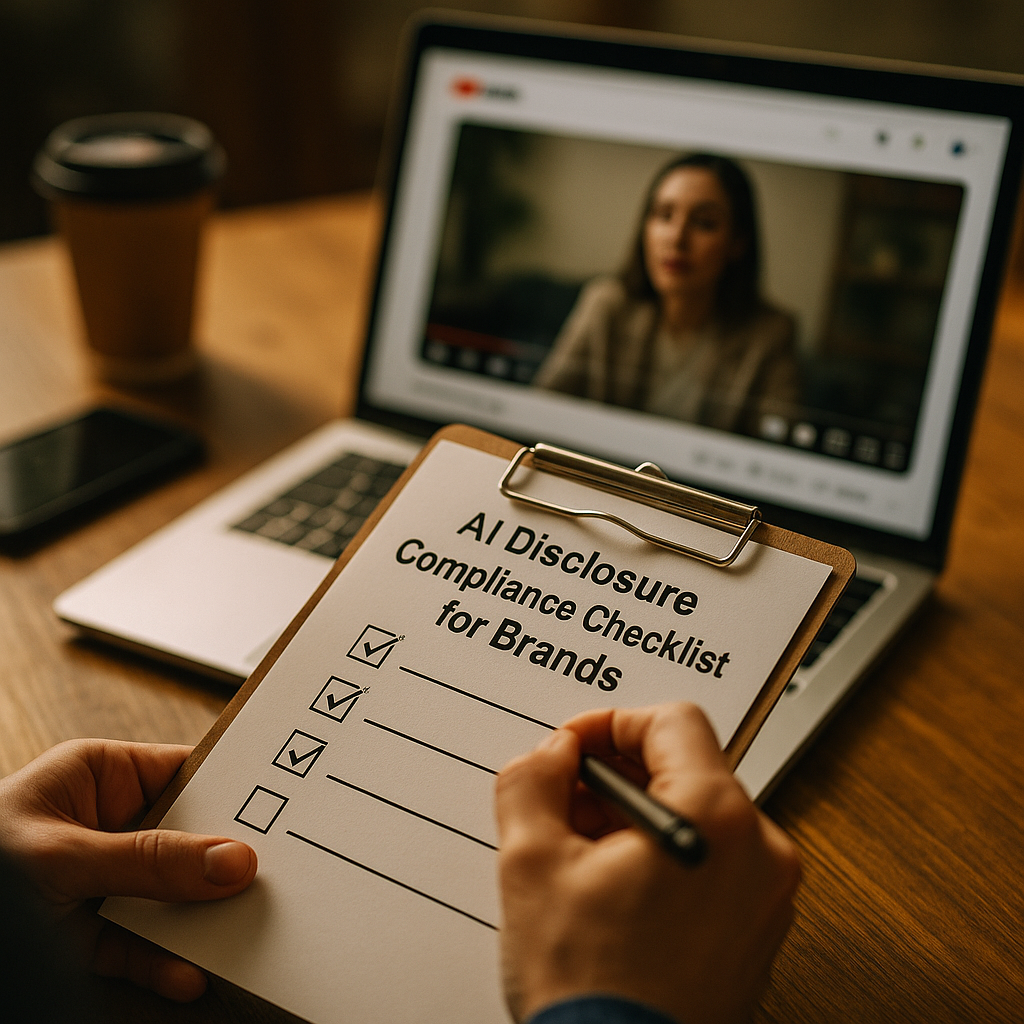
Nearly 60% of brand creative teams have no documented process for platform-level AI disclosure compliance. With YouTube’s automatic labeling system now active for photorealistic AI-generated content, that gap is no longer a procedural oversight — it’s a liability.
What YouTube’s Automatic Labeling System Actually Does
YouTube’s AI disclosure framework requires creators and brands to self-disclose when content contains “significant” photorealistic AI generation — meaning AI-generated faces, realistic environments, voices, or scenarios that a viewer could plausibly mistake for real footage. When you check the disclosure box in YouTube Studio, a label appears in the video description or, for sensitive topics, directly on the player itself.
The automatic labeling component adds a layer brands often miss: YouTube’s own detection systems can apply an AI label to your content even if you don’t self-disclose. That matters enormously for sponsored content. If YouTube’s algorithm flags and labels a video that you failed to disclose, the platform may apply additional enforcement actions, and the reputational optics of a retroactively labeled brand video are difficult to manage.
YouTube’s detection system can override brand silence. If the algorithm finds photorealistic AI generation that you didn’t disclose, it labels the content anyway — and the enforcement history stays attached to the creator’s channel, not just the video.
What counts as “significant”? YouTube’s guidance points to realistic human faces that don’t belong to real people, AI-generated environments presented as genuine locations, and synthesized audio that mimics a real person’s voice. Cosmetic filters, color grading, and background removal do not trigger the requirement. The line sits at deception potential, not production sophistication.
Why This Is a Brand Problem, Not Just a Creator Problem
Most compliance conversations about AI disclosure place the burden on the individual creator. That framing is operationally convenient for agencies but strategically wrong for brands. When sponsored content carries your product, your logo, or your brand voice, enforcement consequences attach to your campaign — even if the creator’s channel absorbs the platform penalty.
FTC rules on influencer disclosure compliance already establish that brands share responsibility for misleading content in sponsored posts. YouTube’s AI labeling system creates a second, parallel disclosure obligation that runs through the platform’s terms of service rather than federal advertising law. Both can be violated simultaneously. That’s a double exposure most legal and compliance teams haven’t mapped yet.
The contract implications are real. If your influencer agreement doesn’t specify who is responsible for checking the AI disclosure flag before publishing, you have a gap. Review your creator contract clauses to ensure that AI content disclosure obligations are explicitly assigned to the creator with a brand approval step built in before the video goes live.
The Pre-Publication Checklist: 9 Verification Points
Work through these nine checks before any sponsored YouTube video containing photorealistic AI generation is published. Assign each item to a named team member or role in your workflow, not just “the team.”
- Asset inventory audit: List every AI-generated asset in the video. Faces, environments, voice-overs, and background music generated by AI tools like Runway, Sora, ElevenLabs, or similar all count as candidates for disclosure evaluation.
- Deception-potential test: For each asset, apply YouTube’s standard: could a reasonable viewer mistake this for real footage, a real person, or a real location? If yes, the video requires disclosure.
- YouTube Studio disclosure flag confirmation: Verify that the creator has checked the “Contains realistic-looking AI content” option in YouTube Studio before scheduling publication. Get a screenshot. Keep it on file.
- Label placement review: For general-audience sponsored content, the label appears in the description. For content touching health, finance, elections, or social issues, YouTube places the label directly on the video player. Confirm which placement applies and whether it’s visible in your pre-publish preview.
- FTC disclosure cross-check: YouTube’s AI label does not satisfy the FTC’s material connection disclosure requirement. Confirm that a separate, clear paid partnership disclosure exists in the video and description. These are two distinct obligations. Review current FTC disclosure integration standards if your team needs a refresher.
- Synthetic voice or likeness clearance: If the video uses a synthetic voice that resembles any real person, or a generated likeness based on a real individual’s appearance, verify legal clearance. California’s deepfake advertising law creates additional state-level exposure here. Consult your team’s guidance on California deepfake ad compliance before sign-off.
- Human oversight sign-off: AI-generated creative should not reach publication without a human reviewer specifically tasked with compliance verification, not just creative approval. This is distinct from a creative director reviewing aesthetics. See your organization’s AI ad creative oversight policy for the correct escalation path.
- Archive and documentation: Save the published video URL, the YouTube Studio disclosure screenshot, the asset inventory, and the approver’s name and sign-off date. If YouTube’s system later applies an automatic label or flags the content, you need a complete paper trail.
- Post-publish monitoring: Check the published video within 24 hours of going live. Confirm the label appears as expected. If YouTube’s system has applied an additional or different label, flag it to legal immediately.
Where Production Teams Are Getting This Wrong
The most common failure isn’t malicious. It’s a workflow handoff problem. The creative team that builds the AI assets hands off to the production team, which hands off to the creator or agency, which hands off to whoever manages the channel. At each step, the assumption is that someone else handled the disclosure check. Nobody did.
A second failure pattern: treating AI disclosure as a one-time creative decision rather than a publication gate. The team decides early in production that “this video has AI in it, we’ll disclose,” and then the actual checkbox in YouTube Studio never gets verified at the publication stage. Intention is not documentation.
Brands using AI remix tools or automated content generation at scale face compounding risk. The FTC disclosure risk from AI remix tools is documented and growing, and YouTube’s automatic detection is calibrated to catch exactly the kind of photorealistic output these tools produce.
The checkbox in YouTube Studio is not a formality. It is a legal artifact. Treat it the way you treat a signed insertion order.
Sensitive Categories Require Elevated Review
YouTube applies stricter labeling placement for content touching health, finance, elections, legal matters, and social issues. For brands operating in pharma, financial services, insurance, or any category with heightened regulatory scrutiny, a photorealistic AI-generated spokesperson in a sponsored video is a high-risk creative choice regardless of how well-executed the disclosure is.
Regulatory bodies don’t grade on the curve of good intentions. The FTC’s guidance on endorsements, combined with YouTube’s platform-level labeling requirements and potential state-level deepfake laws, creates a layered compliance environment that a single disclosure checkbox does not fully address. In sensitive categories, loop in legal before the AI creative brief is even written, not after the video is in post-production.
The Google support documentation on YouTube’s disclosure requirements is the authoritative source for current policy language. Reference it directly when briefing agencies or production partners, rather than relying on summaries.
Updating Your Agency and Creator Briefs
Every creative brief for YouTube sponsored content should now include a dedicated AI disclosure section. Specify: which AI tools are approved for use, what level of photorealism triggers the disclosure requirement, who is responsible for the YouTube Studio flag, and what documentation must be sent to the brand before publication.
Agencies managing multi-creator campaigns at scale need a systematic solution. A pre-flight compliance checklist built into your campaign management workflow is the operational fix. Manual review at scale doesn’t hold. Build the YouTube AI disclosure check into whatever tool your team uses for pre-publication approval, whether that’s a project management system, a DAM, or a dedicated influencer marketing platform.
External compliance resources like IAB guidelines on AI-generated content and FTC endorsement guidance should be referenced in your standard operating procedures, not just bookmarked by one person on the legal team.
The immediate next step: Pull your last three YouTube sponsored campaigns that used any AI-generated visual or audio elements. Check whether the YouTube Studio disclosure flag was applied and documented. If you can’t verify it within ten minutes, your compliance workflow has a hole that needs closing before the next campaign launches.
Frequently Asked Questions
Does YouTube’s AI label satisfy FTC disclosure requirements for sponsored content?
No. YouTube’s AI content label addresses the platform’s policy on synthetic media, while FTC disclosure rules address the material connection between a brand and a creator. A sponsored video requires both: the YouTube AI label (when applicable) and a clear, conspicuous paid partnership disclosure. Satisfying one does not satisfy the other.
What types of AI-generated content require the YouTube disclosure?
YouTube requires disclosure for “significant” photorealistic AI generation that could mislead viewers. This includes AI-generated human faces that don’t belong to real people, realistic environments or events that didn’t happen, and synthetic voices that mimic real individuals. It does not apply to filters, color grading, background removal, or standard production enhancements.
Who is responsible for checking the YouTube Studio disclosure flag on sponsored content?
The channel owner (typically the creator) must check the flag in YouTube Studio, but the brand carries shared compliance responsibility for the content it sponsors. Brand teams should require documented confirmation that the flag has been applied before approving publication, with screenshot documentation kept on file.
Can YouTube automatically add an AI label to content a brand didn’t disclose?
Yes. YouTube’s detection systems can apply an AI label even if the creator or brand did not self-disclose. When this happens, the platform may take additional enforcement action. This makes proactive self-disclosure the lower-risk path, both operationally and reputationally.
Does the AI disclosure requirement apply to AI-generated voiceovers and music?
AI-generated music used as background audio generally does not trigger the requirement. However, synthetic voices that realistically mimic a specific real person’s voice, or AI voiceovers presented as a real person speaking, do fall under the photorealistic AI generation policy and require disclosure.
How should brands handle YouTube AI disclosure for content in sensitive categories like finance or health?
For content touching health, finance, elections, or social issues, YouTube applies the AI label directly on the video player rather than only in the description. This increases viewer visibility significantly. Brands in these categories should conduct legal review of any AI-generated creative before production begins, not just before publication.
Top Influencer Marketing Agencies
The leading agencies shaping influencer marketing in 2026
Agencies ranked by campaign performance, client diversity, platform expertise, proven ROI, industry recognition, and client satisfaction. Assessed through verified case studies, reviews, and industry consultations.
Moburst

-
2

The Shelf
Boutique Beauty & Lifestyle Influencer AgencyA data-driven boutique agency specializing exclusively in beauty, wellness, and lifestyle influencer campaigns on Instagram and TikTok. Best for brands already focused on the beauty/personal care space that need curated, aesthetic-driven content.Clients: Pepsi, The Honest Company, Hims, Elf Cosmetics, Pure LeafVisit The Shelf → -
3

Audiencly
Niche Gaming & Esports Influencer AgencyA specialized agency focused exclusively on gaming and esports creators on YouTube, Twitch, and TikTok. Ideal if your campaign is 100% gaming-focused — from game launches to hardware and esports events.Clients: Epic Games, NordVPN, Ubisoft, Wargaming, Tencent GamesVisit Audiencly → -
4

Viral Nation
Global Influencer Marketing & Talent AgencyA dual talent management and marketing agency with proprietary brand safety tools and a global creator network spanning nano-influencers to celebrities across all major platforms.Clients: Meta, Activision Blizzard, Energizer, Aston Martin, WalmartVisit Viral Nation → -
5

The Influencer Marketing Factory
TikTok, Instagram & YouTube CampaignsA full-service agency with strong TikTok expertise, offering end-to-end campaign management from influencer discovery through performance reporting with a focus on platform-native content.Clients: Google, Snapchat, Universal Music, Bumble, YelpVisit TIMF → -
6

NeoReach
Enterprise Analytics & Influencer CampaignsAn enterprise-focused agency combining managed campaigns with a powerful self-service data platform for influencer search, audience analytics, and attribution modeling.Clients: Amazon, Airbnb, Netflix, Honda, The New York TimesVisit NeoReach → -
7

Ubiquitous
Creator-First Marketing PlatformA tech-driven platform combining self-service tools with managed campaign options, emphasizing speed and scalability for brands managing multiple influencer relationships.Clients: Lyft, Disney, Target, American Eagle, NetflixVisit Ubiquitous → -
8

Obviously
Scalable Enterprise Influencer CampaignsA tech-enabled agency built for high-volume campaigns, coordinating hundreds of creators simultaneously with end-to-end logistics, content rights management, and product seeding.Clients: Google, Ulta Beauty, Converse, AmazonVisit Obviously →