


Nearly 80% of brand marketers say they have no documented process for verifying AI disclosure compliance on creator-produced content. With YouTube’s automatic AI content label standards now in full effect, that gap is a liability, not just an oversight. Here is exactly how to close it.
What YouTube’s AI Disclosure Standards Actually Require
YouTube’s framework mandates that creators disclose when content uses AI to generate or significantly alter realistic-looking footage, audio, or imagery. This isn’t limited to deepfakes or synthetic avatars. It covers AI-generated voiceovers that sound like real people, digitally recreated environments, and AI-altered faces or bodies. For sponsored content, the stakes are higher because the brand is implicated in any non-compliance, not just the creator.
The disclosure appears as a label in the video description and, for sensitive topics (health, finance, elections), as an on-screen label during playback. YouTube’s system can apply labels automatically when its detection tools flag content, but creators and brands should not rely on that as a safety net. Automatic detection is imperfect. A label applied after publication, without prior disclosure, still signals non-compliance to regulators.
YouTube’s automatic labeling is a backstop, not a compliance strategy. If the platform labels your sponsored content without prior disclosure, you have already failed the standard from a brand governance perspective.
Brand teams also need to understand the interaction between YouTube’s policy and broader disclosure obligations. The FTC’s endorsement guidance treats AI-generated content as a material fact that may require its own disclosure layer, separate from the paid partnership tag. Your FTC and EU DSA compliance framework should already account for this, but many brand teams are running those tracks independently rather than integrating them.
Building the Pre-Production Gate
Compliance starts before the creator opens a single AI tool. The most common failure point isn’t malicious intent; it’s a creator who used Runway, ElevenLabs, or Adobe Firefly to polish a scene and didn’t realize that qualified as reportable AI use under YouTube’s standards.
Your pre-production gate needs three things:
- A mandatory AI tool declaration form. Before the creator begins production, they complete a short form listing every AI tool they plan to use and the specific function (voiceover generation, background replacement, face alteration, script drafting). Script drafting alone does not trigger YouTube’s disclosure requirement, but it’s worth capturing for your own records.
- A contract clause that binds the creator. The brief isn’t enough. The contract must explicitly state that the creator is responsible for accurate disclosure in the YouTube Studio settings, with a warranty that all AI-generated or AI-altered elements will be declared prior to upload. See our guidance on contract clauses for brand leverage for language you can adapt.
- A clear definition of “realistic-seeming” content. Brief creators explicitly: if a viewer could reasonably believe the AI-generated element is real, it requires disclosure. Give examples. A cartoon-style AI illustration does not. A photorealistic AI-generated product shot does.
The Review Workflow: Four Checkpoints Before Upload
Once production is underway, brand teams need a structured review cadence. Ad hoc approvals miss things. Here are the four checkpoints that matter:
Checkpoint 1: Draft review with AI asset log. When the creator submits the content draft, they submit an accompanying AI asset log. This is a simple spreadsheet: tool used, element affected, timestamp in the video. Your team reviews the draft against the log to confirm everything flagged as AI-generated is genuinely present and visible.
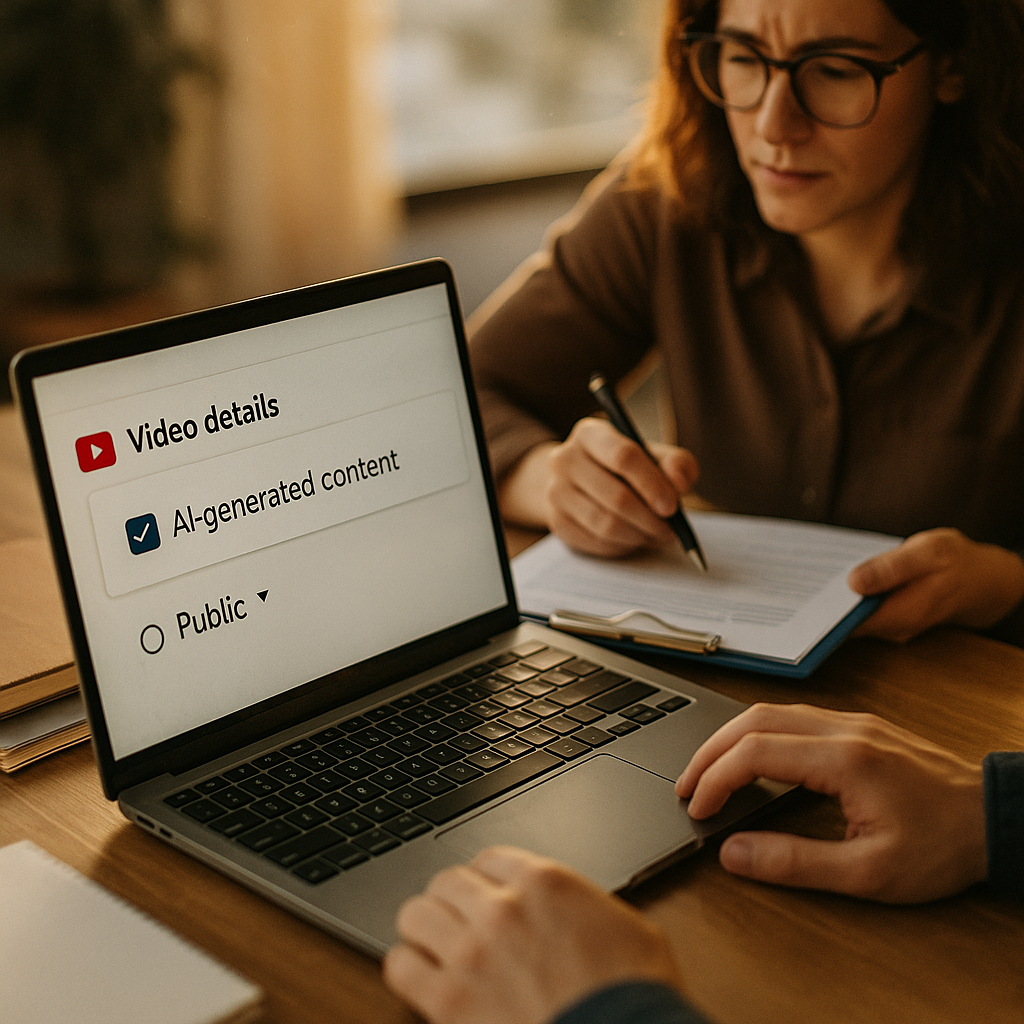
Checkpoint 2: YouTube Studio disclosure verification. Before final approval, require a screenshot from the creator’s YouTube Studio showing the “Contains AI-generated content” toggle is activated and the appropriate description-level disclosure is drafted. This is non-negotiable. Do not approve upload without it.
Checkpoint 3: Sensitive category check. If your brand operates in health, wellness, financial services, or any politically adjacent category, the video likely triggers YouTube’s requirement for an on-screen label during playback, not just a description label. Your legal or compliance team should confirm the category classification before upload.
Checkpoint 4: Post-upload audit within 48 hours. After the video goes live, someone on your team checks the published video to confirm the disclosure label appears as expected. YouTube’s system occasionally overrides creator settings or applies a different label than anticipated. Catch it early.
For teams managing multiple creators simultaneously, this workflow integrates cleanly into existing pre-flight compliance checklists. Add the AI disclosure checkpoints as a dedicated module rather than scattering them across existing review steps.
AI Tools That Most Frequently Trigger the Requirement
Not every AI tool creates a disclosure obligation. Brand teams benefit from maintaining a living reference list. Based on current platform guidance and industry usage patterns, these categories consistently trigger YouTube’s standard:
- AI voice cloning or synthesis (ElevenLabs, Resemble AI, Adobe Podcast Enhance when used for voice replacement)
- Video generation or scene synthesis (Runway Gen-3, Sora, Pika Labs)
- Face or body alteration (FaceSwap tools, AI beauty filters that alter facial structure, not just lighting)
- Photorealistic image generation used as video backgrounds or product visuals (Midjourney, DALL-E 3, Stable Diffusion)
- AI lip-sync tools that alter the creator’s mouth movements to match translated audio
Tools that generally do not trigger the requirement: AI-assisted color grading, noise reduction, automated captions, script suggestion tools, and AI-powered editing assistants that don’t alter realistic visual or audio elements.
If your brand is also managing AI-generated creative at the campaign level, the human oversight policy for AI ad creative covers the governance layer that sits above individual creator decisions.
The creator using an AI lip-sync tool to serve a Spanish-language version of your campaign to a Latin American audience is not being deceptive. But without disclosure, it looks that way. Build the system before the use case surprises you.
Contractual Protections and Liability Allocation
When YouTube flags or removes a sponsored video for AI disclosure non-compliance, who bears the cost? Without explicit contract language, this is contested territory. Brand teams should address three specific scenarios in creator agreements:
First, if a creator fails to disclose AI use and YouTube applies a retroactive label or removes the content, the creator should bear the cost of reshoot or re-edit. This requires a specific warranty clause, not just a general compliance clause. Second, if YouTube’s automatic detection applies a label the creator disputes (because they didn’t use generative AI in the way the platform interprets), the contract should outline a dispute resolution process with a defined response timeline. Third, if the brand requested an AI element (such as asking the creator to use an AI voiceover for a translated version), the brand shares disclosure responsibility. Clarity on who initiates the YouTube Studio disclosure toggle in that scenario is essential.
The intersection of AI content rights and creator agreements is covered in detail in our analysis of creator content rights for AI, and the FTC angle on AI-remixed content is addressed in the guide on AI remix tools and FTC disclosure risk.
Operationalizing This at Scale
A workflow that works for three creators breaks at thirty. Operational efficiency requires systematizing the documentation layer. Consider deploying a creator compliance portal or a standardized intake process within your existing influencer management platform (Grin, Aspire, CreatorIQ all support custom brief and approval workflows). The AI asset log and YouTube Studio screenshot requirement should be built into your content approval stages, not managed via email chains.
Platform-level guidance from Google’s support documentation and YouTube’s creator policies are updated periodically. Assign a single team member to own platform policy monitoring and schedule a quarterly review of your workflow against any changes. The FTC’s endorsement resources and the ICO’s AI guidance are the two regulatory sources most likely to affect US and UK brand programs respectively.
Your next concrete step: pull your last three sponsored YouTube campaigns and check whether AI tool use was documented in the brief and contract, and whether the published videos carry disclosure labels where they should. That gap analysis will tell you exactly where this workflow needs to be inserted.
FAQs
Does YouTube’s AI disclosure requirement apply to all sponsored content or only certain categories?
The disclosure requirement applies to any content that uses AI to generate or significantly alter realistic-looking video, audio, or images, regardless of whether the content is sponsored. However, sponsored content in sensitive categories (health, finance, elections, legal matters) also requires an on-screen playback label in addition to the standard description-level disclosure. Brand teams should assess both the AI use and the content category independently.
Can brands be held responsible if a creator fails to disclose AI use on YouTube?
Yes. While YouTube’s primary enforcement action targets the creator’s channel, brands can face reputational and regulatory exposure, particularly if the FTC or equivalent regulator determines that the AI-generated element constitutes a material omission in a paid endorsement. Contractual warranties and indemnification clauses are the primary protection mechanism for brand teams.
What is the difference between YouTube’s automatic AI label and the creator-selected disclosure toggle?
The creator-selected toggle in YouTube Studio is a voluntary disclosure that the creator controls before upload. YouTube’s automatic label is applied by the platform’s detection system, which may activate after publication if the system identifies AI-generated content. Relying on automatic detection is not a compliant strategy; creators and brands should always complete voluntary disclosure before a video goes live.
Does using AI for video captions or script writing trigger YouTube’s disclosure requirement?
No. AI tools used for captions, transcription, script drafting, SEO title suggestions, or editing assistance that does not alter realistic visual or audio elements do not trigger YouTube’s disclosure requirement. The standard is specifically focused on AI that generates or significantly alters realistic-looking footage, voices that sound like real people, or imagery that could be mistaken for real events.
How should brand teams handle AI-translated voiceovers for international campaign versions?
If an AI tool is used to generate or clone the creator’s voice in a translated language, this triggers YouTube’s disclosure requirement because it involves synthetic audio that mimics a real person. The brand team should confirm the YouTube Studio disclosure toggle is activated for each regional version of the video and ensure the creator’s contract explicitly covers disclosure obligations for all published versions, not just the original language upload.
Top Influencer Marketing Agencies
The leading agencies shaping influencer marketing in 2026
Agencies ranked by campaign performance, client diversity, platform expertise, proven ROI, industry recognition, and client satisfaction. Assessed through verified case studies, reviews, and industry consultations.
Moburst

-
2

The Shelf
Boutique Beauty & Lifestyle Influencer AgencyA data-driven boutique agency specializing exclusively in beauty, wellness, and lifestyle influencer campaigns on Instagram and TikTok. Best for brands already focused on the beauty/personal care space that need curated, aesthetic-driven content.Clients: Pepsi, The Honest Company, Hims, Elf Cosmetics, Pure LeafVisit The Shelf → -
3

Audiencly
Niche Gaming & Esports Influencer AgencyA specialized agency focused exclusively on gaming and esports creators on YouTube, Twitch, and TikTok. Ideal if your campaign is 100% gaming-focused — from game launches to hardware and esports events.Clients: Epic Games, NordVPN, Ubisoft, Wargaming, Tencent GamesVisit Audiencly → -
4

Viral Nation
Global Influencer Marketing & Talent AgencyA dual talent management and marketing agency with proprietary brand safety tools and a global creator network spanning nano-influencers to celebrities across all major platforms.Clients: Meta, Activision Blizzard, Energizer, Aston Martin, WalmartVisit Viral Nation → -
5

The Influencer Marketing Factory
TikTok, Instagram & YouTube CampaignsA full-service agency with strong TikTok expertise, offering end-to-end campaign management from influencer discovery through performance reporting with a focus on platform-native content.Clients: Google, Snapchat, Universal Music, Bumble, YelpVisit TIMF → -
6

NeoReach
Enterprise Analytics & Influencer CampaignsAn enterprise-focused agency combining managed campaigns with a powerful self-service data platform for influencer search, audience analytics, and attribution modeling.Clients: Amazon, Airbnb, Netflix, Honda, The New York TimesVisit NeoReach → -
7

Ubiquitous
Creator-First Marketing PlatformA tech-driven platform combining self-service tools with managed campaign options, emphasizing speed and scalability for brands managing multiple influencer relationships.Clients: Lyft, Disney, Target, American Eagle, NetflixVisit Ubiquitous → -
8

Obviously
Scalable Enterprise Influencer CampaignsA tech-enabled agency built for high-volume campaigns, coordinating hundreds of creators simultaneously with end-to-end logistics, content rights management, and product seeding.Clients: Google, Ulta Beauty, Converse, AmazonVisit Obviously →