


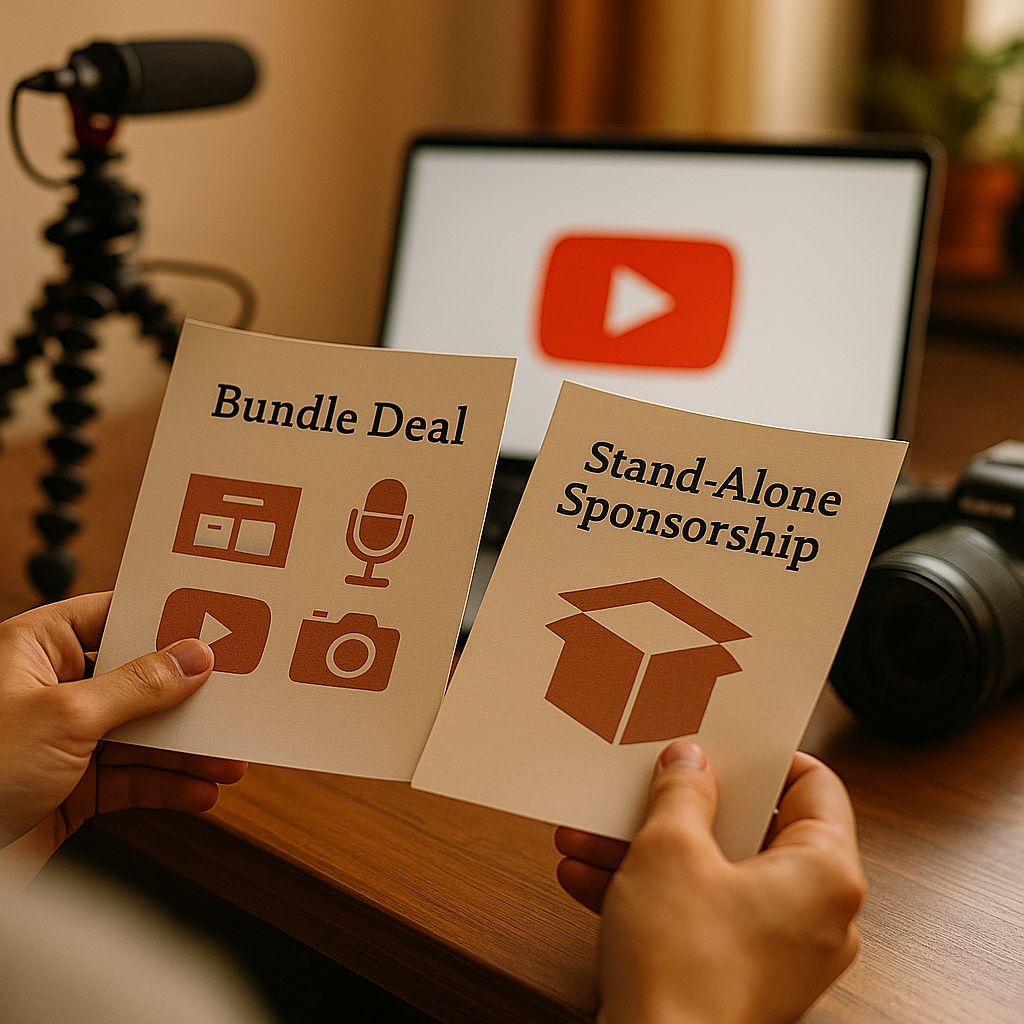
YouTube creator bundles now represent some of the largest line items in influencer upfronts — yet most brand buyers evaluate them with frameworks built for single-placement deals. That mismatch costs budgets.
What a Creator Bundle Actually Includes (And What’s Just Packaging)
The pitch sounds compelling: one creator, one contract, integrated placements across long-form video, Shorts, Community posts, and live segments, with AI-assisted scheduling to hit optimal publish windows and a brand safety guarantee baked into the deal terms. Platforms like YouTube’s creator monetization ecosystem have actively encouraged these bundled upfront structures, and talent agencies representing mid-to-large creators have leaned into them hard over the past two years.
But “bundle” is a marketing word. Before you evaluate economics, you need to disaggregate what you’re buying.
- Multi-format placements: Typically one dedicated integration per long-form video (60-second mid-roll style) plus Shorts repurposing, Community post mentions, and sometimes a live shoutout. Each has a different CPM benchmark and a different audience behavior profile.
- AI scheduling: This refers to publish-time optimization, usually powered by the creator’s own analytics tools (VidIQ, TubeBuddy, or proprietary agency platforms) or YouTube Studio’s built-in recommendations. It’s rarely proprietary to the bundle itself.
- Brand safety guarantees: The language here varies enormously. Some bundles offer money-back provisions if content violates agreed-upon content adjacency standards. Others simply promise pre-approval rights, which you could negotiate into any stand-alone deal.
Strip those three components down and you’re often looking at a volume discount wrapped in technology language. That’s not inherently bad. But you need to price each component separately before you assess whether the bundle math works.
The Stand-Alone Deal Baseline
Run this exercise before any bundle negotiation. Price out what each placement would cost individually at current market rates, then compare.
For a mid-tier YouTube creator with 500K to 2M subscribers, a dedicated integration in a long-form video typically runs $8,000 to $25,000 depending on niche, engagement rate, and category CPM premiums (finance and B2B skew higher). A Shorts placement from the same creator, if negotiated separately, might add $2,000 to $6,000. Community post mentions rarely command more than $1,000 to $2,500 as stand-alones. That’s a blended market rate of roughly $11,000 to $33,500 for equivalent coverage.
Bundle pricing for the same creator tier commonly comes in at $18,000 to $40,000 when AI scheduling and brand safety provisions are layered in. At the low end of that range, the bundle can represent a genuine discount on placement value. At the high end, you’re paying a meaningful premium for the convenience layer and contractual protections. Whether that premium is justified depends on your program maturity and internal bandwidth.
If your team is running more than 15 active creator relationships simultaneously, the operational consolidation of bundles often pays for itself in hours saved on contract management, content review cycles, and campaign reporting. Below that threshold, stand-alone deals usually win on pure economics.
Unpacking the AI Scheduling Claim
This is where brand buyers get sold a feature that’s mostly table stakes. AI scheduling in creator bundles typically means the creator’s team uses algorithmic publish-time recommendations to maximize early view velocity, which improves search indexing and subscriber notification performance. That directly affects your sponsorship’s reach within the first 48 hours after publish — which is when the majority of brand recall lift occurs for YouTube integrations.
The practical question for buyers: does the bundle contract specify that AI scheduling decisions require your approval, or does the creator retain control? For most brands, ceding that control is fine. But if your campaign has hard date requirements (a product launch window, a retail event, a seasonal peg), you need approval rights written into the agreement. Not all bundle contracts include this by default.
For deeper context on how AI-assisted tools are reshaping creator partnerships from a supplier discovery angle, the analysis on AI-driven supplier discovery is worth reviewing before your next negotiation briefing.
Brand Safety Guarantees: What’s Enforceable vs. What’s Aspirational
Brand safety in YouTube creator bundles usually comes in three tiers, and knowing which tier you’re buying matters more than the guarantee language itself.
Tier 1 (Pre-production review): You see a script or outline before filming. This is the most valuable protection and should be non-negotiable for regulated categories (pharma, financial services, CPG with claims restrictions). The FTC’s endorsement guidelines place disclosure obligations on brands as well as creators, so pre-production visibility is also your compliance backstop.
Tier 2 (Pre-publish approval): You see the final edit before it goes live. Standard for most professional creator relationships, but it compresses your review timeline to 24 to 48 hours in most bundle agreements. If your internal legal review takes longer, flag this in contract negotiation.
Tier 3 (Post-publish remediation): The creator agrees to remove or edit content if it violates agreed standards after publish. This is the weakest form of brand safety guarantee and should not command a pricing premium. Once a video is live, even 24 hours of problematic adjacency can create reputational exposure that no take-down reverses.
Agencies building diversified creator ecosystems tend to standardize on Tier 1 for hero content and Tier 2 for always-on programming, which is a reasonable baseline for bundle evaluation as well.
Multi-Format Placement: Where Bundle Economics Actually Break Down
Here’s the structural problem with most creator bundles: they bundle placements with fundamentally different audience behaviors and attribution windows into a single blended CPM. You end up subsidizing lower-value formats with budget that could have gone to your highest-performing placement type.
YouTube Shorts have dramatically different view completion rates, click behaviors, and audience age skews compared to long-form integrations. If your conversion data shows that long-form integrations drive 80% of your attributed revenue from YouTube creator partnerships, a bundle that forces 30% of your spend into Shorts and Community posts is structurally inefficient — regardless of what the blended CPM looks like on paper.
Before signing any bundle, pull your last 12 months of YouTube creator attribution data segmented by format. If you don’t have that breakdown, consider running a paid-first creator campaign structure to generate clean format-level performance data before committing to a multi-format upfront.
The good news: bundle contracts are more negotiable than agencies often present. You can frequently negotiate format weighting, requesting, for example, two long-form integrations and one Community post rather than the default package, without blowing up the deal. Get this in writing during the term sheet stage, not after the master agreement is signed.
The single most common bundle negotiation mistake brands make is accepting the default format mix. Agencies build bundles to move inventory creators have available, not to optimize your specific conversion funnel.
When Bundles Win: A Decision Framework
Bundle economics favor brands in specific operational and strategic contexts. Use this as a quick internal checklist:
- You’re running an always-on YouTube program with consistent quarterly investment, not a one-off campaign. Bundles reward continuity with better effective CPMs over time.
- Your team has limited bandwidth for individual contract negotiation, content review, and performance reporting across multiple creators. Operational consolidation has real dollar value when headcount is constrained.
- You’re building long-term creator equity rather than transactional reach. The contractual structure of bundles often includes options on future content, exclusivity provisions, or right-of-first-refusal clauses that benefit brands investing in long-term creator partnerships.
- Your brand safety requirements are high and you operate in a regulated category. A well-structured bundle with Tier 1 guarantees is often cheaper than retrofitting protections into stand-alone deals after problems arise.
- The creator’s audience is your primary channel, not one of many. If a specific creator’s subscriber base represents a disproportionate share of your addressable market, locking in multi-format presence at a volume discount makes strategic sense.
Stand-alone deals win when you need format-level precision, when your team has the bandwidth to manage complexity, or when you’re testing a creator relationship before committing to upfront spend. Platforms like eMarketer consistently report that brands with mature influencer programs split their YouTube budgets between bundled creator upfronts and spot buys, using the former for brand equity plays and the latter for performance-driven campaigns.
For brands evaluating how YouTube creator spend fits within a broader creator amplification budget, the format-weighting question is directly relevant to how you structure your overall allocation.
One more angle worth considering: bundle deals with established creators now increasingly include content licensing provisions that allow brands to repurpose creator content in paid media. If you’re running YouTube creator content into connected TV or display, as more sophisticated programs are doing per Sprout Social’s media intelligence data, the licensing value embedded in a bundle can meaningfully shift the effective CPM calculation in your favor. Factor this into your valuation model before comparing bundle versus stand-alone on placement cost alone.
Run your next bundle proposal through a simple three-column spreadsheet: (1) market rate for each placement type at stand-alone pricing, (2) value of operational features (scheduling, safety guarantees, approval workflow), and (3) licensing and repurposing value if applicable. If the bundle price exceeds the sum of columns one through three, negotiate or walk. If it comes in below, you have a defensible buy.
Frequently Asked Questions
What is a YouTube creator bundle deal?
A YouTube creator bundle is an upfront advertising package that combines multiple content placements (typically long-form video integrations, Shorts, and Community posts) from a single creator into one contract, often with added features like AI-assisted publish scheduling and brand safety guarantees. These bundles are usually sold through talent agencies or creator management platforms as alternatives to negotiating each placement type individually.
Are YouTube creator bundles more cost-effective than stand-alone sponsorships?
It depends on your program structure and operational context. Bundles can offer genuine cost advantages when your team lacks bandwidth for individual deal management, when you need consistent multi-format presence, or when you’re investing in a long-term creator relationship. Stand-alone deals typically offer better value when you need format-level precision or when your attribution data shows that only one or two formats actually drive conversion in your category.
What should brand safety guarantees in creator bundles actually include?
At minimum, brand safety provisions should include pre-publish content approval rights, clear content adjacency standards (what topics or formats are off-limits in the same video), and a defined remediation process if standards are violated after publish. For regulated categories, pre-production script review should be non-negotiable. Avoid bundles where “brand safety” means only post-publish take-down rights, as that offers minimal practical protection once content has been live.
How does AI scheduling in creator bundles affect campaign performance?
AI scheduling in creator bundles refers to algorithmic publish-time optimization designed to maximize early view velocity, subscriber notification rates, and search indexing. This directly affects how many of a creator’s subscribers see your integration within the first 48 hours after publish, which is when the majority of brand recall lift typically occurs. For campaigns with hard date requirements, confirm that scheduling decisions require your sign-off before committing to a bundle contract.
Can brands negotiate the format mix inside a creator bundle?
Yes, and they should. Default bundle format mixes are typically designed around what inventory the creator has available, not what drives conversion for your specific category. Brands can and should negotiate format weighting (for example, requesting additional long-form integrations in place of Shorts placements) during the term sheet stage. Most agencies will accommodate reasonable format adjustments to close a deal, especially for higher-value quarterly or annual commitments.
Should content licensing be factored into bundle pricing?
Absolutely. Many YouTube creator bundles now include provisions allowing brands to repurpose creator content in paid media, including social ads, display, and connected TV. If you plan to use creator content beyond organic YouTube reach, the licensing value embedded in a bundle can meaningfully lower your effective CPM compared to stand-alone deals where repurposing rights must be negotiated and priced separately. Always identify and value licensing terms before comparing bundle versus stand-alone economics.
Top Influencer Marketing Agencies
The leading agencies shaping influencer marketing in 2026
Agencies ranked by campaign performance, client diversity, platform expertise, proven ROI, industry recognition, and client satisfaction. Assessed through verified case studies, reviews, and industry consultations.
Moburst

-
2

The Shelf
Boutique Beauty & Lifestyle Influencer AgencyA data-driven boutique agency specializing exclusively in beauty, wellness, and lifestyle influencer campaigns on Instagram and TikTok. Best for brands already focused on the beauty/personal care space that need curated, aesthetic-driven content.Clients: Pepsi, The Honest Company, Hims, Elf Cosmetics, Pure LeafVisit The Shelf → -
3

Audiencly
Niche Gaming & Esports Influencer AgencyA specialized agency focused exclusively on gaming and esports creators on YouTube, Twitch, and TikTok. Ideal if your campaign is 100% gaming-focused — from game launches to hardware and esports events.Clients: Epic Games, NordVPN, Ubisoft, Wargaming, Tencent GamesVisit Audiencly → -
4

Viral Nation
Global Influencer Marketing & Talent AgencyA dual talent management and marketing agency with proprietary brand safety tools and a global creator network spanning nano-influencers to celebrities across all major platforms.Clients: Meta, Activision Blizzard, Energizer, Aston Martin, WalmartVisit Viral Nation → -
5

The Influencer Marketing Factory
TikTok, Instagram & YouTube CampaignsA full-service agency with strong TikTok expertise, offering end-to-end campaign management from influencer discovery through performance reporting with a focus on platform-native content.Clients: Google, Snapchat, Universal Music, Bumble, YelpVisit TIMF → -
6

NeoReach
Enterprise Analytics & Influencer CampaignsAn enterprise-focused agency combining managed campaigns with a powerful self-service data platform for influencer search, audience analytics, and attribution modeling.Clients: Amazon, Airbnb, Netflix, Honda, The New York TimesVisit NeoReach → -
7

Ubiquitous
Creator-First Marketing PlatformA tech-driven platform combining self-service tools with managed campaign options, emphasizing speed and scalability for brands managing multiple influencer relationships.Clients: Lyft, Disney, Target, American Eagle, NetflixVisit Ubiquitous → -
8

Obviously
Scalable Enterprise Influencer CampaignsA tech-enabled agency built for high-volume campaigns, coordinating hundreds of creators simultaneously with end-to-end logistics, content rights management, and product seeding.Clients: Google, Ulta Beauty, Converse, AmazonVisit Obviously →