


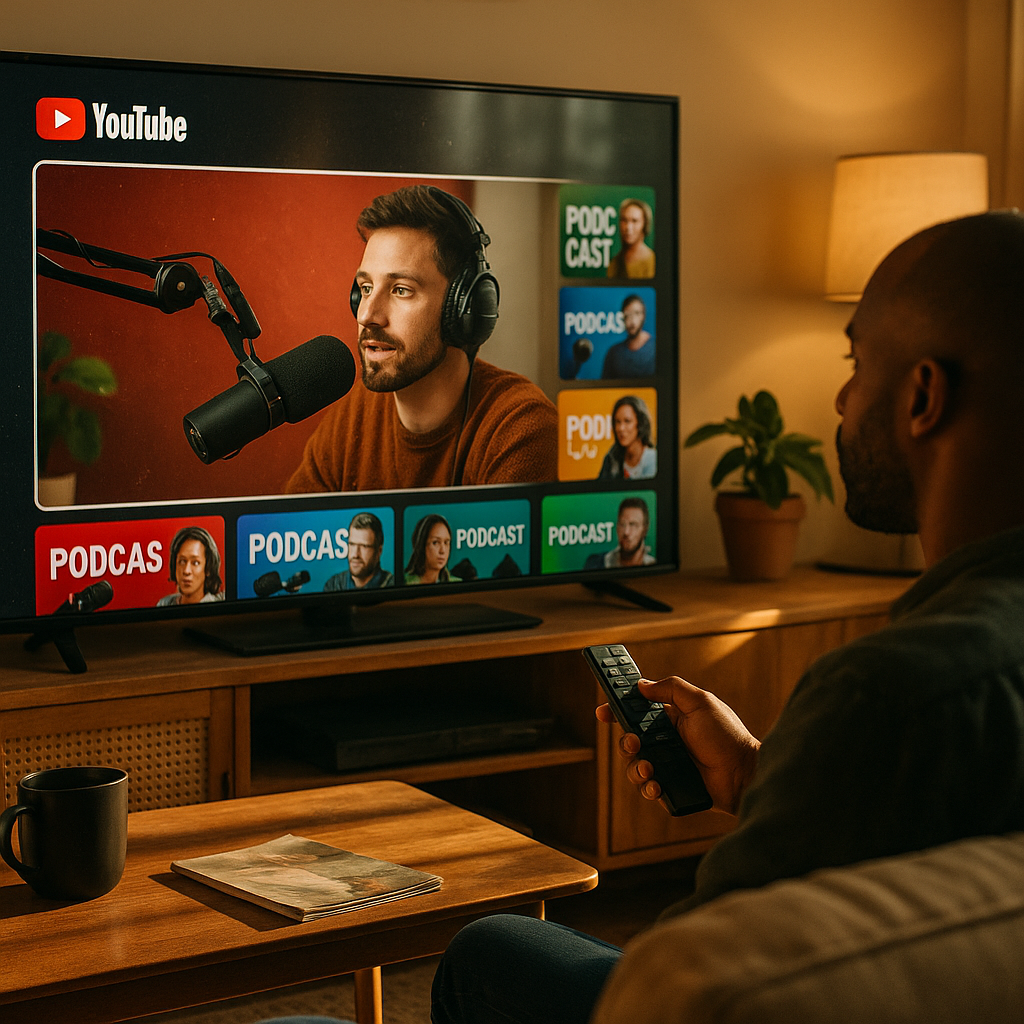
More than 1 billion people now watch podcasts on YouTube every month, and a growing share of that viewing happens on a television, not a phone. That single shift, audio content consumed like prestige TV, is quietly rewriting the rules for branded podcast placements. If your media plan still treats the YouTube Podcasts tab like a repurposed feed slot, you are leaving reach and credibility on the table.
What the Podcasts Tab Actually Is
The Podcasts tab sits alongside Home, Shorts, and Subscriptions in YouTube’s main navigation. It is not a separate app or a walled garden. It is a curated surface that pulls video podcasts, audio-only uploads with static art, and clipped highlight reels into one destination, then ranks them using the same recommendation engine that powers the rest of the platform.
For brands, that matters more than it sounds. A placement inside a podcast episode is no longer bound by the discovery limits of a private RSS feed or a walled audio app. It inherits YouTube’s search index, its Shorts-driven clipping ecosystem, and increasingly, its living room audience. That combination is why buyers who used to treat podcast sponsorships as an audio line item are now folding them into video and CTV budgets.
Why the Living Room Changes the Math
YouTube has said for several years running that it is the leading platform for TV screen viewing time in the United States, and podcast content is one of the fastest growing categories on that screen. When a listener switches from earbuds on a commute to a 65 inch display on the couch, the entire creative calculus changes. Lower thirds become legible again. Product callouts get noticed instead of half-heard. A host read that felt like background noise on mobile becomes a full-attention moment on a shared screen.
This is the same living room shift we have tracked in branded OTT channel strategy, and the underlying lesson holds here too: creative built for a six inch screen rarely survives the jump to a television without adjustment.
A brand mention that works as background noise on a phone can either disappear or become the most memorable moment of the episode on a television, there is very little middle ground on a shared screen.
Positioning Branded Audio for a Screen That Doesn’t Scroll
Mobile podcast listening is forgiving. Viewers half-listen while doing dishes or driving. Living room viewing is a different behavioral contract: someone chose to sit down and watch, often with a partner or roommate in the room, and they expect a visual payoff for that attention. That has three direct implications for how brands should brief creators.
- Design the read for eyes, not just ears. If the host is holding a product, showing a QR code, or gesturing at a graphic, make sure that visual element is legible at ten feet, not ten inches. Test creative on an actual TV before approving it.
- Slow the pacing. Fast-cut mobile editing style reads as chaotic on a big screen. Give the sponsored segment room to breathe, a beat longer than feels natural on a phone script.
- Assume co-viewing. Households often watch podcasts together. Messaging aimed at a single anonymous listener performs worse than messaging that acknowledges a shared moment, think “you and your roommate” framing rather than “you, personally.”
This is not a minor tweak. It is closer to the discipline shift brands went through when repurposing short form clips for connected TV, which we covered in YouTube Shorts on TV screens. The lesson repeats: native mobile creative rarely survives the jump unmodified, and podcast audio is no exception now that video is the default wrapper.
Ad Formats Available Inside the Tab
Brands currently have three practical entry points into the Podcasts tab, and they carry very different risk and cost profiles.
- Host-read integrations. Negotiated directly with the creator, these remain the highest-trust format because the audience already has a parasocial relationship with the host. Pricing tracks closely with the creator’s YouTube subscriber count and average view duration, not just download numbers.
- Pre-roll and mid-roll video ads. Standard YouTube ad inventory now serves against podcast content the same way it does against any long-form video, which means brands can buy programmatically through Google Ads without a direct creator relationship. It is scalable, but it lacks the endorsement lift of a host read.
- Clip-driven Shorts sponsorship. Many podcast creators cut sponsored segments into standalone Shorts. Because Shorts distribute independently of the full episode, a well-cut clip can outperform the parent episode in raw reach, especially if it lands on a For You style surface.
Most mature programs run a blend: host-read for trust and completion rate, programmatic pre-roll for scaled reach against relevant podcast content, and clip sponsorship for a cheap top-of-funnel boost. Treat this the way you would a channel mix in any diversified paid social strategy, not a single bet on one unit type.
Brands already running Google’s broader creator ad tools should not treat the Podcasts tab as an isolated channel. It sits inside the same auction and reporting infrastructure documented in Google’s advertiser help center, which means existing brand safety controls, exclusion lists, and frequency caps generally carry over.
Measurement Gets Harder Before It Gets Better
Here is the uncomfortable part. Attribution for living room podcast ads is genuinely messy right now. Someone hears a host read a promo code while watching on a TV, then completes the purchase on a phone twenty minutes later. Cross-device stitching is imperfect even with a logged-in YouTube ecosystem, and third-party pixel tracking simply does not exist on a television screen the way it does on a browser.
Practical workarounds that brands are using today:
- Unique promo codes per creator, tracked at the point of sale rather than at the click, since living room viewers rarely click anything mid-episode.
- Branded landing page URLs that are easy to type or remember without a hyperlink, since TV viewers cannot tap a link.
- Post-purchase survey attribution (“how did you hear about us”) layered against media spend by creator and flight window.
- Lift studies comparing brand search volume in markets with heavy podcast buys against control markets with none.
This mirrors the measurement gap we flagged in AVOD companion post attribution, where ad supported streaming created the same last-click blind spot. Podcasts on the living room screen inherit that same problem, and any brand promising clean, click-level ROI on this channel is either overstating certainty or measuring something narrower than they claim.
If a media partner promises precise last-click attribution for a living room podcast placement, ask them to show the tracking mechanism first. In most cases, the honest answer is promo codes and lift studies, not pixels.
Building Creator Relationships That Extend Past One Read
Podcast hosts on YouTube tend to reward consistency over one-off spend. A single sponsored segment barely registers against a creator’s back catalog. A recurring slot, tied to a season or a recurring segment name, builds the kind of familiarity that pays off in recall studies. This is the same logic behind the always-on retainer model we detail in YouTube always-on creator retainers, and podcast hosts are arguably an even better fit for that structure because episodic cadence is already built into their production rhythm.
It also pays to keep the relationship alive between paid flights. Creators who post to their YouTube Community tab between episodes give brands a low-cost way to stay visible without buying another host read, whether that is a poll about an upcoming product or a behind-the-scenes photo from a branded segment.
A Rollout Checklist for the Next Two Quarters
- Audit which of your current podcast sponsorships already run video, and pull living room view share for each before renewing.
- Rebrief creative for ten-foot legibility, not just mobile safe zones.
- Negotiate one recurring segment placement instead of scattering one-off reads across unrelated shows.
- Set up promo code and lift-study measurement before launch, not after the first flight underperforms on last-click reporting.
- Loop your legal or compliance team in early. FTC disclosure rules apply to podcast host reads exactly as they do to any other sponsored content, and a verbal disclosure buried under thirty seconds of ad copy will not satisfy the FTC’s endorsement guidelines.
Budget benchmarking helps too. Pulling category CPM data from eMarketer or audience sizing from Statista before you negotiate gives you leverage against inflated “video podcast” premiums that some sales teams are currently charging without proof of living room lift.
Next Step
Pick two podcast partners already producing video episodes, run a one-quarter test with recurring host reads and promo code tracking, and compare living room completion rates against your existing CTV buys before committing bigger budget. The data from that test will tell you more than any sales deck will.
FAQs
What is the YouTube Podcasts tab and how is it different from a regular video upload?
The Podcasts tab is a dedicated navigation surface on YouTube that curates video podcasts, audio-only episodes with static art, and podcast clips. Content still lives on the creator’s channel and inherits standard YouTube recommendations, search indexing, and Shorts distribution, the tab is a discovery layer, not a separate platform.
Do brands need different creative for podcast placements watched on a TV versus a phone?
Yes. Text, QR codes, and product callouts need to be legible at a distance, pacing should slow down slightly, and messaging performs better when it accounts for co-viewing households rather than assuming a single, distracted mobile viewer.
How do brands measure ROI on living room podcast ads without click tracking?
Most brands rely on unique promo codes tracked at purchase, memorable branded URLs, post-purchase attribution surveys, and geographic lift studies comparing markets with heavy podcast spend against control markets, since pixel-based click attribution does not function on television screens.
Are host-read podcast integrations more effective than programmatic pre-roll ads on YouTube?
Host-read integrations generally carry higher trust and recall because they leverage the audience’s existing relationship with the creator. Programmatic pre-roll offers more scale and lower cost per impression but lacks that endorsement effect, most mature media plans use both formats together.
Do FTC disclosure rules apply to sponsored segments inside YouTube podcasts?
Yes. Sponsored podcast content on YouTube is subject to the same FTC endorsement guidelines as any other influencer content, meaning disclosures need to be clear, conspicuous, and not buried inside unrelated ad copy or fine print.
Top Influencer Marketing Agencies
The leading agencies shaping influencer marketing in 2026
Agencies ranked by campaign performance, client diversity, platform expertise, proven ROI, industry recognition, and client satisfaction. Assessed through verified case studies, reviews, and industry consultations.
Moburst

-
2

The Shelf
Boutique Beauty & Lifestyle Influencer AgencyA data-driven boutique agency specializing exclusively in beauty, wellness, and lifestyle influencer campaigns on Instagram and TikTok. Best for brands already focused on the beauty/personal care space that need curated, aesthetic-driven content.Clients: Pepsi, The Honest Company, Hims, Elf Cosmetics, Pure LeafVisit The Shelf → -
3

Audiencly
Niche Gaming & Esports Influencer AgencyA specialized agency focused exclusively on gaming and esports creators on YouTube, Twitch, and TikTok. Ideal if your campaign is 100% gaming-focused — from game launches to hardware and esports events.Clients: Epic Games, NordVPN, Ubisoft, Wargaming, Tencent GamesVisit Audiencly → -
4

Viral Nation
Global Influencer Marketing & Talent AgencyA dual talent management and marketing agency with proprietary brand safety tools and a global creator network spanning nano-influencers to celebrities across all major platforms.Clients: Meta, Activision Blizzard, Energizer, Aston Martin, WalmartVisit Viral Nation → -
5

The Influencer Marketing Factory
TikTok, Instagram & YouTube CampaignsA full-service agency with strong TikTok expertise, offering end-to-end campaign management from influencer discovery through performance reporting with a focus on platform-native content.Clients: Google, Snapchat, Universal Music, Bumble, YelpVisit TIMF → -
6

NeoReach
Enterprise Analytics & Influencer CampaignsAn enterprise-focused agency combining managed campaigns with a powerful self-service data platform for influencer search, audience analytics, and attribution modeling.Clients: Amazon, Airbnb, Netflix, Honda, The New York TimesVisit NeoReach → -
7

Ubiquitous
Creator-First Marketing PlatformA tech-driven platform combining self-service tools with managed campaign options, emphasizing speed and scalability for brands managing multiple influencer relationships.Clients: Lyft, Disney, Target, American Eagle, NetflixVisit Ubiquitous → -
8

Obviously
Scalable Enterprise Influencer CampaignsA tech-enabled agency built for high-volume campaigns, coordinating hundreds of creators simultaneously with end-to-end logistics, content rights management, and product seeding.Clients: Google, Ulta Beauty, Converse, AmazonVisit Obviously →