


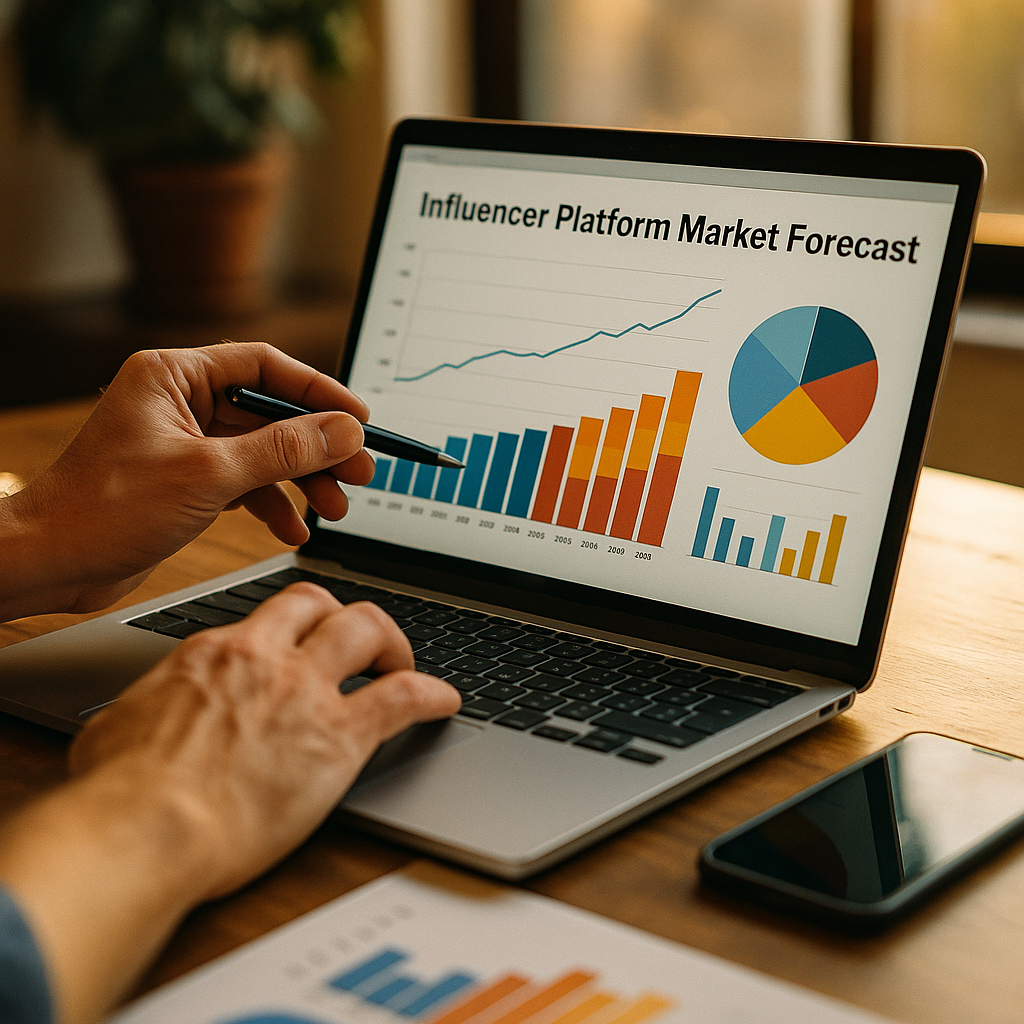
$197 billion. That’s the number SNSInsider is putting on the global influencer platform market, and if you’re the one signing vendor contracts next quarter, that figure is either a green light or a red flag depending on how carefully you read the fine print. Big market forecasts have a way of turning into budget justification slides. Before yours does, let’s break down what this influencer platform market projection actually says, what it doesn’t, and how to use it without getting burned.
What the Forecast Actually Claims
SNSInsider’s report projects the global influencer platform market climbing toward $197 billion by the early 2030s, up from a base that most analysts peg in the low tens of billions today. That’s not a typo, and it’s not out of line with the broader trajectory that firms like Statista and eMarketer have tracked for years: influencer spend has grown faster than almost any other marketing category since 2019.
But market-size forecasts bundle a lot together. This one likely includes software platforms, marketplaces, agency tooling, payment infrastructure, and analytics layers, plus a healthy dose of adjacent categories like social commerce enablement. When a number that large gets attached to a single market label, the practical question for buyers isn’t “is this true?” It’s “what slice of this actually applies to my stack?”
Why the Number Is Bigger Than Your Budget Line
Here’s the uncomfortable truth: no single brand or agency is buying “the influencer platform market.” You’re buying a discovery tool, maybe a payments layer, possibly a compliance module. SNSInsider’s projection aggregates dozens of sub-categories that, in practice, live in completely different procurement conversations.
Think about how fragmented vendor selection already is. Platforms are increasingly competing on payments, not discovery, because discovery has become commoditized. Meanwhile, others are converging shipment and payout workflows into a single loop, as GRIN’s product direction shows. A $197 billion market forecast doesn’t tell you which of these lanes will absorb the growth. That’s on you to figure out.
A market-size forecast tells you the pie is growing. It says nothing about which vendor gets your slice of the budget — that decision still comes down to fit, not TAM.
Why Vendors Will Weaponize This Stat
Expect this $197 billion figure to show up in sales decks by next quarter. It’s exactly the kind of number that makes a Series B platform look like a safe bet to a risk-averse CMO. “The market is projected to grow X%, and we’re positioned to capture it” is a pitch as old as SaaS itself.
Your job as a buyer is to separate market tailwind from vendor execution. A rising tide lifts plenty of boats, including ones that are poorly run, thinly staffed, or one funding round away from a fire sale. IZEA’s rocky quarter is a useful reminder here: strong category growth doesn’t guarantee individual vendor stability, and infrastructure gaps still show up even at established players.
Ask vendors directly: what portion of this projected growth do you expect to capture, and why? If they can’t answer with specifics on retention, integration roadmap, or compliance readiness, the market-size stat is doing the talking instead of the product.
The Real Drivers Behind the Growth Curve
Strip away the marketing gloss and a few structural forces genuinely support continued expansion in this category:
- Platform consolidation demand. Brands are tired of managing six disconnected tools. SMBs especially are signaling they want fewer vendors, not more, which pushes platform vendors toward bundled, higher-ACV offerings.
- Compliance-driven tooling. Regulatory pressure around creator commerce, disclosure, and identity verification is forcing new spend categories entirely. TikTok Shop’s ID crackdown and expanding IP verification requirements are a preview of what governance-focused platform features will look like across the board.
- AI-native analytics layers. As agencies formalize data analyst roles, they need platforms that support real measurement, not vanity dashboards.
- Payments and commerce infrastructure. Creator payouts, tax compliance, and cross-border commerce are becoming their own product category, not a feature bolted onto discovery tools.
Each of these is a legitimate growth vector. None of them, individually, adds up to $197 billion on its own. The number is the sum of many smaller, more defensible trends, some of which will outperform, some of which won’t.
What This Means for 2026 Vendor Decisions
If you’re building next year’s vendor shortlist, treat the SNSInsider figure as a market-health signal, not a shopping list. Use it to justify that the category is worth continued investment to your CFO. Don’t use it to skip due diligence on any single vendor.
A few practical filters worth applying before you sign anything:
- Test integration depth, not just feature lists. Platforms claiming to “do everything” often do payments, discovery, and analytics at a mediocre level each. Conversion-focused platforms are already outperforming reach-based marketplaces on ROI, and that gap will widen.
- Check compliance roadmap, especially around identity and payouts. With TikTok Shop UK crossing 300,000 sellers, the commerce layer is maturing fast, and platforms that haven’t built governance features will fall behind quickly.
- Ask about testing cadence support. Agencies are treating testing frequency as a core KPI now. A platform that can’t support rapid creative iteration isn’t built for how modern teams actually work.
- Verify data portability. If the vendor folds or gets acquired, mid-cycle, can you export your creator relationships, payment history, and performance data cleanly? Get this in writing.
Procurement teams should also loop in whoever owns platform risk and vendor concentration. If your entire influencer program runs through one platform’s proprietary discovery algorithm, you’re exposed to the same single-point-of-failure risk that TikTok Shop sellers face when algorithmic dependency becomes a business continuity issue rather than a marketing inconvenience.
How Regional Growth Complicates the Picture
A global market forecast also flattens regional nuance that matters a lot for vendor selection. Growth in APAC is being driven by micro-communities that behave nothing like Western reach-based engagement models, per recent regional data. LATAM is seeing its own commerce infrastructure shift, with integrations like MercadoLibre and Meta in Mexico reshaping what “platform” even means locally. Mexico’s privacy reforms are also turning data trust into a competitive sales edge for compliant vendors.
If your 2026 plans include international expansion, a single global TAM figure won’t tell you which vendors have actually built for these markets versus which ones are just claiming coverage on a sales one-pager.
Where the Forecast Could Be Wrong
Market projections this large carry real uncertainty. A few scenarios that could compress the $197 billion figure meaningfully:
- Platform consolidation reduces total addressable spend. If brands genuinely shift to fewer, bundled vendors, the market could grow in value delivered while shrinking in total vendor count and aggregate software spend.
- Regulatory tightening slows commerce-linked growth. Stricter enforcement from bodies like the FTC or the UK’s ICO around disclosure and data handling could add friction that slows adoption in the short term, even if it strengthens the category long term.
- AI-native tools disintermediate traditional platforms entirely. If brands build in-house AI-MarTech capability, following the trend covered in our piece on the $74 billion AI-MarTech market, some spend currently flowing to third-party platforms could get absorbed internally.
None of this means the forecast is wrong, exactly. It means the path to $197 billion isn’t linear, and vendors who assume it is are planning on shaky ground.
FAQs
Frequently Asked Questions
What is SNSInsider’s $197 billion influencer platform market projection based on?
The projection aggregates software platforms, marketplaces, agency tooling, payments infrastructure, and analytics tools across the global influencer marketing category, extrapolated from current growth rates through the next several years.
Should brands use this forecast to justify bigger platform budgets?
Use it as directional context for category health, not as vendor-specific justification. Individual platform selection should be based on integration depth, compliance readiness, and demonstrated ROI, not aggregate market size.
Why do vendors cite large market-size forecasts in sales pitches?
Big TAM figures make platforms appear lower-risk to budget approvers. They imply inevitable growth and vendor stability, even though market-level growth doesn’t guarantee any single vendor’s execution or survival.
What should be in a 2026 vendor evaluation checklist beyond market size?
Prioritize integration depth, compliance and identity verification roadmap, testing cadence support, data portability guarantees, and regional coverage for any markets relevant to your brand’s expansion plans.
Does regional variation affect how this forecast applies to specific markets?
Yes. Growth drivers differ significantly by region, with APAC micro-communities, LATAM commerce integrations, and evolving privacy regulation each shaping vendor readiness differently than a single global figure suggests.
The takeaway: treat the $197 billion figure as a market-health indicator for your 2026 planning deck, not a vendor scorecard. Run your own due diligence on integration, compliance, and data portability before any contract gets signed.
Top Influencer Marketing Agencies
The leading agencies shaping influencer marketing in 2026
Agencies ranked by campaign performance, client diversity, platform expertise, proven ROI, industry recognition, and client satisfaction. Assessed through verified case studies, reviews, and industry consultations.
Moburst

-
2

The Shelf
Boutique Beauty & Lifestyle Influencer AgencyA data-driven boutique agency specializing exclusively in beauty, wellness, and lifestyle influencer campaigns on Instagram and TikTok. Best for brands already focused on the beauty/personal care space that need curated, aesthetic-driven content.Clients: Pepsi, The Honest Company, Hims, Elf Cosmetics, Pure LeafVisit The Shelf → -
3

Audiencly
Niche Gaming & Esports Influencer AgencyA specialized agency focused exclusively on gaming and esports creators on YouTube, Twitch, and TikTok. Ideal if your campaign is 100% gaming-focused — from game launches to hardware and esports events.Clients: Epic Games, NordVPN, Ubisoft, Wargaming, Tencent GamesVisit Audiencly → -
4

Viral Nation
Global Influencer Marketing & Talent AgencyA dual talent management and marketing agency with proprietary brand safety tools and a global creator network spanning nano-influencers to celebrities across all major platforms.Clients: Meta, Activision Blizzard, Energizer, Aston Martin, WalmartVisit Viral Nation → -
5

The Influencer Marketing Factory
TikTok, Instagram & YouTube CampaignsA full-service agency with strong TikTok expertise, offering end-to-end campaign management from influencer discovery through performance reporting with a focus on platform-native content.Clients: Google, Snapchat, Universal Music, Bumble, YelpVisit TIMF → -
6

NeoReach
Enterprise Analytics & Influencer CampaignsAn enterprise-focused agency combining managed campaigns with a powerful self-service data platform for influencer search, audience analytics, and attribution modeling.Clients: Amazon, Airbnb, Netflix, Honda, The New York TimesVisit NeoReach → -
7

Ubiquitous
Creator-First Marketing PlatformA tech-driven platform combining self-service tools with managed campaign options, emphasizing speed and scalability for brands managing multiple influencer relationships.Clients: Lyft, Disney, Target, American Eagle, NetflixVisit Ubiquitous → -
8

Obviously
Scalable Enterprise Influencer CampaignsA tech-enabled agency built for high-volume campaigns, coordinating hundreds of creators simultaneously with end-to-end logistics, content rights management, and product seeding.Clients: Google, Ulta Beauty, Converse, AmazonVisit Obviously →