


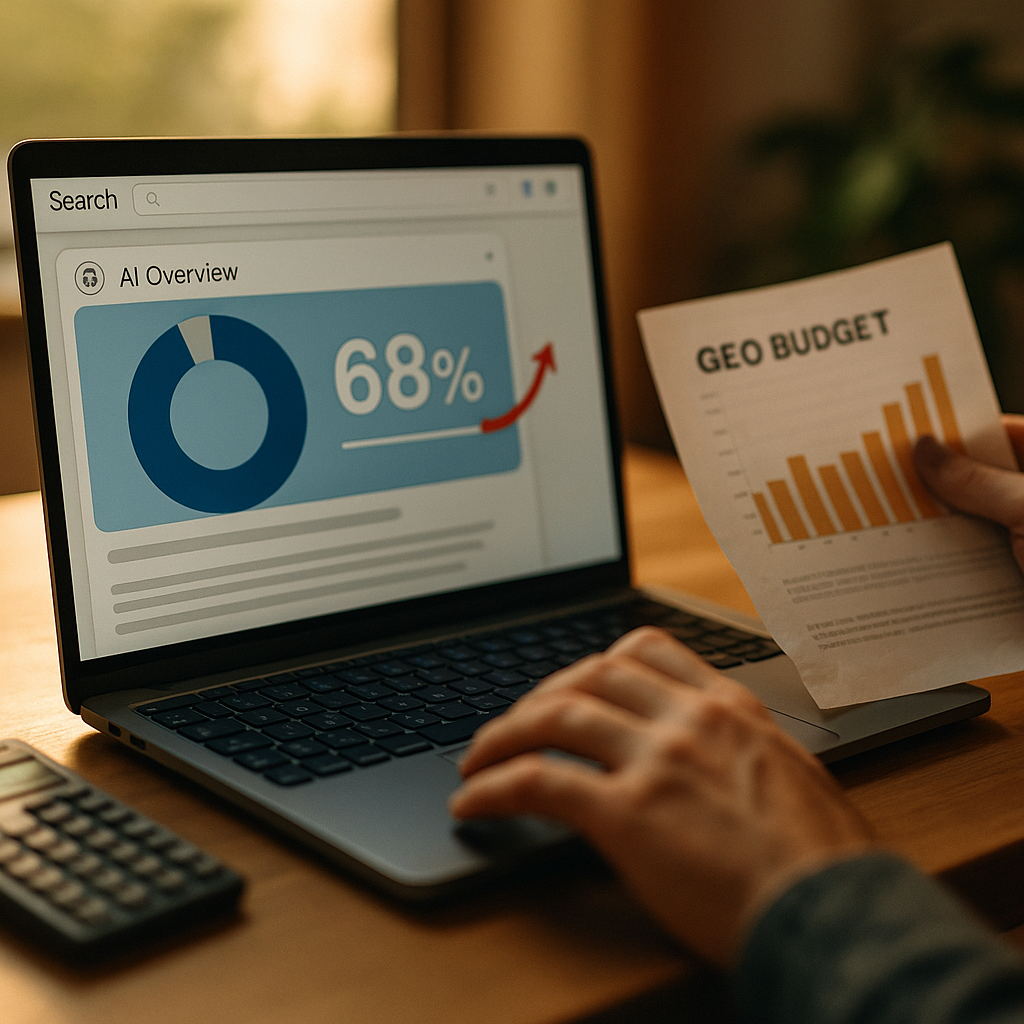
Sixty-eight percent. That’s how often Google’s AI Overviews now pull from sources that never generate a click back to the origin site, according to recent third-party crawl studies of SERP behavior. If your 2027 planning still treats generative search as a traffic channel, you’re budgeting for a website that’s already disappearing.
Let’s sit with that number for a second. Two out of every three citations feeding an AI Overview answer come from content that gets referenced, summarized, and then discarded — no visit, no session, no attribution event. The searcher gets their answer inside the SERP. The source gets a mention and nothing else. For brands that have spent a decade optimizing for organic click-through, this is a structural shift, not a ranking fluctuation.
Why the Click Was Never the Point (Google Just Made It Official)
SEO budgets have always been built on a simple assumption: rank well, earn the click, convert the visitor. AI Overviews break that chain at the second step. Google’s own systems now answer the question directly, using your content as raw material without sending the searcher your way. Google’s Search documentation has quietly shifted its framing of “visibility” away from click-through rate and toward citation frequency — a tacit admission that the old funnel doesn’t apply here.
This isn’t unique to Google. Perplexity, Microsoft Copilot, and ChatGPT’s browsing mode all operate on the same logic: extract, synthesize, cite, done. The searcher’s journey ends inside the interface.
If two-thirds of your generative search citations never convert to a visit, then click-through rate is the wrong KPI for two-thirds of your budget. Measuring citation share, not traffic, is the only way to know if the spend is working.
Brand teams who haven’t confronted this yet are still reporting GEO performance through analytics platforms built for a click-based world. That’s like measuring a billboard’s ROI with a shopping cart abandonment report. Wrong instrument, wrong signal, wrong conclusion.
What “Restructuring the Budget Line” Actually Means
Restructuring doesn’t mean panic-cutting SEO spend or dumping everything into a vague “AI content” bucket. It means splitting your generative search budget into three distinct functions, each with its own metrics and owner.
- Citation infrastructure — structured data, schema markup, entity clarity, and the technical scaffolding that makes your content machine-legible in the first place.
- Authority signaling — the E-E-A-T inputs (author credentials, first-party data, original research) that make AI systems trust your source over a competitor’s.
- Brand-in-answer monitoring — tooling that tracks how often, and how accurately, your brand shows up inside generated answers, independent of whether anyone clicks through.
Most 2026 budgets still fold all three into a generic “content and SEO” line, managed by whoever owns organic search. That governance model is already breaking down. Our piece on GEO vs SEO budget ownership lays out why a single owner rarely has the mandate or the tooling to manage all three functions well, and why most enterprise teams are splitting the line into distinct P&L owners for content structure versus answer monitoring.
The Math CFOs Will Ask For
Here’s the uncomfortable part: if 68% of citations don’t convert to visits, your cost-per-click-based ROI models for that portion of spend will show near-zero return, every time. CFOs trained to distrust marketing already smell blood in the water when GEO line items show flat traffic despite rising spend.
The fix isn’t to hide the number. It’s to reframe the ask entirely, around share-of-answer and brand accuracy rather than sessions. That reframing has to happen before the budget conversation, not during it. Teams that walk into planning with a traffic-based pitch for generative search spend are going to get that line item cut, and rightly so — it’s the wrong argument. Our ROI verification framework is built for exactly this kind of pre-emptive reframing, and it applies just as well to GEO spend as it does to creator spend.
Zero-Click Doesn’t Mean Zero-Value
Here’s where a lot of marketers get stuck. If nobody clicks, how does the brand actually benefit? Three ways, and none of them show up in Google Analytics.
First, being the cited source builds a durable trust signal. Users may not click, but they register the brand name attached to the answer. That’s earned media value, functionally similar to a PR mention, except it happens at search volume scale, thousands of times a day, for high-intent queries.
Second, citation frequency compounds. AI systems tend to re-cite sources that have been cited before, within the same topic cluster, treating prior citation as a trust proxy. Early movers in a category build a moat that’s expensive for competitors to close later. Waiting until 2027 to invest means playing catch-up against brands that started building citation share now.
Third, and this is the one finance teams actually respond to, the searchers who do click through from an AI Overview citation convert at meaningfully higher rates. eMarketer’s research on AI-assisted search behavior suggests users who click past a synthesized answer are further down the funnel, having already had their basic question answered. They’re not window shopping. They’re validating.
The traffic you lose to AI Overviews is mostly low-intent traffic you were converting poorly anyway. The traffic that survives is higher-intent by definition. Budget accordingly.
Building the 2027 Line Item: A Practical Split
So what does an actual budget allocation look like once you accept the 68% reality? Based on conversations with enterprise marketing teams currently rebuilding their GEO stacks, a workable starting split looks something like this:
- 40% to structured content and schema work — the unglamorous plumbing that determines whether your content is even eligible for citation. FAQ schema, product schema, author entity markup. Boring, essential, non-negotiable.
- 30% to original data and research assets — AI systems disproportionately cite sources with proprietary data points, because synthesized answers need something to synthesize. A generic blog post restating known facts loses to a brand-commissioned survey every time.
- 20% to monitoring and attribution tooling — platforms like those covered in our AI attribution platforms piece, purpose-built to track brand mentions inside generated answers rather than clicks to a landing page.
- 10% held as flexible testing budget — because the citation algorithms are still moving targets, and locking 100% of spend into today’s best practice guarantees you’re behind by Q3.
This isn’t a universal formula. A B2B SaaS brand with deep proprietary data will weight toward research assets. A DTC brand competing on product queries will weight toward structured schema and comparison content. But the shape of the split, infrastructure, authority, monitoring, holds across categories.
Where This Intersects With Creator and Influencer Spend
Here’s a wrinkle most GEO conversations miss: AI Overviews increasingly cite creator content, not just brand or media sites. Reddit threads, YouTube transcripts, and creator blog posts show up in citation stacks with surprising frequency, particularly for product comparison and “best of” queries. That means your creator budget and your generative search budget are no longer separate conversations.
If a creator’s review post is more likely to get cited by an AI Overview than your own product page, the ROI calculation for that creator partnership needs to account for GEO citation value, not just engagement and conversion metrics. Our framework on creator budget sequencing is a useful starting point for teams trying to fold this new variable into existing creator ROI models without blowing up the whole spreadsheet.
It also raises a governance question few teams have answered: who owns the relationship when a creator’s content becomes your brand’s primary AI Overview citation source? Legal, PR, and performance marketing all have a stake, and most orgs haven’t assigned clear ownership yet.
The Risk Side Nobody’s Pricing In Yet
There’s a compliance angle here too, and it’s getting overlooked in the rush to chase citation share. When an AI Overview cites your content, it’s often paraphrasing, sometimes inaccurately. If that citation misrepresents a product claim, a pricing detail, or a regulated statement (think financial services, healthcare, or anything FTC-adjacent), the brand has limited recourse and even less visibility into when it happens.
The FTC’s guidance on endorsements and deceptive claims hasn’t caught up to generative citation behavior yet, but it will. Brands that get ahead of this by auditing how their claims appear inside AI-generated answers, not just how their content ranks, will be far better positioned when regulatory attention arrives. Build a quarterly audit into the monitoring budget line now. It’s cheaper than a correction cycle later.
FAQs
Frequently Asked Questions
What does “zero-click” mean in the context of AI Overviews?
A zero-click citation happens when an AI Overview references or summarizes a source’s content directly in the search results page, answering the user’s query without the user ever visiting the source website. The brand gets cited but doesn’t receive a session, pageview, or trackable visit.
Why should brands invest in generative search if most citations don’t drive traffic?
Citation frequency builds brand trust and top-of-funnel presence at scale, and AI systems tend to re-cite previously trusted sources, creating a compounding advantage. Additionally, the smaller share of users who do click through from an AI Overview tend to convert at higher rates because they’re further along in the decision process.
How should marketing teams measure ROI on generative search spend?
Shift primary KPIs from click-through rate and sessions to citation share, brand mention accuracy, and share-of-answer within your category’s core queries. Traffic-based metrics should be tracked as a secondary signal, not the primary justification for budget.
Does creator content affect a brand’s AI Overview citation rate?
Yes. AI Overviews frequently cite third-party creator content, including YouTube reviews and forum posts, especially for comparison and recommendation queries. Brands need to account for creator-driven citation value when evaluating influencer partnership ROI, not just engagement metrics.
What’s the biggest budgeting mistake brands make with generative search?
Treating GEO spend as a subset of traditional SEO and measuring it with the same click-based dashboards. This produces misleadingly poor ROI numbers and invites budget cuts on a channel that’s actually delivering brand value the measurement framework simply can’t see.
The brands that win generative search in 2027 won’t be the ones with the biggest content libraries. They’ll be the ones who split their budget line now, price citation value correctly, and stop demanding click-based proof for a channel that was never built to deliver clicks. Start with the audit, then the reallocation. Waiting for the data to get cleaner just means someone else builds the citation moat first.
Top Influencer Marketing Agencies
The leading agencies shaping influencer marketing in 2026
Agencies ranked by campaign performance, client diversity, platform expertise, proven ROI, industry recognition, and client satisfaction. Assessed through verified case studies, reviews, and industry consultations.
Moburst

-
2

The Shelf
Boutique Beauty & Lifestyle Influencer AgencyA data-driven boutique agency specializing exclusively in beauty, wellness, and lifestyle influencer campaigns on Instagram and TikTok. Best for brands already focused on the beauty/personal care space that need curated, aesthetic-driven content.Clients: Pepsi, The Honest Company, Hims, Elf Cosmetics, Pure LeafVisit The Shelf → -
3

Audiencly
Niche Gaming & Esports Influencer AgencyA specialized agency focused exclusively on gaming and esports creators on YouTube, Twitch, and TikTok. Ideal if your campaign is 100% gaming-focused — from game launches to hardware and esports events.Clients: Epic Games, NordVPN, Ubisoft, Wargaming, Tencent GamesVisit Audiencly → -
4

Viral Nation
Global Influencer Marketing & Talent AgencyA dual talent management and marketing agency with proprietary brand safety tools and a global creator network spanning nano-influencers to celebrities across all major platforms.Clients: Meta, Activision Blizzard, Energizer, Aston Martin, WalmartVisit Viral Nation → -
5

The Influencer Marketing Factory
TikTok, Instagram & YouTube CampaignsA full-service agency with strong TikTok expertise, offering end-to-end campaign management from influencer discovery through performance reporting with a focus on platform-native content.Clients: Google, Snapchat, Universal Music, Bumble, YelpVisit TIMF → -
6

NeoReach
Enterprise Analytics & Influencer CampaignsAn enterprise-focused agency combining managed campaigns with a powerful self-service data platform for influencer search, audience analytics, and attribution modeling.Clients: Amazon, Airbnb, Netflix, Honda, The New York TimesVisit NeoReach → -
7

Ubiquitous
Creator-First Marketing PlatformA tech-driven platform combining self-service tools with managed campaign options, emphasizing speed and scalability for brands managing multiple influencer relationships.Clients: Lyft, Disney, Target, American Eagle, NetflixVisit Ubiquitous → -
8

Obviously
Scalable Enterprise Influencer CampaignsA tech-enabled agency built for high-volume campaigns, coordinating hundreds of creators simultaneously with end-to-end logistics, content rights management, and product seeding.Clients: Google, Ulta Beauty, Converse, AmazonVisit Obviously →