


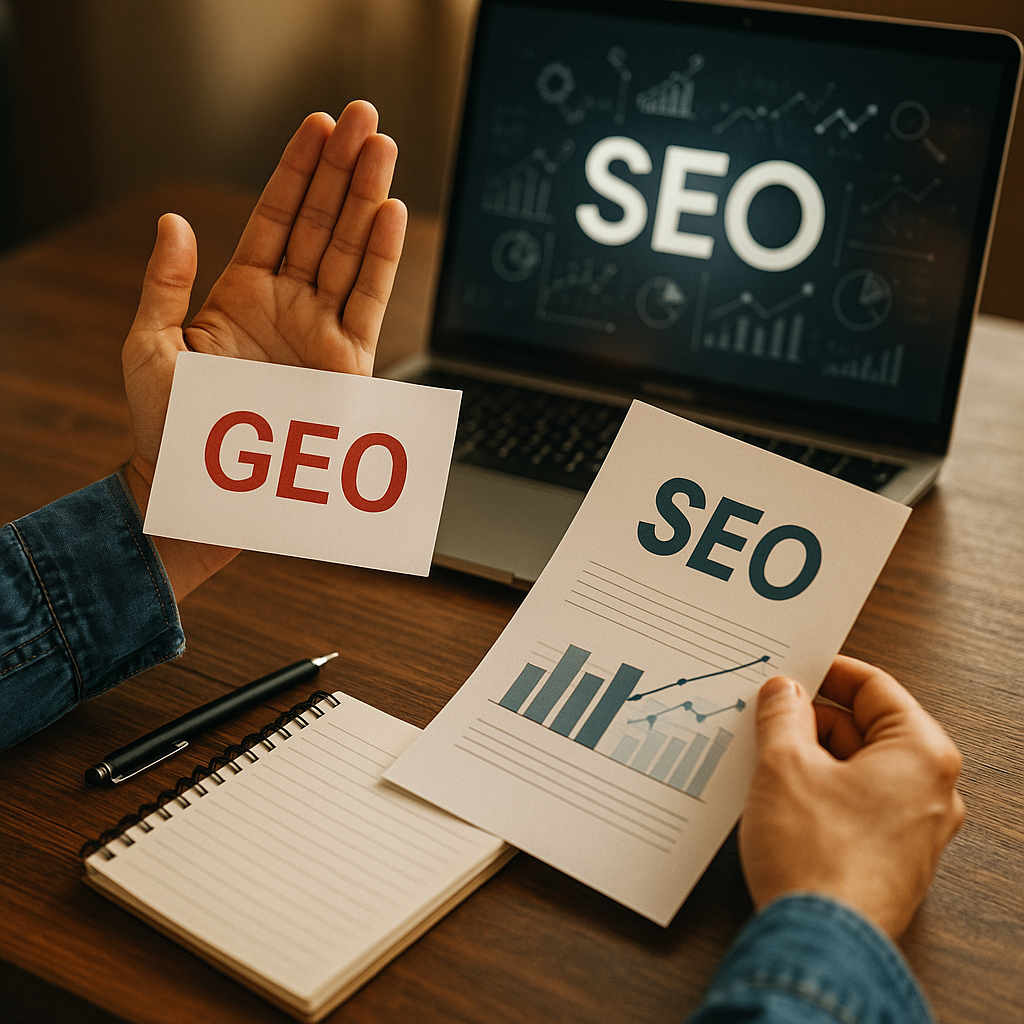
81 percent. That’s the share of marketing decision-makers who, when asked directly, said they don’t think “GEO” (generative engine optimization) deserves to exist as its own discipline. They call it SEO. Full stop. A new Fractl survey just handed the industry a reality check, and it has real consequences for how you pitch, budget, and staff AI search work in the year ahead.
If you’ve spent the last eighteen months watching vendors slap “GEO” onto every deck, this data point should make you pause. Not because AI-driven search doesn’t matter — it clearly does — but because the label itself may be doing more harm than good when it comes to securing budget internally.
The Survey Says: One Discipline, Not Two
Fractl’s research polled marketing decision-makers across agencies and in-house teams, and the finding was blunt: most practitioners see optimizing for ChatGPT, Perplexity, and Google’s AI Overviews as an extension of search engine optimization, not a parallel or replacement discipline. They’re not rejecting the tactics. They’re rejecting the branding.
This isn’t a semantic quibble. Language shapes budget lines. If finance and leadership hear “GEO” as a brand-new line item, they’ll ask for a brand-new business case, a brand-new vendor evaluation, and probably a brand-new headcount justification. If they hear “SEO, evolved,” the ask gets folded into an existing, trusted budget with a track record.
When 81% of decision-makers reject a term, the problem isn’t awareness — it’s that the term is asking them to justify a second budget for what feels like one job.
Why the Terminology Fight Actually Matters for Budgets
Marketing leaders are already stretched thin trying to prove AI ROI to skeptical CFOs. Adding a new acronym to the mix — one that implies a wholly separate skill set, tool stack, and reporting structure — makes that job harder, not easier.
Consider how procurement actually works. A CMO walks into a budget review. If the ask is “we need $150K more for GEO,” the CFO’s first question is: what was our SEO budget covering before, and why doesn’t it cover this? That’s an uncomfortable conversation. But if the ask is “our SEO scope now includes AI answer engines, and here’s the incremental spend to cover new monitoring tools,” that’s a normal budget conversation. Same money. Very different friction.
This matters even more given how fast the visibility landscape is shifting. Gartner has projected that a meaningful share of search volume will resolve through AI-generated answers rather than traditional blue links — a shift covered in depth in our piece on Gartner’s AI-answer forecast. Brands don’t have the luxury of stalling budget approval over naming conventions while that transition accelerates.
What Practitioners Are Actually Doing (Regardless of What They Call It)
Here’s the nuance the survey reveals: rejecting the term “GEO” doesn’t mean marketers are ignoring the work. Quite the opposite. Most respondents said they’re actively adjusting content strategy for AI-driven discovery — structuring pages for extractability, building topical authority, earning citations in AI-generated answers. They’re just doing it under the SEO umbrella, with SEO teams, using largely the same skill set they’d use to rank in Google.
That’s consistent with what we’re seeing across the industry. Structured data, clear sourcing, authoritative first-party data, and strong E-E-A-T signals help both traditional rankings and AI Overview inclusion. The overlap is bigger than the marketing hype suggests. Google’s own Search Central guidance continues to emphasize the same fundamentals — helpful content, demonstrated expertise, verifiable sourcing — regardless of whether the end result is a ranked link or an AI-generated summary.
- Content structure: Clear headers, concise answers near the top, and scannable formatting help both classic SERPs and LLM extraction.
- Authority signals: Original data, named experts, and citations from reputable sources matter more, not less, in an AI-summarized world.
- Technical hygiene: Crawlability, schema markup, and fast load times remain foundational — nothing “GEO-specific” replaces them.
- Brand mentions off-site: Unlinked citations across the web increasingly influence whether AI tools surface your brand at all.
None of this requires a rebrand. It requires an expanded scope for a team that already exists.
Where the Real Divide Shows Up: Reporting and Attribution
If there’s a place where AI search genuinely behaves differently, it’s measurement — not strategy. Traditional SEO reporting leans on rankings, organic sessions, and click-through rate. AI answer engines often generate zero clicks even when they drive brand consideration, a phenomenon explored in our analysis of generative search erosion by category.
That’s the actual operational challenge marketers face, and it’s a measurement problem, not a naming problem. Brands need new ways to track share of voice inside AI answers, citation frequency, and downstream brand lift, even when there’s no clickstream to analyze. Tools like Profound, Otterly, and even manual prompt-testing panels have emerged to fill that gap. None of these vendors require you to build a separate “GEO department” to use them; they slot into existing SEO and brand-tracking workflows.
This is also where marketing mix modeling is regaining relevance. As we covered in our piece on MMM filling attribution gaps, click-based attribution alone can’t capture the influence of zero-click AI answers on purchase behavior. Brands that pair MMM with AI-citation tracking get a much more honest read on what’s actually working.
The Vendor Problem Hiding Inside the Terminology Debate
Here’s the uncomfortable part nobody wants to say out loud: a chunk of the “GEO” branding push came from agencies and tool vendors looking to sell something new. New category, new pricing tier, new retainer. That’s not inherently cynical — genuine innovation deserves new language sometimes — but the Fractl data suggests practitioners see through it.
This tracks with a broader pattern in martech right now. Just as vendor consolidation is reshaping renewal strategy across the stack, buyers are getting sharper about distinguishing genuine capability shifts from repackaged offerings. If your agency partner is pitching a “GEO retainer” that’s functionally identical to what your SEO team already does, that’s worth scrutinizing hard before signing.
The smartest brands aren’t asking “do we need a GEO budget?” They’re asking “does our SEO team have the tools and mandate to cover AI answer engines?” That’s a cheaper, faster, more defensible question.
That said, don’t swing too far toward dismissiveness. Some AI-search-specific capabilities genuinely don’t exist inside legacy SEO tooling — prompt-based visibility tracking across multiple LLMs, for instance, or citation-graph analysis for AI-generated answers. The right move isn’t “ignore AI search” or “build a parallel department.” It’s “extend the existing team’s scope and tooling budget with clear incremental line items.”
How to Reframe the Budget Conversation Internally
If you’re heading into planning season, here’s how to apply this directly:
- Don’t ask for a new budget category. Ask for an expanded SEO scope with named incremental costs (new tools, added headcount hours, specific vendor contracts).
- Reframe KPIs, not the team. Add AI citation share and answer-engine visibility as new metrics inside the existing SEO dashboard, not a separate report nobody reads.
- Audit vendor pitches for redundancy. If a “GEO agency” pitch overlaps 80% with your current SEO scope of work, negotiate it as an add-on, not a new contract.
- Train the existing team. Upskilling current SEO staff on AI-answer mechanics is far cheaper than hiring a standalone “GEO specialist” role that may not exist in twelve months anyway.
This approach also aligns with how algorithm fluency is becoming a baseline hiring filter for senior marketers generally. The expectation isn’t that you hire a new specialist for every algorithm shift — it’s that your existing team stays fluent enough to adapt.
What This Means for Content and Creator Strategy
There’s a downstream effect here for brands running influencer and creator programs too. AI answer engines increasingly pull from social platforms, review sites, and creator content when constructing responses about products and brands. That means the content your creators produce isn’t just feeding social discovery — as covered in our piece on social search rewriting the funnel — it’s also potentially feeding AI training and retrieval systems.
Brands that treat creator content, owned content, and technical SEO as three disconnected budgets are going to struggle to show up coherently across AI answer engines. The winning structure looks more unified: one content and visibility strategy, measured across search, social, and AI surfaces, funded from a coordinated budget rather than three competing ones.
FAQs
Practical next step: Before your next budget cycle, rename your internal line item from “GEO” to “SEO: AI Search Extension” and attach three new KPIs — AI citation frequency, answer-engine share of voice, and branded query lift — to your existing SEO dashboard. That single reframe will get you funded faster than any new-category pitch will.
FAQs
What did the Fractl survey actually find about GEO versus SEO?
Fractl found that 81 percent of marketing decision-makers surveyed do not consider “GEO” (generative engine optimization) a distinct discipline from SEO. Most see AI search optimization as an extension of existing SEO practice rather than a new specialty requiring separate strategy, staffing, or budget.
Does this mean AI search optimization isn’t a real practice?
No. The tactics behind optimizing for AI Overviews, ChatGPT, and Perplexity are real and increasingly important. The survey shows practitioners reject the branding and category separation, not the underlying work. Most are folding these tactics into existing SEO workflows rather than building parallel teams.
Should brands still budget separately for AI search visibility tools?
Brands should budget for new tools and capabilities, such as AI-citation tracking or prompt-based visibility monitoring, but frame them as incremental additions to the SEO budget rather than an entirely new department. This makes approval easier and avoids redundant vendor spend.
How should marketing teams measure success in AI answer engines?
Traditional click-through metrics don’t capture AI answer engine performance well since many interactions are zero-click. Teams should track citation frequency, share of voice within AI-generated answers, and branded search lift, ideally paired with marketing mix modeling to account for influence that doesn’t show up in clickstream data.
Is hiring a dedicated GEO specialist worth it?
For most organizations, no. The Fractl data and current market behavior suggest it’s more cost-effective to upskill existing SEO staff on AI-answer mechanics than to create a standalone role around a category most decision-makers don’t recognize as separate.
FAQs
Top Influencer Marketing Agencies
The leading agencies shaping influencer marketing in 2026
Agencies ranked by campaign performance, client diversity, platform expertise, proven ROI, industry recognition, and client satisfaction. Assessed through verified case studies, reviews, and industry consultations.
Moburst

-
2

The Shelf
Boutique Beauty & Lifestyle Influencer AgencyA data-driven boutique agency specializing exclusively in beauty, wellness, and lifestyle influencer campaigns on Instagram and TikTok. Best for brands already focused on the beauty/personal care space that need curated, aesthetic-driven content.Clients: Pepsi, The Honest Company, Hims, Elf Cosmetics, Pure LeafVisit The Shelf → -
3

Audiencly
Niche Gaming & Esports Influencer AgencyA specialized agency focused exclusively on gaming and esports creators on YouTube, Twitch, and TikTok. Ideal if your campaign is 100% gaming-focused — from game launches to hardware and esports events.Clients: Epic Games, NordVPN, Ubisoft, Wargaming, Tencent GamesVisit Audiencly → -
4

Viral Nation
Global Influencer Marketing & Talent AgencyA dual talent management and marketing agency with proprietary brand safety tools and a global creator network spanning nano-influencers to celebrities across all major platforms.Clients: Meta, Activision Blizzard, Energizer, Aston Martin, WalmartVisit Viral Nation → -
5

The Influencer Marketing Factory
TikTok, Instagram & YouTube CampaignsA full-service agency with strong TikTok expertise, offering end-to-end campaign management from influencer discovery through performance reporting with a focus on platform-native content.Clients: Google, Snapchat, Universal Music, Bumble, YelpVisit TIMF → -
6

NeoReach
Enterprise Analytics & Influencer CampaignsAn enterprise-focused agency combining managed campaigns with a powerful self-service data platform for influencer search, audience analytics, and attribution modeling.Clients: Amazon, Airbnb, Netflix, Honda, The New York TimesVisit NeoReach → -
7

Ubiquitous
Creator-First Marketing PlatformA tech-driven platform combining self-service tools with managed campaign options, emphasizing speed and scalability for brands managing multiple influencer relationships.Clients: Lyft, Disney, Target, American Eagle, NetflixVisit Ubiquitous → -
8

Obviously
Scalable Enterprise Influencer CampaignsA tech-enabled agency built for high-volume campaigns, coordinating hundreds of creators simultaneously with end-to-end logistics, content rights management, and product seeding.Clients: Google, Ulta Beauty, Converse, AmazonVisit Obviously →