


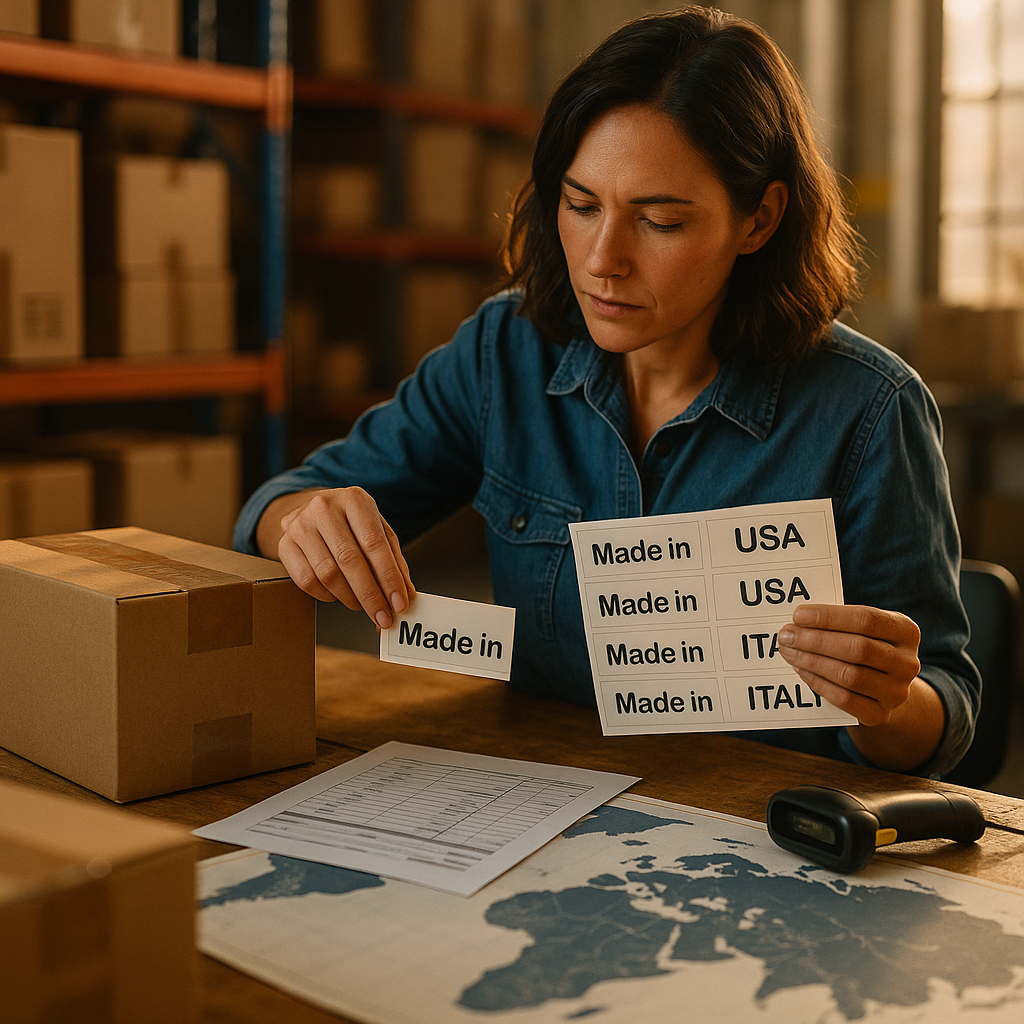
Navigating the complexities of global supply chains requires a clear understanding of “Made in” labeling regulations. Today’s business landscape makes compliance critical for regulatory approvals and consumer trust. Learn how to protect your brand, streamline logistics, and avoid costly mistakes as we break down everything you need to know about “Made in” labeling for international markets.
Understanding “Made in” Labeling Requirements in Global Markets
Each country enforces its own unique rules for “Made in” labeling, directly impacting product packaging, marketing, and cross-border sales. For example, the United States uses the Federal Trade Commission’s (FTC) standard that products must be “all or virtually all” made in the USA to use the label. Meanwhile, the European Union distinguishes between “Made in EU” and “Made in [Country]” based on the location of substantial transformation—a legal definition that differs widely across jurisdictions.
Increasing consumer awareness and stricter government scrutiny mean non-compliance can lead to hefty penalties and import bans. In 2025, regulatory agencies like the FTC, EU authorities, and the Chinese Customs continue to increase enforcement, targeting companies failing to properly track and disclose their sourcing. For global manufacturers, “Made in” country-of-origin (COO) claims are no longer optional—they are a critical compliance and marketing consideration.
Key Documentation for Country of Origin Labeling Compliance
Accurate and accessible documentation forms the backbone of compliance. To withstand government audits or legal challenges, companies must maintain:
- Bills of Material (BOM): Showing the origin country of each input and sub-assembly.
- Supplier Declarations: Confirming source and transformation processes.
- Certificates of Origin: For international shipments, often validated by a chamber of commerce or government authority.
- Manufacturing Records: Documenting processes, percentage of domestic content, and assembly sites.
Lean on digital systems like enterprise resource planning (ERP) software, which increasingly offer modules specifically for traceability and origin documentation. Regular supplier audits, clear documentation standards, and effective change management processes ensure ongoing trust in compliance data.
Differences in “Made in” Labeling by Major Trading Regions
Multinational businesses must adapt to varying rules across key export markets. Some of the most influential regulations include:
- United States: “All or virtually all” standard. Mixed-origin goods must clarify, e.g., “Assembled in USA with global components.” False claims can lead to product recalls or million-dollar civil penalties.
- European Union: Uses the “substantial transformation” rule—where the product changed its nature or use. In some sectors, EU or regional labels are preferred over an individual country.
- China: Requires precise COO information and often inspects for compliance at customs. Products with ambiguous or misleading labels face immediate return or destruction.
- Australia/Canada: Demand a clear explanation of the main manufacturing process and the origin of core ingredients or components. They provide guidance for “Packaged in” versus “Made in” claims.
Always consult legal updates or trade associations within your sector. Staying up-to-date lets you preemptively adjust labeling and avoid customs disruptions or reputational risk.
Best Practices for Managing Supply Chain Transparency
Supply chain transparency—the ability to trace and verify every step—has emerged as a business necessity. Here’s how to build a transparent operation for robust “Made in” labeling compliance:
- Map Suppliers: Identify and rank every contributor, from raw materials through to final assembly.
- Implement Digital Traceability: Use barcode, RFID, or blockchain technology for real-time tracking and verification.
- Conduct Regular Supplier Audits: Schedule site visits and independent reviews of origin documentation.
- Use Contract Clauses: Outline country-of-origin and documentation requirements in supplier contracts, including penalties for misreporting.
- Train Teams: Equip compliance, procurement, and production staff with clear education on current COO rules and red flags.
Adopting these best practices doesn’t just safeguard legal compliance; it strengthens consumer trust and positions your company for rapid response to regulatory changes or public scrutiny.
Labeling Technology and Automation for 2025 Supply Chains
Emerging technology is reshaping “Made in” labeling and compliance processes. In 2025, global supply chains can utilize:
- Smart Labels: Embedded with QR codes, allowing consumers and regulators to instantly verify country-of-origin information and supply chain details.
- AI-driven Compliance Software: Flags discrepancies in documentation, alerts teams to jurisdictional changes, and updates label templates in real time.
- Blockchain-based Records: Immutable logs linking product batches to certified supplier data—boosting traceability and trust in multinational audits.
- Cloud-based Collaboration Tools: Centralize communication with suppliers, reduce paperwork errors, and ensure all stakeholders operate off current requirements.
These tools streamline supply chain management, minimize human error, and allow rapid scaling into new markets without costly compliance missteps.
Enforcement Trends and Avoiding Costly Mistakes
Regulatory enforcement around “Made in” labeling intensified throughout 2024 and remains a top priority for customs, trade, and consumer agencies in 2025. Authorities are:
- Increasing spot inspections both at borders and in retail environments.
- Imposing higher fines on misrepresented claims, including “Made in [Country]” violations in electronics, apparel, and food sectors.
- Scrutinizing online sales channels just as much as physical retail.
To avoid costly mistakes:
- Monitor jurisdictional changes and regulatory updates actively.
- Document your labeling methodology and any origin claim calculations.
- React quickly—product recalls and corrective labeling are far cheaper than litigation or loss of market access.
Experienced compliance advisors or trade lawyers can provide tailored risk assessments and solution blueprints for your industry and target markets.
Conclusion: Building a Resilient “Made in” Labeling Strategy
Meeting “Made in” labeling regulations is fundamental for global supply chains in 2025. Invest in thorough documentation, transparent supplier relationships, and adaptable technology to maintain compliance across multiple jurisdictions. Your best defense is a proactive approach—continuously educate your team, audit your supply chain, and leverage automation for flawless execution.
Frequently Asked Questions (FAQs)
-
What is the “all or virtually all” standard for “Made in” claims?
In the U.S., “all or virtually all” means that, except for minor components, all significant parts and processing are of U.S. origin. If imported parts are essential, a U.S. origin claim isn’t allowed unless you provide a qualified statement such as “Assembled in USA with international components.”
-
How do I determine the country of origin for complex products?
Use the “substantial transformation” principle: the COO is where the product undergoes its most significant change in form or function. For detailed or industry-specific questions, legal counsel or professional import/export advisors are recommended.
-
What are the risks of non-compliance with “Made in” labeling?
Risks include shipment delays, customs seizures, product recalls, substantial fines, and reputational damage. As of 2025, repeat offenders face heightened penalties, especially in cross-border e-commerce.
-
Should startups and small exporters invest in compliance technology?
Yes. Scalable, cloud-based tools start at accessible price points and minimize compliance risks from day one. Early investment helps startups expand globally while demonstrating credibility to partners and consumers.
-
Is a self-declared “Made in” label ever enough?
No. Self-declaration must be substantiated by thorough records, supplier documentation, and periodic audits, and is always subject to regulatory review in the importing country.
Top Influencer Marketing Agencies
The leading agencies shaping influencer marketing in 2026
Agencies ranked by campaign performance, client diversity, platform expertise, proven ROI, industry recognition, and client satisfaction. Assessed through verified case studies, reviews, and industry consultations.
Moburst

-
2

The Shelf
Boutique Beauty & Lifestyle Influencer AgencyA data-driven boutique agency specializing exclusively in beauty, wellness, and lifestyle influencer campaigns on Instagram and TikTok. Best for brands already focused on the beauty/personal care space that need curated, aesthetic-driven content.Clients: Pepsi, The Honest Company, Hims, Elf Cosmetics, Pure LeafVisit The Shelf → -
3

Audiencly
Niche Gaming & Esports Influencer AgencyA specialized agency focused exclusively on gaming and esports creators on YouTube, Twitch, and TikTok. Ideal if your campaign is 100% gaming-focused — from game launches to hardware and esports events.Clients: Epic Games, NordVPN, Ubisoft, Wargaming, Tencent GamesVisit Audiencly → -
4

Viral Nation
Global Influencer Marketing & Talent AgencyA dual talent management and marketing agency with proprietary brand safety tools and a global creator network spanning nano-influencers to celebrities across all major platforms.Clients: Meta, Activision Blizzard, Energizer, Aston Martin, WalmartVisit Viral Nation → -
5

The Influencer Marketing Factory
TikTok, Instagram & YouTube CampaignsA full-service agency with strong TikTok expertise, offering end-to-end campaign management from influencer discovery through performance reporting with a focus on platform-native content.Clients: Google, Snapchat, Universal Music, Bumble, YelpVisit TIMF → -
6

NeoReach
Enterprise Analytics & Influencer CampaignsAn enterprise-focused agency combining managed campaigns with a powerful self-service data platform for influencer search, audience analytics, and attribution modeling.Clients: Amazon, Airbnb, Netflix, Honda, The New York TimesVisit NeoReach → -
7

Ubiquitous
Creator-First Marketing PlatformA tech-driven platform combining self-service tools with managed campaign options, emphasizing speed and scalability for brands managing multiple influencer relationships.Clients: Lyft, Disney, Target, American Eagle, NetflixVisit Ubiquitous → -
8

Obviously
Scalable Enterprise Influencer CampaignsA tech-enabled agency built for high-volume campaigns, coordinating hundreds of creators simultaneously with end-to-end logistics, content rights management, and product seeding.Clients: Google, Ulta Beauty, Converse, AmazonVisit Obviously →