


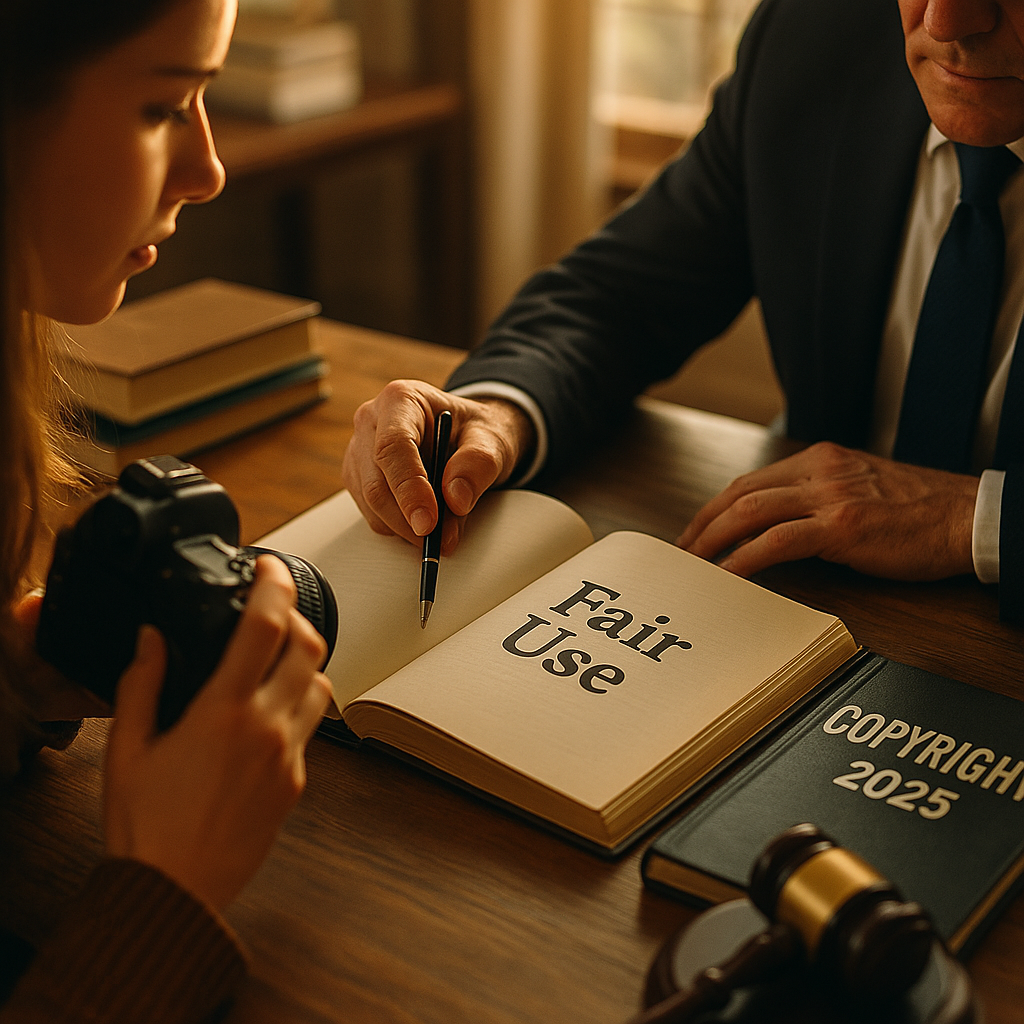
Navigating the legal line between fair use and copyright infringement matters more in 2025 than ever, as creators remix media across platforms and rights owners enforce aggressively. One wrong assumption can trigger takedowns, demonetization, or lawsuits; one overly cautious choice can weaken your message. This guide clarifies how courts analyze use, what red flags to avoid, and how to document decisions—before you publish.
Understanding Fair Use Doctrine Basics
Fair use is a legal doctrine that can allow limited use of copyrighted material without permission, depending on context. It is not a blanket “free use” rule and it is not a guaranteed shield. It is a fact-specific analysis that courts apply after weighing multiple factors. That means the same clip, image, or paragraph might be lawful in one setting and infringing in another.
In practice, fair use often protects uses that serve the public interest, such as criticism, commentary, reporting, teaching, scholarship, and research. But purpose alone is not enough. Courts also care about how much you used, what you took, whether your use substitutes for the original, and whether your use is transformative—adding new meaning or message rather than merely republishing.
If you publish content online, remember that platform rules can be stricter than copyright law. A platform may remove content based on automated detection, even if you believe it is fair use. Plan for both the legal standard and the practical reality of enforcement.
Fair Use Factors Analysis: How Courts Weigh Decisions
Courts typically evaluate fair use using four factors. No single factor automatically decides the outcome; the overall balance matters. This is why “I credited the creator” or “I’m not making money” rarely settles the question.
1) Purpose and character of the use (transformative use)
This factor asks what you are doing with the material. Uses that add new context, analysis, or meaning tend to fare better than simple reposts. Transformative use can include critique of a video, parody that targets the original, or a documentary excerpt used to illustrate an argument. Commercial intent can weigh against you, but it does not automatically defeat fair use—especially when the use is strongly transformative.
2) Nature of the copyrighted work
Using highly creative works (music, films, art photography, fiction) can be harder to justify than using factual or informational works. Unpublished works also receive stronger protection. If you rely on creative material, your transformation and minimal use usually need to be stronger.
3) Amount and substantiality
This is about both quantity and qualitative importance. Taking a short excerpt can still be problematic if it is the “heart” of the work (for example, the signature chorus of a song or the climactic scene of a film). A useful internal test is: Did you take more than needed to make your point? If yes, reduce it.
4) Effect on the market (market harm)
Courts ask whether your use competes with the original or undermines its licensing market. If your audience could treat your content as a substitute—watching your upload instead of renting the film, or using your extracted images instead of buying the photographer’s license—this factor can weigh heavily against fair use. If your use is commentary that does not replace the original, you are in a stronger position.
Practical takeaway: Before publishing, write one or two sentences addressing each factor. If you cannot do that convincingly, treat the use as high-risk and pivot to licensing or original material.
Transformative Use Examples: What Usually Helps (and What Doesn’t)
Creators often ask for a simple checklist. Fair use is not that clean, but you can learn patterns that commonly strengthen or weaken a claim.
Uses that often support a stronger fair use position
- Criticism and review: quoting a passage to analyze writing quality, or showing clips to critique editing, pacing, or claims.
- News reporting with analysis: embedding a brief excerpt to explain what happened, followed by original reporting and context.
- Education with tight relevance: a limited excerpt used to teach a specific concept (not a full substitute for the original).
- Parody: mimicking elements of the original to comment on the original itself, not just to be funny.
- Comparative analysis: side-by-side short segments to compare techniques, accuracy, or messaging.
Uses that often weaken a fair use position
- Reuploads and compilations: “best moments,” “full scene,” “top 10 clips,” or “music with lyrics” that can replace the original.
- Minimal added value: a reaction video with little analysis, long uninterrupted footage, or commentary that does not engage the content.
- Decorative use: background music, “vibe” imagery, or thumbnails that use copyrighted characters mainly for appeal.
- High-resolution reposting: images or PDFs that allow viewers to download and reuse without buying or licensing.
Follow-up question creators ask: “If I change it by 10% or 30 seconds, is it fair use?” No. There is no reliable “percent rule.” What matters is whether the amount used is reasonable for your purpose and whether your use competes with the original or its licensing market.
Copyright Infringement Risks: Common Red Flags and How to Lower Exposure
Copyright infringement usually means using protected expression without permission in a way the law does not excuse. To navigate risk responsibly, watch for these red flags and apply practical mitigations.
Red flags that increase infringement risk
- Using the “best part”: choruses, punchlines, signature visuals, or key plot scenes.
- Long, continuous excerpts: especially when the audience can follow the story or consume the core value from your upload.
- Posting in a way that replaces a purchase: full articles behind paywalls, full lectures sold by the creator, or full stock photo sets.
- Using material you could easily license: courts may view a developed licensing market as evidence of market harm if you bypass it.
- Using content primarily to attract attention: copyrighted artwork or characters used as branding, merch designs, or recurring channel identity.
Risk-reduction steps that help in real life
- Use the minimum necessary: shorter clips, lower resolution for images when appropriate, and avoid uninterrupted segments.
- Add clear analytical value: on-screen annotations, structured critique, or referenced claims you evaluate.
- Make it non-substitutable: ensure your audience still needs the original for full enjoyment or utility.
- Keep source files and notes: save what you used, where you found it, and your fair use reasoning per factor.
- Consider alternatives: public domain sources, your own b-roll, licensed stock, or creator collaborations.
Crediting is good ethics but not a legal permission. Attribution alone does not convert infringement into fair use. It can, however, reduce confusion and support good-faith behavior, which may matter in disputes.
DMCA Takedown and Content ID: What to Expect on Platforms
Even if your use is legally defensible, distribution platforms operate with their own enforcement systems. In 2025, two realities matter: automated detection and rapid takedown workflows.
DMCA takedown basics (U.S.-focused, but globally influential)
Platforms often comply with notices to maintain “safe harbor” protections. If you receive a takedown, you may be offered a counter-notice process. A counter-notice can restore content, but it also escalates the dispute and may require you to provide personal information. If the rights holder then files a lawsuit within the required window, the platform may keep the content down.
Content ID and automated claims
Some platforms use fingerprinting systems for music and video. These can trigger monetization redirection, blocking, or muting, even when you believe your use is fair. Automated tools do not evaluate nuance well; they match patterns.
How to prepare before you publish
- Build in “explainability”: label clips, cite what you are responding to, and make your commentary obvious to a human reviewer.
- Separate audio tracks: avoid embedding copyrighted music under your voice; it is harder to defend and easier to match.
- Keep a takedown response plan: know who reviews notices, how you decide whether to counter, and what deadlines apply.
- Document licensing where applicable: store receipts, emails, and license terms in one place.
Reader follow-up: “Should I always counter-notice?” Not always. If your use is weak, a counter-notice can increase risk. If your use is strong and your business depends on the content, a counter-notice may be appropriate after you evaluate the factors and consequences.
Licensing, Permissions, and Best Practices for Creators and Businesses
Fair use is one path; licensing and permissions are often the simplest. If you rely on copyrighted materials at scale—marketing teams, agencies, educators, SaaS companies, documentary producers—build a repeatable workflow.
When permission is usually the smarter move
- Advertising and brand marketing: using music, images, or clips to sell products often increases scrutiny and weakens fair use arguments.
- Using entire works or high-value portions: full songs, full articles, full illustrations, or full photo series.
- Using content as a core feature: your product depends on the copyrighted work, not commentary about it.
- High-stakes launches: campaigns where takedowns would cause major loss.
Permission and licensing options
- Direct permission: email the creator or rights holder with a clear request (what you’ll use, where, how long, paid or unpaid, territories).
- Stock and production libraries: clarify whether licenses cover social ads, broadcast, podcasts, apps, and paid placements.
- Creative Commons: confirm the exact license type and comply with attribution and restrictions (some disallow commercial use or derivatives).
- Work-for-hire and assignments: ensure contracts clearly transfer the needed rights.
Best-practice compliance habits (EEAT-friendly)
- Create a rights log: track assets, owners, license terms, and renewal dates.
- Use a pre-publish checklist: fair use factor notes, clip length, market substitution risk, and platform policy considerations.
- Train your team: align editors, social managers, and designers so standards are consistent.
- Consult qualified counsel for edge cases: especially for documentaries, investigative pieces, or content with significant revenue.
Important clarity: This article provides general educational information, not legal advice. Laws and outcomes vary by jurisdiction and facts.
FAQs About Fair Use and Copyright Infringement
Is fair use the same as “non-commercial use”?
No. Non-commercial intent can help, but it does not automatically make a use fair. Courts still evaluate transformation, amount used, and market harm.
Does giving credit prevent copyright infringement?
No. Attribution is good practice but it is not permission and it does not automatically qualify a use as fair use.
How much of a song or video can I use without permission?
There is no universal safe length. Use only what you need for your purpose, avoid taking the “heart” of the work, and ensure your use does not substitute for the original.
Are reaction videos always fair use?
No. Reaction content can be fair use when it adds substantial commentary, critique, or analysis and avoids long uninterrupted playback. Minimal commentary and extensive footage increase risk.
What should I do if I get a DMCA takedown notice?
Confirm whether the claim is accurate, preserve evidence of your sourcing and analysis, and evaluate whether your use is defensible under the four factors. Consider the business impact, the platform’s counter-notice process, and whether legal counsel is appropriate before responding.
Can I use AI-generated content trained on copyrighted works?
Risk depends on how the model was trained, what rights you have under the tool’s terms, and whether the output is substantially similar to a protected work. Treat outputs that resemble a specific artist’s recognizable expression as higher risk, and keep records of prompts and tool licenses.
Fair use is a flexible doctrine, not a permission slip, and copyright infringement risk rises when your content substitutes for the original or uses its most valuable elements. In 2025, the safest path is to be intentional: transform what you use, take only what you need, and document your reasoning. When the stakes are high or transformation is thin, license or seek permission.
Top Influencer Marketing Agencies
The leading agencies shaping influencer marketing in 2026
Agencies ranked by campaign performance, client diversity, platform expertise, proven ROI, industry recognition, and client satisfaction. Assessed through verified case studies, reviews, and industry consultations.
Moburst

-
2

The Shelf
Boutique Beauty & Lifestyle Influencer AgencyA data-driven boutique agency specializing exclusively in beauty, wellness, and lifestyle influencer campaigns on Instagram and TikTok. Best for brands already focused on the beauty/personal care space that need curated, aesthetic-driven content.Clients: Pepsi, The Honest Company, Hims, Elf Cosmetics, Pure LeafVisit The Shelf → -
3

Audiencly
Niche Gaming & Esports Influencer AgencyA specialized agency focused exclusively on gaming and esports creators on YouTube, Twitch, and TikTok. Ideal if your campaign is 100% gaming-focused — from game launches to hardware and esports events.Clients: Epic Games, NordVPN, Ubisoft, Wargaming, Tencent GamesVisit Audiencly → -
4

Viral Nation
Global Influencer Marketing & Talent AgencyA dual talent management and marketing agency with proprietary brand safety tools and a global creator network spanning nano-influencers to celebrities across all major platforms.Clients: Meta, Activision Blizzard, Energizer, Aston Martin, WalmartVisit Viral Nation → -
5

The Influencer Marketing Factory
TikTok, Instagram & YouTube CampaignsA full-service agency with strong TikTok expertise, offering end-to-end campaign management from influencer discovery through performance reporting with a focus on platform-native content.Clients: Google, Snapchat, Universal Music, Bumble, YelpVisit TIMF → -
6

NeoReach
Enterprise Analytics & Influencer CampaignsAn enterprise-focused agency combining managed campaigns with a powerful self-service data platform for influencer search, audience analytics, and attribution modeling.Clients: Amazon, Airbnb, Netflix, Honda, The New York TimesVisit NeoReach → -
7

Ubiquitous
Creator-First Marketing PlatformA tech-driven platform combining self-service tools with managed campaign options, emphasizing speed and scalability for brands managing multiple influencer relationships.Clients: Lyft, Disney, Target, American Eagle, NetflixVisit Ubiquitous → -
8

Obviously
Scalable Enterprise Influencer CampaignsA tech-enabled agency built for high-volume campaigns, coordinating hundreds of creators simultaneously with end-to-end logistics, content rights management, and product seeding.Clients: Google, Ulta Beauty, Converse, AmazonVisit Obviously →