


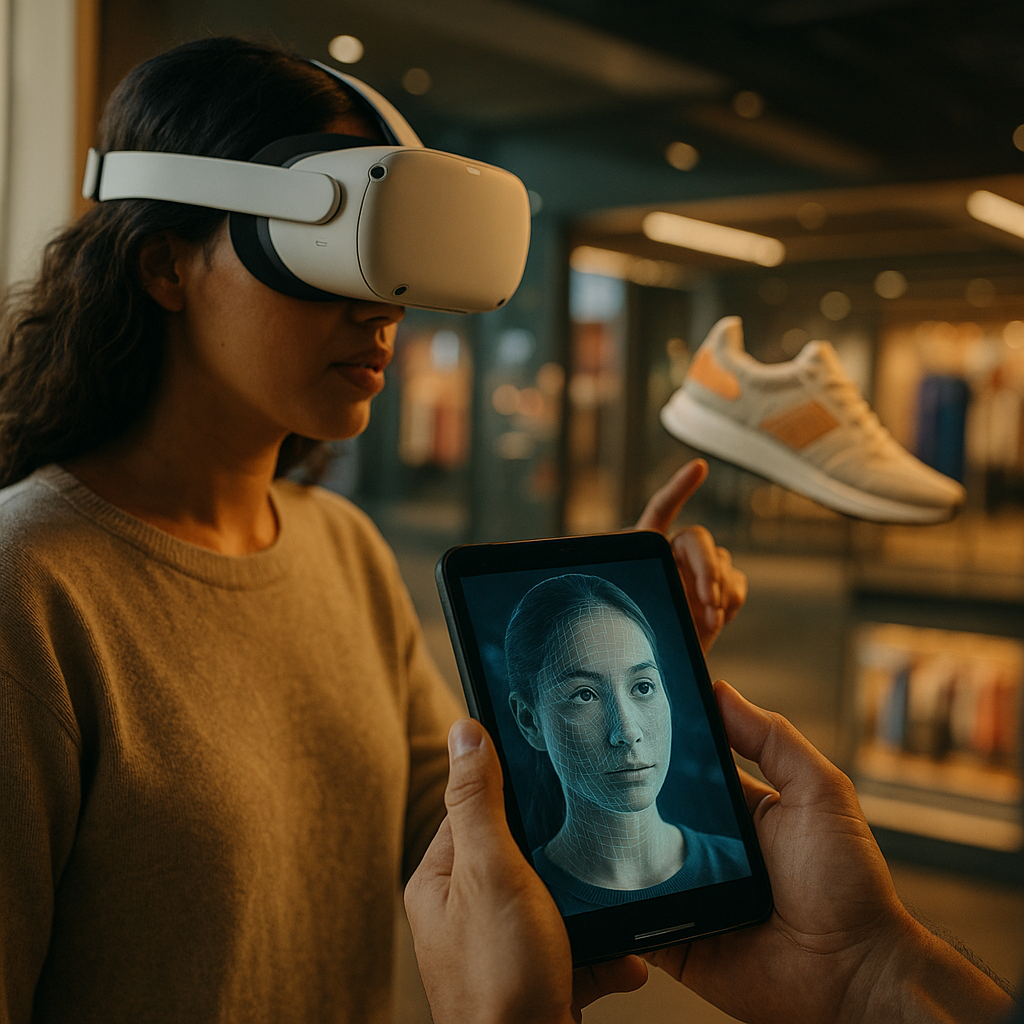
Virtual reality retail is moving from novelty to daily habit, and shoppers now browse, try on, and pay inside immersive worlds. That convenience comes with a tradeoff: sensors can capture intimate signals that go beyond names and emails. Navigating biometric data privacy in virtual reality shopping hubs requires clear consent, strong security, and smart governance—or trust collapses fast. What should you demand before your next virtual checkout?
What Counts as VR biometric data privacy in shopping hubs
In VR shopping, “biometric” often means more than fingerprints. It includes data generated by your body and behavior while you move through immersive spaces. Because VR devices sit on your face and track motion continuously, they can infer sensitive traits even when a user never “inputs” them.
Common biometric and biometric-adjacent signals in VR commerce include:
- Eye tracking: gaze direction, fixation duration, pupil dilation, blink rate—used for “attention analytics,” interface control, or measuring interest in products.
- Facial movement tracking: micro-expressions, mouth movement, cheek/eyebrow motion—used for avatars, social presence, and customer service interactions.
- Voiceprints: unique voice characteristics, along with speech content—used for voice login, assistance, and call-center style support.
- Hand and body motion: skeletal tracking, gesture patterns, gait—used for navigation, sizing, and frictionless interactions.
- Physiological signals (device-dependent): heart rate, skin temperature, stress proxies—used for wellness features or “comfort” tuning.
In a shopping hub, these signals can become personal data even when stored without a name. A stable device identifier, headset account, payment token, or persistent avatar can reconnect “anonymous” biometrics to a real person. Readers often ask, “Is gaze data really biometric?” The practical answer is yes when it can identify you, link across sessions, or reveal sensitive traits such as disability, emotional state, or health-related inferences.
How virtual reality shopping privacy risks show up in the real customer journey
Privacy threats in VR shopping aren’t abstract—they appear at predictable moments in the funnel. Knowing where risk concentrates helps shoppers and operators reduce it without killing personalization.
High-risk moments include:
- Onboarding and calibration: eye/face calibration may capture high-fidelity templates. If stored carelessly, it becomes a long-lived identifier.
- Try-on experiences: virtual fitting and body sizing can collect body measurements or infer body shape—highly sensitive data that can affect self-image and discrimination risk.
- Social shopping: shared spaces, voice chat, and avatar expressions can expose bystanders. One shopper’s recording can become another shopper’s data leak.
- Behavioral merchandising: “heatmaps” of gaze and movement can indicate preferences, compulsions, or vulnerabilities. In the wrong hands, this supports manipulative targeting.
- Payments and identity linking: combining biometrics with account data and payment credentials increases breach impact and makes re-identification easier.
Two follow-up questions come up repeatedly: “Can a retailer sell my VR biometrics?” and “Can VR data affect pricing?” The risk exists if governance is weak. Even if raw biometrics aren’t sold, derived profiles (attention scores, impulse markers, predicted demographics) can be shared with partners. Dynamic pricing based on behavioral or physiological vulnerability is a major trust breaker and may violate consumer protection laws depending on jurisdiction.
Meeting GDPR and biometric data expectations in immersive retail (2025)
In 2025, regulators and consumers expect privacy-by-design, especially for biometrics. While exact obligations depend on where the business and shoppers are located, a GDPR-aligned approach remains a strong baseline for global VR shopping hubs because it emphasizes necessity, proportionality, and user rights.
Key GDPR-style principles that matter most for VR biometrics:
- Lawful basis and explicit consent: biometric data used for unique identification typically requires explicit consent, and consent must be as easy to withdraw as it is to give.
- Purpose limitation: collect for a specific purpose (e.g., avatar animation) and don’t quietly reuse it for advertising analytics.
- Data minimization: if you only need “looked at product for 2 seconds,” don’t store raw gaze vectors at full frequency.
- Transparency: explain what is collected, what is inferred, who receives it, and how long it is kept—inside the headset, not buried in a web page.
- Rights management: provide access, deletion, correction, portability, and objection workflows that work for VR-native accounts.
For operators, a practical way to meet these expectations is to run a Data Protection Impact Assessment (DPIA) whenever adding eye tracking, facial tracking, or physiological sensing to commerce features. Readers also ask, “What about U.S. states?” Several U.S. state privacy laws and biometric statutes can apply, especially where biometrics are defined broadly or require notice and consent. The safest operational posture is to treat VR biometrics as high-risk everywhere: get clear consent, minimize retention, and avoid secondary use.
Building consent management for biometrics that works in VR
Consent in VR must be understandable at headset speed. Long text walls break immersion and lead to blind acceptance—exactly the opposite of meaningful choice. Strong consent design increases trust and reduces regulatory risk.
Design patterns that work well in immersive shopping:
- Layered notices: a short, plain-language prompt (“Use eye tracking to improve navigation?”) with a deeper “learn more” panel.
- Granular toggles: separate switches for avatar animation, accessibility controls, analytics, and advertising. Avoid bundling.
- Just-in-time prompts: ask at the moment of use (e.g., when entering a try-on booth), not at first launch for everything.
- Consent receipts: provide a clear record inside account settings showing what was agreed to and when.
- Withdrawal without penalties: if users opt out of biometrics, offer a functional alternative (controller navigation, manual sizing, password/PIN login).
To answer the common follow-up, “Can you make biometrics required?”—only when the feature truly cannot work without it and the user has an equivalent non-biometric route to shop. For example, letting a shopper browse and buy should not require eye tracking or facial tracking. When biometrics are used for authentication, offer strong alternatives such as passkeys, device-based login, or PIN plus fraud checks.
Best practice for children and teens: implement age-appropriate experiences that default to minimal collection, disable targeted advertising, and require verified parental consent where laws demand it. In VR, this also includes protecting bystanders in shared spaces and limiting recordings.
Implementing data security for VR platforms: storage, sharing, and retention
Security is where privacy promises either hold or fail. VR shopping hubs often involve multiple vendors: headset OS, analytics SDKs, payment providers, ad networks, and the hub operator. Each integration expands the attack surface.
Security controls that meaningfully reduce biometric risk:
- On-device processing where possible: keep raw eye/face tracking local and transmit only what is needed (e.g., UI selection events) rather than continuous streams.
- Strong encryption: encrypt data in transit and at rest, and isolate biometric stores from identity and payment systems.
- Short retention defaults: store raw sensor data for the minimum time required—often minutes or hours, not weeks. Retain only aggregated, de-identified metrics where justified.
- Strict vendor controls: audit SDKs, limit data fields, contractually forbid secondary use, and enforce deletion and breach notification timelines.
- Access governance: role-based access, least privilege, and tamper-evident logging for any staff or system touching biometric-related data.
- Red-team and abuse testing: test re-identification risks, avatar impersonation, deepfake voice misuse, and session hijacking.
Shoppers often wonder, “If data is ‘anonymized,’ am I safe?” Not always. High-dimensional biometric and behavioral data can be re-identified by linking patterns across sessions. A safer approach is data minimization plus aggregation, combined with technical and contractual controls to prevent linking.
For shared virtual malls, recording is a special danger. If the platform allows user recordings, provide visible recording indicators, default-off recording for private try-on areas, and clear reporting tools. Treat audio and motion recordings as sensitive data with limited retention.
Driving ethical personalization in VR retail without surveillance creep
Personalization can improve accessibility and reduce friction—when it’s bounded. Ethical personalization is not “collect everything and optimize later.” It is a disciplined choice to use the smallest signal set needed to deliver a shopper benefit, with clear user control.
Examples of ethical personalization choices:
- Accessibility-first eye tracking: enable gaze-based selection for mobility limitations, processed on-device, with no advertising reuse.
- Try-on without identity linkage: compute size recommendations locally, store only user-approved measurements, and keep them separate from ad profiles.
- Contextual merchandising: personalize based on current session choices (filters, favorites) rather than long-term biometric-derived traits.
- Frequency caps and anti-manipulation rules: avoid nudges tied to inferred stress, arousal, or vulnerability markers.
To support EEAT expectations, VR retailers should publish a plain-language biometric data use policy, name an accountable privacy leader, document their risk assessments, and provide support channels that can answer specific questions (“Do you store my gaze data?” “For how long?” “Which vendors get it?”). When customers can verify claims, trust increases and support costs drop.
FAQs on biometric data privacy in virtual reality shopping hubs
Do VR shopping hubs collect biometric data even if I don’t enable special features?
They may collect motion and controller inputs by default to operate the experience. Eye, face, voiceprint, or physiological signals typically require explicit activation or device permissions, but implementations vary. Check in-app privacy settings and permission prompts inside the headset.
Is gaze tracking considered sensitive information?
Yes, because gaze patterns can reveal interests, conditions, and emotional responses, and may help identify someone when combined with other data. Treat it as sensitive and expect clear consent, short retention, and limited sharing.
Can I shop in VR without providing biometrics?
You should be able to browse and purchase without biometric collection beyond what is technically necessary to run the app. If a hub requires eye or face tracking for basic shopping, ask for an alternative mode or choose a different provider.
How long should VR retailers retain biometric-related data?
Only as long as needed for the stated purpose. For many use cases, raw sensor streams should be processed and discarded quickly, while aggregated analytics may be kept longer if properly de-identified and not linkable back to users.
What should I look for in a trustworthy VR shopping privacy policy?
Specifics: data types collected (eye, face, voice, motion), purposes, retention periods, vendor sharing, user rights, and how to delete or export data. Vague phrases like “we may collect information to improve services” are a warning sign.
What security features matter most for protecting biometric data?
On-device processing, encryption, strict vendor restrictions, access controls with auditing, and short retention. Also look for clear breach notification commitments and a straightforward way to report privacy concerns.
VR commerce can feel effortless, but biometric signals make it uniquely personal—and uniquely risky. In 2025, the safest path is clear: collect only what the experience truly needs, keep processing local when possible, separate biometrics from identity and payments, and give shoppers real control through granular, reversible consent. If a virtual mall can’t explain its biometric practices simply, it hasn’t earned your trust.
Top Influencer Marketing Agencies
The leading agencies shaping influencer marketing in 2026
Agencies ranked by campaign performance, client diversity, platform expertise, proven ROI, industry recognition, and client satisfaction. Assessed through verified case studies, reviews, and industry consultations.
Moburst

-
2

The Shelf
Boutique Beauty & Lifestyle Influencer AgencyA data-driven boutique agency specializing exclusively in beauty, wellness, and lifestyle influencer campaigns on Instagram and TikTok. Best for brands already focused on the beauty/personal care space that need curated, aesthetic-driven content.Clients: Pepsi, The Honest Company, Hims, Elf Cosmetics, Pure LeafVisit The Shelf → -
3

Audiencly
Niche Gaming & Esports Influencer AgencyA specialized agency focused exclusively on gaming and esports creators on YouTube, Twitch, and TikTok. Ideal if your campaign is 100% gaming-focused — from game launches to hardware and esports events.Clients: Epic Games, NordVPN, Ubisoft, Wargaming, Tencent GamesVisit Audiencly → -
4

Viral Nation
Global Influencer Marketing & Talent AgencyA dual talent management and marketing agency with proprietary brand safety tools and a global creator network spanning nano-influencers to celebrities across all major platforms.Clients: Meta, Activision Blizzard, Energizer, Aston Martin, WalmartVisit Viral Nation → -
5

The Influencer Marketing Factory
TikTok, Instagram & YouTube CampaignsA full-service agency with strong TikTok expertise, offering end-to-end campaign management from influencer discovery through performance reporting with a focus on platform-native content.Clients: Google, Snapchat, Universal Music, Bumble, YelpVisit TIMF → -
6

NeoReach
Enterprise Analytics & Influencer CampaignsAn enterprise-focused agency combining managed campaigns with a powerful self-service data platform for influencer search, audience analytics, and attribution modeling.Clients: Amazon, Airbnb, Netflix, Honda, The New York TimesVisit NeoReach → -
7

Ubiquitous
Creator-First Marketing PlatformA tech-driven platform combining self-service tools with managed campaign options, emphasizing speed and scalability for brands managing multiple influencer relationships.Clients: Lyft, Disney, Target, American Eagle, NetflixVisit Ubiquitous → -
8

Obviously
Scalable Enterprise Influencer CampaignsA tech-enabled agency built for high-volume campaigns, coordinating hundreds of creators simultaneously with end-to-end logistics, content rights management, and product seeding.Clients: Google, Ulta Beauty, Converse, AmazonVisit Obviously →