


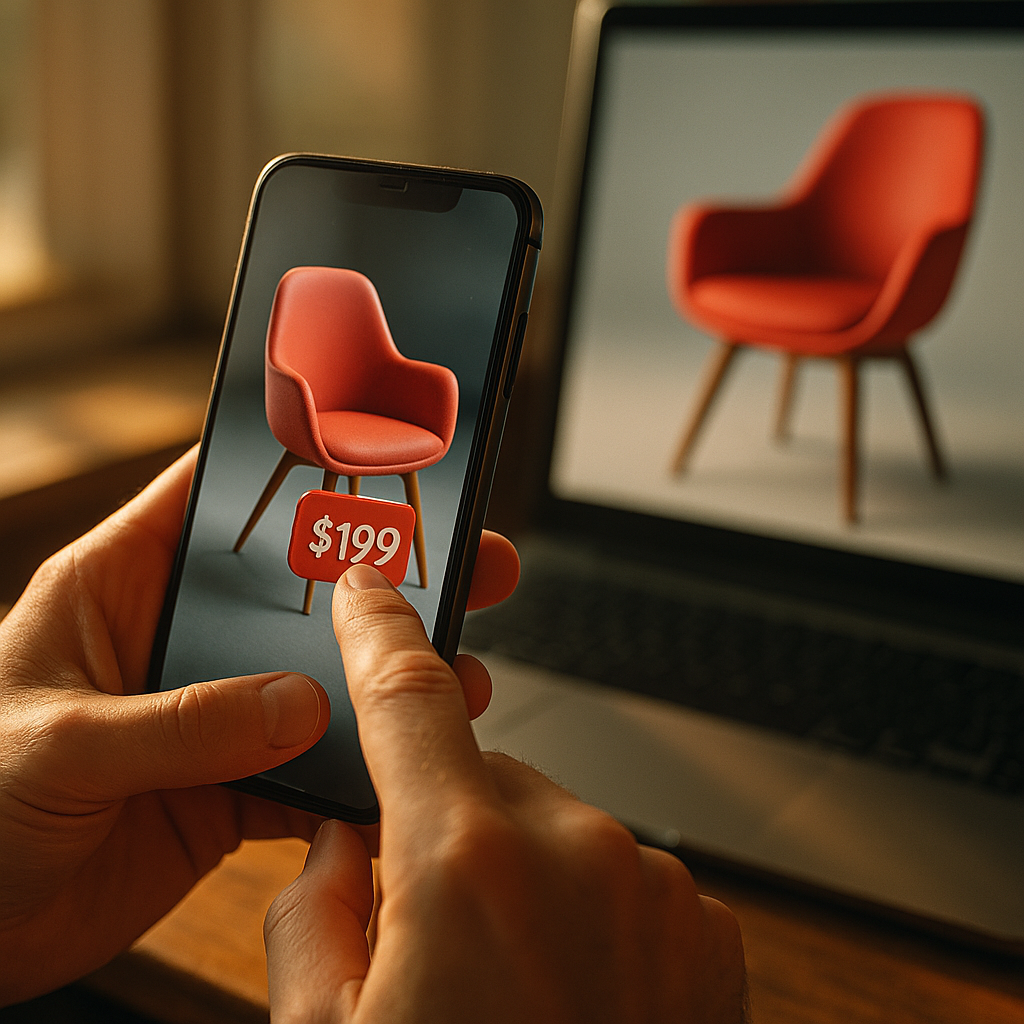
In 2026, immersive media is shifting from novelty to performance channel, and brands need sharper creative principles to win attention. The Science of Visual Anchoring in 3D Immersive Brand Advertisements explains why certain objects, motions, and spatial cues help viewers orient quickly, remember messages longer, and act with confidence. The real advantage appears when psychology, design, and measurement work together.
Visual anchoring psychology in immersive advertising
Visual anchoring is the practice of giving viewers a stable focal reference inside a complex visual environment. In 3D immersive advertising, that reference might be a hero product, a branded object, a recurring color field, a human face, or a motion path that guides the eye through space. The purpose is simple: reduce cognitive friction while increasing recall and action.
Human attention is selective, not limitless. When users enter an immersive brand scene, they face more sensory information than they would in a flat display ad. Depth, parallax, movement, sound, and interactive elements all compete for processing resources. A visual anchor acts as a perceptual shortcut. It tells the brain where to look first, what matters most, and how the rest of the scene should be interpreted.
This matters because immersive ads often fail for a predictable reason: they prioritize spectacle over orientation. If viewers cannot identify the center of meaning within the first moments, they may explore without understanding, or leave without remembering the brand. Anchoring solves that by pairing novelty with clarity.
From an EEAT perspective, the principle aligns with established findings in cognitive psychology and user experience research. People process structured environments more efficiently than chaotic ones. They remember information better when it is connected to a salient visual cue. They make decisions faster when a scene offers hierarchy rather than equal visual weight across all elements.
For marketers, the practical implication is direct. A 3D immersive ad should never ask the audience to discover the brand message by accident. The anchor should make meaning immediately available, then reward exploration with deeper product context, emotional storytelling, or interactive proof points.
3D advertising design principles that guide attention
Strong anchors do not happen by intuition alone. They are engineered through design choices that shape gaze, motion, and memory. In 3D advertising, the most effective anchors typically combine several attention-guiding signals at once.
- Scale: Larger objects naturally attract attention first, especially when they contrast with surrounding elements.
- Contrast: Differences in brightness, color, texture, or motion help the anchor stand out against the environment.
- Position: Elements placed near the central field of view or at key entry points in the experience gain priority.
- Motion hierarchy: Controlled movement can direct attention, but too many moving objects weaken the effect.
- Depth cues: Foreground placement, shadows, occlusion, and perspective make an anchor feel physically important.
- Semantic familiarity: Recognizable forms such as packaging, logos, faces, or product silhouettes are processed faster.
Designers should think of anchoring as a sequence, not a single asset. The first anchor captures attention. The second anchor confirms context. The third anchor supports action, such as tapping for details, rotating a product, or entering a branded world. This sequence mirrors how attention unfolds over time.
For example, a beauty brand launching a 3D ad for a new serum might begin with an oversized bottle suspended in a calm, high-contrast environment. The bottle becomes the primary anchor. A subtle particle trail then leads viewers to ingredient callouts floating nearby, creating a secondary anchor. Finally, an illuminated “try shade” or “shop now” interaction appears along the same visual path, establishing the action anchor.
This layered approach avoids a common mistake: placing the call to action in a disconnected corner or revealing product benefits only after excessive exploration. If the viewer has to search too hard, performance drops. Effective 3D design makes discovery feel intuitive rather than laborious.
Brands should also match anchor style to category expectations. Luxury campaigns may use slower motion, negative space, and material realism to create confidence. Gaming or entertainment campaigns may rely on kinetic anchors and bold depth transitions. Retail ads often work best with product-first anchors that quickly connect visual interest to purchase intent.
Spatial attention cues for immersive brand experiences
Immersive environments change how attention behaves because viewers experience space, not just layout. Spatial attention cues are therefore central to anchoring. These cues help the audience understand where they are, what is near or far, and which route to follow through the branded scene.
Several cues are particularly effective in immersive brand experiences:
- Directional lighting: Spotlighting the hero object creates instant priority and reinforces depth.
- Environmental framing: Arches, doorways, shelves, or scenic openings can visually “point” toward the anchor.
- Guided perspective: Camera entry angles and object arrangement can steer first attention before interaction begins.
- Motion vectors: Flowing particles, character gaze, or product animation can move the eye from one message to the next.
- Audio synchronization: A subtle sound cue tied to the anchor can strengthen orientation when used sparingly.
Spatial cues are especially valuable in mixed reality, augmented reality, and interactive mobile experiences where users can change their viewpoint. Unlike traditional ads, immersive ads cannot assume a fixed frame. The design must remain legible from multiple angles and under varying levels of user control.
This raises an important follow-up question: Can too much freedom reduce ad effectiveness? Yes. Full freedom without guidance often leads to weak message retention. The answer is not to remove interactivity but to scaffold it. Give users room to explore, while continuously reintroducing the visual anchor through recurring shapes, branded materials, lighting patterns, or interface prompts.
Another practical question is how long the anchor should remain dominant. In most cases, it should remain perceptually available throughout the experience, even if it stops being the largest element on screen. Think of it as a home base for attention. Users may move outward to explore details, but the ad should always provide a clear route back to the core product or brand promise.
Brand recall metrics in 3D ad performance
Anchoring is not only a creative theory. It should be measured against business outcomes. The most useful evaluation framework links attention structure to recall, engagement quality, and downstream action.
Start with brand recall. If users remember the environment but not the advertiser, the experience failed. Visual anchors improve recall when the brand identity is integrated into the focal element rather than added as a separate logo afterthought. Packaging shape, signature colors, and product form are often stronger memory drivers than floating corporate marks.
Next, evaluate message recall. Can users describe the main benefit after exposure? Anchors help here by connecting the benefit to a specific visual object or interaction. If a sustainability claim is central, the ad should visually tie that claim to a concrete product component or transformation, not just text in space.
Then assess engagement quality, not just engagement volume. Time spent can mislead if users linger because they are confused. Better signals include:
- Time to first meaningful focus on the hero element
- Interaction completion rate for the main guided action
- Sequence adherence showing whether users follow the intended story path
- Return-to-anchor behavior indicating that orientation remains intact during exploration
Finally, connect anchoring to conversion intent. Did users tap for product details, save the experience, share it, begin a trial, or visit a purchase page? The strongest immersive ads reduce the gap between fascination and action. Anchoring helps by keeping the decision point visually tied to the product, rather than burying it beneath decorative world-building.
Brands with advanced measurement capabilities may also use eye-tracking, heat mapping, or spatial analytics to learn where attention begins, drifts, and ends. These methods are useful when interpreted carefully. They can reveal whether the anchor is strong enough, whether secondary elements are stealing attention, and whether the call to action appears at the right point in the journey.
For credibility and EEAT, teams should document test conditions, audience segments, device context, and creative variations. A finding from a headset-based demo may not transfer directly to a mobile AR format. Good analysis respects context rather than overgeneralizing.
Neuromarketing and sensory load in immersive media
The neuroscience angle matters because immersive ads engage more of the perceptual system than static or standard video formats. That can amplify emotion and memory, but it can also increase sensory load. Anchoring is one of the most effective tools for keeping load within a productive range.
When a scene contains too many competing stimuli, the brain spends energy sorting relevance instead of encoding meaning. Users may describe the experience as “cool” yet struggle to remember what was offered. This is a classic symptom of overstimulation without hierarchy.
Anchors reduce that problem in three ways:
- They lower search cost by making the starting point obvious.
- They create prediction by establishing a stable reference that helps the brain map the environment.
- They improve encoding by tying information to a prominent, repeated visual cue.
Emotion also interacts with anchoring. A powerful immersive ad often creates awe, curiosity, delight, or urgency. But emotional intensity works best when it is attached to a clear object of attention. In practice, that means the emotional peak of the scene should coincide with the brand anchor, not occur in an unrelated visual flourish.
Consider a travel brand promoting an immersive destination preview. A dramatic sunrise over a 3D coastline may create wonder, but the ad still needs a focal anchor, such as a branded itinerary portal, a bookable featured experience, or a signature location marker. Without that anchor, users remember the scenery but not the offering.
Marketers also ask whether realism or stylization works better for anchoring. The answer depends on the category and audience intent. Realism can increase trust in products where texture, fit, scale, or material accuracy matter. Stylization can increase distinctiveness and emotional response in entertainment, lifestyle, or youth-focused campaigns. In both cases, the anchor must remain legible, consistent, and semantically linked to the brand promise.
Immersive creative optimization for better conversions
Once the science is clear, execution becomes an optimization process. Brands should treat visual anchoring in 3D immersive brand advertisements as a system that can be tested, refined, and scaled.
Begin with a simple creative framework:
- Define the primary action. What should the user understand or do first?
- Select the anchor object. Which visual element best represents the brand and the action?
- Build a hierarchy. Determine what appears first, second, and third in the experience.
- Limit competing stimuli. Remove decorative motion or text that distracts from the anchor.
- Reinforce the anchor. Repeat its visual logic through color, shape, audio, or interaction feedback.
- Measure and iterate. Test variations in scale, entry angle, motion, and CTA placement.
Optimization should answer practical questions that teams often overlook:
- Is the brand visible within the first seconds?
- Does the user know where to look next without reading instructions?
- Can the main message be understood from multiple viewing angles?
- Does interaction deepen understanding or just add friction?
- Is the CTA visually connected to the anchor?
Teams should also design for device reality. Mobile immersive ads often require stronger, simpler anchors because viewing conditions are more variable and session lengths are shorter. Headset experiences can support richer exploration, but even there, orientation remains essential. More available space does not remove the need for hierarchy.
One final best practice: align creative, strategy, and analytics teams from the start. Immersive campaigns often underperform when designers focus on visual novelty, media teams focus on interaction rates, and brand teams focus on storytelling in isolation. Anchoring provides a common language. It connects attention, memory, and action in a way every team can evaluate.
FAQs about visual anchoring in immersive ads
What is visual anchoring in 3D immersive advertising?
It is the use of a clear focal element to guide attention within a spatial ad environment. The anchor helps users orient quickly, understand the message, and move toward the intended action.
Why is visual anchoring important for brand performance?
It improves brand recall, reduces confusion, and helps users connect the immersive experience to a product or offer. Without an anchor, viewers may remember the spectacle but forget the advertiser.
What makes a strong visual anchor?
A strong anchor is salient, easy to recognize, visually distinct, and closely linked to the brand promise. It usually combines scale, contrast, placement, depth, and semantic familiarity.
Can a logo alone serve as the anchor?
Sometimes, but usually not as effectively as a branded product, package, character, or meaningful object. In immersive ads, anchors work best when they carry both identity and message.
How do you measure whether visual anchoring works?
Track brand recall, message recall, time to first meaningful focus, interaction completion, sequence flow, return-to-anchor behavior, and conversion actions such as clicks, saves, or purchases.
Does visual anchoring limit creativity?
No. It gives creativity structure. The most memorable immersive campaigns combine artistic freedom with clear attention hierarchy, so users enjoy exploration without losing the core message.
Is visual anchoring more important in AR and VR than in standard display ads?
Yes. Immersive formats contain more sensory information and often allow user-controlled viewpoints. That added complexity makes orientation and attention guidance much more important.
What is the biggest mistake brands make in 3D immersive ads?
They often overload the scene with motion, effects, or interactive elements before establishing a focal point. This creates confusion and weakens both recall and conversion.
Visual anchoring turns immersive advertising from visual experimentation into a disciplined brand tool. When brands give audiences a clear focal point, they reduce cognitive load, strengthen recall, and guide action more effectively. In 2026, the best 3D campaigns do not just impress the senses. They organize attention with intention, then convert curiosity into measurable business results for sustainable growth.
Top Influencer Marketing Agencies
The leading agencies shaping influencer marketing in 2026
Agencies ranked by campaign performance, client diversity, platform expertise, proven ROI, industry recognition, and client satisfaction. Assessed through verified case studies, reviews, and industry consultations.
Moburst

-
2

The Shelf
Boutique Beauty & Lifestyle Influencer AgencyA data-driven boutique agency specializing exclusively in beauty, wellness, and lifestyle influencer campaigns on Instagram and TikTok. Best for brands already focused on the beauty/personal care space that need curated, aesthetic-driven content.Clients: Pepsi, The Honest Company, Hims, Elf Cosmetics, Pure LeafVisit The Shelf → -
3

Audiencly
Niche Gaming & Esports Influencer AgencyA specialized agency focused exclusively on gaming and esports creators on YouTube, Twitch, and TikTok. Ideal if your campaign is 100% gaming-focused — from game launches to hardware and esports events.Clients: Epic Games, NordVPN, Ubisoft, Wargaming, Tencent GamesVisit Audiencly → -
4

Viral Nation
Global Influencer Marketing & Talent AgencyA dual talent management and marketing agency with proprietary brand safety tools and a global creator network spanning nano-influencers to celebrities across all major platforms.Clients: Meta, Activision Blizzard, Energizer, Aston Martin, WalmartVisit Viral Nation → -
5

The Influencer Marketing Factory
TikTok, Instagram & YouTube CampaignsA full-service agency with strong TikTok expertise, offering end-to-end campaign management from influencer discovery through performance reporting with a focus on platform-native content.Clients: Google, Snapchat, Universal Music, Bumble, YelpVisit TIMF → -
6

NeoReach
Enterprise Analytics & Influencer CampaignsAn enterprise-focused agency combining managed campaigns with a powerful self-service data platform for influencer search, audience analytics, and attribution modeling.Clients: Amazon, Airbnb, Netflix, Honda, The New York TimesVisit NeoReach → -
7

Ubiquitous
Creator-First Marketing PlatformA tech-driven platform combining self-service tools with managed campaign options, emphasizing speed and scalability for brands managing multiple influencer relationships.Clients: Lyft, Disney, Target, American Eagle, NetflixVisit Ubiquitous → -
8

Obviously
Scalable Enterprise Influencer CampaignsA tech-enabled agency built for high-volume campaigns, coordinating hundreds of creators simultaneously with end-to-end logistics, content rights management, and product seeding.Clients: Google, Ulta Beauty, Converse, AmazonVisit Obviously →