


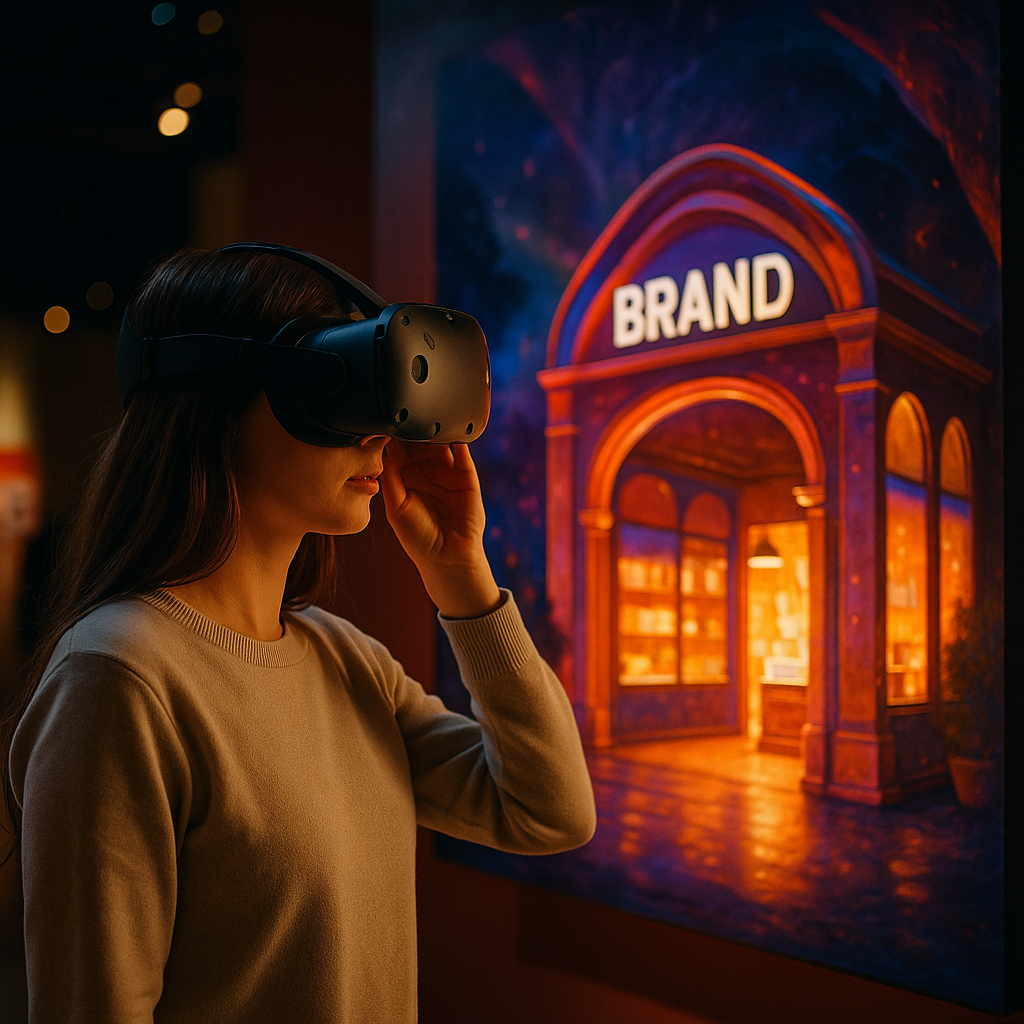
Spatial computing brand storytelling is moving from flat screens into responsive, immersive environments where audiences can explore, interact, and influence narrative flow. In 2026, that shift matters because attention is harder to earn and easier to lose. Brands that design useful, memorable experiences instead of passive campaigns can build stronger recall, trust, and action. What will those formats look like next?
Immersive brand experiences are redefining narrative structure
Spatial computing blends digital content with physical space through augmented reality, mixed reality, computer vision, sensors, and real-time 3D interfaces. For brand leaders, the practical implication is clear: storytelling no longer has to follow a fixed beginning, middle, and end on a single screen. It can unfold around the customer, respond to movement, and change based on context.
This changes format design at a fundamental level. A product launch, for example, can become a guided environment where people walk through features instead of scrolling through them. A retail brand can let shoppers visualize items in their homes while layered content explains craftsmanship, sourcing, or use cases. An entertainment brand can build location-aware story moments that reward participation rather than passive watching.
From an EEAT perspective, the strongest experiences are not immersive for immersion’s sake. They are built on a clear understanding of user intent. Helpful brand storytelling in spatial environments should answer real questions: What does this product do? How does it fit into my life? Why should I trust this brand? When a spatial experience serves those needs, it becomes informative, not gimmicky.
Brands should also recognize that immersive storytelling has a different pacing model. Users expect control. They want to explore, skip, return, compare, and personalize. That means the narrative must be modular. Instead of one message delivered in order, think of connected narrative layers:
- Core layer: the essential brand message
- Context layer: information tied to location, time, or user behavior
- Proof layer: demonstrations, reviews, certifications, and transparent claims
- Action layer: next steps such as purchase, sign-up, save, or share
This modular approach makes stories more adaptable across devices, from phones and wearables to headsets and connected environments. It also helps teams maintain consistency while tailoring experiences to customer context.
Augmented reality marketing creates participation instead of passive viewing
Among the most accessible spatial formats, augmented reality marketing continues to expand because it works on devices consumers already use. The strategic advantage is participation. Rather than watching a brand promise, users test it in their own surroundings.
That matters for products that benefit from visualization, comparison, and demonstration. Beauty brands can overlay shades and textures. Home brands can place furniture at scale. Automotive brands can guide users through features around a life-size vehicle model. Travel brands can turn physical locations into interactive previews of destinations or services.
The storytelling shift here is from description to situated experience. A brand can say a sofa fits a compact apartment, but an AR placement tool proves it. A skincare brand can claim education and personalization, but a spatial diagnostic flow can explain ingredients, routines, and expected outcomes more convincingly.
To make these formats effective, marketers need to focus on utility first. Users adopt AR experiences when they help them decide faster or with more confidence. Strong execution typically includes:
- Fast onboarding: minimal friction before value appears
- Clear visual cues: guidance that helps users place, rotate, or interact naturally
- Credible information: accurate dimensions, material details, availability, and pricing
- Seamless continuity: options to save, revisit, purchase, or speak with support
Many teams ask whether immersive formats reduce performance clarity. In practice, they can improve it if measurement is built into the journey. Track dwell time, interaction depth, repeat usage, assisted conversion, and post-experience brand lift. Those metrics show whether the story increased understanding, not just novelty.
Another likely question is whether every brand needs AR. No. It is most valuable when space, scale, fit, use, or context affect decision-making. If a spatial layer does not add clarity, it should not be forced into the campaign.
Mixed reality storytelling turns physical spaces into media channels
Mixed reality storytelling goes further by anchoring digital narratives to the real world in persistent, interactive ways. For future brand formats, this means stores, event venues, packaging, public installations, and even workplaces can become living storytelling surfaces.
Consider how this affects experiential marketing. Instead of a branded event that ends when guests leave, a mixed reality layer can extend the experience before, during, and after attendance. Visitors might unlock different chapters through movement, product interaction, or collaboration with others. The story becomes social, spatial, and data-informed.
This format is especially powerful for brands with complex value propositions. B2B companies can map abstract services into visible workflows. Healthcare brands can explain treatment pathways in understandable 3D. Industrial brands can demonstrate infrastructure, safety systems, or lifecycle benefits in real-world contexts where buyers actually evaluate solutions.
For credibility, brands should avoid exaggerated visual claims. If an experience simulates outcomes, that should be transparent. If data powers the experience, sourcing and permissions should be clear. Trust is central to EEAT, and spatial storytelling raises the stakes because the experience feels more real than a standard ad. Misleading representations can damage confidence quickly.
Operationally, mixed reality also requires tighter collaboration. Brand strategists, UX designers, 3D artists, product teams, retail operators, legal reviewers, and analytics specialists all shape the final experience. Successful programs usually start with a narrow use case, then scale. A pilot inside one store or one event series often reveals what users actually value.
The long-term opportunity is significant: physical spaces stop being static backdrops and start behaving like responsive narrative systems. That opens new storytelling formats such as guided product discovery paths, interactive founder stories tied to packaging, and service explainers layered onto real environments at the moment of need.
Customer experience personalization makes brand stories adaptive and useful
One of the biggest advantages of spatial computing is adaptive storytelling. In standard digital campaigns, personalization often means changing a headline or offer. In spatial environments, it can shape the journey itself. The system can respond to where a person is, what they look at, how long they engage, what they already know, and what they seem ready to do next.
That makes customer experience personalization more relevant to future storytelling formats than many marketers realize. A first-time visitor may need orientation and trust signals. A repeat customer may want shortcuts, upgrades, or deeper product detail. A high-intent buyer may need comparison tools or financing information. Spatial interfaces can provide each without forcing everyone through the same narrative path.
Done well, adaptive storytelling improves helpfulness. Done poorly, it feels intrusive. The difference lies in transparency and restraint. Brands should collect only the data needed for the experience, explain why it is being used, and offer controls where possible. Privacy is not a compliance footnote; it is a storytelling issue. If users feel watched rather than supported, the narrative fails.
To keep personalization useful, ask these practical questions:
- What signal improves the experience immediately?
- What user choice should remain explicit rather than inferred?
- What content is essential regardless of profile?
- How can users edit, pause, or restart the journey?
Adaptive brand stories also support accessibility. A spatial experience can offer alternate navigation modes, audio guidance, text reinforcement, adjustable pacing, and simplified views. This is not just inclusive design; it expands reach and strengthens comprehension. If future storytelling formats are truly customer-centered, accessibility has to be part of the concept from the start, not added later.
Spatial commerce content will connect storytelling to measurable business outcomes
As the technology matures, one concern remains constant: can immersive brand storytelling drive results beyond awareness? In 2026, the answer increasingly depends on how closely storytelling connects to decision-making. Spatial commerce content performs best when it reduces uncertainty and shortens the path from interest to action.
That action may be a purchase, but it can also be lead generation, appointment booking, product configuration, subscription, in-store visit, or sales-assisted follow-up. The best formats make that transition feel natural. If someone has just explored a product in their space, the next step should not be a disconnected landing page. It should preserve context, preferences, and progress.
This is where many brand teams need a stronger framework. Instead of treating immersive storytelling as a top-of-funnel activation, integrate it across the journey:
- Discovery: attract attention with a clear, relevant spatial use case
- Evaluation: help users compare, test, and understand options
- Decision: provide proof, pricing, availability, and frictionless next actions
- Retention: extend utility after purchase through onboarding, support, and upgrades
- Advocacy: encourage shareable, user-controlled moments worth revisiting
When leaders ask how to justify investment, measurement should cover both brand and business metrics. Useful indicators include engagement quality, content completion in 3D flows, add-to-cart rate after interaction, return visit behavior, reduction in product returns, and customer satisfaction. For service brands, track qualified leads, time-to-decision, and sales conversation quality.
Another important consideration is content operations. Spatial storytelling requires new assets, new workflows, and ongoing optimization. Reusable 3D product models, modular scripts, metadata standards, and cross-platform publishing systems can significantly improve efficiency. Without that foundation, costs rise and consistency drops.
In short, future brand storytelling formats will win when they are connected to commerce logic, not isolated as experimental media.
Future marketing technology will reward brands that design for trust, utility, and scale
The next wave of future marketing technology will not reward brands simply for showing up in spatial environments. It will reward those that solve real communication problems better than traditional formats can. That means being selective about use cases, disciplined about user experience, and rigorous about credibility.
From experience design to content governance, the winning principles are straightforward:
- Lead with usefulness: answer customer questions more clearly than a static format can
- Design for natural behavior: movement, gesture, voice, and gaze should feel intuitive
- Protect trust: disclose data use, avoid deceptive simulation, and substantiate claims
- Build modularly: create assets and narratives that can adapt across channels and devices
- Measure what matters: connect engagement to understanding, intent, and outcomes
Brand storytelling is also becoming more cross-functional. Marketing, product, customer support, retail, and data teams all influence whether a spatial experience feels coherent. If one team treats it as a campaign while another treats it as a service layer, users feel the disconnect. Strategic ownership matters.
There is also a creative shift underway. The strongest stories in spatial computing are less about spectacle and more about agency. Users want to inspect, learn, test, configure, and decide. Brands that respect that agency can create experiences that feel memorable because they are genuinely helpful.
For organizations just starting, the smartest path is often narrow and evidence-led: pick a high-value moment, solve it exceptionally well, and scale based on performance. That approach reflects both strong digital strategy and EEAT principles, because it prioritizes user benefit over trend chasing.
FAQs about spatial computing and brand storytelling
What is spatial computing in marketing?
Spatial computing in marketing refers to digital experiences that understand and respond to physical space. It includes augmented reality, mixed reality, 3D interfaces, and context-aware content that lets people interact with brands beyond flat screens.
How does spatial computing improve brand storytelling?
It makes storytelling interactive, contextual, and personalized. Instead of delivering one fixed message, brands can let audiences explore products, services, and narratives in ways that match their environment and intent.
Is spatial computing only useful for retail brands?
No. Retail is a visible use case, but B2B, healthcare, education, travel, automotive, entertainment, and industrial sectors can all use spatial formats to explain complex offerings more clearly and persuasively.
What are the biggest risks in immersive brand experiences?
The main risks are weak utility, privacy missteps, poor usability, and exaggerated claims. If the experience is hard to use or feels misleading, it can reduce trust rather than strengthen it.
How should brands measure success in spatial storytelling?
Use a mix of engagement and outcome metrics. Track interaction depth, completion rates, assisted conversions, repeat usage, lead quality, sales impact, and post-experience satisfaction or brand lift.
Do users need headsets to experience spatial brand storytelling?
No. Many effective experiences run on smartphones and tablets through AR. Headsets can enable richer immersion, but they are not required for most practical brand use cases.
How can brands start with spatial computing without overspending?
Begin with one customer problem where spatial context clearly adds value, such as product visualization or guided education. Pilot it, measure results, refine the experience, and then expand to other journey stages.
Will spatial computing replace traditional content formats?
Not completely. It will complement them. Articles, video, product pages, and email still matter, but spatial layers will increasingly support moments where interaction and context improve understanding and decision-making.
Spatial computing is reshaping how brands communicate by turning stories into interactive, context-aware experiences. The most effective formats in 2026 do not chase novelty; they reduce friction, build trust, and help people decide with confidence. Brands that pair immersive design with clear utility, privacy discipline, and measurable goals will create storytelling systems that perform across awareness, conversion, and loyalty.
Top Influencer Marketing Agencies
The leading agencies shaping influencer marketing in 2026
Agencies ranked by campaign performance, client diversity, platform expertise, proven ROI, industry recognition, and client satisfaction. Assessed through verified case studies, reviews, and industry consultations.
Moburst

-
2

The Shelf
Boutique Beauty & Lifestyle Influencer AgencyA data-driven boutique agency specializing exclusively in beauty, wellness, and lifestyle influencer campaigns on Instagram and TikTok. Best for brands already focused on the beauty/personal care space that need curated, aesthetic-driven content.Clients: Pepsi, The Honest Company, Hims, Elf Cosmetics, Pure LeafVisit The Shelf → -
3

Audiencly
Niche Gaming & Esports Influencer AgencyA specialized agency focused exclusively on gaming and esports creators on YouTube, Twitch, and TikTok. Ideal if your campaign is 100% gaming-focused — from game launches to hardware and esports events.Clients: Epic Games, NordVPN, Ubisoft, Wargaming, Tencent GamesVisit Audiencly → -
4

Viral Nation
Global Influencer Marketing & Talent AgencyA dual talent management and marketing agency with proprietary brand safety tools and a global creator network spanning nano-influencers to celebrities across all major platforms.Clients: Meta, Activision Blizzard, Energizer, Aston Martin, WalmartVisit Viral Nation → -
5

The Influencer Marketing Factory
TikTok, Instagram & YouTube CampaignsA full-service agency with strong TikTok expertise, offering end-to-end campaign management from influencer discovery through performance reporting with a focus on platform-native content.Clients: Google, Snapchat, Universal Music, Bumble, YelpVisit TIMF → -
6

NeoReach
Enterprise Analytics & Influencer CampaignsAn enterprise-focused agency combining managed campaigns with a powerful self-service data platform for influencer search, audience analytics, and attribution modeling.Clients: Amazon, Airbnb, Netflix, Honda, The New York TimesVisit NeoReach → -
7

Ubiquitous
Creator-First Marketing PlatformA tech-driven platform combining self-service tools with managed campaign options, emphasizing speed and scalability for brands managing multiple influencer relationships.Clients: Lyft, Disney, Target, American Eagle, NetflixVisit Ubiquitous → -
8

Obviously
Scalable Enterprise Influencer CampaignsA tech-enabled agency built for high-volume campaigns, coordinating hundreds of creators simultaneously with end-to-end logistics, content rights management, and product seeding.Clients: Google, Ulta Beauty, Converse, AmazonVisit Obviously →