


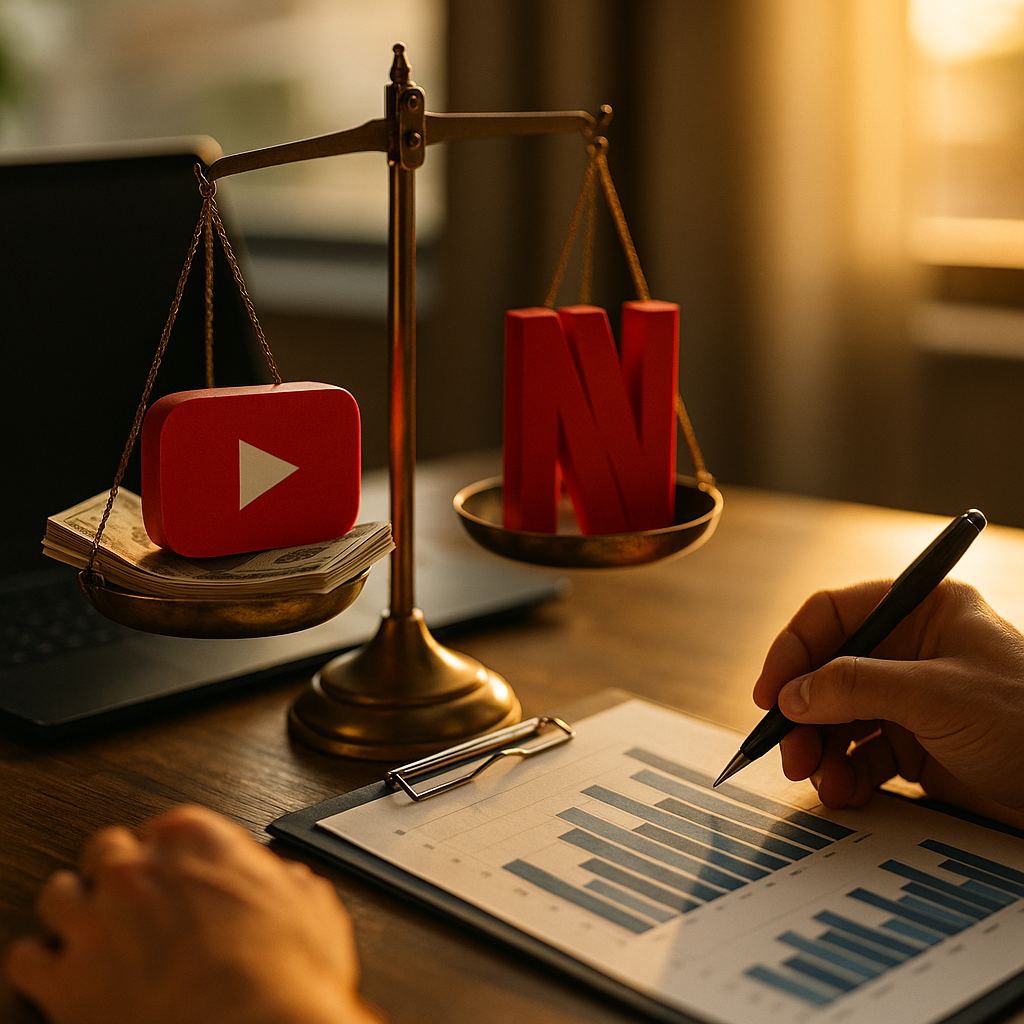
Netflix Gets the Awards. YouTube Gets the Eyeballs.
YouTube commands 12.7 percent of total U.S. streaming viewership — Netflix sits at 8.4 percent. For media buyers still routing the majority of video budgets toward premium subscription platforms, that gap is no longer a rounding error. It’s a strategic miscalculation.
What the Viewership Gap Actually Means for Budget Allocation
Raw share numbers are a starting point, not a conclusion. The more important question is: who’s watching YouTube, under what conditions, and with what purchase intent? Because when you layer demographics and ad-supported access on top of that 12.7 percent figure, the case for reweighting creator-produced YouTube content becomes significantly stronger.
Statista viewership data consistently shows YouTube over-indexing among 18–34-year-olds — precisely the cohort that is abandoning linear TV, using ad blockers on desktop but not on connected TV, and actively choosing ad-supported content over subscription tiers. Netflix’s 8.4 percent share, by contrast, skews toward households paying for ad-free plans. The advertiser-accessible slice of that Netflix audience is considerably smaller than the headline number suggests.
Put plainly: you may be paying Netflix CPMs to reach a premium audience that opted into premium to avoid you.
YouTube’s 12.7% viewership share is fully ad-supported by default. Netflix’s 8.4% share is split between ad-free subscribers and a much smaller ad-supported tier — making the actual addressable advertising audiences far less comparable than the headline numbers imply.
Creator Content Is Not a Downgrade From Studio Content
This is the assumption worth challenging directly. Many brand strategists still categorize creator-produced content as lower-quality inventory compared to Netflix originals or network television — a reflex inherited from a media planning era when production value correlated with audience quality. That correlation has broken down.
MrBeast’s productions now rival studio budgets. Long-form educational channels in finance, health, and technology routinely attract viewers with household incomes and education levels comparable to CNBC’s audience. And unlike Netflix placements, creator content on YouTube arrives with an audience that is already opted into the creator’s recommendation. The trust transfer is baked in. That’s not an editorial opinion — it’s what brands investing in video ad budget strategy have been modeling for the last two upfront cycles.
The more operationally useful frame: YouTube creator inventory is not a substitute for TV. It’s a parallel reach channel with superior targeting, better attribution, and a demographic skew that most TV buys simply cannot access efficiently.
The Ad-Supported Audience Advantage
Netflix’s AVOD (ad-supported video on demand) tier has grown, but let’s be precise about what advertisers are actually buying. Netflix’s ad-supported tier remains a fraction of its overall subscriber base, and CPMs on Netflix have historically entered negotiations at premium levels — often $39–$65 per thousand impressions at launch — before settling downward under supply pressure. YouTube’s CPMs for connected TV placements are meaningfully lower while reaching a larger, more measurable audience.
For brands targeting younger consumers, the math compounds in YouTube’s favor. Gen Z spends more daily minutes on YouTube than on Netflix. They skip ads on YouTube but rewatch creator integrations. They search for product reviews on YouTube before purchasing. If your brand’s objective involves this cohort, the Gen Z brand loyalty data points in one direction: creator-native content on YouTube outperforms passive ad placement on subscription platforms for consideration and purchase intent metrics.
Platforms like eMarketer have documented YouTube’s connected TV growth as one of the most significant shifts in video advertising reach — it’s no longer a mobile-first platform. YouTube on TV screens now accounts for a substantial share of its total watch time, which matters because CTV inventory commands higher brand safety standards and better completion rates.
How to Actually Weight Creator YouTube Content in Your Streaming Budget
Frameworks matter here. Vague directives to “invest more in YouTube” without operational guidance tend to land poorly in media planning meetings. Here’s a workable allocation logic:
- Audience-first segmentation: If your campaign’s primary target is 18–34, allocate a minimum of 40 percent of streaming video budget to YouTube creator integrations and YouTube CTV pre-roll before touching Netflix or Hulu AVOD.
- Attribution capability: YouTube offers pixel-level attribution, UTM tracking, and Google Analytics integration that Netflix AVOD currently cannot match. For performance-oriented campaigns, the measurement advantage alone justifies a higher YouTube weight.
- Creator integration vs. pre-roll: Pre-roll on YouTube and host-read integrations in YouTube creator content are not the same product. Host-read integrations command higher CPMs but deliver significantly higher recall and purchase intent — treat them as separate line items.
- Frequency management: YouTube’s cross-device frequency capping through Google’s infrastructure is more sophisticated than most AVOD platforms. This reduces wasted impressions, which matters when you’re comparing effective CPMs rather than rate card CPMs.
- Content category alignment: The video budget guide framework used by upfront buyers increasingly treats YouTube creator verticals — tech, personal finance, fitness, food — as audience-guaranteed environments comparable to cable network genre channels.
The IAB’s data on creator ad spend growth shows that sophisticated buyers are already moving in this direction — the question is whether your organization is building the operational infrastructure to execute against creator-YouTube buys at scale.
What Netflix Still Does Better
Intellectual honesty matters here. Netflix retains real advantages for specific brand objectives. Premium brand perception, cinematic adjacency, and upper-funnel awareness among 35–54-year-olds with high disposable income — Netflix’s ad-supported placements can still deliver on these. If your campaign requires the implicit endorsement of appearing alongside prestige long-form content, that signal is harder to replicate with creator inventory.
Netflix also offers brand safety at a structural level that YouTube’s creator ecosystem, despite significant improvements in content moderation and brand safety tools, cannot fully guarantee at the creator-content layer. This is a legitimate operational risk, and creator brief strategy and vetting processes need to account for it.
The argument isn’t to abandon Netflix AVOD. It’s to stop treating Netflix’s 8.4 percent share as equivalent to YouTube’s 12.7 percent when the underlying audience composition, ad-supported access, and measurement capability differ so fundamentally.
The Infrastructure Required to Execute This Shift
Reweighting budgets toward creator YouTube content requires more than a spreadsheet adjustment. Brands need creator discovery infrastructure, brief development processes calibrated for long-form YouTube formats, and contract structures that separate pre-roll buys from host-read integrations. The paid-first distribution playbook that works on TikTok and Instagram requires meaningful adaptation for YouTube’s longer content windows and different algorithmic logic.
Google Ads and YouTube’s brand partnerships team have built programmatic tools that allow media buyers to layer creator content with paid amplification — a capability that effectively extends organic creator reach with precision targeting. Used correctly, this turns a single creator integration into a full-funnel asset.
The brands seeing the strongest returns aren’t treating YouTube creator content as an influencer marketing line item. They’re treating it as a media channel with its own buying logic, measurement framework, and creative standards. That operational shift — more than the budget reallocation itself — is where the competitive advantage lives.
The brands winning on YouTube aren’t just spending more there. They’ve built internal systems to buy creator content the way they buy media — with CPM targets, attribution models, and frequency caps. That operational discipline is the real differentiator.
If your team hasn’t yet modeled the ROI of paid amplification layered on top of organic creator reach, that’s the immediate next step — run a controlled test across YouTube creator integrations with paid boost, against equivalent Netflix AVOD spend, and compare measured outcomes against your actual target demographic, not the platform’s claimed audience.
Frequently Asked Questions
Why does YouTube’s viewership share matter more than Netflix’s for ad-supported campaigns?
YouTube’s entire viewership base is ad-supported by default, meaning the full 12.7 percent share is addressable to advertisers. Netflix’s 8.4 percent share is divided between ad-free subscribers and a smaller ad-supported tier, so the actual audience available to advertisers is a fraction of that headline number. For brands targeting younger, ad-tolerant audiences, YouTube’s reach advantage compounds further because of its demographic skew toward 18–34-year-olds.
How should media buyers differentiate between YouTube pre-roll and creator host-read integrations?
They are fundamentally different products and should not share a budget line. Pre-roll is interruptive and skippable — effective for awareness at scale, measurable by completion rate and view-through. Host-read integrations are embedded in a creator’s editorial content and benefit from audience trust in the creator. They command higher CPMs but typically deliver stronger brand recall, purchase intent lift, and lower effective cost-per-conversion. Budget each separately and apply separate success metrics.
What brand safety risks are specific to YouTube creator content, and how do buyers manage them?
The primary risks are creator behavior post-placement, content adjacency in recommendation feeds, and inconsistent brand guideline adherence across creator-produced formats. Mitigation requires rigorous creator vetting before contracting, clear behavioral clauses in agreements, and use of YouTube’s inclusion and exclusion lists in programmatic buys. Brands running large-scale creator programs should also monitor creator channels continuously, not just at the time of the integration.
Is YouTube’s CTV (connected TV) inventory genuinely comparable to Netflix as a premium environment?
For targeting and measurement purposes, yes. YouTube on television screens now accounts for a significant share of total YouTube watch time, and the viewing behavior — lean-back, longer sessions, shared household screens — mirrors traditional TV consumption. CPMs for YouTube CTV inventory are generally lower than Netflix AVOD, with stronger attribution capabilities. It is not a perfect substitute for the brand prestige signal of Netflix adjacency, but for performance-oriented campaigns targeting younger audiences, YouTube CTV often delivers better measured outcomes.
How does creator-produced YouTube content fit into an upfront video budget framework?
Increasingly, sophisticated buyers are negotiating YouTube creator integrations alongside traditional upfront deals — treating creator verticals the way they treat cable network genre environments. This means securing audience guarantees, negotiating integration formats upfront rather than on a per-campaign basis, and building annual creator relationships rather than one-off placements. The upfront model applied to creator content provides cost stability, priority access, and the ability to build longitudinal brand presence within a creator’s audience.
Top Influencer Marketing Agencies
The leading agencies shaping influencer marketing in 2026
Agencies ranked by campaign performance, client diversity, platform expertise, proven ROI, industry recognition, and client satisfaction. Assessed through verified case studies, reviews, and industry consultations.
Moburst

-
2

The Shelf
Boutique Beauty & Lifestyle Influencer AgencyA data-driven boutique agency specializing exclusively in beauty, wellness, and lifestyle influencer campaigns on Instagram and TikTok. Best for brands already focused on the beauty/personal care space that need curated, aesthetic-driven content.Clients: Pepsi, The Honest Company, Hims, Elf Cosmetics, Pure LeafVisit The Shelf → -
3

Audiencly
Niche Gaming & Esports Influencer AgencyA specialized agency focused exclusively on gaming and esports creators on YouTube, Twitch, and TikTok. Ideal if your campaign is 100% gaming-focused — from game launches to hardware and esports events.Clients: Epic Games, NordVPN, Ubisoft, Wargaming, Tencent GamesVisit Audiencly → -
4

Viral Nation
Global Influencer Marketing & Talent AgencyA dual talent management and marketing agency with proprietary brand safety tools and a global creator network spanning nano-influencers to celebrities across all major platforms.Clients: Meta, Activision Blizzard, Energizer, Aston Martin, WalmartVisit Viral Nation → -
5

The Influencer Marketing Factory
TikTok, Instagram & YouTube CampaignsA full-service agency with strong TikTok expertise, offering end-to-end campaign management from influencer discovery through performance reporting with a focus on platform-native content.Clients: Google, Snapchat, Universal Music, Bumble, YelpVisit TIMF → -
6

NeoReach
Enterprise Analytics & Influencer CampaignsAn enterprise-focused agency combining managed campaigns with a powerful self-service data platform for influencer search, audience analytics, and attribution modeling.Clients: Amazon, Airbnb, Netflix, Honda, The New York TimesVisit NeoReach → -
7

Ubiquitous
Creator-First Marketing PlatformA tech-driven platform combining self-service tools with managed campaign options, emphasizing speed and scalability for brands managing multiple influencer relationships.Clients: Lyft, Disney, Target, American Eagle, NetflixVisit Ubiquitous → -
8

Obviously
Scalable Enterprise Influencer CampaignsA tech-enabled agency built for high-volume campaigns, coordinating hundreds of creators simultaneously with end-to-end logistics, content rights management, and product seeding.Clients: Google, Ulta Beauty, Converse, AmazonVisit Obviously →