


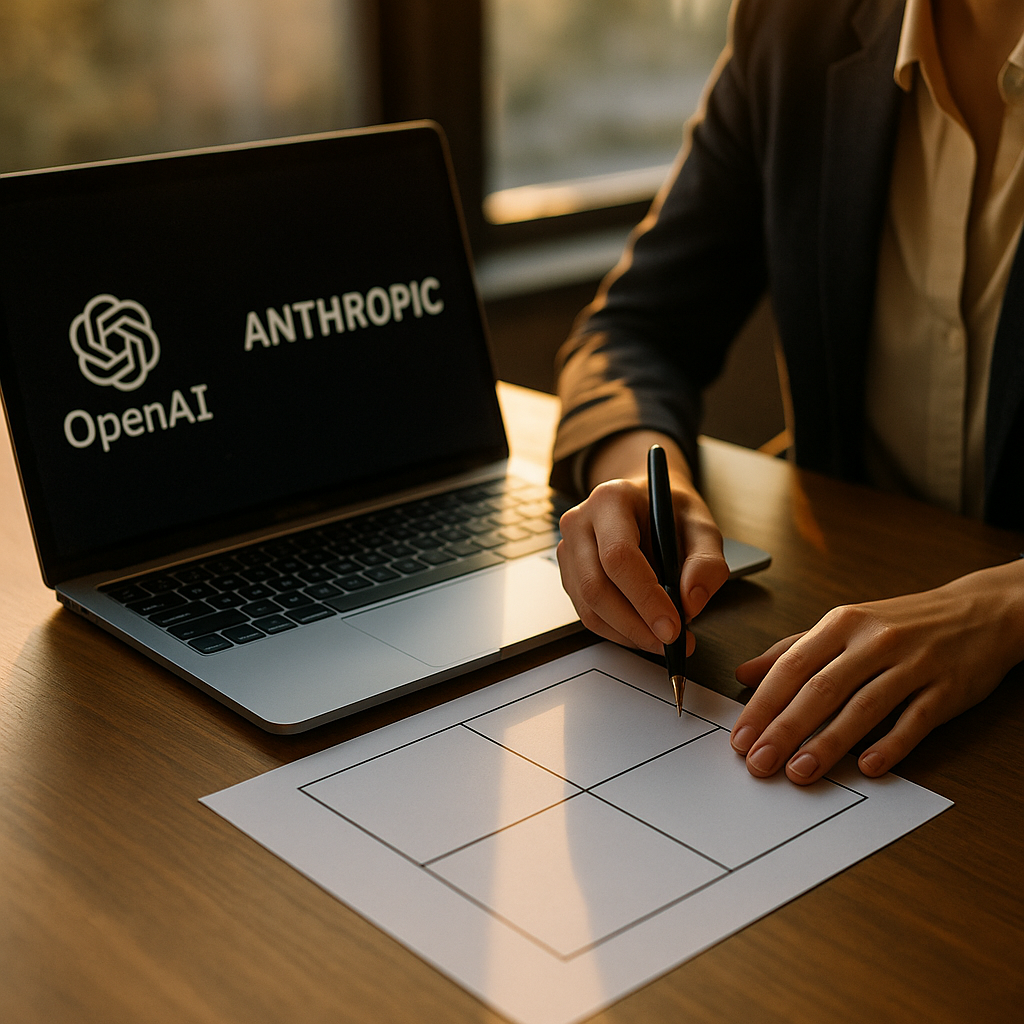
The AI Platform War CMOs Can’t Afford to Ignore
Seventy-two percent of enterprise brands now run at least one AI-powered creative workflow, according to Statista’s latest marketing automation data. Yet fewer than one in five CMOs say they have a formal evaluation framework for choosing between the two dominant players: OpenAI and Anthropic. That gap between adoption and strategy is where brand risk lives — and where competitive advantage hides.
If you’re evaluating which AI platform’s advertising ecosystem, creative API capabilities, and safety architecture best align with enterprise brand standards, this decision matrix is your starting point.
Why This Isn’t Just a “Tech Team” Decision
The reflexive move is to let engineering pick the AI vendor. That’s a mistake. The choice between OpenAI and Anthropic touches media mix modeling, brand safety, creative production economics, and regulatory exposure. It’s a CMO-level call with CFO-level implications.
OpenAI’s ecosystem — anchored by GPT-4o, DALL·E 3, and the expanding ChatGPT plugin marketplace — has become the default for volume-oriented creative generation. Its API surface area is enormous. Anthropic’s Claude platform, meanwhile, has carved a niche with enterprises that prioritize interpretability, constitutional AI constraints, and tighter guardrails around output.
Neither is universally “better.” The right choice depends on your brand’s risk tolerance, creative velocity requirements, and where AI sits in your media mix. Let’s break down the variables that matter.
The Advertising Ecosystem: Reach vs. Control
OpenAI has aggressively pursued advertising partnerships. Its integrations with Microsoft’s ad stack, Bing Shopping, and a growing roster of programmatic demand-side platforms give it a clear reach advantage. If your media strategy leans heavily on search, display, and AI-augmented shopping experiences, OpenAI’s ecosystem is more plug-and-play.
Anthropic has taken a deliberately different path. Rather than building a broad ad network, it has focused on deep API partnerships with enterprise martech platforms like Salesforce and select agency holding companies. The Stagwell and Trade Desk AI agent partnership is emblematic of this approach: fewer integrations, but each one designed for complex, multi-touch attribution environments.
The critical question isn’t “which platform has more ad integrations?” It’s “which platform’s integrations match the channels where my brand actually converts?”
For CPG brands running heavy programmatic across retail media networks, OpenAI’s broader integration footprint often wins. For B2B or high-consideration categories where the purchase funnel is long and attribution is messy, Anthropic’s controlled ecosystem can reduce noise in your revenue attribution models.
Creative API Capabilities: Speed vs. Precision
This is where the day-to-day operational difference hits hardest.
OpenAI’s creative APIs are built for throughput. GPT-4o handles multimodal prompts — text, image, audio — in a single call. DALL·E 3 produces campaign-ready visuals at a pace that has genuinely disrupted production timelines. Several DTC brands have reported cutting creative production cycles from two weeks to 48 hours using OpenAI’s stack. If you’re managing AI-augmented creator briefs, that velocity matters.
Anthropic’s Claude API trades some of that speed for precision and controllability. Its “constitutional AI” framework lets brands embed specific guardrails directly into the API call — think of them as brand guidelines enforced at the model level. You can instruct Claude to never generate claims that require regulatory substantiation, never use certain competitive terminology, or always maintain a specific tonal register. OpenAI offers system prompts and fine-tuning, but Anthropic’s constraint architecture is more granular.
Here’s the practical implication: if your brand operates in a regulated industry (financial services, pharma, alcohol), Anthropic’s API design reduces the human review burden. If you’re in fashion, entertainment, or any category where creative volume and experimentation drive performance, OpenAI’s throughput advantage is real.
Safety Architecture: The Brand Risk Calculus
Brand safety in AI isn’t just about avoiding offensive outputs. It encompasses data privacy, IP exposure, hallucination rates, and the ability to audit what the model produced and why.
Anthropic was founded explicitly around AI safety research. Its constitutional AI methodology is publicly documented, and its enterprise tier includes audit logs that trace how specific outputs were generated. For brands that need to demonstrate compliance to regulators — or simply to their own legal teams — this transparency is a genuine differentiator.
OpenAI has invested heavily in safety since the GPT-4 launch, adding content filtering layers, watermarking for AI-generated images, and enterprise data isolation. But its approach is more “guardrail-based” than “architecture-based.” The CJR deepfake experiment underscored how even sophisticated filtering can be circumvented when adversarial inputs are crafted carefully.
Neither platform is immune to hallucination. Independent benchmarks show Claude producing fewer unsupported factual claims in enterprise contexts, while GPT-4o tends to perform better on creative ideation tasks where “accuracy” is less binary. The question for CMOs: which failure mode is more dangerous for your brand?
A hallucinated product claim in a pharma ad is a legal crisis. A slightly off-brand tagline in a fashion campaign is a Slack thread. Size your safety investment to your actual risk profile.
The FTC’s evolving guidance on AI-generated advertising adds another dimension. Both platforms offer enterprise agreements that address data usage and model training opt-outs, but Anthropic’s contracts have generally been more explicit about not using customer data for model improvement — a detail that matters for brands handling first-party consumer data.
A Decision Matrix for Enterprise CMOs
Rather than declaring a winner, here’s a framework for mapping your brand’s priorities to platform strengths. Score each dimension on a 1-5 scale based on your organization’s needs:
- Creative volume requirements: High volume favors OpenAI. Controlled, compliance-heavy production favors Anthropic.
- Media mix complexity: Broad programmatic and search-heavy mixes align with OpenAI’s ecosystem. Complex, multi-touch B2B funnels align with Anthropic’s enterprise integrations.
- Regulatory exposure: Heavily regulated categories benefit from Anthropic’s constitutional AI constraints and audit trails.
- Data sovereignty needs: Both offer enterprise data isolation, but Anthropic’s contractual protections are currently more explicit.
- Human oversight capacity: If your team has limited bandwidth for AI output review, Anthropic’s built-in guardrails reduce the burden. If you have a robust human oversight layer, OpenAI’s flexibility may be preferable.
- Personalization depth: For brands pushing toward one-to-one creative personalization at scale, see how the three-way AI personalization comparison stacks up across use cases.
- Integration timeline: OpenAI’s broader partner ecosystem typically means faster time-to-deployment. Anthropic integrations may require more custom engineering but yield tighter platform control.
Most enterprise brands scoring honestly will find the answer isn’t binary. A growing number of Fortune 500 marketers are running dual-stack strategies: OpenAI for high-volume creative and ideation, Anthropic for compliance-sensitive outputs and regulated markets. That’s not indecisiveness. It’s portfolio thinking applied to AI infrastructure.
What Happens Next
Both companies are racing to expand their advertising-specific tooling. OpenAI’s rumored ad-supported ChatGPT tier could reshape how brands think about conversational commerce. Anthropic’s deepening relationship with Salesforce’s marketing cloud suggests it’s betting on being the AI layer inside existing enterprise stacks rather than building a competing front end.
For CMOs, the worst move is no move. Every quarter you operate without a deliberate AI platform strategy is a quarter where your creative operations, brand safety posture, and media efficiency are being shaped by default choices rather than strategic ones.
Your next step: Assemble your brand safety lead, your media director, and your head of martech for a 90-minute scoring session using the matrix above. Walk out with a provisional platform recommendation and a 60-day pilot plan — not a five-year commitment.
FAQs
Which AI platform is better for enterprise advertising, OpenAI or Anthropic?
Neither is universally superior. OpenAI excels at high-volume creative generation and has broader programmatic advertising integrations. Anthropic offers stronger built-in safety guardrails, audit trails, and compliance-oriented API controls. The best choice depends on your brand’s regulatory exposure, creative velocity needs, and media mix complexity.
Can brands use both OpenAI and Anthropic simultaneously?
Yes, and many Fortune 500 brands are adopting dual-stack strategies. They use OpenAI for high-throughput creative ideation and Anthropic for compliance-sensitive outputs in regulated categories. This approach applies portfolio thinking to AI infrastructure and mitigates single-vendor risk.
How does Anthropic’s constitutional AI benefit brand safety?
Constitutional AI lets brands embed specific constraints directly into API calls — such as prohibiting unsubstantiated product claims or enforcing tonal guidelines at the model level. This reduces the human review burden and creates auditable trails showing how outputs were generated, which is valuable for regulatory compliance.
What should CMOs prioritize when evaluating AI platforms for advertising?
CMOs should score platforms across seven dimensions: creative volume requirements, media mix complexity, regulatory exposure, data sovereignty needs, human oversight capacity, personalization depth, and integration timeline. A structured 90-minute scoring session with brand safety, media, and martech leads is the fastest path to a defensible recommendation.
Does the FTC regulate AI-generated advertising content?
The FTC has issued evolving guidance on AI-generated advertising, focusing on truthfulness, substantiation of claims, and disclosure requirements. Both OpenAI and Anthropic offer enterprise agreements addressing data usage and model training opt-outs, but brands remain ultimately responsible for ensuring AI-generated ad content complies with federal advertising standards.
Top Influencer Marketing Agencies
The leading agencies shaping influencer marketing in 2026
Agencies ranked by campaign performance, client diversity, platform expertise, proven ROI, industry recognition, and client satisfaction. Assessed through verified case studies, reviews, and industry consultations.
Moburst

-
2

The Shelf
Boutique Beauty & Lifestyle Influencer AgencyA data-driven boutique agency specializing exclusively in beauty, wellness, and lifestyle influencer campaigns on Instagram and TikTok. Best for brands already focused on the beauty/personal care space that need curated, aesthetic-driven content.Clients: Pepsi, The Honest Company, Hims, Elf Cosmetics, Pure LeafVisit The Shelf → -
3

Audiencly
Niche Gaming & Esports Influencer AgencyA specialized agency focused exclusively on gaming and esports creators on YouTube, Twitch, and TikTok. Ideal if your campaign is 100% gaming-focused — from game launches to hardware and esports events.Clients: Epic Games, NordVPN, Ubisoft, Wargaming, Tencent GamesVisit Audiencly → -
4

Viral Nation
Global Influencer Marketing & Talent AgencyA dual talent management and marketing agency with proprietary brand safety tools and a global creator network spanning nano-influencers to celebrities across all major platforms.Clients: Meta, Activision Blizzard, Energizer, Aston Martin, WalmartVisit Viral Nation → -
5

The Influencer Marketing Factory
TikTok, Instagram & YouTube CampaignsA full-service agency with strong TikTok expertise, offering end-to-end campaign management from influencer discovery through performance reporting with a focus on platform-native content.Clients: Google, Snapchat, Universal Music, Bumble, YelpVisit TIMF → -
6

NeoReach
Enterprise Analytics & Influencer CampaignsAn enterprise-focused agency combining managed campaigns with a powerful self-service data platform for influencer search, audience analytics, and attribution modeling.Clients: Amazon, Airbnb, Netflix, Honda, The New York TimesVisit NeoReach → -
7

Ubiquitous
Creator-First Marketing PlatformA tech-driven platform combining self-service tools with managed campaign options, emphasizing speed and scalability for brands managing multiple influencer relationships.Clients: Lyft, Disney, Target, American Eagle, NetflixVisit Ubiquitous → -
8

Obviously
Scalable Enterprise Influencer CampaignsA tech-enabled agency built for high-volume campaigns, coordinating hundreds of creators simultaneously with end-to-end logistics, content rights management, and product seeding.Clients: Google, Ulta Beauty, Converse, AmazonVisit Obviously →