


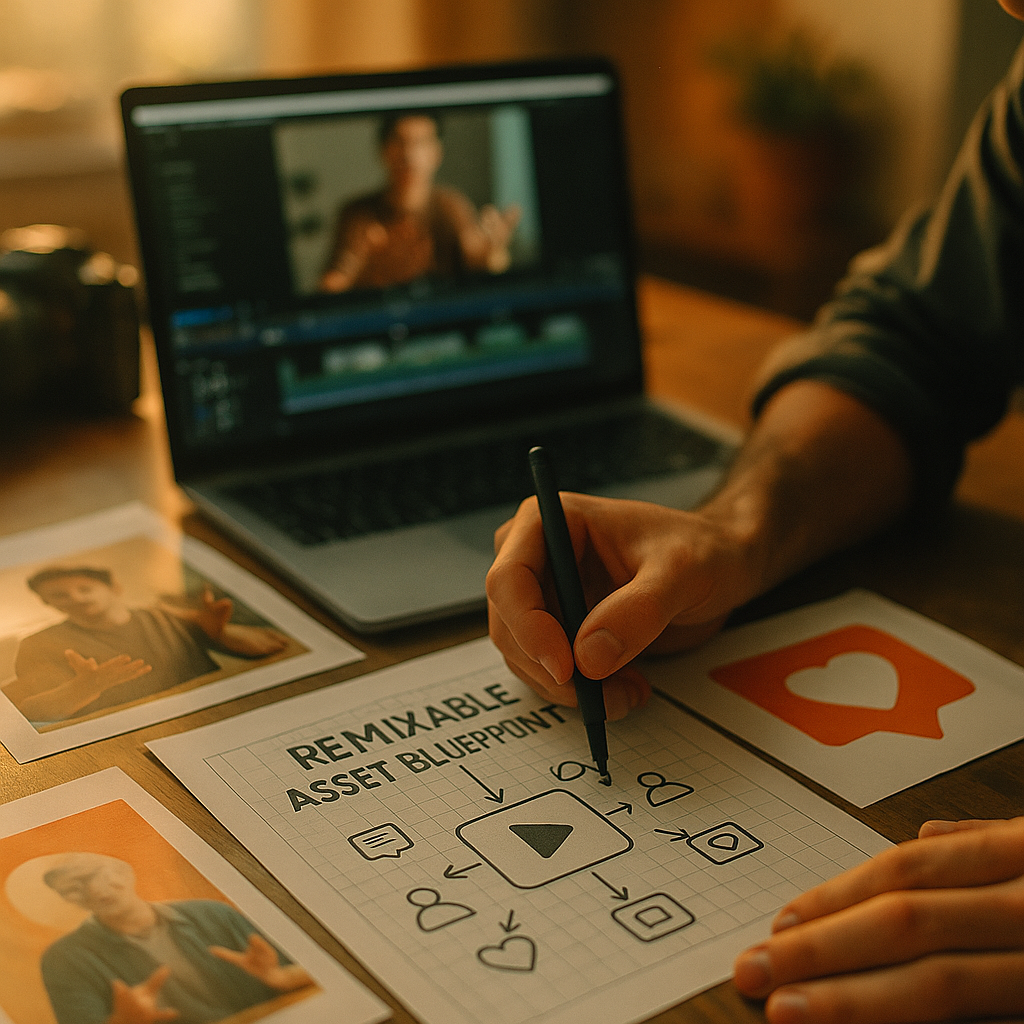
The Remixable Asset Blueprint: Designing Creator Content That Spreads Itself
Brands that design for remixability see 2.8x more earned impressions per campaign dollar than those that don’t, according to TikTok’s business insights. That’s not a rounding error — it’s the difference between a campaign that dies on delivery and one that compounds for weeks. The remixable asset blueprint is how creative directors engineer content that invites duets, stitches, and AI-generated derivatives without spending another cent on distribution.
Why “Finished” Content Is a Liability
Most brand creative ships as a closed object. Polished, locked, final. Every frame deliberate, every beat resolved. That’s great for a TV spot. It’s death on platforms built around participation.
Think about it: TikTok, Instagram Reels, and YouTube Shorts reward content that generates response content. Their algorithms don’t just measure views — they measure what happens after someone watches. Duets, stitches, remixed audio, green-screen reactions. Every derivative piece creates a new node in the recommendation graph, feeding your original asset back into discovery feeds.
A piece of content that can’t be remixed is a piece of content that can only travel as far as your media budget pushes it. Design for openness, and the platform’s own users become your distribution engine.
This doesn’t mean shipping sloppy work. It means shipping strategically incomplete work — content with deliberate gaps that creators feel compelled to fill. The distinction matters enormously for brand safety, which is why pairing this approach with a solid brand safety brief framework is non-negotiable.
The Three Pillars of Remixable Design
After studying campaigns from brands like Duolingo, Crocs, and CeraVe that consistently generate outsized earned media, a pattern emerges. Remixable assets share three structural features: deliberate remix hooks, open narrative structures, and platform-compatible format signals. Let’s break each one down.
Deliberate Remix Hooks
A remix hook is any element within your content specifically designed to be extracted, responded to, or built upon. These aren’t accidents. They’re engineered.
- Audio hooks: A distinctive sound, phrase, or beat that works as a standalone audio clip. Think Nara Smith’s ASMR cadence or the “oh no” sound that launched millions of reaction videos. Brand content needs a sonic signature that creators want to reuse.
- Visual hooks: A green-screen-friendly background, a product placement that begs for a reaction shot, or a visual template (split screen, before/after, ranking format) that others can replicate with their own content.
- Challenge hooks: An explicit or implicit dare. “Show us your version.” “Bet you can’t do this.” The hook works because it creates social proof pressure — once three or four creators respond, dozens more follow. Our guide on challenge-based retail campaigns covers the briefing mechanics in detail.
- Data or opinion hooks: A bold claim, a surprising stat, or a controversial take that creators feel compelled to validate, debunk, or riff on. “This $8 moisturizer outperforms $200 serums” practically writes the duet for you.
The key insight: every asset should contain at least two hook types. Audio-only hooks die if the platform suppresses your sound. Visual-only hooks fail if the trend shifts to voice-first formats. Redundancy isn’t waste — it’s resilience.
Open Narrative Structures
Closed narratives have a beginning, middle, and end. The viewer consumes and moves on. Open narratives deliberately leave one of those elements unresolved.
Three structures work particularly well:
- The unfinished premise. You set up a scenario and cut before the payoff. “I tried the brand’s new product for 30 days and—” End. Creators finish the story with their own experience. The cliffhanger isn’t lazy; it’s an invitation.
- The forking path. Present two options and let the audience (or other creators) choose. “Would you rather have this feature or that feature?” This triggers duet responses where creators pick sides and argue their case — generating conversation threads the algorithm loves.
- The expandable frame. Your content occupies one half of the screen (or one perspective of a story) and leaves the other half literally empty for a duet or stitch. This is especially potent on TikTok, where the duet format places two videos side by side.
If you’re already using story arc briefs for your creator partnerships, you can adapt them by simply removing the third act from your brief. Give creators the setup and conflict. Let them supply the resolution.
Platform-Compatible Format Signals
This is where many creative directors stumble. They design beautiful content that’s technically incompatible with remix features.
Format signals are the structural cues that tell both the platform algorithm and human creators that your content is remix-ready:
- Aspect ratio and safe zones: If you’re designing for duets, your core content needs to work in a half-screen format. That means keeping key visual information centered and avoiding critical elements near the edges that will be cropped.
- Audio separation: Upload content where the voiceover, music, and sound effects are cleanly layered. TikTok and Instagram both let users extract original audio — if your audio is muddled, nobody’s reusing it.
- Stitch-friendly openings: The first three seconds need to function as a standalone clip, because that’s the maximum length a stitch captures on TikTok. Front-load your hook. Don’t bury it under a logo animation.
- Caption and text overlay positioning: Leave space for response text. If your branded captions fill the entire screen, there’s no visual room for a creator to add their reaction text overlay.
According to Sprout Social’s research, video content optimized for platform-native features generates 47% higher engagement than repurposed cross-platform content. Format compliance isn’t a creative constraint — it’s a distribution multiplier.
Accounting for AI-Generated Derivatives
Here’s what’s changed dramatically: AI tools like CapCut’s AI remix features, Runway, and Meta’s generative AI creative tools now let anyone create derivative content from a source video in minutes. A single well-designed brand asset can spawn hundreds of AI-generated variations — new backgrounds, new voiceovers, new visual treatments — all tracing back to your original.
This is both an opportunity and a risk.
The opportunity: your campaign reach can snowball without additional paid spend. One original asset becomes a hundred organic derivatives, each surfacing in different audience segments the algorithm identifies as receptive.
The risk: brand integrity erosion. An AI-remixed version of your content might strip context, alter messaging, or appear alongside content your brand wouldn’t endorse. Understanding the velocity-authenticity trade-off is essential here.
Design AI-remix guardrails into your content from the start. Embed watermarks, use consistent sonic branding, and include visual brand markers that persist even when the content is modified. Your logo should be integrated into the action, not slapped on as an end card that gets clipped.
Smart creative directors are now shipping “remix kits” alongside their hero assets — a folder of separated audio stems, transparent-background product images, brand-approved color overlays, and template files. This doesn’t cost much to produce, and it channels derivative creation toward on-brand outcomes. It’s the same operational logic behind scaling a UGC content engine, just extended to account for AI workflows.
Measuring What Remixability Actually Produces
You can’t justify this approach to a CFO with “vibes.” You need metrics.
Track these specifically:
- Derivative count: How many duets, stitches, remixes, and AI-generated variants originated from your source asset? TikTok’s Creator Marketplace and HubSpot’s social analytics both offer ways to track this.
- Earned impression ratio: Total impressions from derivative content divided by impressions from your original paid/owned distribution. A ratio above 1.0 means remixability is outperforming your media buy.
- Audience overlap delta: Are derivative creators reaching audiences your owned channels don’t? Use platform analytics to compare follower demographics between your brand account and the accounts producing remixed content.
- Sentiment distribution: Not all remixes are positive. Monitor whether derivatives skew toward advocacy, parody, or criticism. A healthy campaign sees 70%+ positive or neutral sentiment across derivatives.
The FTC’s endorsement guidelines still apply to derivative content that promotes your brand, even if you didn’t commission it directly. If a creator’s remix functions as an ad — and especially if they received product or payment for the original collaboration — disclosure obligations follow the content, not just the initial post.
A Practical Starting Framework
If your team ships a brand asset next week, apply this checklist before it goes live:
- Does it contain at least two remix hooks (audio + visual, audio + challenge, etc.)?
- Is the narrative intentionally open — does it leave something for a creator to complete, contest, or extend?
- Does it work in half-screen format for duets without losing core messaging?
- Can the first three seconds function as a standalone stitch clip?
- Is branded audio clean enough for extraction and reuse?
- Have you prepared a remix kit with separated assets for AI-generation tools?
- Are brand markers embedded within the content (not just as removable end cards)?
If you can check all seven, you’ve designed a remixable asset. If you can only check four, you’ve still dramatically improved your odds versus shipping another closed, “finished” piece of content.
Your next step: Pick your highest-performing creator asset from last quarter, audit it against this checklist, and identify which hooks were missing. Then rebuild the brief for your next campaign with those gaps filled. The compounding starts with one asset designed to be opened, not just watched.
Frequently Asked Questions
What is a remixable asset in influencer marketing?
A remixable asset is a piece of brand or creator content deliberately designed with structural elements — such as extractable audio, open narratives, and platform-compatible formatting — that invite other creators and AI tools to produce derivative content like duets, stitches, and remixed videos. The goal is to extend campaign reach organically without additional paid media spend.
How do remix hooks differ from standard calls to action?
A standard call to action asks the viewer to do something outside the content — click a link, visit a store, follow an account. A remix hook invites the viewer to create new content using elements of the original. It operates within the platform’s native features (duet, stitch, audio reuse, green screen) and generates earned media rather than direct conversions.
Do brands retain control over AI-generated derivative content?
Not fully. Once content is published on platforms that allow remixing, derivative works can diverge from brand intent. However, brands can mitigate risk by embedding persistent brand markers within the content, shipping remix kits that guide derivative creation toward on-brand outcomes, and monitoring sentiment across derivatives using social listening tools.
Which platforms support the most remix-friendly features?
TikTok leads with duets, stitches, and reusable audio. Instagram Reels supports remix and audio extraction. YouTube Shorts offers a remix function tied to existing content. CapCut and other AI-powered editing tools further expand derivative creation possibilities across all platforms.
How do you measure the ROI of remixable content?
Key metrics include derivative count (how many remix pieces originated from your asset), earned impression ratio (derivative impressions divided by paid or owned impressions), audience overlap delta (whether derivatives reach new demographics), and sentiment distribution across all derivative content. An earned impression ratio above 1.0 indicates the remixability strategy is outperforming your media investment.
Top Influencer Marketing Agencies
The leading agencies shaping influencer marketing in 2026
Agencies ranked by campaign performance, client diversity, platform expertise, proven ROI, industry recognition, and client satisfaction. Assessed through verified case studies, reviews, and industry consultations.
Moburst

-
2

The Shelf
Boutique Beauty & Lifestyle Influencer AgencyA data-driven boutique agency specializing exclusively in beauty, wellness, and lifestyle influencer campaigns on Instagram and TikTok. Best for brands already focused on the beauty/personal care space that need curated, aesthetic-driven content.Clients: Pepsi, The Honest Company, Hims, Elf Cosmetics, Pure LeafVisit The Shelf → -
3

Audiencly
Niche Gaming & Esports Influencer AgencyA specialized agency focused exclusively on gaming and esports creators on YouTube, Twitch, and TikTok. Ideal if your campaign is 100% gaming-focused — from game launches to hardware and esports events.Clients: Epic Games, NordVPN, Ubisoft, Wargaming, Tencent GamesVisit Audiencly → -
4

Viral Nation
Global Influencer Marketing & Talent AgencyA dual talent management and marketing agency with proprietary brand safety tools and a global creator network spanning nano-influencers to celebrities across all major platforms.Clients: Meta, Activision Blizzard, Energizer, Aston Martin, WalmartVisit Viral Nation → -
5

The Influencer Marketing Factory
TikTok, Instagram & YouTube CampaignsA full-service agency with strong TikTok expertise, offering end-to-end campaign management from influencer discovery through performance reporting with a focus on platform-native content.Clients: Google, Snapchat, Universal Music, Bumble, YelpVisit TIMF → -
6

NeoReach
Enterprise Analytics & Influencer CampaignsAn enterprise-focused agency combining managed campaigns with a powerful self-service data platform for influencer search, audience analytics, and attribution modeling.Clients: Amazon, Airbnb, Netflix, Honda, The New York TimesVisit NeoReach → -
7

Ubiquitous
Creator-First Marketing PlatformA tech-driven platform combining self-service tools with managed campaign options, emphasizing speed and scalability for brands managing multiple influencer relationships.Clients: Lyft, Disney, Target, American Eagle, NetflixVisit Ubiquitous → -
8

Obviously
Scalable Enterprise Influencer CampaignsA tech-enabled agency built for high-volume campaigns, coordinating hundreds of creators simultaneously with end-to-end logistics, content rights management, and product seeding.Clients: Google, Ulta Beauty, Converse, AmazonVisit Obviously →