


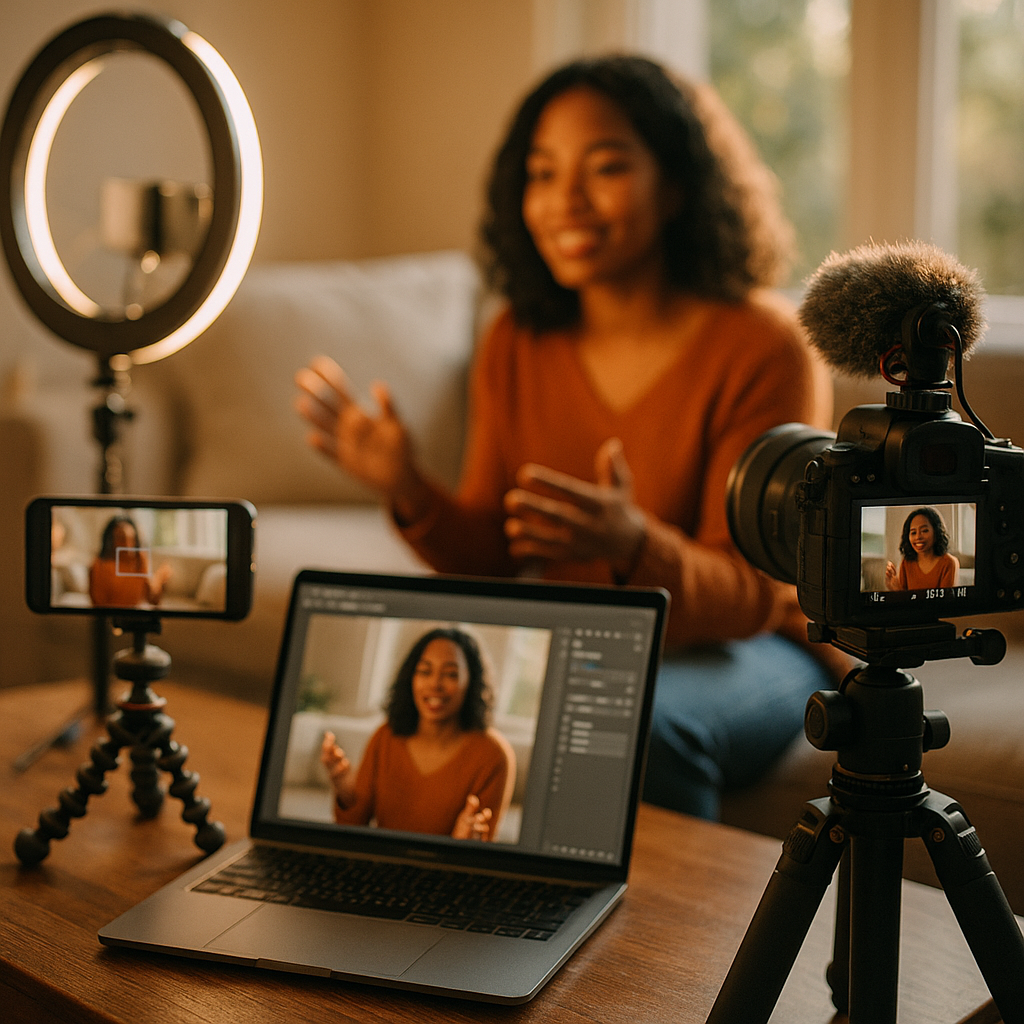
One Shoot, Four Platforms: The Multi-Format Production Template Every Brand Team Needs
Brands producing platform-specific creator content individually are spending roughly 3.2x more per asset than those using multi-format asset production workflows, according to Statista’s creator economy data. That gap widens every quarter as AI-curated feeds demand more format variations, faster. Here’s the creative direction template that collapses a four-shoot calendar into one session — without sacrificing platform-native performance.
Why Single-Session Shoots Are a Strategic Imperative, Not a Budget Hack
Let’s kill a misconception: consolidating shoots isn’t about being cheap. It’s about velocity. AI recommendation engines on TikTok, Instagram, YouTube, and LinkedIn now evaluate content freshness, format compliance, and early engagement signals within the first 30-90 minutes of posting. Miss the native formatting window — wrong aspect ratio, misplaced hook, absent commerce layer — and the algorithm buries your asset before a human ever sees it.
The math is straightforward. A mid-tier creator charges $2,500-$8,000 per shoot day. Multiply that by four platforms and you’re looking at $10,000-$32,000 for what could be a single $3,500-$9,000 session with proper creative direction. But the real savings aren’t financial. They’re temporal.
Brands running single-session multi-format workflows ship platform-ready assets 4-7 days faster than teams producing per-platform. In an AI-curated feed environment, that speed gap often determines whether content rides a trend or chases one.
If you’ve already explored multi-format creator asset libraries, this template goes deeper — adding commerce integration and AI-specific hook architecture to the production framework.
The One-Shoot Creative Direction Template
This template assumes a 3-4 hour creator session yielding raw material for TikTok, Instagram Reels, YouTube Shorts, and LinkedIn Video. It’s structured around modular content blocks rather than finished edits, giving your post-production team (or AI editing tools like Descript, CapCut Commerce Pro, or Opus Clip) the raw ingredients to assemble platform-native outputs.
Pre-Session Setup (Non-Negotiable)
- Shot list organized by content block, not by platform. You’re capturing hooks, product demos, testimonials, B-roll transitions, and CTAs as separate modules. Not “the TikTok version” and “the Reels version.”
- Frame within a 9:16 safe zone with 16:9 awareness. LinkedIn Video performs best at 1:1 or 16:9. Shoot 9:16 but ensure critical visual information stays centered for potential reframing.
- Wardrobe and set continuity plan. One outfit change mid-session gives post-production the illusion of two shoots. Simple, but easily overlooked.
- Audio capture at broadcast quality. Record with a lavalier mic separately from camera audio. LinkedIn and YouTube Shorts audiences are less tolerant of lo-fi audio than TikTok users.
- Commerce asset capture. Product close-ups, unboxing sequences, and “link-in-bio” verbal CTAs shot as standalone clips. These become your shoppable overlays.
For a deeper dive into structuring briefs that survive algorithmic scrutiny, see our guide to algorithm-proof production briefs.
Format-Specific Hook Variations: Same Story, Different First Three Seconds
The hook is the single highest-leverage variable across all four platforms. And each platform’s AI evaluates hooks differently. Here’s what the template prescribes for each surface:
TikTok (0.5-1.5 second hook window)
TikTok’s recommendation engine weighs loop completion and rewatch rate heavily. Your hook should create an open curiosity loop — a question, a visual disruption, or a mid-action start. Capture three hook variations per content block: a “controversy” hook (“Everyone’s wrong about…”), a “result-first” hook (show the outcome before the process), and a “pattern interrupt” hook (unexpected visual or sound). Our breakdown of TikTok hook architecture covers the conversion mechanics in detail.
Instagram Reels (1-2 second hook window)
Reels’ algorithm leans on saves and shares as primary distribution signals. Hooks that promise utility — “Save this for later” framing — outperform pure entertainment hooks by 23% on average for branded content, per Meta’s business insights. Capture a “how-to tease” hook and a “before/after reveal” hook for each content block.
YouTube Shorts (2-3 second hook window)
Shorts benefits from YouTube’s search-and-suggest hybrid model. Hooks should front-load a keyword-relevant statement. Think of it as a verbal title tag. “Here’s why [product category] is about to change” works because YouTube’s AI parses audio transcription for topic relevance. Capture one “search-friendly” hook and one “subscribe-bait” hook per block.
LinkedIn Video (3-5 second hook window)
LinkedIn’s algorithm rewards dwell time and comment-to-view ratio. Professional credibility hooks work here: data citations, counterintuitive business claims, or “what I learned from” framing. The tone shifts from creator-casual to practitioner-authoritative. Capture one “insight” hook and one “debate-starter” hook. This is the only platform where you may want the creator to address camera in a slightly wider shot with a neutral background — mimicking the “talking head at their desk” format that LinkedIn’s user base engages with.
During the shoot, have the creator deliver each hook variation back-to-back with a 3-second pause between takes. This gives editors clean cut points and lets you A/B test hooks without reshooting. Three hooks per platform, four platforms = 12 hook takes. It adds roughly 15 minutes to the session. That’s it.
Commerce Integration Points by Surface
This is where most multi-format templates fall apart. They treat commerce as a post-production afterthought — slap a link sticker on and call it shoppable. Each platform has distinct commerce mechanics, and your shoot needs to capture the raw material for each.
TikTok Shop: Capture a dedicated “product showcase” segment where the creator handles the product, demonstrates a use case, and delivers a verbal CTA like “tap the cart” or “check the shop.” TikTok Shop’s native checkout requires product tagging in-app, but the verbal and visual CTA must be baked into the asset. Read our template for TikTok Shop creative briefs that drive checkout behavior.
Instagram Reels + Shopping Tags: Capture product-in-frame moments that last at least 2 seconds — long enough for a shopping tag overlay. The creator should naturally gesture toward or hold up the product at a consistent point in each content block (ideally the final third, where purchase intent peaks).
YouTube Shorts + Product Shelf: YouTube’s product shelf and affiliate tagging system works best with explicit verbal product mentions. Capture the creator saying the product name and a one-line value prop. YouTube’s AI links this to the product shelf listing. This is also where TikTok’s commerce tools and YouTube’s approach diverge most — YouTube rewards specificity and product naming, while TikTok rewards organic-feeling discovery.
LinkedIn Video + CTA Links: LinkedIn doesn’t support native in-video shopping, but it does support link-in-post and newsletter CTAs. Capture a “learn more” verbal close where the creator transitions from insight-sharing to a soft sell. “We broke down the full framework — link in comments” performs well without triggering LinkedIn’s engagement-penalty algorithm for outbound links in the main post body.
Post-Session Assembly: The Edit Matrix
Once you leave the shoot, your post-production team (or your AI editing pipeline) works from an edit matrix — a spreadsheet mapping each content block to its platform destination, assigned hook variation, commerce integration point, and compliance overlay.
A practical edit matrix for a single creator session producing four platform variants looks like this:
- Content Block A → TikTok (controversy hook + shop CTA), Reels (utility hook + shopping tag at 0:18), Shorts (search hook + product shelf mention), LinkedIn (insight hook + comment CTA)
- Content Block B → Same structure, different topic angle or product feature
- Content Block C → Same structure, testimonial or social proof angle
Three content blocks × four platforms = 12 distinct assets from one 3-4 hour session. Factor in hook A/B testing and you could ship 16-24 variations. That’s a month of platform-native content from a single shoot day.
Tools like CapCut Commerce Pro, Descript, and Vizard now automate much of this reframing and clipping work. The human editorial layer focuses on hook selection, caption strategy, and commerce tag placement — the judgment calls AI still gets wrong.
Compliance and Disclosure Across Surfaces
One often-missed detail: FTC disclosure requirements don’t change across platforms, but disclosure placement best practices do. On TikTok, a verbal disclosure in the first three seconds plus a text overlay is safest. On LinkedIn, a #sponsored or #ad hashtag in the post text satisfies requirements. On Reels and Shorts, the paid partnership label handles much of the heavy lifting, but a verbal mention remains a best practice for brand safety. The FTC’s endorsement guidelines apply uniformly — it’s the platform-native implementation that varies. Build disclosure capture into your shot list. Don’t leave it to post.
For a comprehensive approach to disclosure in AI-edited content, explore our framework for AI-remix-proof disclosure compliance.
Your Next Move
Download this template structure into your next creator brief, run one consolidated session, and measure output volume against your last four-platform production cycle. Most teams see a 55-65% cost reduction and a 40% faster time-to-publish on the first attempt. The template improves from there.
FAQs
How many usable assets can a single multi-format creator session realistically produce?
A well-structured 3-4 hour session using modular content blocks typically yields 12-24 distinct platform-ready assets. This assumes three content blocks, four platform variants per block, and A/B hook testing. Output scales further if you use AI-assisted editing tools for reframing and clipping.
Do I need different creators for different platforms?
Not necessarily. A single creator can serve all four surfaces if they can shift tone between TikTok’s casual energy and LinkedIn’s professional register. During the shoot, brief them on the tonal shift for each hook variation. However, if your LinkedIn audience skews significantly older or more senior than your TikTok audience, a second creator with industry credibility may outperform on that surface.
What’s the biggest mistake brands make with multi-format production?
Shooting finished edits instead of modular content blocks. When you try to film “the TikTok” and “the Reel” as separate complete assets, you lose the flexibility to remix, re-hook, and re-commerce the content for each platform’s unique algorithm and checkout flow. Modular capture is the foundation of efficient multi-format asset production.
How do commerce integration points differ between TikTok Shop and Instagram Shopping?
TikTok Shop requires a verbal and visual CTA that directs users to an in-app cart, with product tagging handled natively in the app. Instagram Shopping relies on shopping tag overlays placed on product-in-frame moments. The key shoot difference: TikTok needs a dedicated product showcase segment, while Instagram needs 2+ second product visibility windows for tag placement.
Can AI editing tools fully automate the post-production assembly?
AI tools like Descript, CapCut Commerce Pro, and Opus Clip handle approximately 70-80% of the mechanical editing — reframing, clipping, captioning, and format conversion. Human editors are still essential for hook selection, commerce tag placement, tone calibration per platform, and compliance review. The judgment layer remains human for now.
Top Influencer Marketing Agencies
The leading agencies shaping influencer marketing in 2026
Agencies ranked by campaign performance, client diversity, platform expertise, proven ROI, industry recognition, and client satisfaction. Assessed through verified case studies, reviews, and industry consultations.
Moburst

-
2

The Shelf
Boutique Beauty & Lifestyle Influencer AgencyA data-driven boutique agency specializing exclusively in beauty, wellness, and lifestyle influencer campaigns on Instagram and TikTok. Best for brands already focused on the beauty/personal care space that need curated, aesthetic-driven content.Clients: Pepsi, The Honest Company, Hims, Elf Cosmetics, Pure LeafVisit The Shelf → -
3

Audiencly
Niche Gaming & Esports Influencer AgencyA specialized agency focused exclusively on gaming and esports creators on YouTube, Twitch, and TikTok. Ideal if your campaign is 100% gaming-focused — from game launches to hardware and esports events.Clients: Epic Games, NordVPN, Ubisoft, Wargaming, Tencent GamesVisit Audiencly → -
4

Viral Nation
Global Influencer Marketing & Talent AgencyA dual talent management and marketing agency with proprietary brand safety tools and a global creator network spanning nano-influencers to celebrities across all major platforms.Clients: Meta, Activision Blizzard, Energizer, Aston Martin, WalmartVisit Viral Nation → -
5

The Influencer Marketing Factory
TikTok, Instagram & YouTube CampaignsA full-service agency with strong TikTok expertise, offering end-to-end campaign management from influencer discovery through performance reporting with a focus on platform-native content.Clients: Google, Snapchat, Universal Music, Bumble, YelpVisit TIMF → -
6

NeoReach
Enterprise Analytics & Influencer CampaignsAn enterprise-focused agency combining managed campaigns with a powerful self-service data platform for influencer search, audience analytics, and attribution modeling.Clients: Amazon, Airbnb, Netflix, Honda, The New York TimesVisit NeoReach → -
7

Ubiquitous
Creator-First Marketing PlatformA tech-driven platform combining self-service tools with managed campaign options, emphasizing speed and scalability for brands managing multiple influencer relationships.Clients: Lyft, Disney, Target, American Eagle, NetflixVisit Ubiquitous → -
8

Obviously
Scalable Enterprise Influencer CampaignsA tech-enabled agency built for high-volume campaigns, coordinating hundreds of creators simultaneously with end-to-end logistics, content rights management, and product seeding.Clients: Google, Ulta Beauty, Converse, AmazonVisit Obviously →