


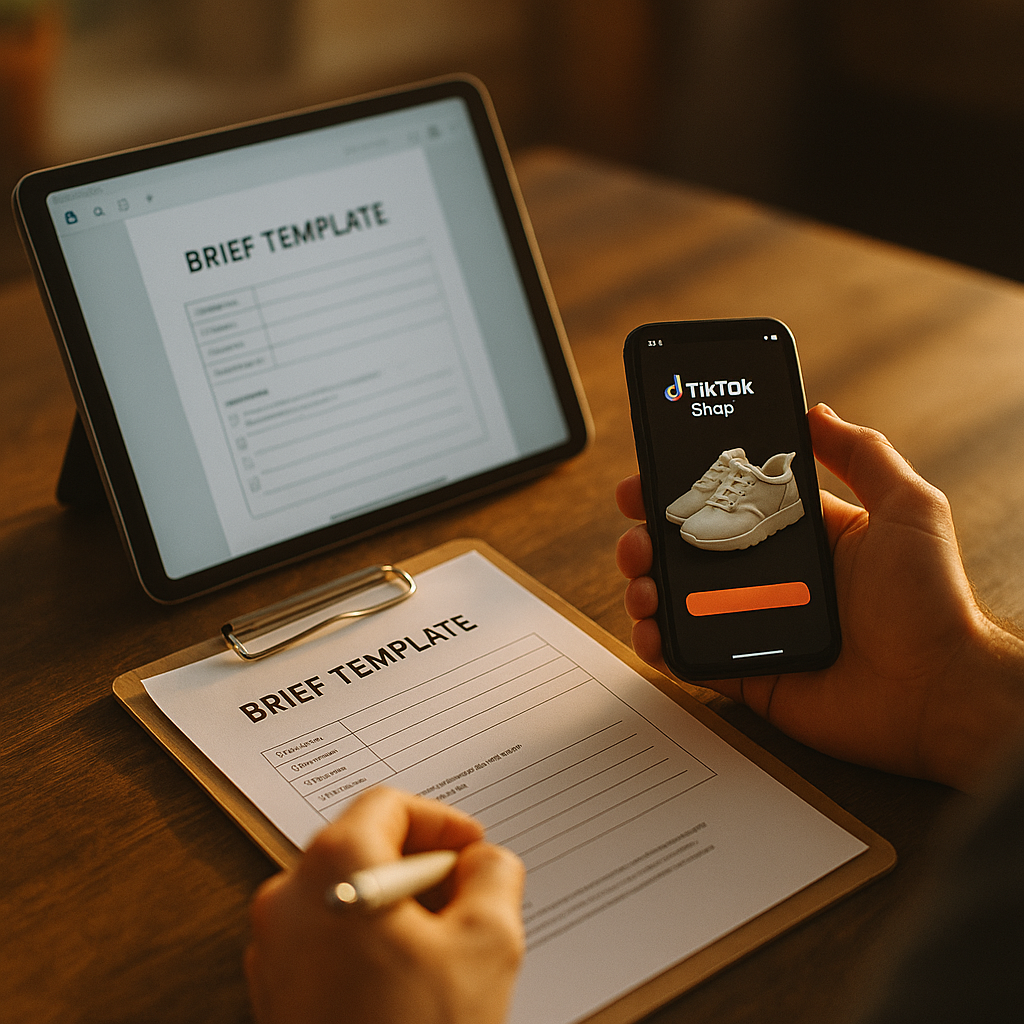
TikTok Shop Converts in Seconds. Your Brief Needs to Work That Fast.
Roughly 67% of TikTok Shop purchases happen within the first viewing session, with no second-screen research, no price comparison tab, no abandoned-cart email required. If your creative brief isn’t engineered around that window, you’re not briefing for TikTok — you’re briefing for a platform that doesn’t exist. This guide gives you the structural template to fix that, category by category.
Why Standard Briefs Fail on TikTok Shop
Most brand-side briefs are written for awareness, then retrofitted for commerce. They specify brand tone, messaging pillars, maybe a CTA. What they don’t specify is when the product appears, how the checkout pin is introduced, or what narrative structure accelerates the decision without feeling like a pitch. Those omissions are catastrophically expensive on TikTok, where the algorithm rewards completion rate and the shop tab rewards friction-free purchase intent simultaneously.
The fundamental mismatch: traditional briefs assume a consideration period. TikTok Shop collapses consideration into the content itself. The creator’s video isn’t driving traffic to a product page — it is the product page. Your brief has to treat it that way.
If you want to understand how emotional drivers further shape this, the TikTok Shop emotional engagement brief covers the affective layer that sits underneath the structural decisions here.
The High-Intent Category Framework
Not all TikTok Shop categories convert at the same speed or through the same triggers. Before you write a single line of creative direction, you need to categorize your product into one of three purchase-behavior profiles:
- Impulse-accelerated: Beauty, personal care, low-AOV accessories. Decision happens in under 30 seconds. The brief must front-load the visual proof, minimize setup narrative, and place the checkout pin at the 15–20 second mark.
- Problem-solution: Home, fitness, wellness, kitchen tools. Viewer needs to recognize a problem they have. Brief must script the problem articulation before product reveal, using the creator’s genuine experience language — not brand copy.
- Social validation: Fashion, trending lifestyle, seasonal. Purchase is triggered by identity fit, not utility. Brief must specify community-anchoring language and creator visual context (aesthetic alignment over product close-ups).
Each profile requires different narrative pacing, different product placement timing, and a different relationship between the verbal script and the on-screen Shop pin. A beauty brief that runs like a wellness tutorial will underperform both.
The Narrative Architecture: Seven Seconds to Hook, Twelve to Convert
Here’s the hard structure. Every high-converting TikTok Shop video follows a compression arc, not a storytelling arc. Brief your creators against these time-stamped beats:
- 0–3 seconds: Pattern interrupt. Specify the visual hook. Not “engaging opening” — specify whether it’s a before/after reveal, a provocative question on-screen, or an action that implies a payoff. Make the brief directive, not suggestive.
- 3–8 seconds: Problem or desire articulation. The creator names the pain point or the aspiration in their own voice. Brief allows improvisation here but must constrain the topic, not the language.
- 8–18 seconds: Product in context. Not a product shot — product in use, producing a visible result. The brief must specify what the result looks like and where on screen it registers. This is where Shop pin placement begins.
- 18–28 seconds: Proof layer. Social proof (comments, before/after), sensory detail, or a comparison contrast. Brief specifies which proof type matches the category profile.
- 28–35 seconds: Frictionless close. Creator directs to pinned product without language that registers as an ad. Brief must explicitly prohibit “link in bio” phrasing and instead mandate direct Shop pin reference or on-screen tap gesture.
The single most expensive brief omission in TikTok Shop campaigns is failing to specify Shop pin placement timing. Pins that appear after the 25-second mark see measurably lower tap-through rates — viewers who converted have already made the decision; viewers who haven’t have scrolled away.
This compression architecture works because TikTok’s documented immediacy behavior is not irrational — it’s conditioned. The TikTok for Business data consistently shows that purchase intent on TikTok peaks during content consumption, not after. Your brief exists to exploit that peak, not to educate the viewer over multiple sessions.
Product Placement Directives That Actually Matter
Placement isn’t just about when the product appears — it’s about how it appears relative to the creator’s body language, the audio, and the caption layer. Brands that brief “show the product” get wildly inconsistent execution. Brands that brief this way get repeatable performance:
- Physical integration over display: Product should be in use, not held up for camera. “Applying the serum on screen” outperforms “showing the serum bottle” by a substantial margin in beauty and skincare categories, based on aggregate Statista e-commerce engagement benchmarks.
- Audio-visual synchrony: The moment the creator mentions the product name should coincide with the on-screen product appearance. Brief this explicitly — it’s a production note, not a creative suggestion.
- Caption layering: TikTok’s native text overlays are underused in brand briefs. Specify that the product name and a single benefit appear as on-screen text during the product-in-use segment. This reinforces the verbal mention for sound-off viewers and helps the algorithm’s content parsing.
For categories with higher AOV or complexity, the product placement calculus shifts. A wellness supplement requires longer demonstration and more credentialing language than a $12 lip stain. The live commerce brief framework has additional guidance on high-AOV product structuring, though the TikTok Shop video context compresses the timing considerably.
Checkout Integration Language — The Part Brands Always Get Wrong
The moment a creator says “use my code for 10% off,” conversion intent drops. It triggers ad recognition, breaks the native content experience, and often implies that the product needs a discount to be worth buying. That’s brand damage bundled into a CTA.
Your brief needs to specify not just what to say, but what not to say. Prohibited language should be explicit in the brief, not assumed. Mandate instead:
- Direct reference to the pinned product: “I’ve linked it below” or “it’s right there in the shop” — casual, contextual, in-platform.
- Urgency signals tied to product scarcity or limited batch, not blanket discounts: “I grabbed the last two” or “this one sells out fast.”
- Trust signals embedded in the narrative, not appended: return policy or quality guarantee mentioned in the context of the creator’s own decision to purchase, not as a branded talking point.
This is where authentic algorithm signals become a commercial asset. TikTok’s algorithm interprets native-feeling commerce content differently than flagged promotional content. Briefs that preserve creator voice through the checkout CTA outperform scripted closes — and the platform’s own performance data supports this.
FTC compliance is non-negotiable here. The FTC’s disclosure guidelines require clear #ad or #sponsored disclosure regardless of how organic the content feels. Brief this separately from the creative direction — it should be a compliance checkpoint, not an afterthought buried in the creative notes.
Turning the Template Into a Repeatable System
One well-designed brief is a campaign asset. Codified across creators and SKUs, it’s a conversion infrastructure. The brands running profitable TikTok Shop programs at scale — Revolve, e.l.f. Cosmetics, Rhode — aren’t briefing creator by creator. They’re running structured templates with modular customization layers: the category profile, the product placement timing, the proof type, the close language. Creators get creative latitude within a defined conversion architecture.
For broader multi-format production thinking, the vertical video production brief provides complementary structure when you’re running parallel campaigns on Reels and Shorts alongside TikTok Shop activations.
The brands consistently outperforming on TikTok Shop aren’t producing better content — they’re running better briefs. The creative brief is the performance lever most brand-side teams underinvest in.
Build a brief review process that scores creator submissions against the time-stamped architecture before approval. Tools like Sprout Social and native TikTok Shop analytics let you back-test which brief variations drove pin tap-through and conversion — close the loop and update the template quarterly. This is how brief quality compounds into category leadership on the platform.
Also, when you’re scoping how TikTok Shop briefs interact with AI-driven product discovery, the creator content structure for AI shopping retrieval is directly relevant — TikTok’s search and recommendation infrastructure is increasingly AI-mediated, and your product language in briefs affects retrieval, not just conversion.
Your immediate next step: Audit your last three TikTok Shop briefs against the five time-stamped narrative beats above. If none of them specified Shop pin placement timing or prohibited discount-code language, you’ve found your conversion gap — and now you know how to close it.
FAQs
What makes a TikTok Shop brief different from a standard influencer brief?
A TikTok Shop brief must account for immediacy purchase behavior — the documented tendency for TikTok users to buy within the first content viewing session. This means specifying Shop pin placement timing, narrative compression architecture, and checkout language directives that a standard awareness or consideration brief would never include. The creator’s video functions as the product page, so the brief has to engineer the entire purchase decision, not just the content quality.
When should the TikTok Shop pin appear in a creator’s video?
Based on platform performance data, Shop pins should appear between the 15 and 25-second mark — after the product has been shown in use but before the viewer reaches the scroll threshold. Pins placed after 25 seconds see lower tap-through rates because high-intent viewers who were going to convert have often already decided, while lower-intent viewers have moved on.
How do I brief different product categories differently on TikTok Shop?
Categorize your product into one of three purchase-behavior profiles: impulse-accelerated (beauty, accessories), problem-solution (wellness, home, fitness), or social validation (fashion, lifestyle). Each profile requires different narrative pacing, different proof types, and different product placement logic. A brief written for one profile applied to another category will structurally underperform regardless of creator quality.
What checkout language should creators avoid in TikTok Shop videos?
Creators should avoid discount code language (“use my code for X% off”), “link in bio” references, and generic ad-style CTAs. These trigger ad recognition in viewers and break the native content experience. Instead, brief creators to reference the pinned product casually (“it’s linked below”), use scarcity signals tied to the product specifically, and embed trust signals naturally within the narrative rather than appending them at the end.
How do I maintain FTC compliance while keeping TikTok Shop content feeling native?
FTC disclosure requirements — #ad or #sponsored labels — must be included regardless of how organic the content is structured. Treat compliance as a separate brief checkpoint from creative direction. The disclosure should be clearly visible without being buried in hashtags. Native-feeling content and proper disclosure are not mutually exclusive; the brief should specify both the disclosure format and the creative approach as distinct requirements.
Top Influencer Marketing Agencies
The leading agencies shaping influencer marketing in 2026
Agencies ranked by campaign performance, client diversity, platform expertise, proven ROI, industry recognition, and client satisfaction. Assessed through verified case studies, reviews, and industry consultations.
Moburst

-
2

The Shelf
Boutique Beauty & Lifestyle Influencer AgencyA data-driven boutique agency specializing exclusively in beauty, wellness, and lifestyle influencer campaigns on Instagram and TikTok. Best for brands already focused on the beauty/personal care space that need curated, aesthetic-driven content.Clients: Pepsi, The Honest Company, Hims, Elf Cosmetics, Pure LeafVisit The Shelf → -
3

Audiencly
Niche Gaming & Esports Influencer AgencyA specialized agency focused exclusively on gaming and esports creators on YouTube, Twitch, and TikTok. Ideal if your campaign is 100% gaming-focused — from game launches to hardware and esports events.Clients: Epic Games, NordVPN, Ubisoft, Wargaming, Tencent GamesVisit Audiencly → -
4

Viral Nation
Global Influencer Marketing & Talent AgencyA dual talent management and marketing agency with proprietary brand safety tools and a global creator network spanning nano-influencers to celebrities across all major platforms.Clients: Meta, Activision Blizzard, Energizer, Aston Martin, WalmartVisit Viral Nation → -
5

The Influencer Marketing Factory
TikTok, Instagram & YouTube CampaignsA full-service agency with strong TikTok expertise, offering end-to-end campaign management from influencer discovery through performance reporting with a focus on platform-native content.Clients: Google, Snapchat, Universal Music, Bumble, YelpVisit TIMF → -
6

NeoReach
Enterprise Analytics & Influencer CampaignsAn enterprise-focused agency combining managed campaigns with a powerful self-service data platform for influencer search, audience analytics, and attribution modeling.Clients: Amazon, Airbnb, Netflix, Honda, The New York TimesVisit NeoReach → -
7

Ubiquitous
Creator-First Marketing PlatformA tech-driven platform combining self-service tools with managed campaign options, emphasizing speed and scalability for brands managing multiple influencer relationships.Clients: Lyft, Disney, Target, American Eagle, NetflixVisit Ubiquitous → -
8

Obviously
Scalable Enterprise Influencer CampaignsA tech-enabled agency built for high-volume campaigns, coordinating hundreds of creators simultaneously with end-to-end logistics, content rights management, and product seeding.Clients: Google, Ulta Beauty, Converse, AmazonVisit Obviously →