


One Missing Disclosure. One Seven-Figure Fine.
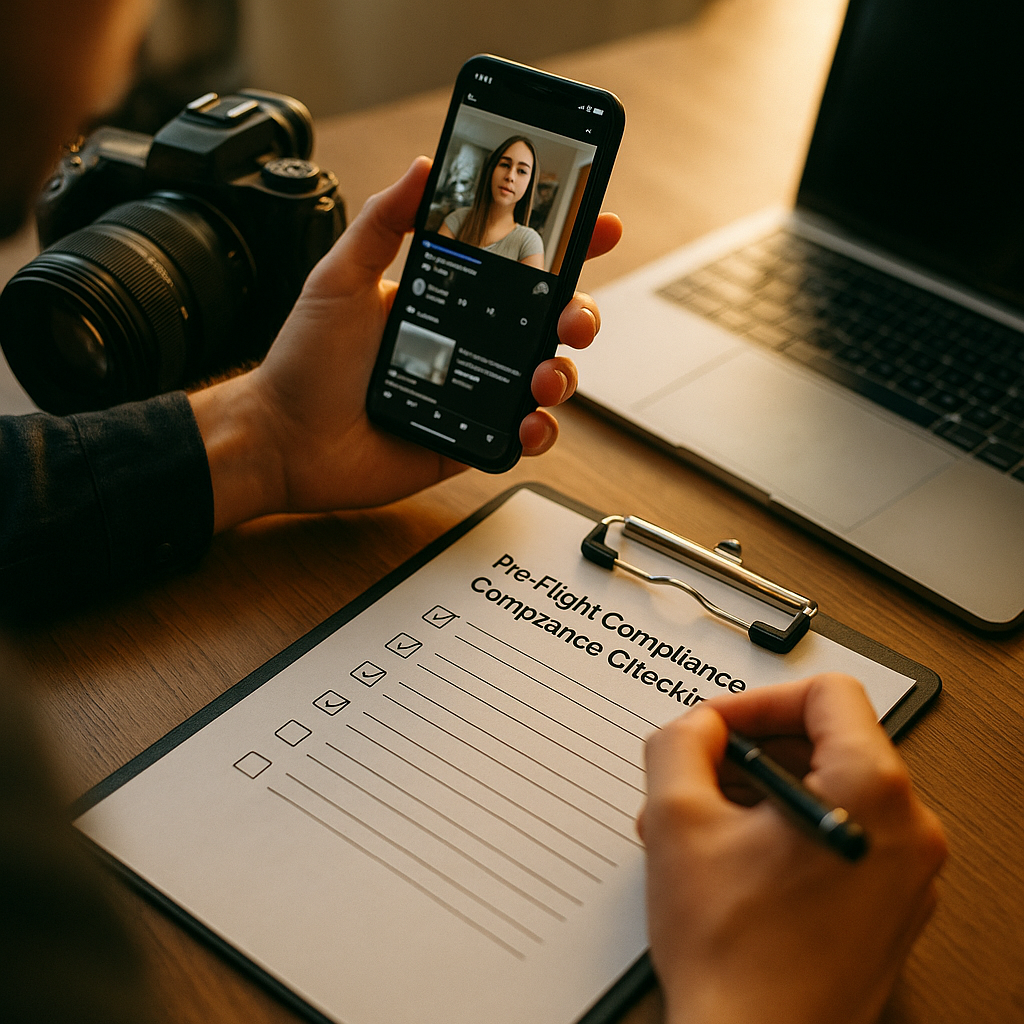
The FTC issued over $1.9 billion in civil penalties across advertising enforcement actions in the past three years. A significant slice traced back to influencer campaigns where brands approved content without a structured review process. The creator campaign pre-flight checklist exists precisely to close that gap — before a single post goes live.
Why “We Have a Brief” Is Not a Compliance Strategy
Most brand teams operate on the assumption that a well-written creator brief covers their liability exposure. It doesn’t. A brief sets intent. A pre-flight checklist confirms execution. Those are two entirely different documents solving two entirely different problems.
Think of it this way: Boeing doesn’t assume the plane is ready because the maintenance manual was distributed. The crew runs through a physical checklist before every flight, regardless of how experienced the pilot is. Your creator program deserves the same discipline — especially when the regulatory environment is this aggressive.
The gap between brief and published post is exactly where compliance failures live. Creators paraphrase claim language. They forget disclosure placement rules on specific platforms. They post to a secondary channel that wasn’t covered in the original agreement. These aren’t malicious acts. They’re operational failures — and under FTC guidelines, the brand bears liability for them. If you haven’t already addressed creator contract gaps and disclosure risk, that’s the foundation this checklist builds on.
Section 1: FTC Disclosure Language Review
The disclosure question has four moving parts that all need verification before approval.
Placement: “Ad” or “Paid partnership” must appear before the fold — meaning visible without any tap, click, or scroll. Instagram’s native paid partnership label satisfies this on feed posts. It does not automatically satisfy it on Stories if the sticker is buried in the bottom corner behind other graphic elements.
Language: The FTC’s current enforcement posture treats vague terms like “collab” or “sp” as insufficient. Acceptable terms include: #ad, #sponsored, “Paid promotion,” or the platform’s native disclosure tool where it’s clearly visible. When AI remix tools are involved in content creation, the disclosure calculus changes — see the emerging issues around AI remix tools and FTC disclosure risk for the full breakdown.
Permanence: Does the disclosure persist if the content is repurposed? A TikTok video pulled into a paid amplification campaign carries the original disclosure — but if that video gets reskinned for programmatic DOOH, you’re in new territory entirely.
Platform-native tools vs. caption-only: Always require both. Platform labels can be toggled off by accident during edits. Caption disclosures provide a redundant layer. Redundancy here is a feature, not a waste of time.
The FTC’s updated guidance treats the brand as the responsible party for disclosure compliance — not the creator. Your approval workflow is your legal defense.
Section 2: Brand Safety Gate Criteria
Brand safety in creator content isn’t just about what the creator is saying. It’s about the content environment around what they’re saying.
Your pre-flight checklist needs a defined set of gate criteria — binary pass/fail questions that disqualify content before it reaches a human review queue. This is where you operationalize brand safety rather than just aspiring to it.
Recommended gate criteria include:
- Does the content contain or reference competitor products without prior approval?
- Does the audio, background imagery, or overlay text conflict with brand positioning guidelines?
- Is the creator’s recent posting history (last 30 days) consistent with brand values? Flag anything requiring legal or PR review.
- Does the content target, feature, or appeal primarily to audiences under 18 in categories requiring additional safeguards? (Relevant especially for Meta’s teen safeguard policies.)
- Is the content free of unverified health, financial, or environmental claims?
For high-volume programs — brand events, product launches with 50+ creators — you need this gate running on a consistent scoring rubric, not on the judgment of whoever happens to be reviewing that day. Inconsistent application is its own liability.
Product Claim Accuracy: The Overlooked Risk
FTC enforcement isn’t the only regulatory concern here. The FDA, FTC, and state AGs all take interest in product claims made through paid influencer content. A creator calling a supplement “clinically proven to boost immunity” based on a brand deck that used the phrase loosely is a regulatory grenade with a delayed fuse.
Your pre-flight checklist should require that every substantive product claim in the creator’s draft maps to a specific, approved claim document. Not “we’ve approved claims like this before.” Not “the brief said results vary.” A direct one-to-one match between what the creator says and what your regulatory team has cleared.
This is especially acute in categories like beauty, wellness, food and beverage, and fintech. A creator saying a skincare product “removes wrinkles” versus “visibly reduces the appearance of fine lines” is a material distinction. Build your checklist to catch that language delta before approval.
The same standard applies to ESG claims. Greenwashing liability in creator content is a fast-growing enforcement area — if your campaigns touch sustainability messaging, a dedicated ESG creator program audit should run parallel to your standard pre-flight.
Platform-Specific Content Policy Verification
Each platform has its own advertising and content policies, and they update more frequently than most brand teams track. Quarterly policy review cycles aren’t enough. Build platform policy verification into every campaign’s pre-flight, not into an annual compliance calendar.
Key platform checkpoints as of current policy:
TikTok: Branded content must use the native Branded Content toggle. There are specific restrictions on content categories including health supplements, financial products, and alcohol. TikTok Shop FTC disclosure rules add another layer for affiliate-linked content. Verify creator eligibility for the Branded Content Policy before approval. Review TikTok’s advertising policies directly for current category restrictions.
Instagram/Meta: The paid partnership label is required and must be visible in the first frame of video content. Stories with swipe-up links to sponsored products require disclosure in the visual frame itself. Check Meta’s business policies for current restricted category rules, which shift regularly.
YouTube: Requires disclosure both within the video (verbally or on-screen within the first 30 seconds for integrations) and via the paid promotion checkbox in YouTube Studio. The Google support documentation covers the checkbox requirement specifically.
LinkedIn: B2B creator campaigns carry their own data and disclosure obligations — particularly around LinkedIn creator campaign compliance when content is later repurposed for paid amplification.
Platform policy violations can result in content removal, account strikes against the creator, and retroactive ad spend loss. None of those outcomes show up in a compliance audit — they show up in campaign performance data, weeks too late.
Building the Checklist Into Your Approval Workflow
A checklist nobody uses is documentation theater. The operational question is: where does this checklist live in your actual approval chain?
Best practice is a two-stage gate. The first stage is automated: a structured intake form that the creator (or your talent management layer) completes when submitting content for review. This form maps directly to your disclosure, brand safety, and platform policy requirements. Submissions that fail automated criteria get flagged before a human reviewer touches them.
The second stage is human review against product claim accuracy and nuanced brand safety criteria — the things an automated check can’t reliably catch. This reviewer should have a scorecard, not an open-ended mandate. Defined criteria. Binary pass/fail where possible. Escalation paths for edge cases.
If your program runs at scale, consider integrating your checklist logic with a platform like Aspire, Grin, or Traackr, which offer approval workflow modules. For campaigns where AI is involved in content generation or matching, your pre-flight needs an additional human override checkpoint — the framework for that is covered in detail in AI campaign human override thresholds.
Also worth noting: the checklist should travel with the content. If that TikTok video gets repurposed for paid social or display, the pre-flight documentation for the original piece needs to be re-reviewed against the new distribution context. Same content, new risk profile.
Build the habit now. The brands that navigate FTC scrutiny well aren’t the ones with the best lawyers on retainer — they’re the ones with the most consistent pre-publication process. For teams looking to formalize their FTC-compliant creator briefs, that document feeds directly into this checklist system.
Start with a one-page version. Five binary questions per section. Run it on your next campaign. Then refine based on what it catches.
Frequently Asked Questions
What should a creator campaign pre-flight checklist include at minimum?
At minimum, your checklist should cover four areas: FTC disclosure language and placement verification, brand safety gate criteria (competitor mentions, audience age, content environment), product claim accuracy mapped to approved claim documents, and platform-specific content policy compliance. Each section should have binary pass/fail criteria to enable consistent review across reviewers and campaign volumes.
Who is legally responsible when a creator fails to disclose a paid partnership?
Under FTC guidelines, the brand — not the creator — bears primary liability for disclosure failures in paid influencer campaigns. The FTC can pursue the brand for material connection violations even if the creator was responsible for drafting the post. This is why a documented pre-flight approval process is a legal risk mitigation tool, not just an operational nicety.
How often should platform content policies be reviewed for compliance purposes?
Platform policies should be reviewed at the start of every campaign, not on a quarterly or annual schedule. TikTok, Meta, and YouTube update their advertising and branded content policies multiple times per year. A policy that was compliant when your template was built may not be compliant today. Assign a specific team member to own platform policy updates as an ongoing responsibility.
Does a pre-flight checklist apply to organic creator content as well as paid posts?
If a brand has any material relationship with the creator — gifting, affiliate commissions, access to events, or other compensation — FTC disclosure requirements apply regardless of whether the post is formally “paid.” Your pre-flight process should apply to any content where a material connection exists, even if no direct payment was made.
How should the checklist handle content repurposed across multiple platforms?
Repurposed content requires a new pre-flight review against the destination platform’s specific policies. Disclosure language, placement requirements, and restricted content categories differ by platform. A TikTok video that passed review on TikTok may not meet Instagram’s disclosure placement standards or YouTube’s branded content checkbox requirement when redistributed. Treat each distribution context as a new approval event.
Top Influencer Marketing Agencies
The leading agencies shaping influencer marketing in 2026
Agencies ranked by campaign performance, client diversity, platform expertise, proven ROI, industry recognition, and client satisfaction. Assessed through verified case studies, reviews, and industry consultations.
Moburst

-
2

The Shelf
Boutique Beauty & Lifestyle Influencer AgencyA data-driven boutique agency specializing exclusively in beauty, wellness, and lifestyle influencer campaigns on Instagram and TikTok. Best for brands already focused on the beauty/personal care space that need curated, aesthetic-driven content.Clients: Pepsi, The Honest Company, Hims, Elf Cosmetics, Pure LeafVisit The Shelf → -
3

Audiencly
Niche Gaming & Esports Influencer AgencyA specialized agency focused exclusively on gaming and esports creators on YouTube, Twitch, and TikTok. Ideal if your campaign is 100% gaming-focused — from game launches to hardware and esports events.Clients: Epic Games, NordVPN, Ubisoft, Wargaming, Tencent GamesVisit Audiencly → -
4

Viral Nation
Global Influencer Marketing & Talent AgencyA dual talent management and marketing agency with proprietary brand safety tools and a global creator network spanning nano-influencers to celebrities across all major platforms.Clients: Meta, Activision Blizzard, Energizer, Aston Martin, WalmartVisit Viral Nation → -
5

The Influencer Marketing Factory
TikTok, Instagram & YouTube CampaignsA full-service agency with strong TikTok expertise, offering end-to-end campaign management from influencer discovery through performance reporting with a focus on platform-native content.Clients: Google, Snapchat, Universal Music, Bumble, YelpVisit TIMF → -
6

NeoReach
Enterprise Analytics & Influencer CampaignsAn enterprise-focused agency combining managed campaigns with a powerful self-service data platform for influencer search, audience analytics, and attribution modeling.Clients: Amazon, Airbnb, Netflix, Honda, The New York TimesVisit NeoReach → -
7

Ubiquitous
Creator-First Marketing PlatformA tech-driven platform combining self-service tools with managed campaign options, emphasizing speed and scalability for brands managing multiple influencer relationships.Clients: Lyft, Disney, Target, American Eagle, NetflixVisit Ubiquitous → -
8

Obviously
Scalable Enterprise Influencer CampaignsA tech-enabled agency built for high-volume campaigns, coordinating hundreds of creators simultaneously with end-to-end logistics, content rights management, and product seeding.Clients: Google, Ulta Beauty, Converse, AmazonVisit Obviously →