


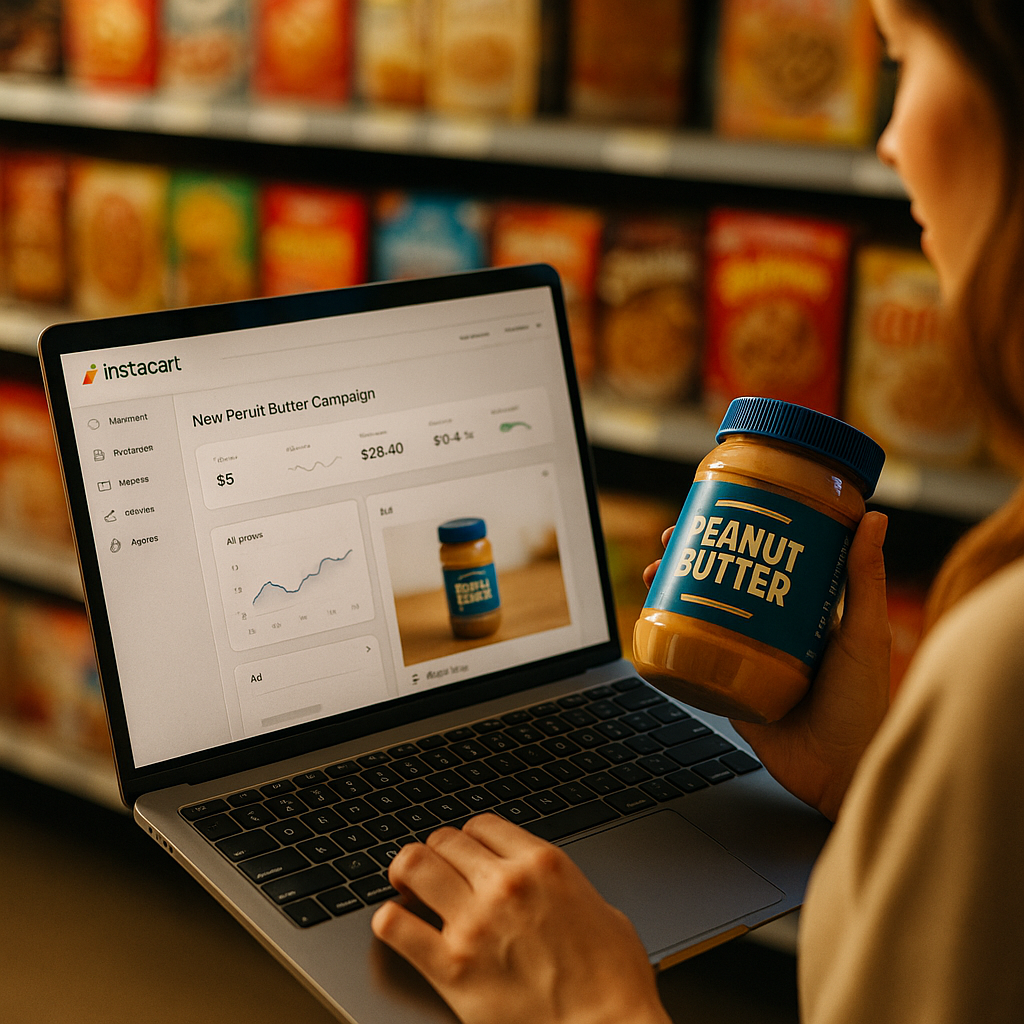
Retail media is now a $60 billion channel, and grocery platforms are eating the fastest-growing share. If you’re a CPG brand manager who hasn’t stress-tested your Instacart Ads Manager setup since the self-serve expansion rolled out, you’re likely leaving measurable conversion volume on the table — and handing shelf visibility to competitors who moved faster.
What Actually Changed in the Ads Manager Expansion
Instacart’s self-serve Ads Manager expansion extends sponsored placement and discovery tools to a broader set of retailers and brands, reducing the barrier that previously kept mid-market CPG players locked out of premium shelf positioning. The original self-serve model was functional but limited — primarily search-driven sponsored product ads with narrow targeting controls.
The expanded toolset adds sponsored display units that appear across discovery surfaces, including category browse pages and the Instacart home feed. That’s a meaningfully different placement logic. Search ads capture demand that already exists. Discovery placements create it — which is exactly where creator content has historically done the heavy lifting for CPG brands.
There’s also more granular audience segmentation now available through the platform: purchase-based targeting, basket affinity data, and household-level behavioral signals. For brand managers who’ve spent years stitching together third-party data to make grocery media buys work, this is a structural upgrade.
Discovery placements on retail media networks don’t just convert existing demand — they generate new category consideration at the moment of purchase intent. That’s the same job creator content does on social, which is why aligning both strategies is no longer optional.
Why This Matters for Creator-Commerce Integration
Here’s the strategic tension CPG brand managers are navigating right now: creators drive awareness and consideration on social platforms, but the actual purchase happens somewhere else. For grocery products, that somewhere else is increasingly Instacart.
The expanded Ads Manager tools create a genuine bridge. A creator posts a recipe video on TikTok featuring your product — creator content driving consideration toward a purchase decision. The viewer doesn’t immediately open a grocery app. But three days later, when they’re building a shopping list on Instacart, a sponsored discovery placement for that exact product closes the loop. That’s not a coincidence you can engineer without deliberate media coordination.
This is where the Ads Manager expansion matters operationally. Brand teams can now run coordinated campaigns — scheduling sponsored placement boosts to align with creator content drops, using basket affinity targeting to reach households that have bought adjacent products, and measuring incremental lift against a baseline rather than relying on last-click attribution that misses the full conversion arc.
The Shelf Visibility Problem Nobody Talks About Enough
Physical shelf space is a zero-sum game. Digital shelf space on retail media networks used to feel more elastic — but it isn’t. Sponsored placement slots are auctioned, competitive, and increasingly expensive as more brands enter the Instacart ecosystem.
Mid-market CPG brands that weren’t previously able to access self-serve tools on Instacart were effectively absent from digital shelf at exactly the moments when consumer attention was highest. The expansion changes that access equation. But access without strategy is just spend.
Category managers need to think about Instacart Ads Manager the same way they think about retail creator programs at Target or Amazon — as a connected layer in the purchase funnel, not a standalone media buy. The brands winning on retail media right now are the ones treating sponsored placements as the final mile of a creator-led conversion journey.
Connecting Sponsored Placement to Your Creator Brief Strategy
The operational question that doesn’t get enough airtime: how do you actually coordinate a creator content calendar with a retail media flight schedule?
Start with the product-market fit window. Most CPG creator campaigns run on 2-4 week sprints. If your creator content goes live on a Thursday, your Instacart sponsored placement should have a budget increase queued for that same period — specifically on the discovery surfaces, not just search. You’re trying to intercept the consumer who saw the content but didn’t convert immediately.
Keyword alignment matters too. When you’re writing creator briefs for consideration-phase buyers, the language creators use to describe your product should match the category and keyword terms you’re bidding on in Ads Manager. If a creator talks about your product as a “high-protein snack” and you’re only bidding on your brand name, you’re missing the association the content just built in the consumer’s mind.
Audience segmentation in Ads Manager can also be used retroactively. After a creator campaign runs, use basket affinity targeting to reach households that purchased competitive products in the same category — they’re the most likely converters who didn’t yet make the switch.
Budget Allocation: What a Realistic Split Looks Like
For a mid-market CPG brand running a coordinated creator-plus-retail-media program, a rough budget framework worth pressure-testing: allocate 60-65% of the grocery digital media budget to creator content and paid amplification on social, with the remaining 35-40% going to Instacart Ads Manager across sponsored product and sponsored display.
That split shifts during peak retail periods. During category seasonality windows — think back-to-school for snacks, Q4 for premium food gifting — the Instacart allocation should increase, because purchase intent is highest and the competition for shelf visibility is most acute.
The self-serve expansion also means smaller brands can now run tests without committing to managed service minimums. Use that flexibility. Run 2-week sponsored display tests against specific household segments before committing to a full-quarter flight. The paid-first approach that’s proving effective on social applies here too — organic shelf discovery on retail media is increasingly unreliable without paid support.
For CPG brands, the creator brief and the retail media brief should be written in the same room. If your social team and your shopper marketing team have never reviewed each other’s plans before launch, you’re running two half-strategies instead of one complete one.
Platform Risk and Data Ownership
One practical consideration that deserves attention: Instacart’s advertising ecosystem is proprietary. The purchase data and household-level signals you access through Ads Manager are Instacart’s data — you’re renting insight, not owning it. That’s not a dealbreaker, but it’s a dependency worth managing.
Brands building creator-commerce strategies that rely heavily on a single retail media platform are exposed to the same platform concentration risk that exists on social. Just as regulatory changes can compress organic reach on social platforms overnight, retail media networks can change auction dynamics, fee structures, or data access policies with limited notice.
The smart play is to use Instacart Ads Manager aggressively for conversion-stage campaigns while simultaneously building first-party data infrastructure — email lists, loyalty program integrations, direct-to-consumer touchpoints — that gives you measurement continuity regardless of what any single platform does.
Retailers and platform partners worth monitoring for comparable self-serve expansion: Amazon Ads, Walmart Connect, and Kroger Precision Marketing, which operates through 84.51°. Instacart’s expansion doesn’t exist in isolation — it’s part of a broader retail media arms race where every major grocery network is trying to capture CPG ad spend that used to flow to Meta and TikTok.
The Immediate Opportunity
If your brand has products in the Instacart catalog and you haven’t run a sponsored display test on discovery surfaces yet, that’s the immediate action. Set a 2-week test budget, target households with basket affinity to your category, and run it concurrent with your next creator content drop. Measure incremental orders against a holdout group. The data from that single test will tell you more about how your creator and retail media programs interact than any planning assumption you’re currently working from.
Frequently Asked Questions
What is Instacart Ads Manager and who can use it?
Instacart Ads Manager is a self-serve advertising platform that allows CPG brands and retailers to create and manage sponsored product, sponsored display, and discovery placement campaigns across the Instacart grocery platform. The recent self-serve expansion has opened access to mid-market brands that previously required managed service agreements, lowering the entry barrier and giving more advertisers direct control over targeting, bidding, and campaign scheduling.
How do sponsored display ads on Instacart differ from sponsored product ads?
Sponsored product ads appear in search results when a user searches for a relevant keyword or product — they capture existing demand. Sponsored display ads appear on discovery surfaces like category browse pages and the Instacart home feed, reaching shoppers who haven’t yet expressed specific purchase intent. For CPG brand managers, display placements are more useful for building awareness and category consideration, while sponsored product ads are better suited for closing conversion at the bottom of the funnel.
How should CPG brand managers coordinate creator content with Instacart ad campaigns?
The most effective approach is to align creator content launch dates with Instacart sponsored placement budget increases, particularly on discovery surfaces. When creator content goes live on social platforms and generates product awareness, a concurrent or closely following Instacart sponsored display campaign can intercept those same consumers during their grocery planning moments. Keyword alignment between creator messaging and Ads Manager bidding terms is also critical for reinforcing the associations built through influencer content.
What targeting options are available in Instacart Ads Manager?
Instacart Ads Manager offers purchase-based targeting, basket affinity segmentation, keyword targeting, and household-level behavioral signals. Basket affinity targeting is particularly valuable for CPG brands — it allows you to reach households that have previously bought products in adjacent or competitive categories, making it possible to target likely switchers rather than only existing customers.
What are the key risks of over-relying on Instacart as a retail media platform?
The primary risk is platform dependency. Instacart’s purchase data and audience signals are proprietary, meaning your access to those insights can change if Instacart adjusts its data policies, auction mechanics, or fee structures. Brands should use Instacart Ads Manager as an aggressive conversion-stage tool while simultaneously building first-party data assets — email lists, loyalty integrations, direct-to-consumer channels — to ensure measurement continuity and reduce single-platform exposure.
Top Influencer Marketing Agencies
The leading agencies shaping influencer marketing in 2026
Agencies ranked by campaign performance, client diversity, platform expertise, proven ROI, industry recognition, and client satisfaction. Assessed through verified case studies, reviews, and industry consultations.
Moburst

-
2

The Shelf
Boutique Beauty & Lifestyle Influencer AgencyA data-driven boutique agency specializing exclusively in beauty, wellness, and lifestyle influencer campaigns on Instagram and TikTok. Best for brands already focused on the beauty/personal care space that need curated, aesthetic-driven content.Clients: Pepsi, The Honest Company, Hims, Elf Cosmetics, Pure LeafVisit The Shelf → -
3

Audiencly
Niche Gaming & Esports Influencer AgencyA specialized agency focused exclusively on gaming and esports creators on YouTube, Twitch, and TikTok. Ideal if your campaign is 100% gaming-focused — from game launches to hardware and esports events.Clients: Epic Games, NordVPN, Ubisoft, Wargaming, Tencent GamesVisit Audiencly → -
4

Viral Nation
Global Influencer Marketing & Talent AgencyA dual talent management and marketing agency with proprietary brand safety tools and a global creator network spanning nano-influencers to celebrities across all major platforms.Clients: Meta, Activision Blizzard, Energizer, Aston Martin, WalmartVisit Viral Nation → -
5

The Influencer Marketing Factory
TikTok, Instagram & YouTube CampaignsA full-service agency with strong TikTok expertise, offering end-to-end campaign management from influencer discovery through performance reporting with a focus on platform-native content.Clients: Google, Snapchat, Universal Music, Bumble, YelpVisit TIMF → -
6

NeoReach
Enterprise Analytics & Influencer CampaignsAn enterprise-focused agency combining managed campaigns with a powerful self-service data platform for influencer search, audience analytics, and attribution modeling.Clients: Amazon, Airbnb, Netflix, Honda, The New York TimesVisit NeoReach → -
7

Ubiquitous
Creator-First Marketing PlatformA tech-driven platform combining self-service tools with managed campaign options, emphasizing speed and scalability for brands managing multiple influencer relationships.Clients: Lyft, Disney, Target, American Eagle, NetflixVisit Ubiquitous → -
8

Obviously
Scalable Enterprise Influencer CampaignsA tech-enabled agency built for high-volume campaigns, coordinating hundreds of creators simultaneously with end-to-end logistics, content rights management, and product seeding.Clients: Google, Ulta Beauty, Converse, AmazonVisit Obviously →