


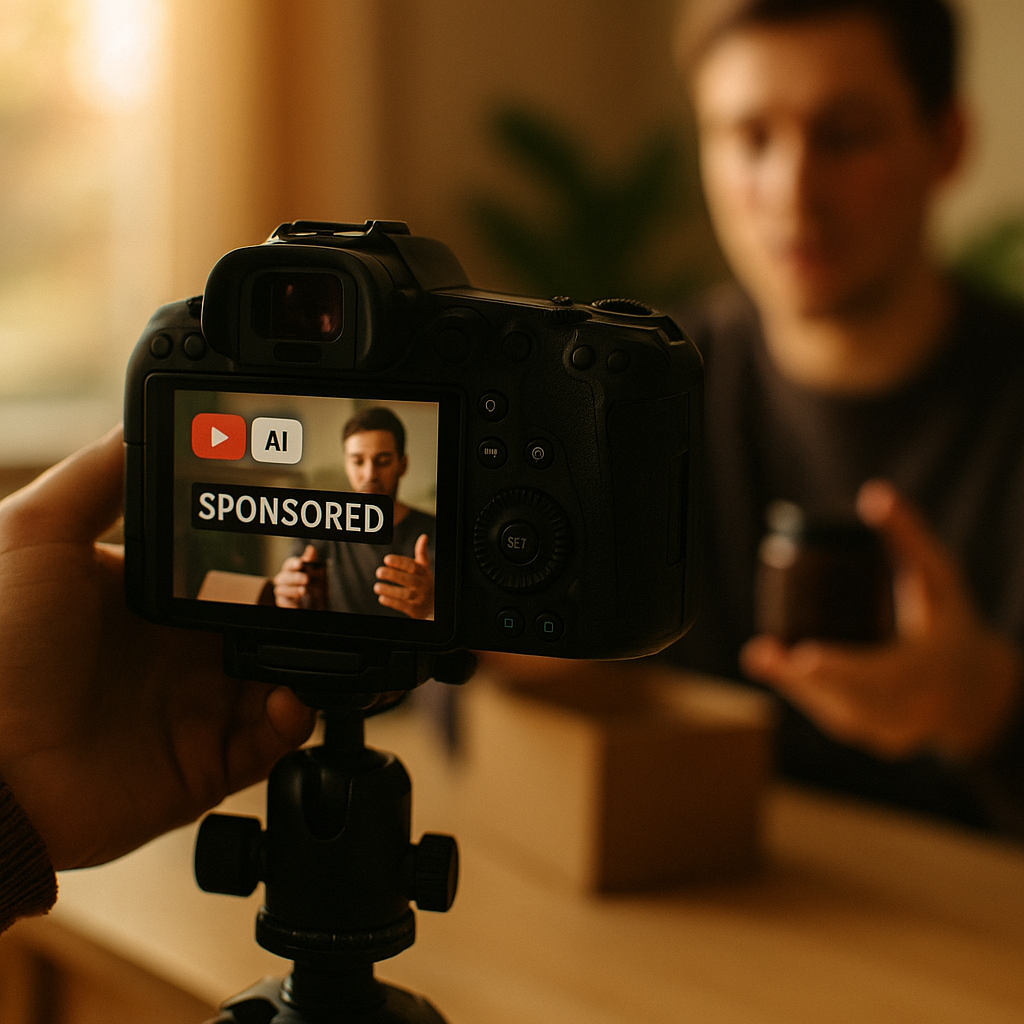
YouTube is labeling your sponsored content before you get the chance to. The platform’s automatic AI disclosure system now applies photorealistic AI labels to creator videos without creator or brand input, and if that content is also a paid promotion, your campaign is sitting at the intersection of two disclosure regimes simultaneously. Most brand legal teams haven’t caught up.
What YouTube’s Automatic Labeling System Actually Does
YouTube’s AI detection system scans uploaded content for photorealistic AI-generated or AI-altered visuals, including synthetic faces, AI-generated environments, and digitally altered likenesses. When detected, YouTube auto-applies a label in the video description and, in some cases, directly on the video itself. Creators don’t approve this label. It goes up automatically.
The trigger isn’t limited to fully AI-generated videos. A creator who uses an AI skin-smoothing tool, generates a synthetic B-roll background, or uses a voice clone for a segment can trigger the label. For brands running beauty, fashion, travel, or lifestyle campaigns, this is not a niche concern. It’s a mainstream operational risk.
YouTube’s photorealistic AI label can appear on sponsored content before a brand’s legal team even reviews the final cut, creating a compounding disclosure scenario that no standard influencer contract currently addresses.
The system also interacts with YouTube’s existing paid promotion disclosure toggle, which creators are required to activate for sponsored content. When both labels appear together, viewers see two separate disclosure signals. That sounds like over-disclosure, but the regulatory and reputational implications are more complicated than they appear.
Why Sponsored Content Creates a Compounding Disclosure Problem
Here’s the scenario that should concern every brand team: A creator produces a sponsored video for a skincare brand. They use an AI tool to enhance lighting and smooth skin tone in post-production. YouTube’s system flags this as photorealistic AI alteration. The automatic label appears. The creator has also activated the paid promotion toggle. Now the video carries both a “paid promotion” label and an AI alteration disclosure.
The brand approved the creative. But the brand never approved the AI tool use. And the brand almost certainly didn’t anticipate a platform-level disclosure appearing alongside their sponsorship tag. From a FTC AI disclosure trigger standpoint, the platform label doesn’t substitute for FTC-required verbal or on-screen disclosures. Both operate independently. Brands that assume one satisfies the other are exposed.
The FTC’s position on AI in advertising is increasingly explicit: consumers have a right to know when AI has materially altered what they’re seeing, especially in product demonstrations. A YouTube auto-label handles platform compliance. It does not handle the brand’s FTC obligations. For a deeper operational view of how these overlap, YouTube AI disclosure workflows for brand teams lay out exactly where the gaps occur.
The Contract Clauses Brands Are Missing
Most influencer contracts in circulation today were drafted before platform-level AI disclosure became automated. They address FTC language, usage rights, exclusivity, and sometimes general AI tool restrictions. They don’t address what happens when the platform makes a disclosure decision on the brand’s behalf.
These are the specific provisions brand legal teams should be adding now:
- AI Tool Disclosure Obligation: Require creators to disclose any AI tools used in production, in the pre-approval submission, not after posting. This includes generative AI, AI-assisted editing, voice synthesis, and AI-generated visual assets. Give the brand team the ability to flag content likely to trigger YouTube’s automatic label before it goes live.
- Pre-Post Platform Label Acknowledgment: Add a clause that explicitly states the creator accepts responsibility for any platform-generated disclosure labels triggered by their production choices. This separates brand liability from creator production decisions.
- Label Conflict Resolution Protocol: Define what happens if a YouTube auto-label contradicts or complicates the brand’s own disclosure language. Include a takedown or edit-request right with a defined response window (72 hours is a reasonable standard).
- AI Alteration Approval Gate: Any AI-generated or AI-altered visual content involving the brand’s products, logo, spokesperson, or brand environment must receive explicit written approval before production is finalized. Not before posting. Before production is finalized.
- Indemnification Scope Expansion: Standard indemnification language covers FTC violations. Expand it to cover platform policy violations, including automated label disputes, that arise from undisclosed AI tool use.
For teams working through broader AI provisions, the detailed breakdown at creator contract AI provisions for platform-native tools covers the architecture for these clauses across multiple platforms, not just YouTube.
Rethinking the Approval Workflow
The approval workflow problem is upstream of the contract problem. Even the best contract language fails if the workflow doesn’t catch AI tool use before content is submitted for final approval.
Most brand approval workflows have three stages: brief alignment, draft review, and final approval. AI tool disclosure needs to be a mandatory field at the draft review stage, not an afterthought. The creative brief should explicitly list which AI tools are approved, which are prohibited, and which require case-by-case review. Brands running large creator programs through platforms like GRIN or Aspire should configure these as required fields in their submission forms.
The specific sequence that reduces exposure looks like this: creator submits AI tool list with draft, brand team reviews for YouTube label triggers, legal flags any photorealistic alteration near product claims, final approval is conditional on AI tool sign-off. That’s four gates, not three. It adds time. It’s worth it.
Brands that route AI tool disclosure through the creative brief, not the contract, catch label-triggering content before it’s produced, not after it’s already live on YouTube with a platform disclosure their legal team never reviewed.
When the Label Goes Up Anyway
Even with strong contracts and better workflows, the label will sometimes appear unexpectedly. YouTube’s detection system is not perfectly predictable, and creators don’t always know which of their tools will trigger it. Having a response protocol matters.
The immediate question is whether to leave the video live, request an edit, or pull the content. Pulling sponsored content mid-campaign has performance and relationship consequences. The better default is to assess whether the auto-label creates a regulatory risk beyond the platform-level disclosure, and whether it materially misrepresents the brand’s product. If a photorealistic AI label appears on a video where the product itself was not AI-generated or AI-altered, the label is technically accurate about the production, not the product. That distinction matters for FTC purposes.
Brands operating across multiple markets should also be aware that FTC guidelines and EU regulations treat AI-generated content differently. The FTC and EU DSA compliance framework for creator campaigns is relevant here, particularly for brands running simultaneous US and European YouTube campaigns where a single video can carry different regulatory weight in different jurisdictions.
What YouTube’s Policy Means for Brand Safety Standards
YouTube’s move toward automated AI disclosure is not isolated. Google’s broader policies on synthetic media are tightening, and the direction of travel is toward more disclosure, applied earlier, with less creator control over timing. Brands that treat YouTube’s AI label as a creator problem are misreading the situation. When your brand appears in a video with an AI disclosure label, the disclosure attaches to your brand in the consumer’s perception, not just to the creator’s production choices.
This connects directly to how brands should be thinking about YouTube UGC brand safety policy at a campaign architecture level. The question isn’t just “is this content safe?” It’s “does this content, with any platform-applied labels, represent the brand the way we intend?” Those are different questions with different answers.
The compliance audit process for creator content should now include a YouTube AI label risk assessment as a standard line item alongside FTC disclosure checks. Tools like Brandwatch can help monitor label appearances across large creator rosters at scale. Manual spot-checking is no longer sufficient when automated systems are making disclosure decisions in real time.
For brands running YouTube-heavy programs at volume, a YouTube AI disclosure checklist is the fastest way to audit current exposure before campaign launch. Use it at the contract stage, not the performance review stage.
The Immediate Operational Priorities
Start with the contract template. Pull every active YouTube influencer agreement and identify whether it addresses AI tool disclosure, platform-applied labels, and label conflict resolution. If those provisions are absent, the contract has a material gap. Amend active agreements with a written addendum before the next campaign cycle. Integrate the full clause set into your master template this quarter.
Then audit the approval workflow. Map where AI tool disclosure currently sits in your submission process. If it’s not a required field before draft review, move it there. Run a one-campaign pilot with the new workflow to identify friction points before you roll it out across the full roster. The goal is catching label-triggering content before it’s produced, not managing disclosure surprises after a video is live.
Frequently Asked Questions
Does YouTube’s automatic AI label satisfy FTC disclosure requirements for sponsored content?
No. YouTube’s automatic AI disclosure label operates under YouTube’s platform policies and addresses the presence of photorealistic AI-generated or AI-altered content. It does not satisfy the FTC’s separate requirement that paid promotions be clearly and conspicuously disclosed. Brands and creators must still meet FTC standards independently, including verbal or on-screen “ad” or “paid partnership” disclosures where required.
What types of AI tool use are most likely to trigger YouTube’s automatic photorealistic AI label?
YouTube’s system targets content that could be mistaken for real footage. High-risk triggers include AI-generated synthetic faces or bodies, AI-altered skin or facial features in close-up shots, generative AI backgrounds that replace real environments, and AI voice cloning used to replace or supplement a creator’s natural voice. AI-assisted color grading or general editing tools are generally lower risk, but brands should require creator disclosure of all AI tools used to avoid surprises.
Can a brand require a creator to remove or dispute YouTube’s AI disclosure label?
Creators can submit a request to YouTube to dispute or remove an automatic AI label if they believe it was applied in error. However, YouTube makes the final determination. Brands can contractually require creators to initiate a dispute within a defined timeframe, but they cannot guarantee label removal. This is why pre-production AI tool disclosure and approval gates are more operationally reliable than post-publication label management.
Should AI tool disclosure be in the influencer contract or the creative brief?
Both. The contract should establish the legal obligation: creators must disclose all AI tools used in production and obtain brand approval for any AI use that could trigger a platform disclosure label. The creative brief should operationalize this by listing approved, prohibited, and review-required AI tools specifically for that campaign. Relying on the contract alone creates a legal framework without an operational catch mechanism.
What happens to brand liability if a creator uses an undisclosed AI tool that triggers a YouTube label?
If the contract includes an AI tool disclosure requirement and the creator violates it, the brand has a contractual basis for indemnification and potentially for requiring content removal or edit. Without that clause, the brand shares reputational exposure from the label even if it had no knowledge of the AI tool use. Expanding indemnification language to cover platform-applied labels triggered by undisclosed creator production choices is a critical contract update for any brand running YouTube-sponsored content.
Top Influencer Marketing Agencies
The leading agencies shaping influencer marketing in 2026
Agencies ranked by campaign performance, client diversity, platform expertise, proven ROI, industry recognition, and client satisfaction. Assessed through verified case studies, reviews, and industry consultations.
Moburst

-
2

The Shelf
Boutique Beauty & Lifestyle Influencer AgencyA data-driven boutique agency specializing exclusively in beauty, wellness, and lifestyle influencer campaigns on Instagram and TikTok. Best for brands already focused on the beauty/personal care space that need curated, aesthetic-driven content.Clients: Pepsi, The Honest Company, Hims, Elf Cosmetics, Pure LeafVisit The Shelf → -
3

Audiencly
Niche Gaming & Esports Influencer AgencyA specialized agency focused exclusively on gaming and esports creators on YouTube, Twitch, and TikTok. Ideal if your campaign is 100% gaming-focused — from game launches to hardware and esports events.Clients: Epic Games, NordVPN, Ubisoft, Wargaming, Tencent GamesVisit Audiencly → -
4

Viral Nation
Global Influencer Marketing & Talent AgencyA dual talent management and marketing agency with proprietary brand safety tools and a global creator network spanning nano-influencers to celebrities across all major platforms.Clients: Meta, Activision Blizzard, Energizer, Aston Martin, WalmartVisit Viral Nation → -
5

The Influencer Marketing Factory
TikTok, Instagram & YouTube CampaignsA full-service agency with strong TikTok expertise, offering end-to-end campaign management from influencer discovery through performance reporting with a focus on platform-native content.Clients: Google, Snapchat, Universal Music, Bumble, YelpVisit TIMF → -
6

NeoReach
Enterprise Analytics & Influencer CampaignsAn enterprise-focused agency combining managed campaigns with a powerful self-service data platform for influencer search, audience analytics, and attribution modeling.Clients: Amazon, Airbnb, Netflix, Honda, The New York TimesVisit NeoReach → -
7

Ubiquitous
Creator-First Marketing PlatformA tech-driven platform combining self-service tools with managed campaign options, emphasizing speed and scalability for brands managing multiple influencer relationships.Clients: Lyft, Disney, Target, American Eagle, NetflixVisit Ubiquitous → -
8

Obviously
Scalable Enterprise Influencer CampaignsA tech-enabled agency built for high-volume campaigns, coordinating hundreds of creators simultaneously with end-to-end logistics, content rights management, and product seeding.Clients: Google, Ulta Beauty, Converse, AmazonVisit Obviously →