


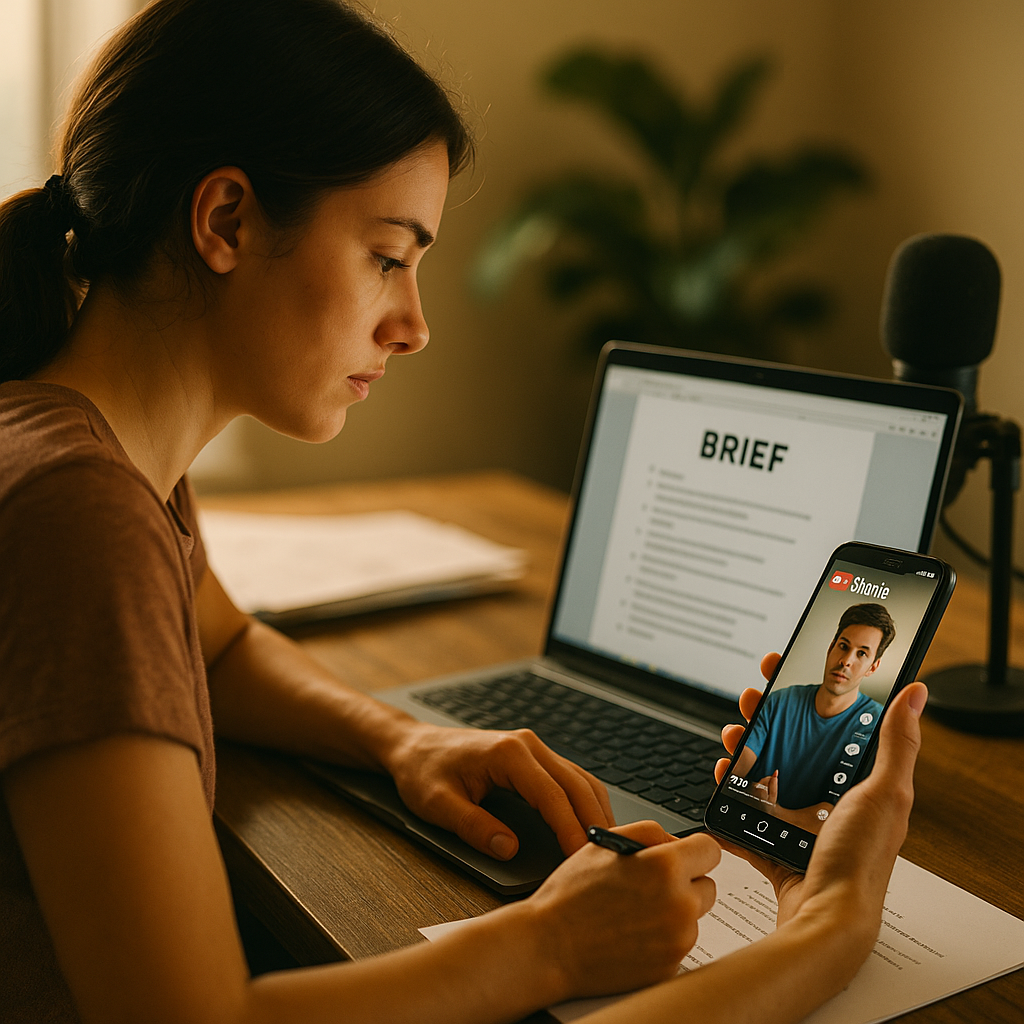
Fewer than 15% of branded YouTube Shorts currently meet the platform’s minimum retention thresholds required for ad revenue share eligibility. If your creator briefs are not explicitly engineered around that benchmark, you are funding content that the algorithm will quietly bury — and leaving monetization upside entirely on the table.
Why “Short” and “High-Retention” Are Not the Same Thing
Most brand teams still brief Shorts the way they brief traditional :30 spots: logo early, product feature in the middle, call to action at the end. That structure is architecturally wrong for sub-60-second vertical video. YouTube’s Shorts feed is a swipe-loop environment. The algorithm ranks clips on average percentage viewed, not total views. A 58-second video where 70% of viewers drop at the 20-second mark will always underperform a 45-second clip with 85% completion, regardless of paid seeding behind it.
This is not a creative preference. It is a monetization eligibility issue. YouTube’s Partner Program requires creators to hit 10 million Shorts views in 90 days to qualify for ad revenue share. For brands structuring long-term creator compensation partly around platform monetization (an increasingly common approach to reduce flat-fee overhead), briefs that kill retention kill creator income and damage the partnership.
If your Shorts brief doesn’t specify a retention target — ideally 75% average view duration — you don’t have a performance brief. You have a production checklist.
The Four-Layer Architecture That Drives Completion
High-retention Shorts follow a repeatable structure. Brief creators against these four layers explicitly, not as suggestions but as deliverable requirements.
Layer 1: The Zero-Second Hook (frames 1-3)
The first three seconds must create an open loop. Not a brand intro. Not a “hey guys.” A visual or verbal pattern interrupt that makes skipping feel like a loss. Tactics that consistently work: a surprising result shown before the method, a counterintuitive statement, or a direct question that targets a specific pain point the viewer already has. For brand campaigns, this means coaching creators to lead with the tension the product resolves — not the product itself.
Layer 2: Continuous Tension (seconds 4-40)
This is the retention engine. The clip must sustain the open loop created in Layer 1. Every five to seven seconds, something must change: a new visual, a new information beat, a turn in the narrative. Brief creators to storyboard at the sentence level, treating each line of script as a retention micro-beat. Tools like Sprout Social‘s video analytics can help you validate which storyboard structures actually hold attention in post-analysis.
Layer 3: The Value Delivery (seconds 40-52)
Close the loop you opened in seconds one through three. Deliver the answer, the result, the payoff. This is where the brand or product can sit naturally because it is now the resolution to a question the viewer was already invested in. The integration feels earned rather than inserted.
Layer 4: The Loop Trigger (seconds 52-60)
End in a way that rewards rewatching. A visual callback to the opening frame, an unresolved secondary question, or a result that only makes full sense after the viewer has seen the beginning again. YouTube’s algorithm rewards replays. Loop triggers are one of the few explicit mechanics brands can brief without restricting creative expression.
What Goes Into the Brief, Specifically
Generic briefs produce generic content. Here is what a retention-optimized Shorts brief needs to specify beyond standard brand guidelines:
- Target retention rate: Minimum 70% average view duration, with 80%+ as the stretch goal for algorithm amplification.
- Hook format requirement: Specify open-loop only. No brand name, logo, or product mention in the first five seconds.
- Pacing guideline: Maximum seven seconds between visual or narrative changes.
- Script approval layer: Require a sentence-level script (not just a treatment) before production begins. Each sentence should map to a specific retention beat.
- Length target: 45 to 58 seconds. Under 45 seconds reduces available ad inventory; over 58 seconds risks classification as a standard video, which has different algorithmic treatment.
- Loop-back element: Creator must identify the loop trigger in the pre-production document.
- Disclosure placement: Per FTC guidelines, paid partnership disclosure must appear on-screen and in the audio within the first 10 seconds. Brief this as a retention-compatible requirement, not an afterthought, so creators integrate it into the hook layer rather than stacking it as a title card that signals “ad” to viewers.
The brief for Instagram Reels and the brief for YouTube Shorts should not be the same document. Platform mechanics differ enough that a single asset repurposed across both will underperform on at least one. For context on how to structure Reels briefs with similar precision, the shoppable Reels briefing framework covers completion rate architecture specifically for Meta’s feed logic.
The Ad Revenue Share Eligibility Angle — and Why It Changes Creator Incentives
YouTube’s Shorts revenue share is structured differently from long-form. Revenue from ads running between Shorts is pooled, then distributed to creators based on their share of total Shorts views in the pool, adjusted for music licensing costs. Creators do not earn per-view the way they do on standard YouTube videos.
This matters for brands because it reframes how you should structure creator compensation. If a creator is YPP-eligible for Shorts, their platform earnings are partially tied to aggregate performance across all their Shorts, not just yours. A brand brief that tanks their retention metrics on your campaign clip can dilute their overall Shorts pool share for the entire 90-day evaluation window. That is a real financial harm you are causing, and sophisticated creators (and their managers) now know this.
The strategic implication: retention-optimized briefs are not just a campaign performance issue. They are a creator relations issue. Brands that brief poorly are becoming known in creator circles as partners who hurt channel metrics. That reputation affects your ability to recruit top-performing creators at competitive rates. The YouTube creator concentration risk problem compounds when the best creators on the platform start declining your briefs.
Top-tier Shorts creators are now negotiating “retention floor clauses” — contractual protections against brand briefs that structurally compromise their channel metrics. If you haven’t seen this yet, you will.
Pre-Production Approval Process That Doesn’t Kill Creative
The tension every brand team faces: rigorous brief compliance versus creative freedom. Over-approving kills the authenticity that makes Shorts work. Under-approving produces assets that miss retention benchmarks. The answer is staged approvals at the right checkpoints, not a single final review.
Build a three-gate system. Gate one: hook review. Before any production, approve only the first five seconds. This is where most retention is won or lost, and it requires the least production investment to change. Gate two: script-level pacing review. Map each sentence to the four-layer architecture and flag pacing gaps before shooting. Gate three: final edit with retention timing. Review the rough cut against the brief’s pacing guideline, counting the seconds between visual changes. This can be done in-house using YouTube Studio’s audience retention graph on unlisted videos before publishing.
This workflow applies equally well to TikTok. If you’re running parallel campaigns, the TikTok watch-time brief framework maps directly to the same three-gate logic and can help your team standardize approval processes across platforms.
Measuring What Actually Matters After Publish
Post-publish, the metrics that indicate retention architecture success are specific. Track these in YouTube Studio analytics:
- Average percentage viewed: The primary retention signal. Below 65% means the architecture failed somewhere.
- Swipe-away rate in the first 3 seconds: Diagnoses hook failure specifically.
- Re-watches per viewer: Validates whether the loop trigger worked.
- Views from Shorts feed vs. subscriber feed: Algorithm amplification shows up as a high ratio of Shorts feed traffic.
Benchmark against the creator’s own organic Shorts performance, not industry averages. A creator whose non-branded Shorts average 82% retention but whose branded clip hits 61% is a clear brief failure, regardless of total view count. eMarketer data consistently shows that branded short-form video underperforms organic by an average of 18 to 22 percentage points in retention — closing that gap is the entire point of the briefing process outlined here.
For brands managing creators across multiple short-form platforms simultaneously, the brief architecture logic transfers. The sponsored Reels algorithm brief approach on Meta follows similar retention-first principles, and building cross-platform brief templates saves significant operational overhead.
The immediate next step: Pull your last three Shorts campaigns from YouTube Studio, compare average percentage viewed against the creator’s organic Shorts baseline, and calculate the gap. That number is your brief quality score — and it tells you exactly how much retention architecture your current process is leaving behind.
Frequently Asked Questions
What is the minimum retention rate a YouTube Short needs to qualify for ad revenue share?
YouTube does not publish a specific retention percentage as a hard eligibility cutoff for the Shorts revenue pool. However, internal benchmarks shared by creators and agency partners consistently indicate that Shorts averaging below 60 to 65% average view duration receive significantly reduced algorithmic distribution, which in turn suppresses the view volume needed for YPP Shorts eligibility (10 million views in 90 days). Brands should brief to a minimum 70% average view duration target to provide sufficient headroom.
Should a branded YouTube Short lead with the product or the hook?
The hook must come first, always. Placing a brand logo, product shot, or sponsor mention in the first five seconds signals “advertisement” to the viewer’s pattern recognition and dramatically increases swipe-away rates. The product or brand should enter at the value delivery layer (roughly seconds 40 to 52), where it functions as the resolution to the tension established in the hook. This structure is both more effective for retention and more compliant with FTC disclosure requirements when the paid partnership label is integrated into the hook rather than layered on top of it.
How is YouTube Shorts revenue share calculated for creators?
YouTube pools ad revenue generated between Shorts videos in the feed, then distributes it to eligible creators based on their proportional share of total views in the pool during each payment period, after deducting costs for licensed music. This means a creator’s earnings are influenced by their total Shorts view volume across all content, not just branded clips. Brand campaigns that reduce a creator’s retention metrics can suppress their overall pool share — a meaningful financial consideration that brands and creator partners should address explicitly in compensation discussions.
What is the optimal length for a YouTube Short that maximizes both retention and ad revenue eligibility?
The practical sweet spot is 45 to 58 seconds. Clips under 45 seconds reduce the available ad inventory window and offer less time to build and close the narrative loop that drives re-watches. Clips that push past 60 seconds are classified as standard YouTube videos rather than Shorts, which changes their algorithmic treatment entirely. Within the 45 to 58 second range, tighter scripts (closer to 45 seconds) tend to produce higher completion percentages, while longer clips (52 to 58 seconds) allow more product integration time if the retention architecture is strong.
Can the same creator brief be used for YouTube Shorts and TikTok videos?
No. While both platforms reward watch time and penalize early drop-off, their algorithmic distribution models, loop mechanics, and audience interaction patterns differ enough to require platform-specific briefs. YouTube Shorts weight re-watches more heavily in distribution decisions. TikTok’s algorithm places greater emphasis on completion rate and comment velocity in the first hour. A brief optimized for Shorts loop triggers may not translate to TikTok’s comment-driven amplification model. Brands running parallel campaigns should build separate brief templates for each platform rather than adapting a single document.
Top Influencer Marketing Agencies
The leading agencies shaping influencer marketing in 2026
Agencies ranked by campaign performance, client diversity, platform expertise, proven ROI, industry recognition, and client satisfaction. Assessed through verified case studies, reviews, and industry consultations.
Moburst

-
2

The Shelf
Boutique Beauty & Lifestyle Influencer AgencyA data-driven boutique agency specializing exclusively in beauty, wellness, and lifestyle influencer campaigns on Instagram and TikTok. Best for brands already focused on the beauty/personal care space that need curated, aesthetic-driven content.Clients: Pepsi, The Honest Company, Hims, Elf Cosmetics, Pure LeafVisit The Shelf → -
3

Audiencly
Niche Gaming & Esports Influencer AgencyA specialized agency focused exclusively on gaming and esports creators on YouTube, Twitch, and TikTok. Ideal if your campaign is 100% gaming-focused — from game launches to hardware and esports events.Clients: Epic Games, NordVPN, Ubisoft, Wargaming, Tencent GamesVisit Audiencly → -
4

Viral Nation
Global Influencer Marketing & Talent AgencyA dual talent management and marketing agency with proprietary brand safety tools and a global creator network spanning nano-influencers to celebrities across all major platforms.Clients: Meta, Activision Blizzard, Energizer, Aston Martin, WalmartVisit Viral Nation → -
5

The Influencer Marketing Factory
TikTok, Instagram & YouTube CampaignsA full-service agency with strong TikTok expertise, offering end-to-end campaign management from influencer discovery through performance reporting with a focus on platform-native content.Clients: Google, Snapchat, Universal Music, Bumble, YelpVisit TIMF → -
6

NeoReach
Enterprise Analytics & Influencer CampaignsAn enterprise-focused agency combining managed campaigns with a powerful self-service data platform for influencer search, audience analytics, and attribution modeling.Clients: Amazon, Airbnb, Netflix, Honda, The New York TimesVisit NeoReach → -
7

Ubiquitous
Creator-First Marketing PlatformA tech-driven platform combining self-service tools with managed campaign options, emphasizing speed and scalability for brands managing multiple influencer relationships.Clients: Lyft, Disney, Target, American Eagle, NetflixVisit Ubiquitous → -
8

Obviously
Scalable Enterprise Influencer CampaignsA tech-enabled agency built for high-volume campaigns, coordinating hundreds of creators simultaneously with end-to-end logistics, content rights management, and product seeding.Clients: Google, Ulta Beauty, Converse, AmazonVisit Obviously →