


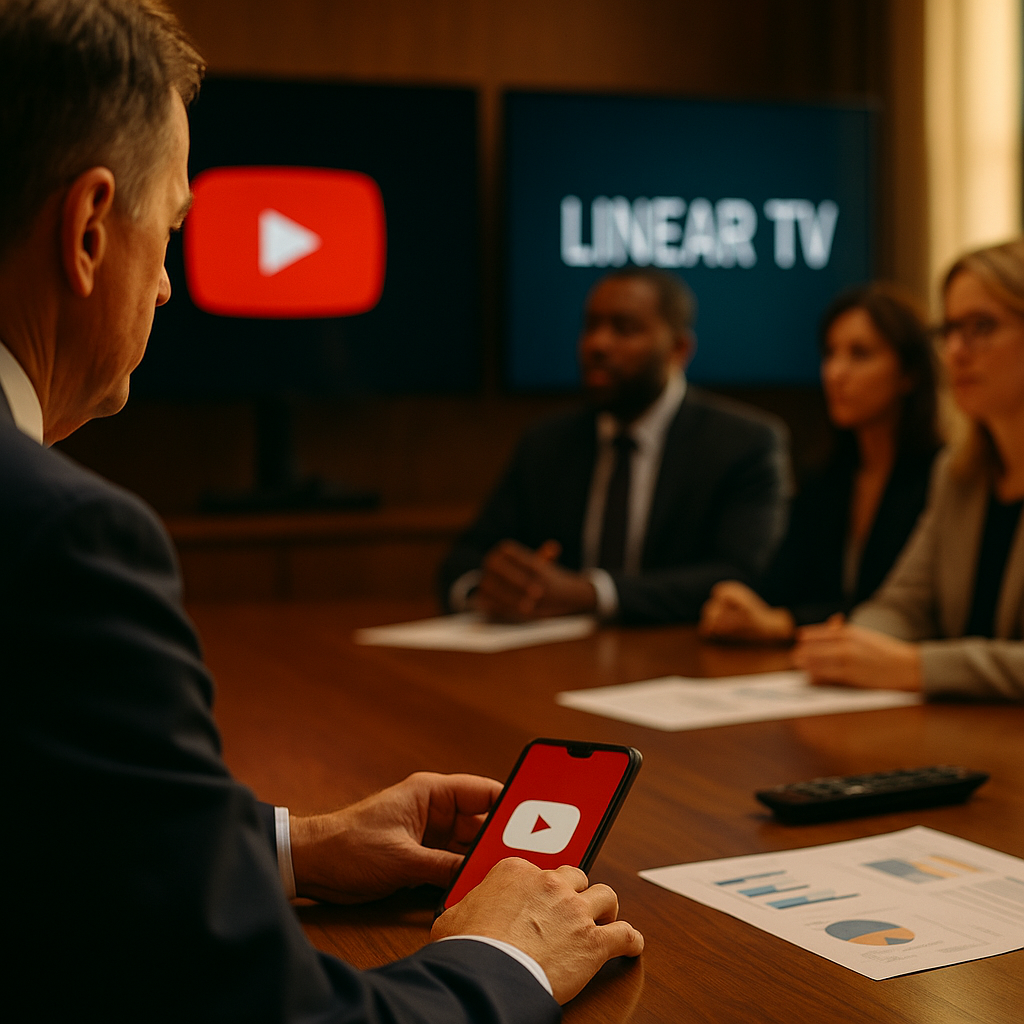
YouTube has held 12 to 13 percent of daily TV viewership share consistently enough that it now regularly leads all networks in Nielsen’s The Gauge report. If your upfront budget still treats it as a digital line item rather than a premium video channel, you are paying a structural tax on your media mix that compounds every quarter.
Why the Nielsen Number Changes the Conversation
Nielsen’s The Gauge measures share of total TV usage time across linear, streaming, and YouTube. When YouTube’s 12-13% share leads individual broadcast and cable networks month after month, it stops being a “social platform” argument and becomes a reach argument — one that CFOs and CMOs can follow without a digital media glossary.
That distinction matters enormously when you are making the upfront case. Linear TV upfront commitments are built on the premise that guaranteed reach justifies premium CPMs and locked-in spend. YouTube’s consistent viewership leadership directly challenges that premise. You are not asking leadership to bet on an emerging channel. You are asking them to catch up to where audiences already are.
YouTube’s share of daily TV time is not a trend indicator. It is a current-state measurement. The audience migration already happened. The budget migration has not.
The internal sell gets easier when you frame it this way. Stop saying “YouTube is growing.” Start saying “YouTube leads, and our budget doesn’t reflect that.”
How to Structure the C-Suite Argument
Most budget reallocation pitches fail because they lead with platform enthusiasm rather than fiduciary logic. Here is a framework that works at the CFO and CEO level, not just with your media team.
Step one: Anchor on cost-per-point, not platform preference. Pull your linear TV CPMs from the last upfront cycle. Compare them against YouTube’s guaranteed CPMs through Google Preferred (now YouTube Select) inventory. The gap is significant. For most CPG and retail advertisers, YouTube Select CPMs run 20-40% below comparable primetime network inventory, while delivering measurably higher completion rates on 15-and-30-second formats according to eMarketer benchmarks.
Step two: Introduce the creator inventory layer. YouTube Select covers programmatic and direct reserved buys against premium creator content. This is where the upfront argument gets sophisticated. Brands that shift upfront dollars to YouTube can layer programmatic guaranteed placements against the same creator channels where they are running influencer campaigns, compressing the gap between paid media and earned trust.
Step three: Address the accountability gap in linear directly. Linear TV’s measurement infrastructure is panel-based and lagged. YouTube provides impression-level data, brand lift studies through Google’s built-in tools, and integration with third-party measurement vendors like DoubleVerify and Integral Ad Science. When a CFO asks “how do we know this is working,” the honest answer on linear is “we don’t, for 6-8 weeks.” On YouTube, you know in days.
The Creator Inventory Angle Most Media Plans Miss
Here is where brand teams often undersell the opportunity. YouTube creator inventory is not just a media buy. It is a contextual environment that linear cannot replicate. When a mid-to-large creator produces long-form content around a category your brand occupies, their audience is self-selected, attentive, and frequently in a purchase consideration mindset.
Compare that to a 30-second spot in a primetime drama. Same viewer age demographic, potentially. Completely different intent signal.
The $480B creator economy trajectory is built substantially on YouTube’s long-form ecosystem. Brands that treat creator partnerships and media buying as separate budget lines are leaving an efficiency arbitrage on the table. A coordinated strategy, where your media team and influencer team are buying against the same creator channels, is operationally feasible today through Google’s partnership program structures.
For brands already running creator amplification programs, this is the logical extension: move from boosting creator posts reactively to placing reserved inventory in creator environments proactively as part of upfront planning.
Objections You Will Hear (And How to Answer Them)
Four objections come up in almost every C-suite reallocation conversation.
“Our target audience skews older and watches linear.” Nielsen’s own data segments viewership by age. Pull the 35-54 data specifically. YouTube’s share in that cohort has grown materially over the past three years. The assumption that linear dominates older audiences is aging out faster than most media plans acknowledge. Reference Nielsen’s Gauge data directly — it carries third-party credibility in the room.
“We have upfront commitments we can’t break.” You don’t need to break them this cycle. The argument is about where incremental dollars go and how the next upfront negotiation is structured. Start with 15-20% of your next upfront commitment as a YouTube reallocation test. The data you generate in one cycle will close the argument in the next.
“YouTube brand safety is a concern.” This is a 2019 objection. YouTube Select and YouTube Masthead buys operate against curated inventory lists that brands control. Third-party verification through DoubleVerify, Integral Ad Science, or integrated social analytics tools provides the same reporting layer your linear agency uses for contextual adjacency. Document your brand safety controls in the pitch deck. It signals operational maturity.
“We don’t have the creative for YouTube.” This is a real constraint, but it is not a budget argument. It is a production argument. YouTube’s 6-second bumper, 15-second, and 30-second formats are compatible with existing TV asset libraries. The migration does not require net-new creative in cycle one. Address this separately from the budget reallocation discussion so it doesn’t become a veto point.
Every objection to YouTube reallocation has a factual answer. The brands that lose the internal argument lose it because they let objections become stall tactics rather than addressable line items.
Building the One-Slide Financial Case
C-suite decisions often live or die on a single slide. Here is what it needs to contain.
- Current state: Linear upfront spend, CPM, estimated reach, and measurement lag
- Proposed state: Reallocated percentage to YouTube Select plus creator inventory, with projected CPM, reach estimate, and measurement timeline
- Risk profile: Brand safety controls, contractual flexibility, and exit provisions
- Measurement plan: Brand lift, search lift, and conversion metrics with vendor and timeline
- Pilot scope: A specific dollar figure, specific quarter, and specific success criteria
Do not put platform logos on this slide. Put numbers. The CFO is looking at this as a capital allocation decision. Make it look like one. If you need benchmarks to fill in the projected CPM column, Statista’s media cost data and eMarketer’s programmatic video benchmarks are citable, third-party sources your finance team will respect.
For brands managing creator programs at scale, the measurement infrastructure you already have in place for influencer campaigns translates directly to YouTube media measurement. That is an argument for efficiency, not duplication of effort.
The Timing Question
Upfront negotiations for major networks typically begin in Q1 and close by mid-year. If your organization is entering upfront season without a YouTube reallocation position documented, you are already behind the conversation. Agencies that specialize in connected TV and video are actively presenting these comparisons to their clients. If yours isn’t, that is worth a direct conversation with your media agency lead.
The professionalization of the creator economy means the supply side is ready for institutional media buys. The infrastructure for transacting YouTube creator inventory at upfront scale exists today through Google’s preferred partner program and third-party marketplaces. The constraint is almost always internal: budget governance structures that haven’t caught up to where viewership actually sits.
Audit your upfront commitments now. Identify which linear properties are delivering the weakest cost-per-point performance. Those are your reallocation candidates. Run the YouTube equivalent reach calculation. Build the slide. Schedule the meeting before your agency does it for you.
Frequently Asked Questions
What is YouTube’s current share of daily TV viewership?
According to Nielsen’s The Gauge report, YouTube consistently holds approximately 12 to 13 percent of daily TV usage time in the United States, which regularly places it ahead of individual broadcast and cable networks. This share covers viewing across connected TVs, mobile, and desktop within the total TV usage measurement framework.
How does YouTube creator inventory differ from standard YouTube advertising?
Standard YouTube advertising places ads across a broad inventory pool based on audience targeting. Creator inventory, accessed through YouTube Select or direct creator partnerships, places your brand within specific high-performing creator channels where audience intent and contextual alignment are tighter. For upfront budget purposes, YouTube Select allows brands to reserve premium creator inventory with guaranteed impression delivery, similar to a reserved TV buy.
Can brands reallocate upfront TV dollars to YouTube without breaking existing commitments?
In most cases, yes. Existing upfront commitments can be honored while redirecting incremental budget or the next upfront cycle’s negotiation toward YouTube. A practical approach is to designate 15 to 20 percent of the next upfront commitment as a YouTube pilot allocation, generate measurement data within that cycle, and use results to inform a larger reallocation in the following year’s negotiations.
How should brands address YouTube brand safety concerns in internal pitches?
YouTube Select and curated inventory lists allow brands to define exactly which content categories and creator channels their ads appear against. Combined with third-party verification tools like DoubleVerify or Integral Ad Science, brands can provide the same level of contextual reporting they use for linear TV adjacency. Documenting these controls explicitly in the reallocation proposal addresses the brand safety objection before it becomes a veto point.
What measurement metrics should brands use to evaluate YouTube upfront performance?
The core metrics for evaluating YouTube upfront buys include brand lift (measured through Google’s built-in Brand Lift Study tool), search lift, video completion rate, cost-per-completed-view, and where applicable, offline sales lift through matched-market testing. These metrics provide faster feedback loops than linear TV’s panel-based measurement, typically delivering actionable data within two to four weeks of a campaign launch.
Top Influencer Marketing Agencies
The leading agencies shaping influencer marketing in 2026
Agencies ranked by campaign performance, client diversity, platform expertise, proven ROI, industry recognition, and client satisfaction. Assessed through verified case studies, reviews, and industry consultations.
Moburst

-
2

The Shelf
Boutique Beauty & Lifestyle Influencer AgencyA data-driven boutique agency specializing exclusively in beauty, wellness, and lifestyle influencer campaigns on Instagram and TikTok. Best for brands already focused on the beauty/personal care space that need curated, aesthetic-driven content.Clients: Pepsi, The Honest Company, Hims, Elf Cosmetics, Pure LeafVisit The Shelf → -
3

Audiencly
Niche Gaming & Esports Influencer AgencyA specialized agency focused exclusively on gaming and esports creators on YouTube, Twitch, and TikTok. Ideal if your campaign is 100% gaming-focused — from game launches to hardware and esports events.Clients: Epic Games, NordVPN, Ubisoft, Wargaming, Tencent GamesVisit Audiencly → -
4

Viral Nation
Global Influencer Marketing & Talent AgencyA dual talent management and marketing agency with proprietary brand safety tools and a global creator network spanning nano-influencers to celebrities across all major platforms.Clients: Meta, Activision Blizzard, Energizer, Aston Martin, WalmartVisit Viral Nation → -
5

The Influencer Marketing Factory
TikTok, Instagram & YouTube CampaignsA full-service agency with strong TikTok expertise, offering end-to-end campaign management from influencer discovery through performance reporting with a focus on platform-native content.Clients: Google, Snapchat, Universal Music, Bumble, YelpVisit TIMF → -
6

NeoReach
Enterprise Analytics & Influencer CampaignsAn enterprise-focused agency combining managed campaigns with a powerful self-service data platform for influencer search, audience analytics, and attribution modeling.Clients: Amazon, Airbnb, Netflix, Honda, The New York TimesVisit NeoReach → -
7

Ubiquitous
Creator-First Marketing PlatformA tech-driven platform combining self-service tools with managed campaign options, emphasizing speed and scalability for brands managing multiple influencer relationships.Clients: Lyft, Disney, Target, American Eagle, NetflixVisit Ubiquitous → -
8

Obviously
Scalable Enterprise Influencer CampaignsA tech-enabled agency built for high-volume campaigns, coordinating hundreds of creators simultaneously with end-to-end logistics, content rights management, and product seeding.Clients: Google, Ulta Beauty, Converse, AmazonVisit Obviously →