


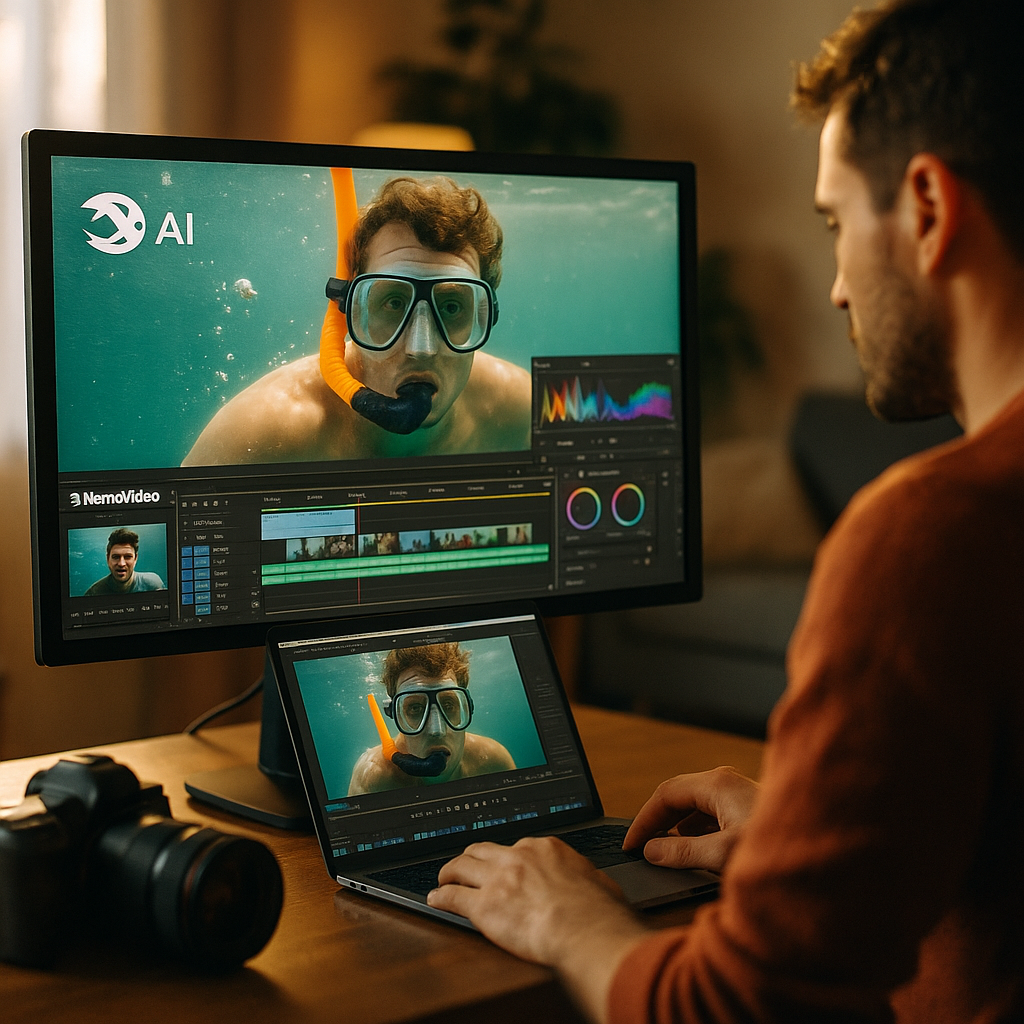
A 40 percent engagement lift across 200-plus brand deployments is not a case study. It’s a production standard shift. NemoVideo’s e-commerce creator network is generating results that should force every commerce-side brand team to revisit how they set creative benchmarks and evaluate AI-assisted video production against traditional human-directed workflows.
What NemoVideo Is Actually Doing
NemoVideo operates at the intersection of AI video generation and creator network deployment. The platform connects brands with a curated pool of e-commerce-focused creators while layering in AI-assisted production tooling that reduces per-asset costs and accelerates iteration cycles. Unlike standalone AI video generators, NemoVideo’s model embeds human creator direction at the brief and approval stages, using AI for rendering, resizing, and variant generation.
The result: brands can brief once and receive dozens of production-ready variants optimized for TikTok Shop, Amazon product pages, Instagram Reels, and Meta DPA formats simultaneously. For AI-assisted creative scale, this architecture matters because it preserves creator authenticity at the top of the funnel while automating the downstream work that typically eats agency hours.
The 40 Percent Number Deserves Scrutiny
Engagement lifts are easy to claim. So let’s unpack what 40 percent actually means in this context and why it holds up under pressure.
The figure refers to average engagement rate improvement across brand campaigns run through NemoVideo’s creator network compared to the same brands’ prior creative benchmarks. That’s a within-brand comparison, not a platform average versus platform average. Within-brand comparisons are harder to game because the baseline is controlled. The brand’s own historical creative is the control group.
A 40 percent engagement lift measured against a brand’s own prior creative baseline is a more credible signal than platform-reported averages. It tells you the production method moved the needle on assets that same audience had already seen and evaluated.
What drives the lift? Three factors show up consistently. First, the creator network skews toward product-native talent, meaning creators who have authentic category experience with the products they’re featuring rather than generalist lifestyle creators dropped into e-commerce contexts. Second, AI-assisted variant testing allows rapid format optimization that human-only production schedules can’t match. Third, the platform’s brief standardization reduces creative drift, a common problem in large creator programs where the tenth creator brief looks nothing like the first.
The Benchmark Problem Most Brand Teams Don’t Know They Have
Here’s a question most commerce leads can’t answer clearly: what is your actual creative benchmark, and when did you last update it?
Most brand teams set creative benchmarks once, often at program launch, then measure new creative against that fixed point indefinitely. This creates two compounding problems. Audience behavior shifts, so a 3 percent engagement rate that was strong eighteen months ago may now signal underperformance. And creative formats evolve fast enough that comparing a 2024-era static graphic to a short-form creator video is functionally meaningless.
NemoVideo’s deployment data is useful here precisely because 200-plus brand deployments provide enough variance to surface format-level benchmarks by category. A home goods brand should not be benchmarking against a beauty brand’s engagement rates. Category-specific baselines, updated on a rolling quarterly basis, are the correct frame.
For teams building or refreshing creator measurement frameworks, this is an operational priority, not a strategic aspiration.
AI-Assisted vs. Human-Directed: The Actual Decision Framework
The industry conversation around AI production often gets stuck in false binaries. AI replaces creators. Human-directed is premium. AI is efficient but soulless. None of these hold up against deployment data.
The more useful frame is: which production decisions benefit from human judgment, and which benefit from computational speed and scale?
Human judgment adds irreplaceable value at four stages: category context and brief development, talent selection and chemistry with a product category, on-camera performance and authentic narrative, and final creative approval against brand standards. These are the stages where AI tools currently introduce the most risk if left unsupervised.
AI-assisted production wins decisively at: format adaptation across aspect ratios and platform specs, A/B variant generation from a single approved master, subtitle and caption localization, and performance-based creative rotation tied to real-time signal. These are time-intensive, low-creativity tasks that inflate production costs without adding differentiation.
NemoVideo’s architecture maps almost exactly onto this split. The 40 percent lift suggests that when the human-AI division of labor is correctly structured, total output quality exceeds what either approach delivers alone. This is consistent with what broader AI platform trends are showing across the marketing stack.
What 200-Plus Deployments Signal About Adoption Velocity
Scale matters. Two hundred deployments across a creator network is not a pilot. It’s a validated production methodology.
For brand commerce teams, the adoption velocity signal is as important as the performance data. When a production approach reaches triple-digit brand deployments, category benchmarks stabilize, platform algorithms develop familiarity with content patterns, and creator talent becomes more efficiently matched to briefs. Network effects compound.
Compare this to the typical brand’s internal creator program. Most run fewer than twenty active creator relationships at any given time, with no systematic variant testing and benchmarks set against broad industry averages. The production sophistication gap between a NemoVideo deployment and a mid-market brand’s in-house creator program is now significant enough to show up in performance data.
This is also relevant to how brands think about collective creator network ROI, where pooled infrastructure delivers compounding returns that solo brand programs can’t replicate internally.
When 200-plus deployments produce consistent 40 percent engagement lifts across categories, the platform has crossed from interesting to infrastructural. At that point, the brand question is not whether to adopt but how fast to integrate it into existing production workflows.
Practical Implications for Commerce Team Budget Allocation
If NemoVideo’s results are reproducible at your brand’s category and scale, the budget case changes materially. Traditional production economics assume a fixed cost-per-asset that scales linearly with content volume. AI-assisted production breaks that assumption.
At the production layer, AI-assisted platforms typically reduce per-variant costs by 60 to 75 percent compared to full human production for the same output volume, based on publicly available estimates from platforms like HubSpot’s content benchmarking and marketplace data tracked by eMarketer. The cost savings compound when you factor in reduced briefing cycles, faster approvals, and automated platform-spec compliance.
The reinvestment question is where most teams get stuck. The correct move is to reallocate saved production budget toward two areas: increasing the quality ceiling on hero creative (the assets that warrant full human direction) and expanding creator talent diversity to capture more category-relevant voices. Neither requires more headcount. Both require clearer production tiering.
Teams navigating AI ad spend sequencing against creator investment will recognize this as the same structural question: where does the human layer generate returns that automation cannot replicate, and how do you protect that budget?
Setting New Creative Benchmarks: A Working Approach
The deployment data from NemoVideo suggests a practical three-step benchmark reset for commerce teams.
- Segment benchmarks by format and category. A TikTok Shop creator video for skincare has a different engagement baseline than a static Amazon PDP asset. Running both against the same benchmark number produces misleading performance signals.
- Separate AI-assisted from human-directed assets in your reporting. Not to favor one over the other, but to understand where each production method over- and under-performs in your specific category. The aggregate number obscures the decision-relevant data.
- Update benchmarks quarterly, not annually. Platform algorithm changes, format trends, and audience attention patterns shift fast enough that an annual benchmark review is already twelve months stale by the time it informs a brief.
Brands tracking creator economy professionalization signals will see this benchmark discipline as part of a broader move toward institutional-grade program management, one that requires the same rigor applied to paid media and applies it to creator and AI-assisted production. Sprout Social’s platform benchmarking tools and TikTok for Business creative insights dashboards both surface format-level data that supports this kind of segmented benchmarking in practice.
One more external reference worth anchoring: the FTC’s disclosure guidelines apply to AI-generated content featuring creator likenesses the same way they apply to human-produced sponsored content. This is not theoretical. Any AI-assisted production workflow that uses creator voice, image, or likeness requires the same disclosure infrastructure as a standard influencer campaign. Build that into your benchmark and approval process from day one.
The immediate next step: pull your last 90 days of creator and AI-assisted creative performance, segment by format and category, and calculate the average engagement rate for each bucket. That number, not a platform average or competitor estimate, is your actual benchmark. Reset from there.
FAQs
What is NemoVideo’s e-commerce creator network?
NemoVideo is a platform that combines a curated network of e-commerce-focused creators with AI-assisted video production tools. Brands brief once and receive multiple production-ready creative variants optimized for platforms like TikTok Shop, Instagram Reels, and Amazon, with human creators directing the concept and performance while AI handles format adaptation, variant generation, and platform-spec compliance.
How significant is a 40 percent engagement lift in influencer marketing?
A 40 percent engagement lift is materially significant, particularly because NemoVideo’s figure is measured against each brand’s own prior creative baseline rather than a broad platform average. Within-brand comparisons are more credible because they control for audience, category, and historical content behavior. A lift of this size across 200-plus deployments suggests a repeatable production methodology rather than a statistical outlier.
How should brand teams decide between AI-assisted and human-directed production?
The decision should be based on where human judgment creates irreplaceable value versus where computation delivers speed and scale. Human direction is essential at brief development, talent selection, on-camera performance, and final approval. AI-assisted production wins at format adaptation, variant generation, caption localization, and performance-based creative rotation. The strongest results come from hybrid architectures that assign each task type to the appropriate production layer.
How often should brand commerce teams update their creative benchmarks?
Quarterly updates are the practical standard for teams running active creator and AI-assisted production programs. Annual benchmark reviews are too slow given the pace of platform algorithm changes and audience behavior shifts. Benchmarks should also be segmented by content format and product category rather than set as a single aggregate number across all creative output.
Does FTC disclosure policy apply to AI-generated creator content?
Yes. The FTC’s endorsement and disclosure guidelines apply to AI-generated content that uses creator likenesses, voices, or identities in the same way they apply to human-produced sponsored content. Any AI-assisted production workflow involving creator representation requires clear disclosure infrastructure, including on-screen labels and caption disclosures, built into the approval process before content goes live.
Top Influencer Marketing Agencies
The leading agencies shaping influencer marketing in 2026
Agencies ranked by campaign performance, client diversity, platform expertise, proven ROI, industry recognition, and client satisfaction. Assessed through verified case studies, reviews, and industry consultations.
Moburst

-
2

The Shelf
Boutique Beauty & Lifestyle Influencer AgencyA data-driven boutique agency specializing exclusively in beauty, wellness, and lifestyle influencer campaigns on Instagram and TikTok. Best for brands already focused on the beauty/personal care space that need curated, aesthetic-driven content.Clients: Pepsi, The Honest Company, Hims, Elf Cosmetics, Pure LeafVisit The Shelf → -
3

Audiencly
Niche Gaming & Esports Influencer AgencyA specialized agency focused exclusively on gaming and esports creators on YouTube, Twitch, and TikTok. Ideal if your campaign is 100% gaming-focused — from game launches to hardware and esports events.Clients: Epic Games, NordVPN, Ubisoft, Wargaming, Tencent GamesVisit Audiencly → -
4

Viral Nation
Global Influencer Marketing & Talent AgencyA dual talent management and marketing agency with proprietary brand safety tools and a global creator network spanning nano-influencers to celebrities across all major platforms.Clients: Meta, Activision Blizzard, Energizer, Aston Martin, WalmartVisit Viral Nation → -
5

The Influencer Marketing Factory
TikTok, Instagram & YouTube CampaignsA full-service agency with strong TikTok expertise, offering end-to-end campaign management from influencer discovery through performance reporting with a focus on platform-native content.Clients: Google, Snapchat, Universal Music, Bumble, YelpVisit TIMF → -
6

NeoReach
Enterprise Analytics & Influencer CampaignsAn enterprise-focused agency combining managed campaigns with a powerful self-service data platform for influencer search, audience analytics, and attribution modeling.Clients: Amazon, Airbnb, Netflix, Honda, The New York TimesVisit NeoReach → -
7

Ubiquitous
Creator-First Marketing PlatformA tech-driven platform combining self-service tools with managed campaign options, emphasizing speed and scalability for brands managing multiple influencer relationships.Clients: Lyft, Disney, Target, American Eagle, NetflixVisit Ubiquitous → -
8

Obviously
Scalable Enterprise Influencer CampaignsA tech-enabled agency built for high-volume campaigns, coordinating hundreds of creators simultaneously with end-to-end logistics, content rights management, and product seeding.Clients: Google, Ulta Beauty, Converse, AmazonVisit Obviously →