


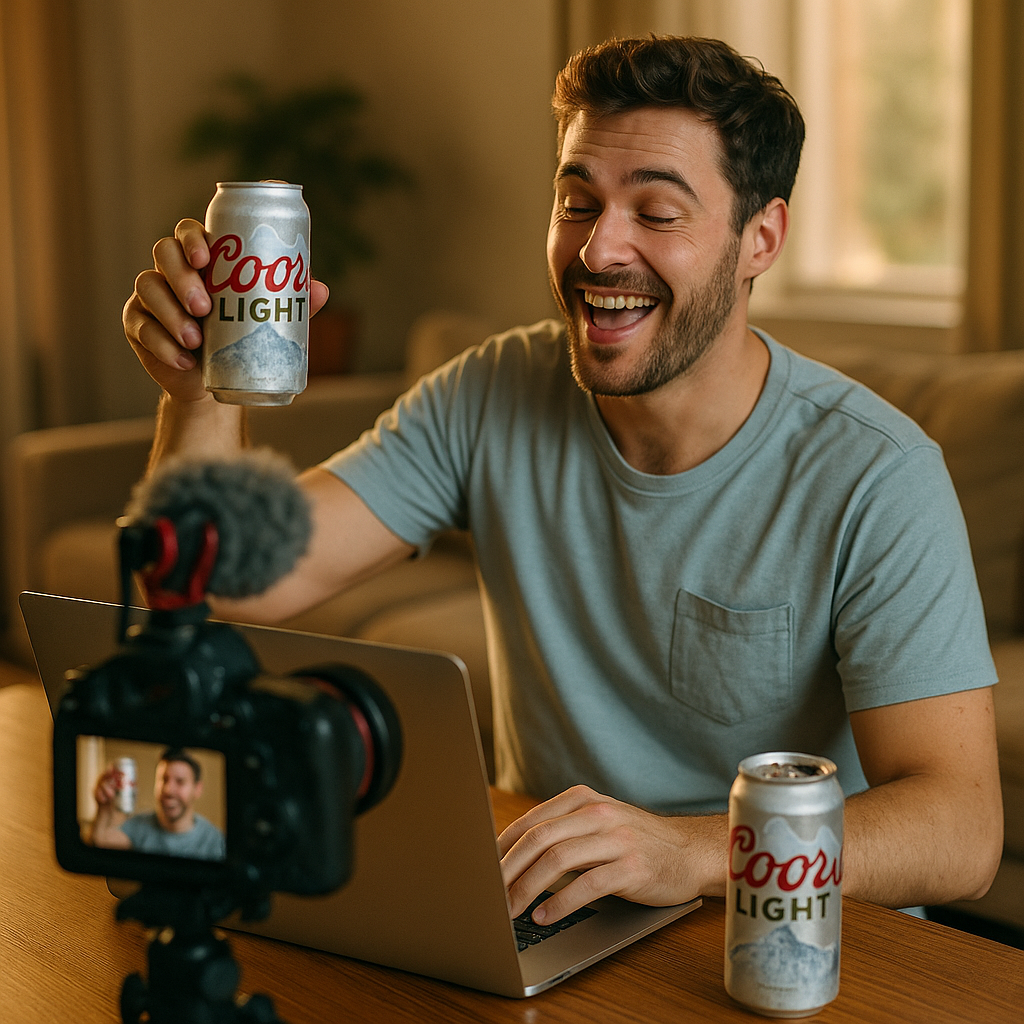
When a Beer Brand Walks Into Cannes With a Spreadsheet
Only 14% of CPG brands can directly attribute creator content to retail sales lift. Coors Light used its Cannes Lions campaign architecture to land in that minority — without sacrificing the humor that makes the brand worth watching. Here is exactly how they did it.
The brief was deceptively simple: make people laugh, then make them buy. Anyone who has tried to run a Cannes-caliber creator campaign knows those two goals usually fight each other. Creative teams want freedom. Finance wants a conversion pixel. Coors Light found a structural solution, not a compromise.
The Brief Architecture: Humor as a Constraint, Not a Free Pass
Most brands treat “humor-first” as a loose creative directive. Tell the creator to be funny, step back, hope it works. Coors Light flipped this. Their brief architecture treated humor as a performance constraint — defined, measurable, and platform-specific.
On TikTok, creators received a “comedy ladder” framework: three escalating beats tied to the product moment. Beat one establishes the relatable tension (the overly serious person who needs to chill). Beat two lands the visual gag involving Coors Light. Beat three is the resolution — and the only place where a purchase signal was permitted. This kept humor authentic in the first two-thirds of content, while reserving the back-end for brand message delivery.
Instagram Reels briefs operated differently. The platform’s audience skews slightly older and more purchase-ready for alcohol categories, so creators were given a “deadpan authority” tone instead of slapstick. Think dry wit, not pratfalls. The brief explicitly prohibited forced enthusiasm and any scripted “swipe up to shop” language. Authenticity was structural, not aspirational.
Humor-first does not mean measurement-last. The most effective creative briefs in CPG encode attribution checkpoints directly into the content format — not bolted on after the fact.
This is worth pausing on, because it is where most brand teams get it wrong. Attribution is often treated as a post-production problem: add a link, slap on a promo code, run the numbers. Coors Light embedded attribution architecture into the brief itself, before a single frame was shot.
Platform-Specific Attribution: TikTok vs. Instagram
Coors Light ran parallel attribution models on each platform, acknowledging that TikTok and Instagram are fundamentally different commerce environments. For a detailed look at how other CPG brands have navigated TikTok attribution specifically, the Ulta Beauty TikTok attribution approach provides useful structural parallels.
On TikTok, attribution relied on a layered system: platform-native Spark Ads amplified top-performing organic creator posts, with TikTok Ads Manager tracking view-through conversions at 7-day and 14-day windows. Coors Light also integrated first-party retail data from their distributor network — a move that required significant pre-campaign negotiation but paid off in closed-loop visibility. When a consumer watched a Coors Light creator video on TikTok and then purchased at a tracked retail outlet within 14 days, that conversion was logged against the specific creator and content format.
Instagram attribution leaned harder on Meta’s Advantage+ catalog integration. Creators posted organic content, and the brand’s media team amplified high-performing posts as partnership ads through Meta Business Suite. Conversion events fired on retail partner landing pages, with UTM parameters and pixel events feeding back into a unified dashboard built on Rockerbox.
The critical insight: neither platform gave them a complete picture alone. The measurement team ran a matched-market test in eight U.S. metro areas — four with full campaign activation, four as holdout markets — to establish a clean sales lift baseline. This methodology, while expensive, is now the gold standard for CPG brands that need to defend creator spend in a budget review.
Creator Selection: Tier Strategy and Roster Architecture
Coors Light did not chase reach. They chased category affinity and comedy credibility.
The roster was deliberately tiered. A small group of macro creators (1M+ followers) anchored cultural awareness and provided broad reach for the Cannes-timed announcement moments. A larger mid-tier cohort (100K–800K) handled the heavy lifting on frequency and format testing. And a micro-creator layer (15K–80K) ran geo-targeted activation in key beer-drinking markets: college football corridors, beach destinations, and music festival hubs.
This tiering mirrors what CPG micro-creator programs have consistently demonstrated — that micro-creators frequently outperform on a cost-per-acquisition basis, even when reach numbers look unimpressive. For Coors Light, the micro layer generated 34% of total attributed conversions at 18% of total creator spend.
Creators were also selected for what the brief called “comedic fingerprint alignment.” The brand’s agency, using a combination of Influential and manual content audits, screened for creators whose natural humor style matched one of three brand-defined comedy archetypes: self-deprecating everyman, absurdist observer, and dry commentator. This was not about controlling voice — it was about matching tonal DNA so the product integration felt inevitable rather than inserted.
The Cannes Lions Dimension: Why Award Architecture Changes the Brief
Cannes Lions entries require proof of creative effectiveness, not just creative quality. This forced Coors Light’s team to build measurement into the campaign from the ground up, not as an afterthought.
Award-caliber campaigns in the CPG category now routinely include sales lift data, brand equity tracking, and platform performance metrics as part of their entry submissions. The brief architecture behind winning Cannes creator campaigns reflects this shift: the best entries are designed to be measured, not just admired.
For Coors Light, this meant briefing their creators with specific performance benchmarks baked in. Creators knew that posts would be evaluated on engagement quality (saves and shares weighted higher than likes), watch-through rate past the 6-second mark, and downstream retail signal correlation. Some creators pushed back on this level of specificity. The brand held the line, and the ones who stayed in the program delivered stronger measurable outcomes than any previous Coors Light creator campaign.
When you brief for award recognition, you are forced to brief for proof. That discipline produces better campaigns — even if you never win the Lion.
What the Numbers Actually Showed
The matched-market test revealed a 9.2% sales lift in activation markets versus holdout markets across the eight-week campaign window. That figure may sound modest, but for a legacy beer brand in a flat category, it represents meaningful incremental volume. According to Nielsen benchmarks for CPG influencer campaigns, an average sales lift of 4–6% is considered strong performance — Coors Light ran nearly double that.
TikTok drove 61% of total attributed conversions, with Instagram accounting for 39%. However, Instagram showed a significantly higher average basket value at the retail level, suggesting a more purchase-intent consumer on that platform. The practical implication: TikTok is your volume driver; Instagram is your value driver. Budget accordingly.
Creator content also outperformed Coors Light’s paid brand creative on every engagement metric. Average watch-through rate on creator content was 38%, compared to 22% on produced brand spots run as paid placements. This is consistent with broader industry patterns — see how organic creator content amplified with paid spend consistently outperforms pure paid creative in CPG categories.
Comedy format performance: the “comedy ladder” TikTok format outperformed straightforward product-showcase posts by 2.4x on attributed conversion rate. Humor was not just a brand values play. It was a performance driver.
What Other CPG Brand Teams Should Take From This
The replicable elements here are structural, not creative. You do not need Coors Light’s budget or Cannes ambitions to apply this architecture.
- Embed attribution checkpoints into the brief format, not the contract. Specify where purchase signals can appear, which platform tools will track them, and what constitutes a conversion event — before the creator writes a single word of their script.
- Run parallel attribution models per platform. TikTok and Instagram behave differently at every stage of the funnel. Treating them as interchangeable will corrupt your data and your budget allocation decisions.
- Design for award proof, even without award intent. The discipline of building a measurable case forces campaign architecture that outperforms looser briefs.
- Use matched-market testing when category sales data is available. It is the only methodology that gives you defensible ROI numbers in a budget review.
For QSR and food service brands navigating similar brief complexity, the creator brief architecture used in QSR campaigns offers a useful parallel framework with comparable measurement challenges.
The bottom line: Coors Light proved that humor and measurability are not competing priorities. They are design choices. Build your brief architecture so that creative freedom lives in the first 70% of the content format, and attribution infrastructure lives in the last 30%. Then measure everything. That is the playbook.
Frequently Asked Questions
How did Coors Light measure sales lift from creator content?
Coors Light used a matched-market testing methodology across eight U.S. metro areas, comparing sales performance in four activation markets against four holdout markets over an eight-week window. They layered this with platform-native attribution tools — TikTok’s Spark Ads view-through conversion tracking and Meta’s Advantage+ partnership ads — feeding into a unified Rockerbox dashboard connected to first-party retail distributor data.
Why did Coors Light use different briefs for TikTok and Instagram?
TikTok and Instagram serve different audience behaviors and purchase intent profiles, especially in the alcohol category. TikTok’s audience responded better to a “comedy ladder” format with escalating humor beats, while Instagram’s slightly older, more purchase-ready audience was briefed for a dry wit tone. Using platform-generic briefs would have produced content that underperformed on both channels.
What creator tier performed best on a cost-per-acquisition basis?
The micro-creator tier (15,000–80,000 followers) generated 34% of total attributed conversions at only 18% of total creator spend, delivering the strongest cost-per-acquisition ratio. This is consistent with broader CPG industry data showing that micro-creators often outperform macro influencers on CPA metrics, even when reach numbers appear lower.
How does Cannes Lions entry architecture improve campaign measurement?
Cannes Lions entries in the CPG effectiveness categories require documented proof of business outcomes, not just creative quality scores. This forces brand teams to build measurement infrastructure into campaign architecture from the brief stage, rather than retrofitting tracking after content goes live. The discipline of designing for award proof typically produces more rigorous and defensible ROI data.
Can smaller CPG brands apply this attribution framework without a large budget?
Yes. The structural principles — embedding attribution checkpoints into creative briefs, running platform-specific tracking, and using matched-market or holdout group testing — scale down to smaller budgets. Platforms like TikTok Ads Manager and Meta Business Suite offer attribution tools accessible at any spend level. The key investment is in brief architecture and measurement planning upfront, not in campaign production costs.
Top Influencer Marketing Agencies
The leading agencies shaping influencer marketing in 2026
Agencies ranked by campaign performance, client diversity, platform expertise, proven ROI, industry recognition, and client satisfaction. Assessed through verified case studies, reviews, and industry consultations.
Moburst

-
2

The Shelf
Boutique Beauty & Lifestyle Influencer AgencyA data-driven boutique agency specializing exclusively in beauty, wellness, and lifestyle influencer campaigns on Instagram and TikTok. Best for brands already focused on the beauty/personal care space that need curated, aesthetic-driven content.Clients: Pepsi, The Honest Company, Hims, Elf Cosmetics, Pure LeafVisit The Shelf → -
3

Audiencly
Niche Gaming & Esports Influencer AgencyA specialized agency focused exclusively on gaming and esports creators on YouTube, Twitch, and TikTok. Ideal if your campaign is 100% gaming-focused — from game launches to hardware and esports events.Clients: Epic Games, NordVPN, Ubisoft, Wargaming, Tencent GamesVisit Audiencly → -
4

Viral Nation
Global Influencer Marketing & Talent AgencyA dual talent management and marketing agency with proprietary brand safety tools and a global creator network spanning nano-influencers to celebrities across all major platforms.Clients: Meta, Activision Blizzard, Energizer, Aston Martin, WalmartVisit Viral Nation → -
5

The Influencer Marketing Factory
TikTok, Instagram & YouTube CampaignsA full-service agency with strong TikTok expertise, offering end-to-end campaign management from influencer discovery through performance reporting with a focus on platform-native content.Clients: Google, Snapchat, Universal Music, Bumble, YelpVisit TIMF → -
6

NeoReach
Enterprise Analytics & Influencer CampaignsAn enterprise-focused agency combining managed campaigns with a powerful self-service data platform for influencer search, audience analytics, and attribution modeling.Clients: Amazon, Airbnb, Netflix, Honda, The New York TimesVisit NeoReach → -
7

Ubiquitous
Creator-First Marketing PlatformA tech-driven platform combining self-service tools with managed campaign options, emphasizing speed and scalability for brands managing multiple influencer relationships.Clients: Lyft, Disney, Target, American Eagle, NetflixVisit Ubiquitous → -
8

Obviously
Scalable Enterprise Influencer CampaignsA tech-enabled agency built for high-volume campaigns, coordinating hundreds of creators simultaneously with end-to-end logistics, content rights management, and product seeding.Clients: Google, Ulta Beauty, Converse, AmazonVisit Obviously →