


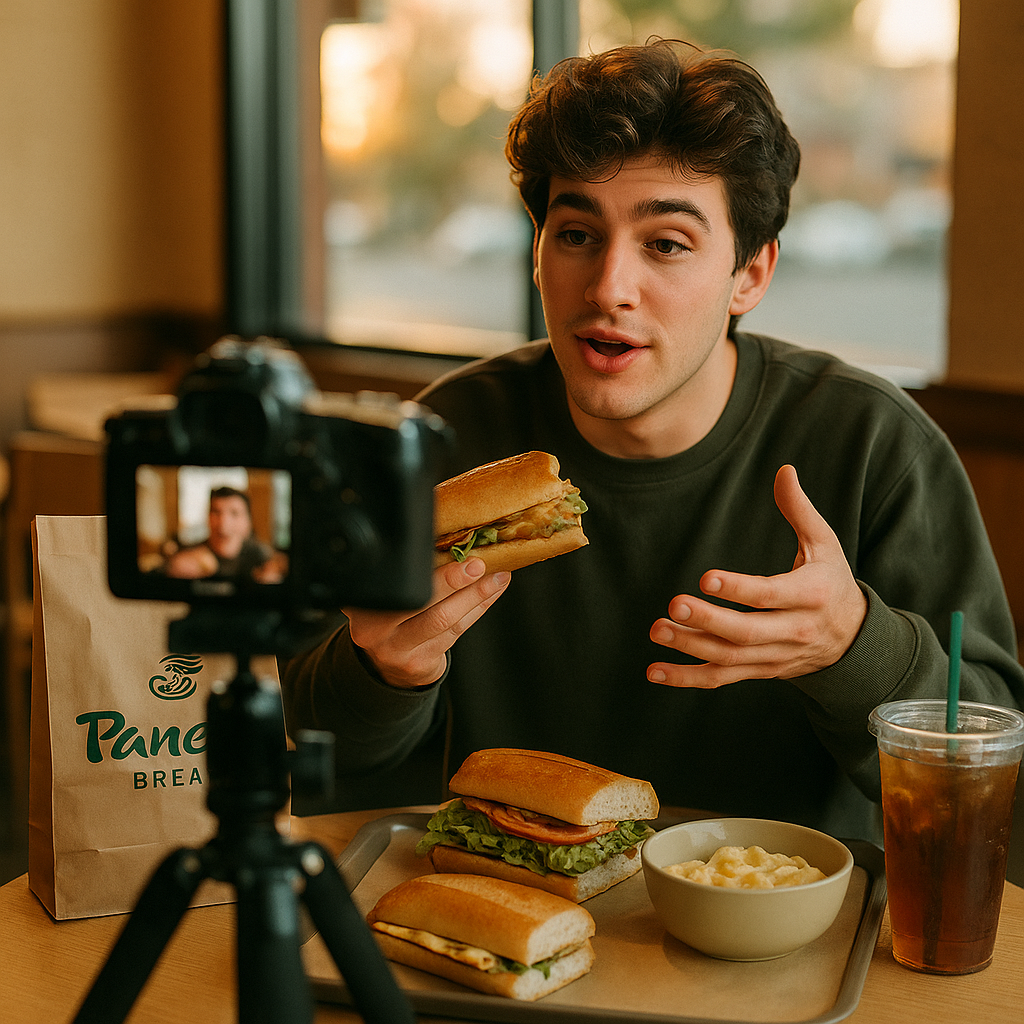
Most Creator Sponsorships Stay Transactional. Panera Didn’t Let That Happen.
When roughly 70% of branded creator deals never move beyond a single post, the brands that engineer long-term creative relationships sit in a genuinely rare category. The Jake Shane and Panera Bread partnership is one of the clearest recent examples of a QSR brand graduating from a tactical placement into something that functions more like a full creative franchise — and the brief architecture behind that shift is worth dissecting in detail.
Who Jake Shane Is (and Why That Matters for QSR Targeting)
Jake Shane is a comedian and content creator whose TikTok-native storytelling style built a multi-million-person audience largely by being unfiltered, conversational, and genuinely funny without being performative. His content doesn’t feel like content. That distinction is load-bearing for any QSR brand operating in a category where authenticity signals matter more than production polish.
His audience skews Gen Z and younger Millennial, which tracks directly with Panera’s documented push to reposition away from its legacy “fast casual for office lunches” identity. Panera’s loyalty program, Sip Club, was already doing heavy lifting on the habitual customer retention side. The Jake Shane relationship was architected to solve a different problem: top-of-funnel cultural relevance with a younger demographic that doesn’t associate Panera with their social identity.
That’s not a media buy problem. That’s a perception problem. And perception problems require creator partnerships structured differently than awareness campaigns.
The Brief Architecture: From One-Off to Campaign Pillar
The structural tell in how Panera and Jake Shane’s collaboration evolved is the progression of creative latitude. Early executions felt like what they were: a brand finding its footing with a creator whose tone it respected but hadn’t fully trusted yet. Posts were integrated, reasonably native to his format, but still carried the fingerprints of a brand team writing guardrails for the first time.
What changed was the brief. Specifically, what the brief stopped specifying.
The most effective creator briefs for long-term campaigns define the outcome and the brand guardrails — then step back. Brands that over-script the creative signal to audiences (and the algorithm) that the content is manufactured. Jake Shane’s Panera content worked because it sounded like Jake Shane talking about Panera, not Panera talking through Jake Shane.
For QSR marketing teams, that shift in brief philosophy has real operational implications. It requires legal and brand safety to move earlier in the process, not later. Guardrails get set during brief architecture, not during content review. This is a structural change to your workflow, not a creative preference.
It also requires a clear decision about what you’re actually optimizing for. Early posts in this partnership leaned into engagement metrics (comments, shares, saves) rather than direct conversion. That’s a deliberate choice, and it needs to be visible in how you brief the creator and how you report back to internal stakeholders who want to see coupon redemptions by week two.
Teams navigating similar brief evolution questions can find a useful framework in how other brands have handled brief architecture and timing when scaling creator relationships past the initial activation phase.
Why QSR Brands Are Uniquely Positioned (and Uniquely Challenged) for This Model
Quick service restaurants have a structural advantage in creator marketing that most brands don’t: the product is cheap, accessible, and consumable on camera. You don’t need to ship inventory. You don’t need a tutorial. The barrier to a creator organically integrating your product is low.
The challenge is differentiation. Every QSR brand can theoretically execute this model. Most of them settle for transactional executions because the procurement and legal infrastructure for long-term creator partnerships is harder to build than it looks. Contracts, content rights, exclusivity windows, FTC compliance — these operational layers slow things down. Brands that solve the operational side move faster and build better creative relationships.
The Benihana creator campaign that drove a measurable reservation lift shows a comparable dynamic in the restaurant category: structured brief-to-execution alignment with measurable in-store outcomes. The brief architecture isn’t just a creative document. It’s a performance contract.
Panera’s Sip Club integration into Jake Shane content is the clearest example of where the campaign-level thinking compounds. Rather than treating the loyalty program as a CTA tagged on at the end of a post, the Sip Club became content-native. The subscription mechanic was framed through Jake Shane’s personality: repetitive, habitual, slightly chaotic, deeply relatable. That’s not an accident. That’s a brief that understood how the creator’s voice could make a product feature feel like a personality trait.
What the Creator Selection Process Got Right
Brand-creator fit analysis still gets under-resourced in most QSR marketing departments. Teams default to reach and demographic overlap, which gets you to “not wrong” but rarely to “right.” Panera’s selection of Jake Shane reflects a more dimensional matching process.
Consider what aligned beyond the audience numbers:
- Tone coherence: Jake Shane’s comedic voice maps to the “slightly chaotic but lovable” brand register Panera was trying to build. This isn’t an accident of casting; it requires someone to have done the qualitative work on creator brand personality before the brief gets written.
- Category adjacency: Food and beverage content appears organically in Jake Shane’s content ecosystem, making the Panera integration feel like an expansion rather than an intrusion.
- Platform alignment: His content architecture (short-form video, conversational delivery, real-time reaction to trending formats) fits the platforms where Panera needed cultural presence.
- Audience behavior, not just demographics: His followers comment, share, and save at rates that suggest active community rather than passive viewership. For a brand building loyalty program awareness, that distinction matters enormously.
The CeraVe x Michael Cera case is the canonical example of brand affinity matching executed at a campaign level. The principles translate directly to QSR: the more dimensional the fit, the more the content feels organic, and the more the organic content performs.
Scaling the Model Without Losing the Signal
Here’s where most brands break down: they see a creator partnership work, and they try to systematize it by running the same play with ten creators simultaneously. The Jake Shane partnership’s value wasn’t replicable at volume. It was replicable as a model, which is a different thing entirely.
A model means: define the outcome before defining the creator, build briefs that give latitude within guardrails, measure for the metric that actually corresponds to your campaign stage, and build a content rights and amplification strategy before launch rather than after. The paid amplification layer on organic creator content is consistently one of the highest-efficiency uses of media budget in this category. Panera’s ability to take Jake Shane’s organic posts and boost them as paid social units extended reach without sacrificing the native feel.
Brands that treat creator content as both organic inventory and paid media assets from the brief stage onward build compounding advantages. Usage rights need to be scoped at contracting, not negotiated retroactively when a post overperforms.
The Wingstop creator model illustrates this cost-efficiency dynamic in the QSR space with specific detail: creator content amplified through paid channels delivered reach comparable to broadcast at a fraction of the CPM. The math works when you build for it from the start.
For attribution, QSR brands have more options than they typically use. Panera’s Sip Club provides a direct attribution layer that most restaurants don’t have: loyalty sign-ups, redemption data, and purchase frequency tied to creator-driven acquisition windows. If you don’t have a loyalty program yet, the Panera case is partially an argument for building one.
External data reinforces the strategic direction here. eMarketer consistently tracks creator marketing spend growth outpacing traditional digital formats, while Sprout Social research on social content performance confirms that audience engagement with creator-integrated brand content outperforms standard brand posts by significant margins. FTC guidelines on disclosure remain non-negotiable in how you structure any long-term creator deal — compliance needs to be baked into brief templates, not reviewed post-production. And for QSR brands still building out creator program infrastructure, TikTok’s creator marketplace provides discovery and performance data that makes the matching process more evidence-driven from the start.
The Operational Takeaway for QSR Marketers
Audit your current creator briefs against one question: does this brief make a great creator better, or does it make them safer? If your answer is the latter, you’re not building toward a Jake Shane situation. You’re building toward forgettable content at predictable CPMs.
The Panera model works because someone decided early that a creator relationship worth having is one where the creator’s voice is the asset, not a vehicle for your talking points. Rebuild your brief architecture around that premise, solve the legal and operational layers before they become blockers, and the campaign-level outcomes follow.
Frequently Asked Questions
What made Jake Shane a strategic fit for Panera Bread beyond audience demographics?
Beyond demographic overlap with Gen Z and younger Millennials, Jake Shane’s comedic voice, habitual content themes, and high-engagement community aligned with Panera’s brand repositioning goals. His tone mapped naturally to the “slightly chaotic but relatable” register Panera needed, and his category adjacency to food and beverage content made integrations feel organic rather than inserted. Dimensional brand-creator fit analysis, not just reach metrics, drove the selection.
How should QSR brands structure creator briefs differently for long-term partnerships versus one-off activations?
Long-term partnership briefs should front-load brand guardrails and compliance requirements, then give creative latitude on format, tone, and execution. Short-term activation briefs often over-specify because there’s no established trust. For campaign-level relationships, the brief should define outcomes and off-limits territory, then step back. Legal review and content rights scoping should happen at the brief stage, not after a post performs well and you want to amplify it.
What attribution methods work best for creator campaigns in the QSR category?
Loyalty program data is the most direct attribution layer available to QSR brands with existing programs, allowing linkage between creator-driven acquisition windows and purchase frequency or sign-up rates. For brands without loyalty infrastructure, promo codes, unique landing pages, and geo-targeted offer redemption data provide workable proxies. Post-lift studies and brand search volume tracking (via tools like Google Trends or platform-native analytics) help quantify upper-funnel impact that doesn’t convert immediately.
Can the Panera and Jake Shane model scale across multiple creators simultaneously?
The specific partnership dynamic doesn’t scale by replication, but the brief architecture model does. Running the same approach with multiple creators simultaneously requires clear content rights frameworks, consistent guardrail documentation, and a performance measurement structure tied to campaign stage rather than uniform KPIs across all partners. Each creator relationship still requires individual brief calibration; the operational infrastructure is what scales, not the creative formula.
What are the FTC compliance requirements for long-term creator brand partnerships?
The FTC requires clear and conspicuous disclosure of material connections between creators and brands in every piece of sponsored content, regardless of how long-standing the relationship is. For ongoing partnerships, this means each individual post still requires explicit disclosure (e.g., #ad or #sponsored). Contract templates for long-term creator deals should include disclosure obligations as a non-negotiable term, and brands carry shared responsibility for ensuring compliance across all deliverables. Current FTC guidance is available at ftc.gov.
Top Influencer Marketing Agencies
The leading agencies shaping influencer marketing in 2026
Agencies ranked by campaign performance, client diversity, platform expertise, proven ROI, industry recognition, and client satisfaction. Assessed through verified case studies, reviews, and industry consultations.
Moburst

-
2

The Shelf
Boutique Beauty & Lifestyle Influencer AgencyA data-driven boutique agency specializing exclusively in beauty, wellness, and lifestyle influencer campaigns on Instagram and TikTok. Best for brands already focused on the beauty/personal care space that need curated, aesthetic-driven content.Clients: Pepsi, The Honest Company, Hims, Elf Cosmetics, Pure LeafVisit The Shelf → -
3

Audiencly
Niche Gaming & Esports Influencer AgencyA specialized agency focused exclusively on gaming and esports creators on YouTube, Twitch, and TikTok. Ideal if your campaign is 100% gaming-focused — from game launches to hardware and esports events.Clients: Epic Games, NordVPN, Ubisoft, Wargaming, Tencent GamesVisit Audiencly → -
4

Viral Nation
Global Influencer Marketing & Talent AgencyA dual talent management and marketing agency with proprietary brand safety tools and a global creator network spanning nano-influencers to celebrities across all major platforms.Clients: Meta, Activision Blizzard, Energizer, Aston Martin, WalmartVisit Viral Nation → -
5

The Influencer Marketing Factory
TikTok, Instagram & YouTube CampaignsA full-service agency with strong TikTok expertise, offering end-to-end campaign management from influencer discovery through performance reporting with a focus on platform-native content.Clients: Google, Snapchat, Universal Music, Bumble, YelpVisit TIMF → -
6

NeoReach
Enterprise Analytics & Influencer CampaignsAn enterprise-focused agency combining managed campaigns with a powerful self-service data platform for influencer search, audience analytics, and attribution modeling.Clients: Amazon, Airbnb, Netflix, Honda, The New York TimesVisit NeoReach → -
7

Ubiquitous
Creator-First Marketing PlatformA tech-driven platform combining self-service tools with managed campaign options, emphasizing speed and scalability for brands managing multiple influencer relationships.Clients: Lyft, Disney, Target, American Eagle, NetflixVisit Ubiquitous → -
8

Obviously
Scalable Enterprise Influencer CampaignsA tech-enabled agency built for high-volume campaigns, coordinating hundreds of creators simultaneously with end-to-end logistics, content rights management, and product seeding.Clients: Google, Ulta Beauty, Converse, AmazonVisit Obviously →