


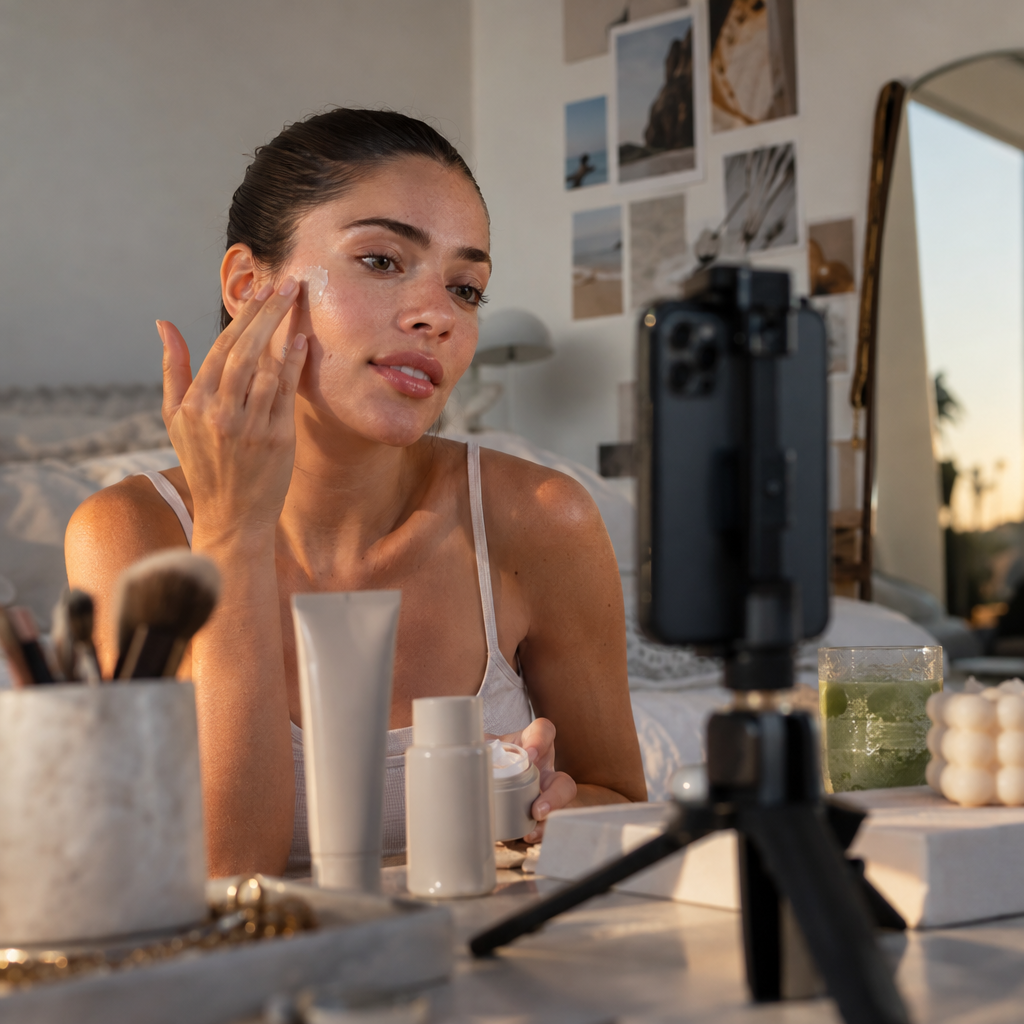
Rhode Skincare spent less on traditional paid media than most mid-tier DTC brands spend in a single quarter, yet it sold to e.l.f. Beauty in a deal reportedly worth up to a billion dollars. The primary keyword here isn’t luck. It’s Rhode Skincare’s founder led UGC strategy, a model that turned Hailey Bieber’s own content instincts into the brand’s entire media engine. How did skipping the ad budget become the growth hack?
Founder-Led UGC Is Not the Same as Influencer Marketing
Most brands treat “founder content” as a bonus layer on top of a paid influencer program. Rhode flipped that hierarchy. Hailey Bieber isn’t a brand ambassador who occasionally posts. She’s the primary content creator, and everything else, the gifted creators, the comment-section engagement, the retail tie-ins, gets built around her output rather than alongside it.
This matters operationally because it collapses the usual approval chain. There’s no brief-to-agency-to-creator-to-legal pipeline eating three weeks before a video goes live. Bieber posts a skin routine, a product tease, or a reaction clip, and it’s the campaign. No media buy required to get reach, because she already has the audience, and the content reads as organic because, well, it is.
Is Hailey Bieber Herself the Media Budget?
Functionally, yes. With tens of millions of followers across Instagram and TikTok, Bieber’s personal reach does the job a paid media line item would otherwise do: guaranteed impressions against a warm, trusting audience. Marketers chasing a similar model should note that this only works because her content doesn’t look like marketing. It looks like a 26-year-old talking about her skin.
Rhode’s real innovation wasn’t skipping paid ads. It was proving that founder authenticity can substitute for reach that brands normally have to rent.
The Numbers Behind the “No Paid Ads” Claim
Let’s be precise, because “zero paid media” gets repeated as a clean myth and it isn’t quite true. Rhode has run limited paid social, mostly to amplify content that was already performing organically, a tactic sometimes called “whitelisting” or spark-style boosting. But the ratio is the story. Where a typical DTC skincare brand might put 60 to 80 percent of its marketing budget into Meta ads and TikTok buys, Rhode has reportedly run lean on paid spend relative to revenue, leaning instead on organic UGC, waitlist drops, and limited product releases that generate their own press cycle.
Compare that to eMarketer’s data on DTC beauty spend, which consistently shows paid social as the dominant acquisition channel for challenger brands. Rhode is the outlier that gets studied precisely because it broke that pattern. The brand’s product drops routinely sell out within minutes, driven almost entirely by anticipation built through organic content and scarcity, not by retargeting pixels.
This is the part brand strategists underestimate: scarcity plus founder content is a demand-generation mechanic, not a UGC gimmick. It works because waitlists and sellouts generate their own earned media coverage, which functions like free paid reach.
The Operational Playbook: What Brands Without a Hailey Bieber Can Actually Steal
Most brands reading this don’t have a founder with 50 million followers. Fair. But the underlying mechanics are replicable at smaller scale, and that’s where the ROI conversation gets interesting for operators without celebrity founders.
- Treat founder or CEO content as a content pillar, not a press function. If your founder is willing to show up on camera regularly, that content outperforms polished brand assets on trust metrics almost every time, per Sprout Social’s ongoing research on brand authenticity.
- Build scarcity into launch cadence. Limited drops do double duty: they create urgency and they generate organic UGC as customers race to document “I got it” moments.
- Let UGC lead creative testing instead of brief-driven production. Rhode’s approach mirrors what other brands are now formalizing through content prototyping models that test raw creator footage before scaling spend behind it.
- Resist the urge to over-polish. Rhode’s lo-fi, phone-shot aesthetic is deliberate. It signals authenticity in a feed saturated with studio-lit ads.
Brands like Liquid Death have proven a parallel version of this thesis works even without a celebrity founder, by turning raw creator clips into paid ads only after they’ve proven organic traction. That sequencing, organic first, paid second, is the transferable lesson from Rhode’s model.
Compliance and Risk: What This Model Can’t Skip
Founder-led content doesn’t get a free pass on disclosure rules. If Hailey Bieber is posting about products she financially benefits from, which she obviously does as the brand’s owner, that relationship needs to be reasonably clear to the audience under FTC endorsement guidelines. Founder equity doesn’t exempt a brand from the same disclosure logic that applies to any paid partnership.
There’s also a concentration risk that brand strategists should flag internally before they pitch leadership on copying this playbook. When your entire media strategy runs through one person’s personal brand, what happens if that person steps back, faces reputational fallout, or simply wants to post less? Rhode mitigated this somewhat by selling to e.l.f. Beauty, which brings operational infrastructure and a creator network (the kind e.l.f. has scaled through tools like CreatorIQ for vetting nano creators) to reduce dependency on any single voice.
Where This Model Breaks for Most Brands
Here’s the honest caveat: this strategy is easiest to copy in theory and hardest to copy in practice. It requires a founder with genuine camera presence, existing audience trust, and the willingness to post consistently, not quarterly. Most CEOs aren’t built for that, and forcing it produces the exact inauthenticity the strategy depends on avoiding.
What’s more transferable is the structural lesson: build organic traction first, let real engagement data tell you what’s working, and only then layer in paid amplification behind proven content. That sequencing shows up across other successful creator-led models, including always-on creator casting approaches that prioritize continuous relationships over campaign bursts, and in retention-based creator compensation models that reward creators for ongoing presence rather than one-off posts.
Marketers evaluating budget allocation should run the math against benchmark data from sources like Statista on DTC customer acquisition costs before assuming organic-first will outperform paid for their specific category. Skincare and beauty have unusually high visual shareability. A B2B SaaS brand chasing this same playbook will hit very different ceiling effects.
What to Do With This Next
If you’re pitching leadership on a Rhode-style pivot, don’t sell “no paid ads.” Sell sequencing: build organic founder or employee-led content first, let the data tell you what resonates, then put budget behind what’s already working instead of guessing upfront. That’s the part of Rhode’s model every brand can actually execute, regardless of who’s holding the camera.
Frequently Asked Questions
Does Rhode Skincare run any paid advertising at all?
Yes, but minimally compared to typical DTC beauty brands. Rhode has used limited paid social to amplify organic content that was already performing well, rather than relying on paid media to generate initial reach or awareness.
Can a brand replicate Rhode’s founder-led UGC strategy without a celebrity founder?
Partially. The scarcity drops, organic-first testing, and lo-fi content aesthetic are replicable at any scale. The guaranteed reach that comes from a founder with tens of millions of existing followers is much harder to substitute without paid amplification or an established creator network.
How does Rhode handle FTC disclosure requirements for founder content?
Founder-owned content involving a financial interest still falls under standard endorsement disclosure expectations. Brands following this model should ensure any founder or executive promoting owned products discloses that relationship clearly, consistent with FTC guidance.
Why did e.l.f. Beauty acquire Rhode instead of Rhode scaling independently?
The acquisition reportedly gave Rhode access to operational infrastructure, retail distribution, and a broader creator network, reducing the brand’s dependency on a single founder’s personal reach to sustain growth.
What’s the biggest risk of a founder-led UGC strategy?
Concentration risk. When growth depends heavily on one person’s content output and personal brand, any disruption to that person’s availability, reputation, or willingness to post can directly threaten the brand’s acquisition engine.
Top Influencer Marketing Agencies
The leading agencies shaping influencer marketing in 2026
Agencies ranked by campaign performance, client diversity, platform expertise, proven ROI, industry recognition, and client satisfaction. Assessed through verified case studies, reviews, and industry consultations.
Moburst

-
2

The Shelf
Boutique Beauty & Lifestyle Influencer AgencyA data-driven boutique agency specializing exclusively in beauty, wellness, and lifestyle influencer campaigns on Instagram and TikTok. Best for brands already focused on the beauty/personal care space that need curated, aesthetic-driven content.Clients: Pepsi, The Honest Company, Hims, Elf Cosmetics, Pure LeafVisit The Shelf → -
3

Audiencly
Niche Gaming & Esports Influencer AgencyA specialized agency focused exclusively on gaming and esports creators on YouTube, Twitch, and TikTok. Ideal if your campaign is 100% gaming-focused — from game launches to hardware and esports events.Clients: Epic Games, NordVPN, Ubisoft, Wargaming, Tencent GamesVisit Audiencly → -
4

Viral Nation
Global Influencer Marketing & Talent AgencyA dual talent management and marketing agency with proprietary brand safety tools and a global creator network spanning nano-influencers to celebrities across all major platforms.Clients: Meta, Activision Blizzard, Energizer, Aston Martin, WalmartVisit Viral Nation → -
5

The Influencer Marketing Factory
TikTok, Instagram & YouTube CampaignsA full-service agency with strong TikTok expertise, offering end-to-end campaign management from influencer discovery through performance reporting with a focus on platform-native content.Clients: Google, Snapchat, Universal Music, Bumble, YelpVisit TIMF → -
6

NeoReach
Enterprise Analytics & Influencer CampaignsAn enterprise-focused agency combining managed campaigns with a powerful self-service data platform for influencer search, audience analytics, and attribution modeling.Clients: Amazon, Airbnb, Netflix, Honda, The New York TimesVisit NeoReach → -
7

Ubiquitous
Creator-First Marketing PlatformA tech-driven platform combining self-service tools with managed campaign options, emphasizing speed and scalability for brands managing multiple influencer relationships.Clients: Lyft, Disney, Target, American Eagle, NetflixVisit Ubiquitous → -
8

Obviously
Scalable Enterprise Influencer CampaignsA tech-enabled agency built for high-volume campaigns, coordinating hundreds of creators simultaneously with end-to-end logistics, content rights management, and product seeding.Clients: Google, Ulta Beauty, Converse, AmazonVisit Obviously →