


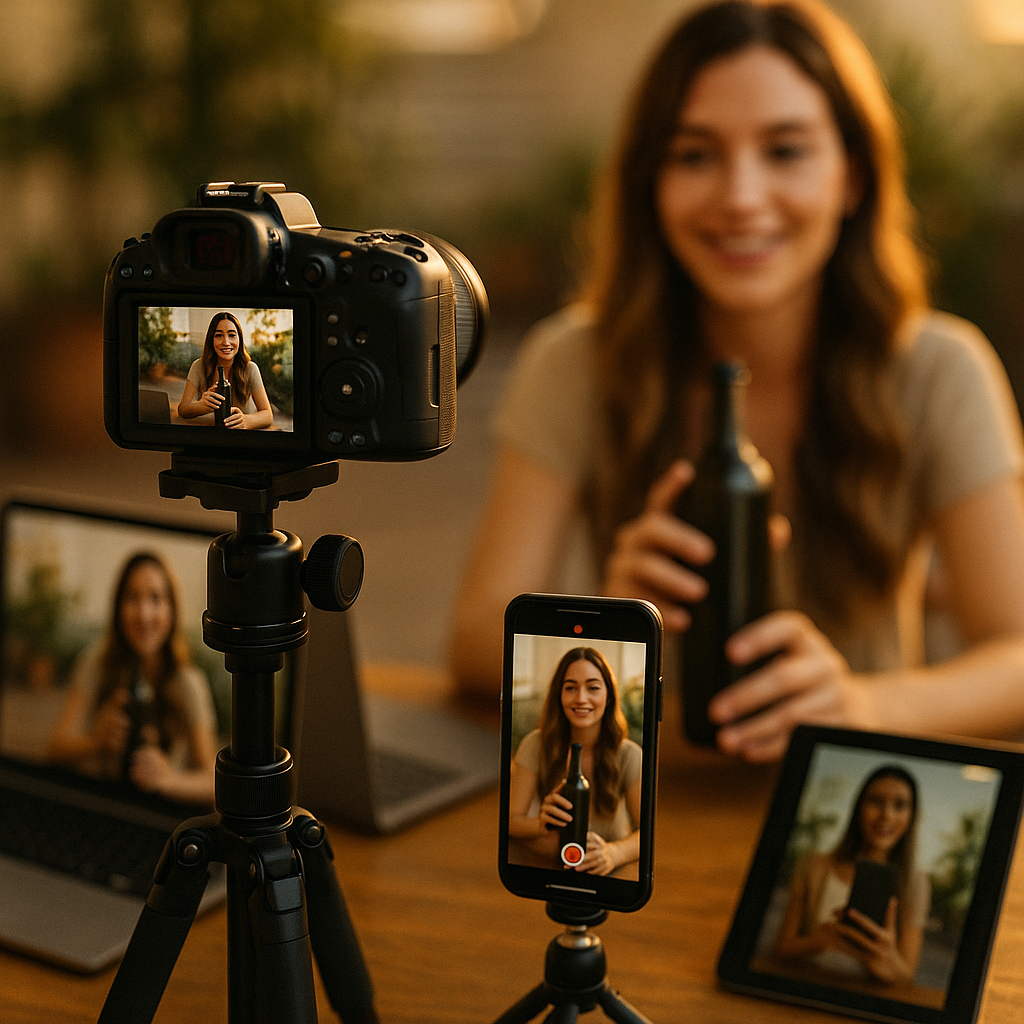
Brands running separate production budgets for TikTok, Reels, Shorts, and AI-shopping feeds are burning money on a problem that doesn’t need to exist. Multi-format creator asset production, planned correctly from pre-production, can yield every variant a modern distribution stack requires from a single shoot day.
Why Separate Production Budgets Are Now a Strategic Liability
The math became unavoidable fast. According to eMarketer, social video ad spend continues to climb steeply, yet most brand teams are still commissioning platform-specific shoots as if TikTok and Reels have fundamentally different production requirements. They don’t. What differs is the edit logic, the caption layer, and the metadata architecture — not the raw footage.
Here’s the real cost: when a campaign requires five creator videos across four platforms, teams often brief creators four or five times separately, review four or five separate deliverable sets, and pay production overhead four or five times. Multiply that across a quarter and you’re looking at a significant budget inefficiency that compounds before anyone notices.
The fix is a shoot-once framework built around modular creative direction. It requires more thinking at the brief stage and far less spend at the production and post-production stage.
Brands that front-load creative direction into the brief stage consistently report 30–40% reductions in per-asset production cost compared to platform-by-platform commissioning — without sacrificing format specificity.
What “AI-Curated Feed Ready” Actually Means for Production
Most brand teams still treat AI feed optimization as a post-production problem. It isn’t. The signals that surface content in TikTok’s For You Page algorithm, Meta’s Advantage+ creative system, and Google’s AI-powered Shopping surfaces are baked into the structure of the content, not the caption or hashtag stack appended afterward.
For AI-curated feeds specifically, three structural elements matter most: the hook density within the first two seconds, the presence of a recognizable product or face anchor, and the audio-visual alignment signal (whether the spoken or overlaid text matches the visual action). For AI Shopping variants, add one more: a product-visible frame that appears within the first three seconds and again in the last three, creating a clear visual bracket that recommendation engines can index.
None of these requirements demand separate footage. They demand a shooting plan that accounts for them. Directing a creator to hold the product naturally at the open, then reference it again in the close, costs nothing. Not briefing that direction costs a reshoot.
For a deeper look at how to structure briefs that build these signals in from the start, see how AI-curated feed briefs are structured differently from standard platform briefs.
The One-Shoot Framework: Four Layers of Creative Direction
This framework operates across four planning layers that exist entirely in the pre-production and brief stages.
Layer 1: The Anchor Scene. Every shoot begins with the core 30-to-45-second creator-led scene. This is the canonical content: direct-to-camera, authentic voice, product naturally integrated. The creator has full narrative latitude here within the guardrails you’ve set. This scene generates the long-form variant for YouTube Shorts (which now surfaces up to 60 seconds effectively), a trimmed Reels edit, and the base for TikTok.
Layer 2: The Bracket Shots. Before and after the anchor scene, the brief specifies two short shooting blocks, each 10–15 seconds. The opening bracket captures the hook: a question, a visual surprise, or a product in use without explanation. The closing bracket captures the CTA moment: product visible, creator speaking directly to the offer. These brackets can be mixed and matched across platform edits without the anchor scene changing.
Layer 3: The Silent Variant Sequence. Many AI-curated feeds and a significant portion of mobile viewers consume video with sound off. The brief should specify a 15-second soundless walkthrough — product visible, text-overlay-friendly framing, no reliance on spoken audio. This generates the AI Shopping-ready asset and a compliant paid social variant simultaneously.
Layer 4: The Raw B-Roll Block. Allocate 10 minutes of the shoot day to product-only, creator-adjacent B-roll: close-ups, flat-lay moments, texture shots. These feed the modular UGC pipeline for remix, A/B testing hooks, and paid amplification without requiring the creator to be available again.
Spec Architecture That Actually Ships
Platform spec compliance is where one-shoot frameworks collapse most often. Not because the footage is wrong, but because the post-production team wasn’t briefed on the safe zone architecture before the shoot.
The practical rule: shoot everything in 9:16 vertical, maintaining a center-frame subject placement with a top safe zone of at least 15% and a bottom safe zone of at least 20%. This single framing decision keeps the content compliant with TikTok’s text overlay zone, Meta’s action bar, and YouTube Shorts’ subscribe button placement simultaneously. Any deviation from center-frame framing that looks aesthetically interesting in-monitor will likely be cropped or obscured in-feed.
For the Reels 4:5 variant (which Meta’s Advantage+ system still serves in feed placements), the center 80% of the 9:16 frame maps cleanly. No reframe needed if the creator stays in frame correctly during the shoot.
Reference the full technical breakdown of vertical video specs for one production run when building your post-production checklist.
Briefing Creators for Multi-Format Output
The brief is the leverage point. A creator who understands they’re producing modular content for four surfaces will perform differently than one who thinks they’re making a TikTok. Neither is wrong — the outcome depends entirely on how the brief frames the task.
Effective multi-format briefs specify three things most standard briefs omit:
- The exact seconds at which a product must be visible (not just “feature the product naturally”)
- The text-overlay-safe framing instruction (typically: “keep your face and product in the center third of the frame throughout”)
- The bracket shot requirement as a separate deliverable line item with its own time allocation on shoot day
Creators briefed this way don’t find it more restrictive. They find it clearer. Ambiguity is what generates reshoots, not structure. For guidance on maintaining creative authenticity within structured briefs, the approach to balancing brand safety and authenticity applies directly here.
If you’re running AI video editing agents in post-production to generate hook variants automatically, the raw footage quality from a well-directed one-shoot session is dramatically cleaner input. Tools like Adobe‘s generative extend features and platform-native tools like TikTok Symphony require stable, well-framed source material to perform well. Garbage in, garbage out applies to AI editing as much as to traditional post.
From Production Framework to Distribution Logic
Producing the assets correctly is half the equation. Distributing them correctly is where brands frequently leave performance on the table.
Each variant produced under this framework should be tagged in your DAM (digital asset management) system with three metadata fields before it leaves post-production: platform target, duration, and AI-feed eligibility (a binary flag indicating whether the product bracket shot is present and within spec). Without this taxonomy, the efficiency gains from one-shoot production dissolve in the distribution workflow when someone has to manually verify which asset is compliant for which surface.
Sprout Social and HubSpot‘s content management layers both support custom metadata fields that can carry this tagging through to scheduling workflows. Build the taxonomy once and the distribution logic follows automatically.
The brands extracting the most value from one-shoot frameworks aren’t just cutting production costs — they’re compressing the time from shoot to live by 40–60% because asset approval and distribution routing become systematic rather than manual.
For performance measurement, connect each variant’s platform-specific UTM parameters back to a unified attribution view. Knowing that the AI Shopping variant outperformed the TikTok hook variant on a cost-per-acquisition basis is the data that lets you weight future shoot-day time toward the highest-yield bracket sequences. See how CPA and attribution goals integrate directly into creator brief architecture for the full loop.
One final operational note: the FTC’s endorsement guidelines apply across every format variant produced from a single shoot. A disclosure that appears in the anchor scene does not automatically carry to the silent variant or the bracket-only edit. Each distributed asset must carry compliant disclosure language appropriate for that format and platform. Build disclosure into the text overlay layer at the post-production stage, not as an afterthought.
Start with one campaign, one creator, and one shoot day. Map your existing deliverable list to the four-layer framework and identify where the bracket shots and silent variant can be captured within the same session. The production efficiency becomes self-evident within a single execution.
FAQs
What is multi-format creator asset production?
Multi-format creator asset production is the practice of designing a single creator shoot session to generate content variants for multiple platforms — TikTok, Instagram Reels, YouTube Shorts, and AI Shopping feeds — simultaneously, rather than commissioning separate productions for each platform.
How does a one-shoot framework reduce production costs?
By consolidating platform-specific deliverables into a single shoot day with modular creative direction (anchor scenes, bracket shots, silent variants, and B-roll blocks), brands eliminate redundant creator fees, separate production overhead, and multiple review cycles. The result is typically a 30–40% reduction in per-asset production cost.
What makes a video asset “AI-shopping ready”?
An AI-shopping-ready asset features a clearly visible product within the first three seconds and again in the final three seconds, uses center-frame composition, and does not rely solely on audio to convey the product’s value. These structural signals allow AI-powered recommendation and shopping surfaces to index and surface the content correctly.
Do different platforms require different aspect ratios?
The safest universal format is 9:16 vertical with center-frame subject placement. This framing works natively for TikTok and YouTube Shorts, and the center 80% of the frame maps cleanly to Meta’s 4:5 feed placement without requiring a separate reframe, provided the subject remains centered during shooting.
How should FTC disclosure be handled across multiple format variants?
Each distributed asset variant — including silent versions and short bracket clips — must carry its own compliant FTC disclosure. A disclosure present in the anchor scene does not automatically transfer to derivative edits. Add disclosure text overlays in post-production for every variant before distribution, not after.
Can AI editing tools work with one-shoot footage?
Yes, and they perform significantly better with well-directed source footage. AI video editing tools like Adobe’s generative features and TikTok Symphony require stable, centered, well-framed footage to generate clean hook and CTA variants. A properly directed one-shoot session produces the clean input these tools need to operate effectively.
Top Influencer Marketing Agencies
The leading agencies shaping influencer marketing in 2026
Agencies ranked by campaign performance, client diversity, platform expertise, proven ROI, industry recognition, and client satisfaction. Assessed through verified case studies, reviews, and industry consultations.
Moburst

-
2

The Shelf
Boutique Beauty & Lifestyle Influencer AgencyA data-driven boutique agency specializing exclusively in beauty, wellness, and lifestyle influencer campaigns on Instagram and TikTok. Best for brands already focused on the beauty/personal care space that need curated, aesthetic-driven content.Clients: Pepsi, The Honest Company, Hims, Elf Cosmetics, Pure LeafVisit The Shelf → -
3

Audiencly
Niche Gaming & Esports Influencer AgencyA specialized agency focused exclusively on gaming and esports creators on YouTube, Twitch, and TikTok. Ideal if your campaign is 100% gaming-focused — from game launches to hardware and esports events.Clients: Epic Games, NordVPN, Ubisoft, Wargaming, Tencent GamesVisit Audiencly → -
4

Viral Nation
Global Influencer Marketing & Talent AgencyA dual talent management and marketing agency with proprietary brand safety tools and a global creator network spanning nano-influencers to celebrities across all major platforms.Clients: Meta, Activision Blizzard, Energizer, Aston Martin, WalmartVisit Viral Nation → -
5

The Influencer Marketing Factory
TikTok, Instagram & YouTube CampaignsA full-service agency with strong TikTok expertise, offering end-to-end campaign management from influencer discovery through performance reporting with a focus on platform-native content.Clients: Google, Snapchat, Universal Music, Bumble, YelpVisit TIMF → -
6

NeoReach
Enterprise Analytics & Influencer CampaignsAn enterprise-focused agency combining managed campaigns with a powerful self-service data platform for influencer search, audience analytics, and attribution modeling.Clients: Amazon, Airbnb, Netflix, Honda, The New York TimesVisit NeoReach → -
7

Ubiquitous
Creator-First Marketing PlatformA tech-driven platform combining self-service tools with managed campaign options, emphasizing speed and scalability for brands managing multiple influencer relationships.Clients: Lyft, Disney, Target, American Eagle, NetflixVisit Ubiquitous → -
8

Obviously
Scalable Enterprise Influencer CampaignsA tech-enabled agency built for high-volume campaigns, coordinating hundreds of creators simultaneously with end-to-end logistics, content rights management, and product seeding.Clients: Google, Ulta Beauty, Converse, AmazonVisit Obviously →