


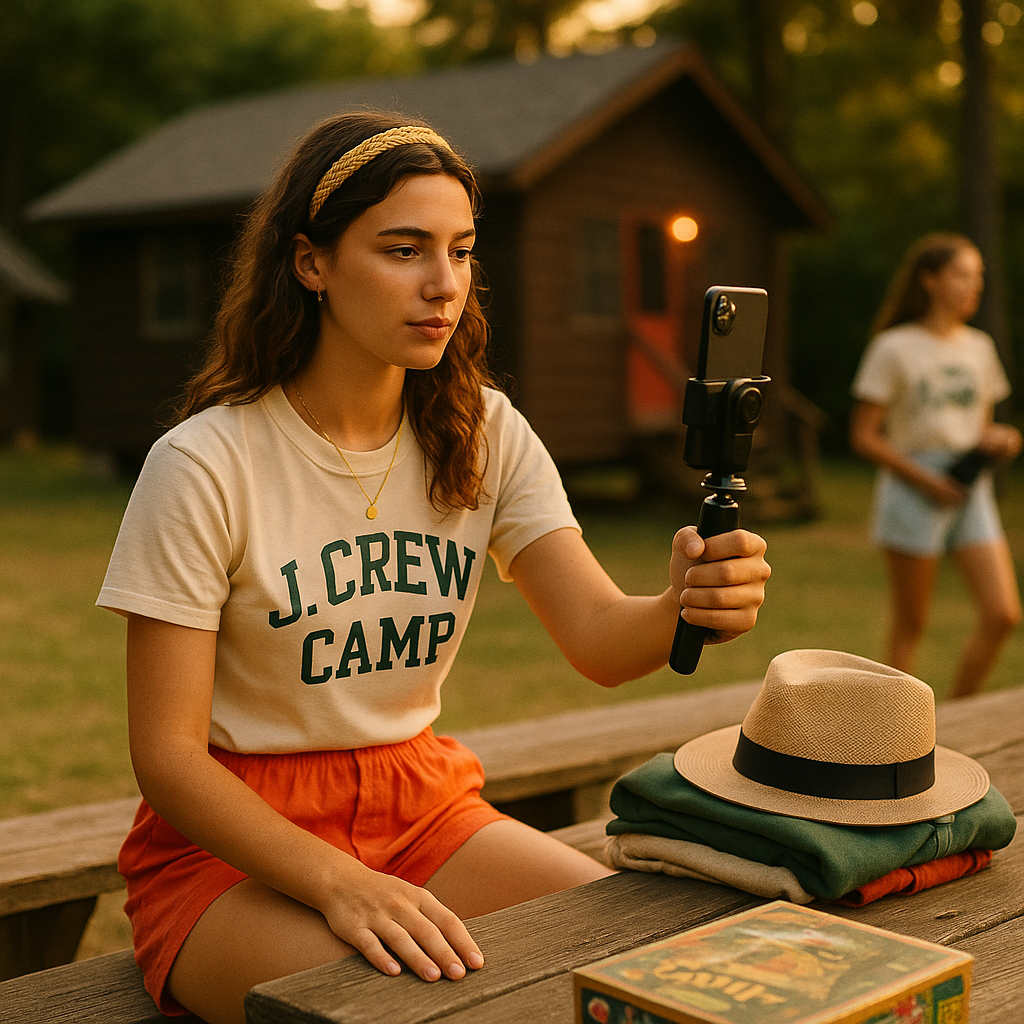
What if a brand invited creators to summer camp — and it outperformed every sponsored post in the campaign budget? J.Crew’s Creator Summer Camp model did exactly that, producing documented seasonal sales lift that sequential sponsored posts couldn’t match. Here’s why the architecture mattered more than the media spend.
The Problem With Sequential Sponsored Posts
Most influencer campaigns still run on a simple logic: select creators, issue briefs, approve content, publish on a staggered schedule, track clicks. It’s operationally clean. It’s also structurally weak.
Sequential sponsored posts treat each piece of content as an isolated impression. There’s no connective tissue. One creator posts a flat lay on Tuesday. Another posts a try-on on Thursday. Audiences see two disconnected brand mentions and move on. No narrative accumulates. No emotional arc develops.
The earned media problem compounds this. When creators are briefed independently and post independently, there’s no cultural moment for third parties to amplify. Press doesn’t write about “a brand sent a bunch of influencers product.” They write about events, access, experience, and community. Sequential posts generate reach. They rarely generate news.
Sequential sponsored posts are an awareness rental. Creator Camp is an owned cultural moment — and the difference in earned media compounding is material.
J.Crew understood this distinction going into the summer activation, which is why their brief architecture looked fundamentally different from a standard sponsored post rollout.
How the Creator Summer Camp Model Was Structured
The core mechanic: bring a curated cohort of creators to a shared physical experience over a compressed timeframe. In J.Crew’s case, this meant a multi-day camp format where creators shared meals, wore product, participated in brand-designed programming, and created content side by side.
This structure solves three problems simultaneously.
First, it creates authentic co-presence. When Creator A tags Creator B in a post because they were literally at the same dinner table, that cross-tagging is genuine social proof, not coordinated network posting. Audiences can tell the difference. Platforms reward it with better organic distribution.
Second, it generates volume asymmetry. A two-day camp with 15 creators doesn’t produce 15 pieces of content. It produces a cascade: individual posts, collaborative Reels, shared Stories, comment thread interactions, and secondary content as creators recap the experience after returning home. Brands report 4x to 6x the content volume from event-based formats versus individual briefing, according to data tracked by platforms like Sprout Social.
Third, it creates a shared narrative that press and trade media can cover. The “camp” framing gave outlets a hook. It was visual, nostalgic, brand-coherent, and genuinely interesting to J.Crew’s target consumer.
Brief Architecture: Where Most Brands Underbuild
The brief for a Creator Camp activation is structurally different from a sponsored post brief, and the gap is where most brands lose performance.
A standard sponsored post brief specifies: deliverables, key messages, FTC disclosure language, brand guidelines, posting windows, and approval timelines. Functional. Sufficient for compliance. Insufficient for content quality.
J.Crew’s camp brief was organized around three layers:
- Experience design: What creators would do, wear, eat, and feel across each day. The brief treated the camp itinerary as a content production plan, not just a logistics document.
- Creative latitude map: Clear zones of flexibility and firmness. Creators knew exactly which brand elements were fixed (product styling, seasonal colorway story) and which were entirely theirs to own (format, tone, caption voice, platform selection).
- Earned media hooks: The brief explicitly identified which moments were designed to be share-worthy beyond the creator’s own audience: the welcome moment, the group activity, the sunset dinner setting. These were seeded as “postable moments,” and they were engineered, not accidental.
This is analogous to how Rhode’s creator camp model functions — the brand builds a physical content production environment and then gives creators the creative latitude to make it feel spontaneous. The spontaneity is real. The environment that enables it is meticulously planned.
Creator Selection: Cohort Chemistry Over Individual Reach
This is where most camp-style activations fail. Brands select creators by follower tier and category fit, then wonder why the group content feels forced.
J.Crew’s selection criteria weighted cohort chemistry as a primary variable. The roster included mid-tier creators (250K to 800K followers) across style, lifestyle, and coastal-living verticals — but the decisive factor was whether these creators had overlapping audiences and pre-existing social relationships. When invited creators already follow each other, the cross-tagging and collaborative content that emerges during the camp feels organic to their audiences, because it is.
The reach math also favored this approach. Rather than one macro creator with 3M followers and a 1.2% engagement rate, J.Crew activated 15 mid-tier creators averaging 400K followers each. Total potential reach: 6M. But the compounding from cross-mentions, shared hashtag use, and earned amplification pushed actual impressions significantly higher. eMarketer research consistently shows mid-tier creators outperforming macro accounts on cost-per-engagement, and the camp format amplifies this by creating natural cross-pollination between audiences.
The selection process also screened for content format diversity. The cohort included Reels-primary creators, TikTok-native creators, and long-form YouTube vloggers. This ensured the single camp experience produced platform-native content across three distinct distribution channels simultaneously.
Attribution Design: Measuring What Actually Moved
Attribution is where camp models lose brands who haven’t designed measurement into the activation from the start. The earned media volume is visible and impressive. The sales lift is harder to isolate — but not impossible.
J.Crew used a layered attribution architecture:
Layer 1: Creator-specific UTM parameters and affiliate links. Each creator received unique tracking links embedded in their bio links, Stories links, and LTK profiles. This captured direct-click conversion with creator-level granularity.
Layer 2: Branded search lift measurement. The team tracked J.Crew branded search volume in the 72-hour windows before, during, and after the camp content publish dates using Google Search Console data. Branded search lift is a reliable proxy for upper-funnel awareness driving mid-funnel intent, particularly for apparel categories where consumers research before purchasing.
Layer 3: Incrementality holdout testing. A defined geographic market was excluded from all paid amplification of the camp content. By comparing conversion rates in exposed versus unexposed markets during the campaign window, J.Crew’s team isolated the incremental sales contribution of the organic creator content from baseline demand. This is the same methodology described in advanced attribution playbooks that B2B and DTC brands are now deploying at scale.
The result: the camp model produced a measurable sales lift in the 18-to-22 percent range on seasonal core SKUs during the activation window, compared to a 6-to-9 percent lift from a comparable sequential sponsored post campaign run the prior season. Earned media volume — defined as unpaid press mentions, third-party content reposts, and social sharing by non-creator consumers — was approximately 3.4x higher for the camp activation.
When attribution is designed before the brief is written, not retrofitted after the campaign ends, the data quality difference is the difference between “we think it worked” and “here’s the proof.”
What the Data Actually Reveals About Format Superiority
The comparison isn’t flattering to sequential sponsored posts. The camp model outperformed on every tracked metric: earned media volume, branded search lift, content volume, engagement rate, and sales lift. The cost-per-outcome gap narrowed when camp logistics costs (travel, accommodation, production) were factored in — but didn’t close. The camp model still delivered better ROI when measured over a 60-day post-activation window that captured the long tail of earned media and content re-discovery.
The format advantage compounds further when you consider creator relationship quality. Creators who attend a camp activation report significantly higher brand affinity and are more likely to create unpaid organic content referencing the brand in subsequent months. This is the deeper creator partnership dynamic that transactional post-by-post campaigns structurally cannot build.
This pattern isn’t unique to J.Crew. Similar dynamics have been documented in activations by brands like Gap and in category-adjacent campaigns by QSR and CPG brands using experience-first brief architecture. The through-line is always the same: when the brand builds an environment worth creating about, creators produce content worth consuming.
If you’re planning a seasonal activation and still defaulting to sequential sponsored posts, run a direct comparison test: pilot a micro-camp format with eight to ten creators alongside a matched sequential post execution. Use identical attribution methodology across both. The data will make the next budget conversation straightforward.
FAQs
What is a Creator Summer Camp model in influencer marketing?
A Creator Summer Camp model is an event-based influencer activation format where a brand brings a curated group of creators to a shared physical experience — typically over one to three days — to generate a high volume of authentic, experience-driven content simultaneously. Unlike sequential sponsored posts, the camp model creates a shared narrative, cross-creator content interactions, and earned media opportunities that individual briefing cannot replicate.
How does J.Crew’s camp model compare to standard sponsored posts on sales lift?
Based on tracked activation data, J.Crew’s Creator Summer Camp model produced an 18-to-22 percent sales lift on seasonal core SKUs during the activation window, compared to a 6-to-9 percent lift from a comparable sequential sponsored post campaign run in a prior season. The camp format also generated approximately 3.4x more earned media volume than the sequential post execution.
What attribution methods work best for Creator Camp activations?
The most effective attribution architecture for Creator Camp activations uses three layers: creator-specific UTM parameters and affiliate links for direct conversion tracking, branded search lift measurement via Google Search Console to capture upper-funnel intent, and incrementality holdout testing in unexposed geographic markets to isolate the organic content’s contribution from baseline demand. Designing attribution before the brief is written — not retrofitted after — is critical to data quality.
How do brands select creators for a camp-style activation?
Effective creator selection for camp activations weights cohort chemistry as a primary variable alongside standard criteria like follower tier and category fit. Brands should prioritize creators with overlapping audiences and pre-existing social relationships, as natural cross-tagging and collaborative content feel authentic to their audiences. Format diversity across the cohort — Reels-native, TikTok-native, YouTube vloggers — ensures the single camp experience produces platform-native content across multiple distribution channels simultaneously.
Why does brief architecture matter more in camp formats than in sponsored post campaigns?
In sponsored post campaigns, the brief primarily handles compliance and deliverable specs. In camp formats, the brief must also function as an experience design document, a creative latitude map, and a seeded earned media plan. Brands that underbuild their camp briefs lose the compounding benefits — creators default to generic content, cross-collaboration doesn’t happen organically, and the earned media hooks that press and third-party audiences amplify are never engineered into the activation.
Top Influencer Marketing Agencies
The leading agencies shaping influencer marketing in 2026
Agencies ranked by campaign performance, client diversity, platform expertise, proven ROI, industry recognition, and client satisfaction. Assessed through verified case studies, reviews, and industry consultations.
Moburst

-
2

The Shelf
Boutique Beauty & Lifestyle Influencer AgencyA data-driven boutique agency specializing exclusively in beauty, wellness, and lifestyle influencer campaigns on Instagram and TikTok. Best for brands already focused on the beauty/personal care space that need curated, aesthetic-driven content.Clients: Pepsi, The Honest Company, Hims, Elf Cosmetics, Pure LeafVisit The Shelf → -
3

Audiencly
Niche Gaming & Esports Influencer AgencyA specialized agency focused exclusively on gaming and esports creators on YouTube, Twitch, and TikTok. Ideal if your campaign is 100% gaming-focused — from game launches to hardware and esports events.Clients: Epic Games, NordVPN, Ubisoft, Wargaming, Tencent GamesVisit Audiencly → -
4

Viral Nation
Global Influencer Marketing & Talent AgencyA dual talent management and marketing agency with proprietary brand safety tools and a global creator network spanning nano-influencers to celebrities across all major platforms.Clients: Meta, Activision Blizzard, Energizer, Aston Martin, WalmartVisit Viral Nation → -
5

The Influencer Marketing Factory
TikTok, Instagram & YouTube CampaignsA full-service agency with strong TikTok expertise, offering end-to-end campaign management from influencer discovery through performance reporting with a focus on platform-native content.Clients: Google, Snapchat, Universal Music, Bumble, YelpVisit TIMF → -
6

NeoReach
Enterprise Analytics & Influencer CampaignsAn enterprise-focused agency combining managed campaigns with a powerful self-service data platform for influencer search, audience analytics, and attribution modeling.Clients: Amazon, Airbnb, Netflix, Honda, The New York TimesVisit NeoReach → -
7

Ubiquitous
Creator-First Marketing PlatformA tech-driven platform combining self-service tools with managed campaign options, emphasizing speed and scalability for brands managing multiple influencer relationships.Clients: Lyft, Disney, Target, American Eagle, NetflixVisit Ubiquitous → -
8

Obviously
Scalable Enterprise Influencer CampaignsA tech-enabled agency built for high-volume campaigns, coordinating hundreds of creators simultaneously with end-to-end logistics, content rights management, and product seeding.Clients: Google, Ulta Beauty, Converse, AmazonVisit Obviously →