


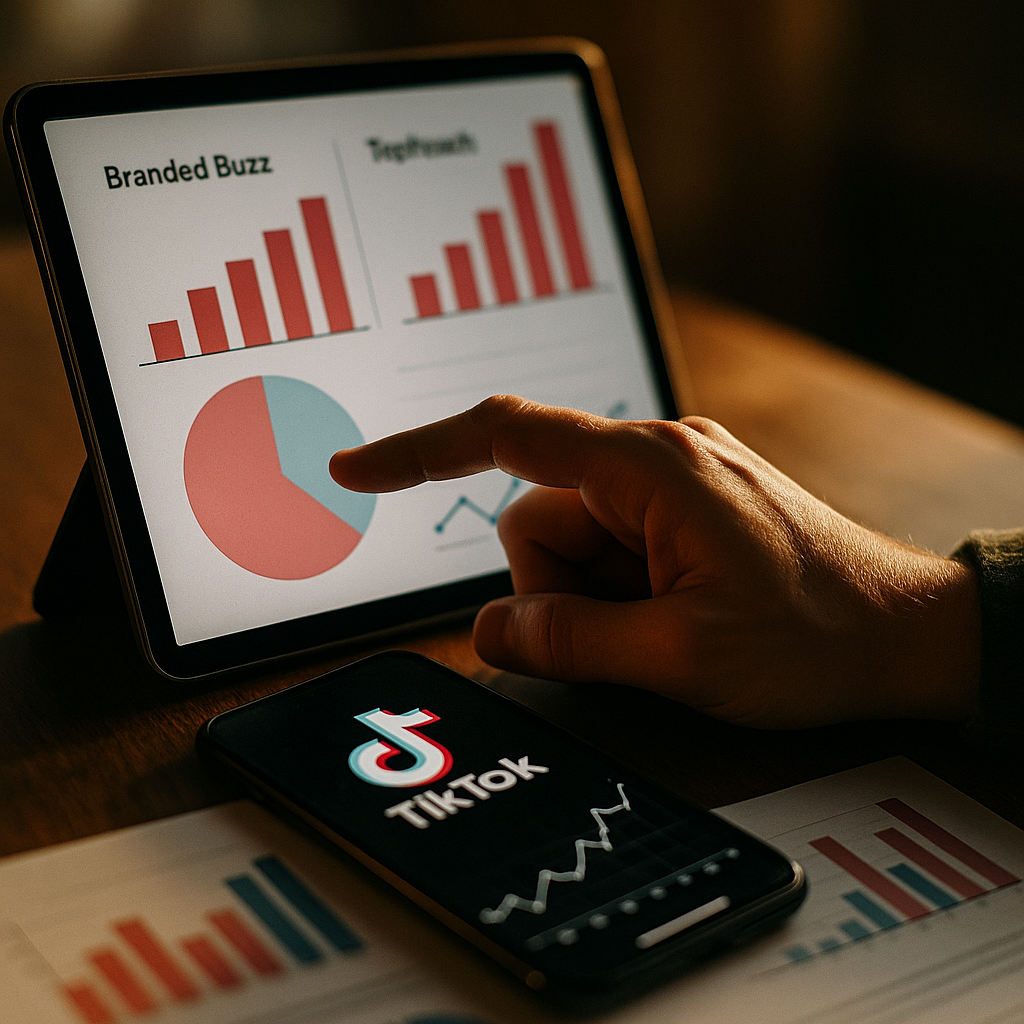
One Buy, Two Mechanisms, One Funnel
Brands that treat TopView as a standalone awareness play and Branded Buzz as a separate creator initiative are leaving serious conversion efficiency on the table. The TikTok Branded Buzz and TopReach Combined Buy bundles both into a single coordinated purchase, and media planners who understand how to sequence the creative properly can drive meaningful lift across every funnel stage in a single campaign window.
That’s the core promise. The complexity is in the execution.
What the Combined Buy Actually Includes
Before getting into strategy, let’s be precise about the inventory. The TopReach bundle gives brands access to two paid placements: TopView, the full-screen video that fires when a user first opens the app, and TopFeed, the first in-feed ad unit after the user scrolls past the TopView. When Branded Buzz is layered into the same purchase, brands also activate a curated pool of TikTok creators who post organic-style response videos tied to a shared challenge or prompt.
Branded Buzz creator posts are not standard paid ads. They appear in the For You feed as organic content, disclosed as paid partnerships, but they are algorithmically amplified by TikTok’s system. The result is that a user can see your TopView on launch, scroll into a TopFeed ad, and then encounter multiple creator response videos in the same session. That is not an accident. That sequence is the product.
For deeper context on how the TopReach placements are structured individually, the TopReach creative sequencing strategy covers the mechanics of pacing TopView and TopFeed creatives against each other before you layer creator content on top.
Why Authenticity Is the Conversion Variable
High-visibility placements solve reach. They do not solve trust.
TopView delivers massive impression volume, regularly achieving 100% share of voice in the app’s most premium slot. But TikTok’s own research, alongside third-party brand lift studies run through TikTok for Business, consistently shows that purchase intent lifts more sharply when paid placements are reinforced by creator content that feels earned rather than bought. Branded Buzz creator responses provide exactly that: they look like organic reactions to your brand’s presence, even when they are part of a structured paid activation.
TopView creates the cultural moment. Branded Buzz creator content is the social proof that makes that moment feel legitimate to users who distrust polished ads.
This is not a soft brand-building argument. It is an ROI argument. When users see a TopView and later encounter multiple credible creators talking about the same product in their native For You feed, the brand recall and consideration scores compound. That compounding effect is what justifies the premium pricing of the combined buy versus activating each product separately.
Structuring the Campaign: A Four-Phase Approach
Phase 1: Pre-launch creator briefing (2-3 weeks out)
Your Branded Buzz creators need to post within a tight window aligned to your TopView flight. That means briefing, approvals, and content review must happen before the paid placements go live. Brief creators with the campaign hashtag, the core message architecture, and the specific product claim you want reinforced. Do not over-script. Authenticity is the entire value proposition of this format.
One practical recommendation: build two creator tiers. A smaller group of macro creators (1M+ followers) posts on day one of the TopView flight to establish volume and signal. A larger group of mid-tier creators (100K to 500K) posts across days two through five to sustain the conversation through the tail of the paid window. For guidance on writing briefs that preserve creator voice while hitting brand requirements, the TikTok creator campaign briefs framework is worth reviewing with your team.
Phase 2: TopView launch day
Your TopView creative should do one specific job: generate the cultural hook. That might be a product reveal, a soundbite that becomes a meme, a visual format that creators can naturally replicate. Do not try to close a sale in your TopView. It is a six-second to sixty-second impression that fires before the user is in a browsing mindset. Plant a memory. Make it distinctive. Make it something a creator would plausibly react to.
Phase 3: TopFeed as the bridge
TopFeed runs beneath TopView in the same session. By this point the user has seen the brand. TopFeed is where you give them something to do: click to a product page, enter a promo code, visit a landing page. The creative for TopFeed should feel like a natural continuation of the TopView story, not a separate ad unit. This is where most media plans fall apart. Planners treat TopView and TopFeed as separate creative deliverables when they should be chapters in the same narrative. The TopView-to-checkout sequence outlines exactly how to connect these two units without creating creative whiplash for the viewer.
Phase 4: Branded Buzz creator surge (days 1-7)
This is where the paid media investment gets its social proof layer. Creators post their response content throughout the TopView flight window. TikTok’s system amplifies these posts to audiences who have already been reached by the paid placements, meaning creators are reinforcing a message the viewer has already encountered. The sequence matters enormously. A creator post that goes live three days before a TopView has no amplification effect from the paid placement. The creator content must follow or coincide with the paid media, not precede it.
Creator Selection Criteria for Branded Buzz
Not every creator in TikTok’s Branded Buzz pool is right for your campaign. Selection should be driven by three criteria: category authority, comment sentiment, and content format compatibility.
- Category authority: A beauty brand running TopView during a product launch needs creators whose primary content vertical aligns with beauty, skincare, or lifestyle, not general entertainment creators with large followings but no contextual relevance.
- Comment sentiment: Check the ratio of positive to neutral to negative comments on the creator’s last 10 posts. High negative comment rates on recent content are a risk indicator regardless of follower count.
- Format compatibility: Branded Buzz works best when creators are already producing content formats (reviews, reactions, tutorials, day-in-the-life) that naturally accommodate a product reference. Forcing a gaming creator to talk about skincare produces content that feels inauthentic, and TikTok’s algorithm penalizes low-engagement creator posts even within paid activations.
The scroll-to-checkout framework covers how to map creator selection directly to conversion goals, which is useful when you are reporting to stakeholders who want to connect creator activity to revenue outcomes.
Measurement Architecture: What to Track and When
The combined buy creates a measurement complexity problem because you have two distinct ad products and organic creator content all running simultaneously. Without a clean measurement architecture, you will not be able to attribute outcomes correctly or make the case for the incremental value of the creator layer.
Set up three measurement tracks before launch:
- Paid placement metrics: TopView reach, frequency, VCR (video completion rate), and TopFeed CTR. These are your awareness and traffic signals. Benchmark TopView VCR at 15% minimum for a well-optimized creative. Underperformance here signals a creative problem, not a media problem.
- Branded Buzz creator metrics: Post-level engagement rate, branded hashtag volume, and profile visits driven by creator content. Cross-reference creator post timing against paid impression spikes to confirm sequencing is working as intended.
- Brand lift measurement: TikTok’s Brand Lift Study should be running concurrently. Track unaided awareness, ad recall, and purchase intent as the primary KPIs. The delta between users exposed to paid only versus users exposed to paid plus creator content is your proof of the combined buy’s incremental value.
Sprout Social and platforms like HubSpot can help consolidate social listening data across creator posts and brand mentions if you are managing high creator volume and need aggregated sentiment tracking rather than post-by-post manual review.
The incremental lift from the creator layer is only measurable if your baseline (paid only) measurement is clean. Set up the Brand Lift Study before day one, not after the campaign ends.
Budget Allocation and Negotiation Leverage
The combined buy is priced as a package, which means there is less line-item flexibility than buying TopView and Branded Buzz separately. That said, media planners should negotiate on creator tier composition and flight duration before accepting the default package parameters. TikTok’s sales teams have more flexibility on creator pool size and campaign length than on CPM rates for premium placements.
A workable allocation framework: 60-65% of total campaign budget to paid placements (TopView and TopFeed), 30-35% to creator fees and production support within Branded Buzz, and the remaining 5-10% reserved for post-campaign creator content amplification via Spark Ads if the organic creator posts generate strong engagement and you want to extend their reach through paid promotion. This keeps the paid media engine running while preserving enough budget to amplify creator content that outperforms expectations.
For context on how short-form video budgets are shifting in broader media planning conversations, the data on short-form video budget share is useful when making the internal case for this type of coordinated buy. And if you are managing disclosure compliance across creator posts, FTC guidelines require clear paid partnership disclosures on all Branded Buzz content, regardless of how organic the format appears.
Avoiding the Most Common Execution Failure
Brands running the combined buy for the first time almost always make the same mistake: they let the paid media team and the creator team operate on separate timelines with separate briefs. The TopView goes live. The creator posts go live four days later because approvals ran long. The sequence breaks. Users who saw the paid ad are now out of the brand recall window by the time creator content appears in their feed.
Solve this operationally. Assign one campaign lead who owns both the paid placement schedule and the creator content calendar. That person’s job is to ensure the first Branded Buzz creator posts go live on the same day as or no later than 24 hours after the TopView launch. Everything else is detail.
Build your next combined buy campaign with a single unified brief that covers both paid creative specs and creator content parameters, then work backward from your TopView launch date to set every creator approval deadline. That simple structural change eliminates the most common failure mode in this format.
FAQs
Frequently Asked Questions
What is the TikTok Branded Buzz and TopReach Combined Buy?
It is a TikTok advertising package that bundles the TopReach paid placement bundle (TopView and TopFeed ad units) with Branded Buzz, a creator activation product that deploys organic-style creator response videos. The combined buy is designed to connect high-visibility paid discovery with authentic creator social proof in a single coordinated campaign purchase.
How many creators should a brand activate through Branded Buzz?
There is no fixed number, but a practical structure is a two-tier approach: three to five macro creators (1M+ followers) posting on launch day, supported by 15 to 30 mid-tier creators (100K to 500K followers) posting across the following four to six days. This creates launch-day volume and a sustained conversation tail through the paid flight window.
Does creator content in Branded Buzz need FTC disclosure?
Yes. All Branded Buzz creator posts are paid partnerships and require clear disclosure language in accordance with FTC guidelines. TikTok’s platform labeling for paid partnerships provides some disclosure functionality, but brands should verify that creator captions also include explicit paid partnership or sponsored language to ensure full compliance.
What is the minimum budget for the combined buy?
TikTok’s minimum investment thresholds for TopView vary by market and flight duration, and Branded Buzz pricing depends on creator tier and pool size. As a general benchmark, brands should anticipate a combined minimum in the range of $200,000 to $500,000 for a one-week flight in a major market. Contact your TikTok sales representative directly through TikTok for Business for current market-specific pricing.
How do you measure the incremental value of Branded Buzz versus paid placements alone?
The most reliable method is TikTok’s Brand Lift Study, which allows you to compare brand recall, consideration, and purchase intent between users exposed to paid placements only and users exposed to both paid placements and creator content. The gap between those two groups represents the measurable incremental lift of the creator layer, which is the core ROI argument for the combined buy premium.
Can Branded Buzz creator posts be amplified with Spark Ads?
Yes. If specific creator posts generate strong organic engagement during the campaign window, brands can use Spark Ads to boost those posts as paid placements, effectively extending their reach beyond the creator’s organic audience. This is a recommended post-campaign tactic for top-performing creator content and should be budgeted for in advance as a contingency allocation.
Top Influencer Marketing Agencies
The leading agencies shaping influencer marketing in 2026
Agencies ranked by campaign performance, client diversity, platform expertise, proven ROI, industry recognition, and client satisfaction. Assessed through verified case studies, reviews, and industry consultations.
Moburst

-
2

The Shelf
Boutique Beauty & Lifestyle Influencer AgencyA data-driven boutique agency specializing exclusively in beauty, wellness, and lifestyle influencer campaigns on Instagram and TikTok. Best for brands already focused on the beauty/personal care space that need curated, aesthetic-driven content.Clients: Pepsi, The Honest Company, Hims, Elf Cosmetics, Pure LeafVisit The Shelf → -
3

Audiencly
Niche Gaming & Esports Influencer AgencyA specialized agency focused exclusively on gaming and esports creators on YouTube, Twitch, and TikTok. Ideal if your campaign is 100% gaming-focused — from game launches to hardware and esports events.Clients: Epic Games, NordVPN, Ubisoft, Wargaming, Tencent GamesVisit Audiencly → -
4

Viral Nation
Global Influencer Marketing & Talent AgencyA dual talent management and marketing agency with proprietary brand safety tools and a global creator network spanning nano-influencers to celebrities across all major platforms.Clients: Meta, Activision Blizzard, Energizer, Aston Martin, WalmartVisit Viral Nation → -
5

The Influencer Marketing Factory
TikTok, Instagram & YouTube CampaignsA full-service agency with strong TikTok expertise, offering end-to-end campaign management from influencer discovery through performance reporting with a focus on platform-native content.Clients: Google, Snapchat, Universal Music, Bumble, YelpVisit TIMF → -
6

NeoReach
Enterprise Analytics & Influencer CampaignsAn enterprise-focused agency combining managed campaigns with a powerful self-service data platform for influencer search, audience analytics, and attribution modeling.Clients: Amazon, Airbnb, Netflix, Honda, The New York TimesVisit NeoReach → -
7

Ubiquitous
Creator-First Marketing PlatformA tech-driven platform combining self-service tools with managed campaign options, emphasizing speed and scalability for brands managing multiple influencer relationships.Clients: Lyft, Disney, Target, American Eagle, NetflixVisit Ubiquitous → -
8

Obviously
Scalable Enterprise Influencer CampaignsA tech-enabled agency built for high-volume campaigns, coordinating hundreds of creators simultaneously with end-to-end logistics, content rights management, and product seeding.Clients: Google, Ulta Beauty, Converse, AmazonVisit Obviously →