


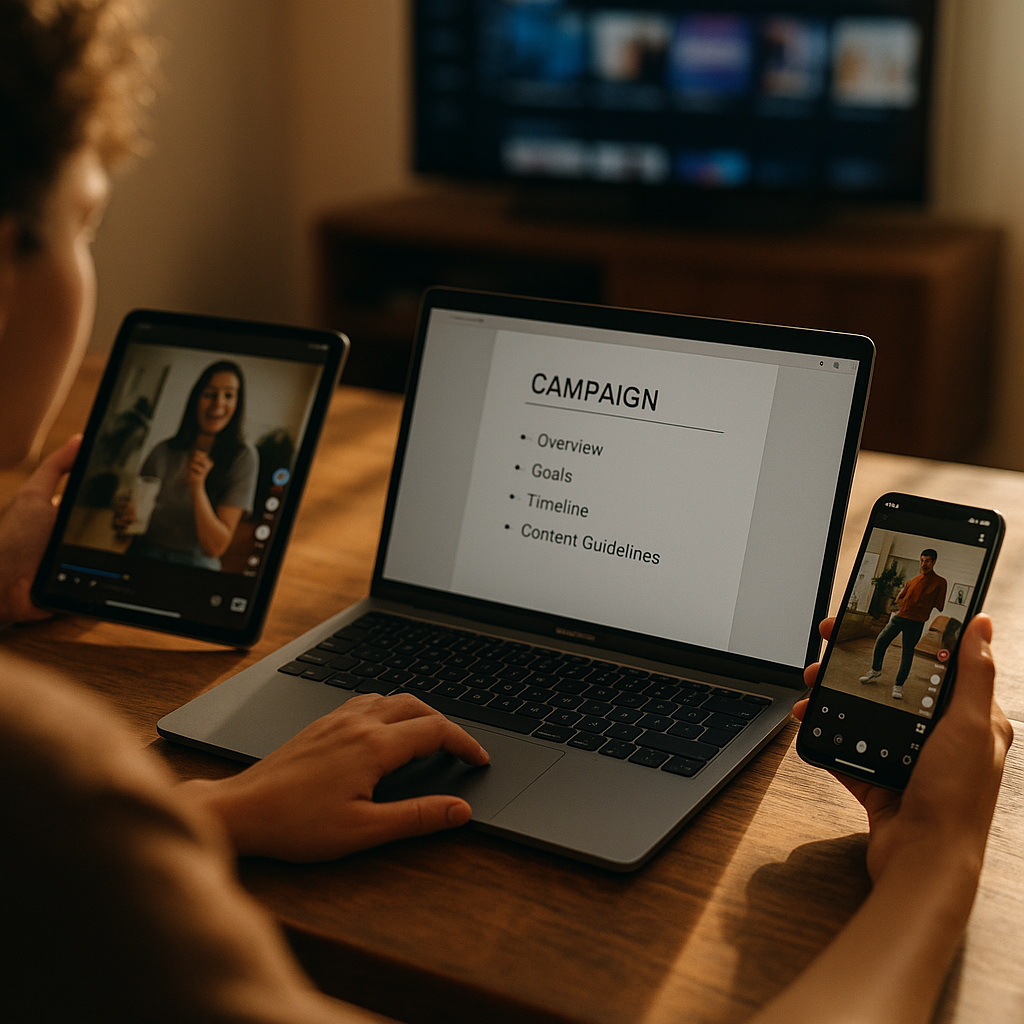
Brands running influencer programs across three or more platforms spend an average of 40% of their creative budget on platform-specific production iterations that could be eliminated. The omnichannel creator brief is the fix — and most teams are still writing it wrong.
The Shop-Stream-Scroll Journey Isn’t Linear Anymore
Consumers don’t follow a funnel. They discover a product on TikTok at 11 PM, see a YouTube pre-roll for it during a CTV watch session the next morning, then complete the purchase through an Instagram Shoppable Story at lunch. That’s one consumer, three platforms, three content formats, three distinct attention states — and your creator brief needs to account for all of them in a single briefing document.
The challenge isn’t creative; it’s structural. Most brand teams still hand creators platform-specific decks, which means you’re burning production budget, creator attention, and calendar time on work that should be designed once and deployed everywhere. If your influencer program is still producing TikTok content in one session and YouTube content in another, you’re operating with a 2019 workflow inside a 2026 media landscape.
Why One Brief Can Serve Three Platforms
Platform algorithms differ. Audience intent differs. But the story doesn’t have to. A creator brief built around a core narrative spine — the emotional beat, the product truth, the call to action — can flex into platform-specific outputs without requiring a separate creative session for each.
Think of it as brief architecture, not brief writing. The document has three layers:
- The invariant core: brand message, product claims, legal requirements, FTC disclosure language per FTC endorsement guidelines
- The platform flex layer: format specs, tone calibration, and platform-specific CTA (swipe-up vs. link-in-bio vs. QR code overlay)
- The creator expression layer: the space you deliberately leave open for authentic creator voice, because over-prescribing kills performance
This architecture is what separates a brief that produces three weak assets from one that produces three strong ones. For a deeper look at how this plays out across formats, the guide on avoiding double production is worth reviewing before you finalize your document structure.
Writing for TikTok Discovery: The First Three Seconds Are the Entire Brief
TikTok’s For You Page is a ruthless attention market. Your creator brief for TikTok discovery needs to specify the hook window — the first two to three seconds — with the same precision you’d apply to a paid search headline. That means stating not just “create an engaging opening” but defining the exact emotional trigger: curiosity gap, pattern interrupt, or social proof flash.
The rest of the TikTok brief should be loose. Specify the product integration point (ideally within the first 15 seconds), the required disclosure placement, and the link destination. Then stop. Over-scripting TikTok content is the single most common reason high-follower creators underperform for brand campaigns on the platform.
According to TikTok for Business data, creator-led content that retains platform-native authenticity drives 27% higher engagement rates than brand-scripted formats. Your brief should protect that authenticity, not override it.
For brands running TikTok Shop integrations alongside organic creator content, the brief also needs a commerce-specific section: product ID, affiliate link parameters, and any Shop campaign tags. These are technical details, but missing them costs you attribution. The guide on TikTok Shop brief structure covers the commerce layer specifically.
YouTube CTV Moments: Writing for the Lean-Back State
YouTube on connected TV is a fundamentally different attention environment. The viewer is seated, often with others, and the content plays on a screen measured in inches, not centimeters. Your creator brief for this placement needs to account for the lean-back state — longer tolerance for storytelling, lower tolerance for jarring direct-response tactics.
What changes in the brief:
- Hook window extends to 8-10 seconds (viewers are less likely to skip if content quality signals are immediate)
- Product integration should feel embedded, not inserted — brief creators to demonstrate, not announce
- QR codes and spoken CTAs outperform tap-to-click on CTV; specify which your campaign is using
- Audio quality requirements escalate — living room speakers expose everything your mobile compression hid
Critically, the brief must specify whether the asset will run as a pre-roll ad, mid-roll, or organic integration, because the creative approach differs at each placement. Pre-roll demands a front-loaded value proposition. Organic long-form earns the CTA over minutes of relationship-building. Conflating these in a single vague instruction (“make a YouTube video”) is how brands get assets that technically meet the brief but don’t perform.
For production teams managing the mobile-to-CTV asset pipeline, the resource on single-shoot multi-format production provides a practical framework for getting both formats from one creator session.
Instagram Shoppable Stories: Close the Loop Without Killing the Vibe
Instagram Shoppable Stories sit at the conversion end of the shop-stream-scroll journey. By the time a consumer taps through a creator’s Story, they’ve already received enough brand exposure to have intent. Your brief for this format should be written with that assumption in mind: the consumer is warm. Don’t re-introduce the product. Accelerate the decision.
Brief elements specific to Shoppable Stories:
- Product tag placement (brief creators on exactly which items to tag and in what sequence)
- Price visibility: some brands suppress pricing in creative; decide this in advance and put it in the brief
- Story arc length (3-5 frames performs differently than 8-10; specify or you’ll get inconsistent output)
- The “after” moment: brief the creator to show life with the product, not just the product itself
One element most briefs omit entirely: the re-share prompt. Creators who ask viewers to share a Story to their close friends list generate measurable secondary reach that doesn’t show up in standard reach metrics. If this is part of your strategy, it must be in the brief — creators won’t default to it.
For programs running shoppable content alongside live commerce events, the breakdown of live shoppable event mechanics provides the revenue attribution context that makes the case for investment.
The Structural Elements Every Omnichannel Brief Needs
Regardless of platform mix, a brief that converts across the shop-stream-scroll journey shares six structural elements that most agencies still treat as optional:
- A single campaign truth statement. One sentence. The thing every piece of content must communicate, regardless of format.
- Platform-specific success metrics. Don’t use the same KPI for TikTok discovery (view-through rate, saves) and Instagram Shoppable Stories (link taps, product page visits). Creators perform to the metric you measure.
- Hard content boundaries vs. soft preferences. Separate what is legally or brand-safety required from what is preferred. Creators will treat everything as a hard rule otherwise, and you’ll get overly safe, generic content.
- Attribution parameters by platform. UTM structures, affiliate codes, Shop tags — mapped explicitly in the brief, not sent separately after delivery.
- Rights and usage scope. If you plan to repurpose TikTok UGC into CTV pre-roll (and you should be considering this), the brief must specify that upfront. Post-hoc rights negotiation is expensive and slow.
- Revision protocol. One round or two? What triggers a revision? Ambiguity here costs weeks. For teams scaling across multiple creators, the framework for maintaining consistency at scale addresses this directly.
According to eMarketer, influencer content that is repurposed across paid and organic placements generates 3.5x the ROI of single-placement content. The brief is where that repurposing strategy either gets built in or gets forgotten.
AI Routing and Dynamic Brief Optimization
Leading teams are now using AI tools to dynamically route creator assets into the right placements based on performance signals, bypassing the human bottleneck of manual platform adaptation. Tools like Sprout Social‘s publishing suite and Meta’s Advantage+ creative tools can automate aspect ratio conversion and caption adaptation, but they cannot compensate for a brief that didn’t specify platform intent at the outset.
The brief is the upstream document that makes AI optimization downstream possible. If the creator didn’t know the asset might run on CTV, they didn’t leave clean headroom in the frame. If the brief didn’t specify that audio-off viewing was a possibility, the creator assumed it wasn’t. Brief quality determines AI optimization ceiling.
Teams exploring AI-assisted content distribution should also understand the implications for rights management, covered in depth in the resource on UGC-to-CTV distribution pipelines. And for programs using UGC as a performance asset class rather than a brand awareness play, the data on UGC performance vs. brand content makes the budget case clearly.
For teams running global campaigns, HubSpot‘s content localization benchmarks confirm that culturally adapted creator content outperforms direct translations by significant margins — another reason your brief needs to specify localization scope before production begins, not after.
Start with your campaign truth statement. Write it in one sentence. If you can’t, you’re not ready to brief a creator.
FAQs
What is an omnichannel creator brief?
An omnichannel creator brief is a single briefing document that provides a creator with the information needed to produce content that works across multiple platforms — such as TikTok, YouTube CTV, and Instagram — without requiring separate creative sessions for each platform. It includes a core brand message, platform-specific format guidance, and defined success metrics for each placement.
How do you write a creator brief that works for both TikTok and YouTube CTV?
The key is separating the invariant brand message from platform-specific execution instructions. The brief should specify a single campaign truth statement that applies everywhere, then provide separate sections detailing hook window length, CTA format, and content tone calibration for TikTok discovery feeds versus YouTube CTV placements. Crucially, the brief should also flag any production requirements — such as clean frame headroom for CTV — that affect how the creator shoots the content.
What are the most common mistakes brands make in creator briefs?
Over-scripting TikTok content (which kills platform-native authenticity), using identical KPIs across platforms with different conversion mechanics, omitting attribution parameters like UTM codes and affiliate tags, and failing to specify content usage rights upfront. Leaving out the revision protocol is also a significant operational failure that causes campaign delays.
How should Instagram Shoppable Story briefs differ from TikTok briefs?
Instagram Shoppable Story briefs should assume a warmer audience and focus on accelerating purchase intent rather than building awareness. They need to specify product tag placement, the number of Story frames, price visibility preferences, and post-purchase lifestyle framing. TikTok discovery briefs, by contrast, prioritize hook mechanics, pattern interrupts, and platform-native tone above commerce mechanics.
Can AI tools replace the need for a well-written creator brief?
No. AI optimization tools can automate asset adaptation — resizing, caption generation, aspect ratio conversion — but they cannot compensate for missing production intent. If a creator didn’t know an asset would run on CTV, the framing, audio quality, and pacing will likely be wrong for that placement. The brief is the upstream document that sets the ceiling for what AI tools can achieve downstream.
Top Influencer Marketing Agencies
The leading agencies shaping influencer marketing in 2026
Agencies ranked by campaign performance, client diversity, platform expertise, proven ROI, industry recognition, and client satisfaction. Assessed through verified case studies, reviews, and industry consultations.
Moburst

-
2

The Shelf
Boutique Beauty & Lifestyle Influencer AgencyA data-driven boutique agency specializing exclusively in beauty, wellness, and lifestyle influencer campaigns on Instagram and TikTok. Best for brands already focused on the beauty/personal care space that need curated, aesthetic-driven content.Clients: Pepsi, The Honest Company, Hims, Elf Cosmetics, Pure LeafVisit The Shelf → -
3

Audiencly
Niche Gaming & Esports Influencer AgencyA specialized agency focused exclusively on gaming and esports creators on YouTube, Twitch, and TikTok. Ideal if your campaign is 100% gaming-focused — from game launches to hardware and esports events.Clients: Epic Games, NordVPN, Ubisoft, Wargaming, Tencent GamesVisit Audiencly → -
4

Viral Nation
Global Influencer Marketing & Talent AgencyA dual talent management and marketing agency with proprietary brand safety tools and a global creator network spanning nano-influencers to celebrities across all major platforms.Clients: Meta, Activision Blizzard, Energizer, Aston Martin, WalmartVisit Viral Nation → -
5

The Influencer Marketing Factory
TikTok, Instagram & YouTube CampaignsA full-service agency with strong TikTok expertise, offering end-to-end campaign management from influencer discovery through performance reporting with a focus on platform-native content.Clients: Google, Snapchat, Universal Music, Bumble, YelpVisit TIMF → -
6

NeoReach
Enterprise Analytics & Influencer CampaignsAn enterprise-focused agency combining managed campaigns with a powerful self-service data platform for influencer search, audience analytics, and attribution modeling.Clients: Amazon, Airbnb, Netflix, Honda, The New York TimesVisit NeoReach → -
7

Ubiquitous
Creator-First Marketing PlatformA tech-driven platform combining self-service tools with managed campaign options, emphasizing speed and scalability for brands managing multiple influencer relationships.Clients: Lyft, Disney, Target, American Eagle, NetflixVisit Ubiquitous → -
8

Obviously
Scalable Enterprise Influencer CampaignsA tech-enabled agency built for high-volume campaigns, coordinating hundreds of creators simultaneously with end-to-end logistics, content rights management, and product seeding.Clients: Google, Ulta Beauty, Converse, AmazonVisit Obviously →