


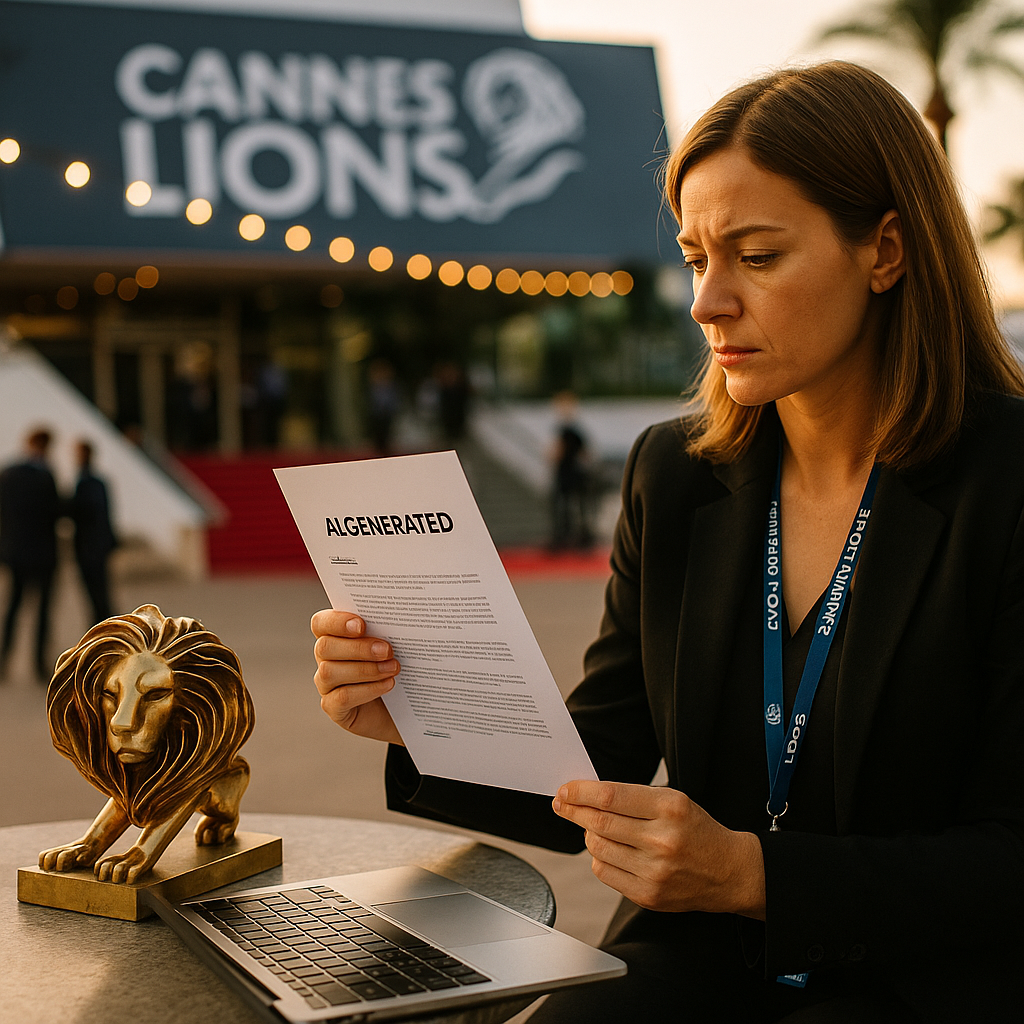
The Cannes AI Consensus Brands Can’t Afford to Ignore
Nearly 60% of creative directors surveyed at Cannes Lions said they’ve deployed AI-generated assets in paid campaigns without a formal disclosure policy. That number should alarm every brand marketer heading into Q3 planning. The Cannes Lions AI in advertising debate didn’t just surface philosophical questions about creativity — it produced something far more actionable: the early architecture of an industry consensus on where human judgment must remain, where automation can run, and how brands must communicate both to regulators and consumers.
If your brand doesn’t have a written AI policy governing your creative workflow by the time Q3 campaigns go live, you are behind the regulatory curve, behind the compliance curve, and — increasingly — behind your competitors.
What the Festival Actually Revealed
Cannes Lions has never been a regulatory body. But it functions as a leading indicator. The conversations, panel frameworks, and award jury decisions that emerged this cycle pointed in three unmistakable directions.
First, juries applied informal human-creative minimums. Work that was perceived as fully AI-generated without meaningful human creative direction consistently underperformed in shortlist reviews, regardless of technical execution quality. Jurors weren’t rejecting AI — they were rejecting the absence of human intent. That distinction matters enormously for how you brief your creative teams and vendors.
Second, autonomous ad systems came under serious scrutiny. Performance Max, Meta Advantage+, and similar black-box optimization tools are delivering strong short-term ROAS for many brands. But festival discourse highlighted a growing discomfort: when AI controls both creative assembly and media placement simultaneously, brand safety governance effectively disappears. The human is no longer in the decision loop. For brands with significant regulatory exposure — financial services, pharma, CPG targeting families — that’s a liability, not a feature.
Third, disclosure standards moved from optional to expected. The EU AI Act’s tiered transparency requirements, already partially in force, provided the regulatory backdrop. Cannes discussions signaled that the broader global advertising industry is coalescing around a similar expectation: audiences should know when AI played a material role in producing what they’re seeing.
The festival’s most durable output wasn’t a winning campaign — it was the emerging consensus that “AI-assisted” and “AI-generated” are legally and reputationally different labels, and brands need explicit internal definitions of both before Q3 budgets are committed.
For more context on how the creative community has been framing human-AI thresholds, the earlier coverage of the human creative minimums debate breaks down the jury dynamics in detail.
Three Policy Changes Brands Need Before Q3
1. Define your AI taxonomy internally — before legal does it for you.
Most brand teams are operating with a dangerous ambiguity: they use AI tools daily but have no internal classification of what constitutes “AI-assisted” versus “AI-generated” creative. Your legal team, your agency partners, and your media buyers are all working from different assumptions. That gap becomes a compliance exposure the moment a regulator asks you to describe your production process.
Build a simple internal taxonomy. “AI-assisted” means a human made the primary creative decisions and used AI tools for execution support — image retouching, copy variation testing, translation. “AI-generated” means the AI produced the core creative asset with human review afterward. These definitions should flow directly into your creative briefs, your agency contracts, and your disclosure protocols. If you haven’t reviewed your studio contracts and compliance frameworks to accommodate this language, that’s the first Q3 to-do.
2. Establish a human-in-the-loop checkpoint for autonomous ad systems.
Autonomous campaign systems are not inherently problematic. The problem is deploying them without governance checkpoints. Establish a mandatory human review gate before any AI-assembled creative variant goes live on a new audience segment. Set hard parameters: brand safety keyword exclusions, creative style guidelines your AI tools must work within, and a weekly audit of what the system actually served versus what you intended.
The agentic web and campaign infrastructure conversation has been accelerating fast, and brands that built governance frameworks early are already showing measurably better compliance outcomes. Don’t wait for an incident to trigger your policy.
3. Formalize your AI disclosure language across every touchpoint.
This is where many brands will resist, fearing consumer backlash. The data doesn’t support that fear. Research from the FTC’s AI disclosure guidance and parallel European studies consistently show that proactive disclosure builds trust rather than eroding it — particularly among 25 to 44-year-old consumers who are already highly aware that AI is pervasive in advertising.
Your disclosure language should appear in creative metadata (for programmatic placements), in influencer content briefs where AI tools are part of the production workflow, and in any branded content where AI generated the core narrative or visual. The FTC compliance and creator trust frameworks your influencer team already uses are the right model — the same transparency logic applies to AI.
The Creator Economy Dimension
Here’s what most brand planning conversations are missing: the Cannes AI debate isn’t separate from your creator marketing strategy. It’s directly connected.
As brands scale AI-assisted content production, the value proposition of human creators becomes sharper, not weaker. Audiences can increasingly detect the homogeneity of AI-optimized content. Authentic creator voices, cultural specificity, and genuine community trust are not things an autonomous ad system can replicate. The brands winning audience attention in Q3 will be those that use AI for efficiency at scale and invest in premium human creative where differentiation matters most.
That means your Q3 roster strategy needs to explicitly account for which creative outputs you’re routing to AI workflows and which require human creator involvement. For context on how top-tier creator partnerships are being structured around exactly this tension, the analysis of entertainment-tier creator partnerships is worth reviewing alongside your media mix planning.
Your team’s ability to execute this distinction confidently also depends on genuine AI literacy. If senior brand marketers don’t understand what these tools actually do, governance policies become theater. The 90-day AI upskilling framework for senior marketers is a practical place to close that gap before Q3 briefs go out.
Regulatory Timeline Pressure Is Real
The EU AI Act’s transparency obligations for AI-generated content affecting consumer decisions are not theoretical future concerns. They are operational requirements for any brand running campaigns in European markets. The UK ICO has published parallel guidance on automated decision-making in advertising contexts. The FTC has signaled active interest in AI disclosure enforcement.
Beyond regulatory compliance, industry bodies are moving. The IAB has been developing AI advertising standards that mirror many of the Cannes consensus positions. WFA guidelines on responsible AI in marketing communications are already being referenced in agency contracts. If your brand is operating on a “we’ll formalize when we have to” timeline, that timeline has arrived.
Q3 campaign planning isn’t just a creative exercise this cycle — it’s a governance exercise. Brands that treat it as both will have a structural advantage when disclosure requirements tighten further in Q4 and beyond.
What This Means for Agency Relationships
Your agency partners need clear direction from you, not ambiguity. If your AI policy is undefined at the brand level, agencies will fill that vacuum with their own defaults — which may not align with your risk tolerance, your disclosure commitments, or your creative standards.
Before Q3 briefings, require every agency partner to document: which AI tools they are using in your account, at which stages of production, and what human review process governs each. This isn’t a trust issue. It’s a contract issue. Your brand bears the reputational and regulatory consequences of AI use in your campaigns, regardless of who made the operational decision.
Frequently Asked Questions
What did Cannes Lions reveal about AI disclosure standards for advertisers?
The festival reinforced an emerging industry consensus that “AI-assisted” and “AI-generated” content require different disclosure treatments. Jury behavior, panel discussions, and regulatory backdrop from the EU AI Act all pointed toward the expectation that brands should proactively label content where AI played a material creative role, particularly in paid advertising contexts.
Do brands legally have to disclose AI-generated advertising content?
In EU markets, the AI Act’s transparency requirements create legal obligations for certain categories of AI-generated content targeting consumers. In the US, FTC guidance on deceptive practices creates a strong compliance case for disclosure. Even where no explicit law mandates it, industry body guidelines from the IAB and WFA are moving toward disclosure as a standard expectation.
How should brands define “AI-assisted” versus “AI-generated” creative?
“AI-assisted” typically means a human made the primary creative decisions and used AI tools to support execution, such as copy testing, image editing, or translation. “AI-generated” means the AI produced the core creative asset, with a human reviewing the output rather than directing the creation. Brands should formalize these definitions internally and embed them in creative briefs, agency contracts, and disclosure protocols.
What governance checkpoints should brands put in place for autonomous ad systems?
At minimum, brands should establish a human review gate before AI-assembled creative variants serve to new audience segments. Hard guardrails should include brand safety keyword exclusions, creative style guidelines the AI must operate within, and a regular audit of served content versus intended parameters. This applies to platforms like Meta Advantage+, Google Performance Max, and similar automated systems.
How does the Cannes AI debate connect to influencer and creator strategy?
As AI scales content production, the distinctiveness of authentic human creator voices becomes more valuable, not less. Brands should use AI for efficiency at scale while preserving premium human creator involvement where cultural relevance and audience trust are the primary objectives. Q3 planning should explicitly define which content outputs go to AI workflows and which require human creator direction.
Audit your AI tool stack against your Q3 brief this week, draft your internal taxonomy before briefings go to agency, and require documented AI governance from every partner before a single campaign asset is produced.
Top Influencer Marketing Agencies
The leading agencies shaping influencer marketing in 2026
Agencies ranked by campaign performance, client diversity, platform expertise, proven ROI, industry recognition, and client satisfaction. Assessed through verified case studies, reviews, and industry consultations.
Moburst

-
2

The Shelf
Boutique Beauty & Lifestyle Influencer AgencyA data-driven boutique agency specializing exclusively in beauty, wellness, and lifestyle influencer campaigns on Instagram and TikTok. Best for brands already focused on the beauty/personal care space that need curated, aesthetic-driven content.Clients: Pepsi, The Honest Company, Hims, Elf Cosmetics, Pure LeafVisit The Shelf → -
3

Audiencly
Niche Gaming & Esports Influencer AgencyA specialized agency focused exclusively on gaming and esports creators on YouTube, Twitch, and TikTok. Ideal if your campaign is 100% gaming-focused — from game launches to hardware and esports events.Clients: Epic Games, NordVPN, Ubisoft, Wargaming, Tencent GamesVisit Audiencly → -
4

Viral Nation
Global Influencer Marketing & Talent AgencyA dual talent management and marketing agency with proprietary brand safety tools and a global creator network spanning nano-influencers to celebrities across all major platforms.Clients: Meta, Activision Blizzard, Energizer, Aston Martin, WalmartVisit Viral Nation → -
5

The Influencer Marketing Factory
TikTok, Instagram & YouTube CampaignsA full-service agency with strong TikTok expertise, offering end-to-end campaign management from influencer discovery through performance reporting with a focus on platform-native content.Clients: Google, Snapchat, Universal Music, Bumble, YelpVisit TIMF → -
6

NeoReach
Enterprise Analytics & Influencer CampaignsAn enterprise-focused agency combining managed campaigns with a powerful self-service data platform for influencer search, audience analytics, and attribution modeling.Clients: Amazon, Airbnb, Netflix, Honda, The New York TimesVisit NeoReach → -
7

Ubiquitous
Creator-First Marketing PlatformA tech-driven platform combining self-service tools with managed campaign options, emphasizing speed and scalability for brands managing multiple influencer relationships.Clients: Lyft, Disney, Target, American Eagle, NetflixVisit Ubiquitous → -
8

Obviously
Scalable Enterprise Influencer CampaignsA tech-enabled agency built for high-volume campaigns, coordinating hundreds of creators simultaneously with end-to-end logistics, content rights management, and product seeding.Clients: Google, Ulta Beauty, Converse, AmazonVisit Obviously →