


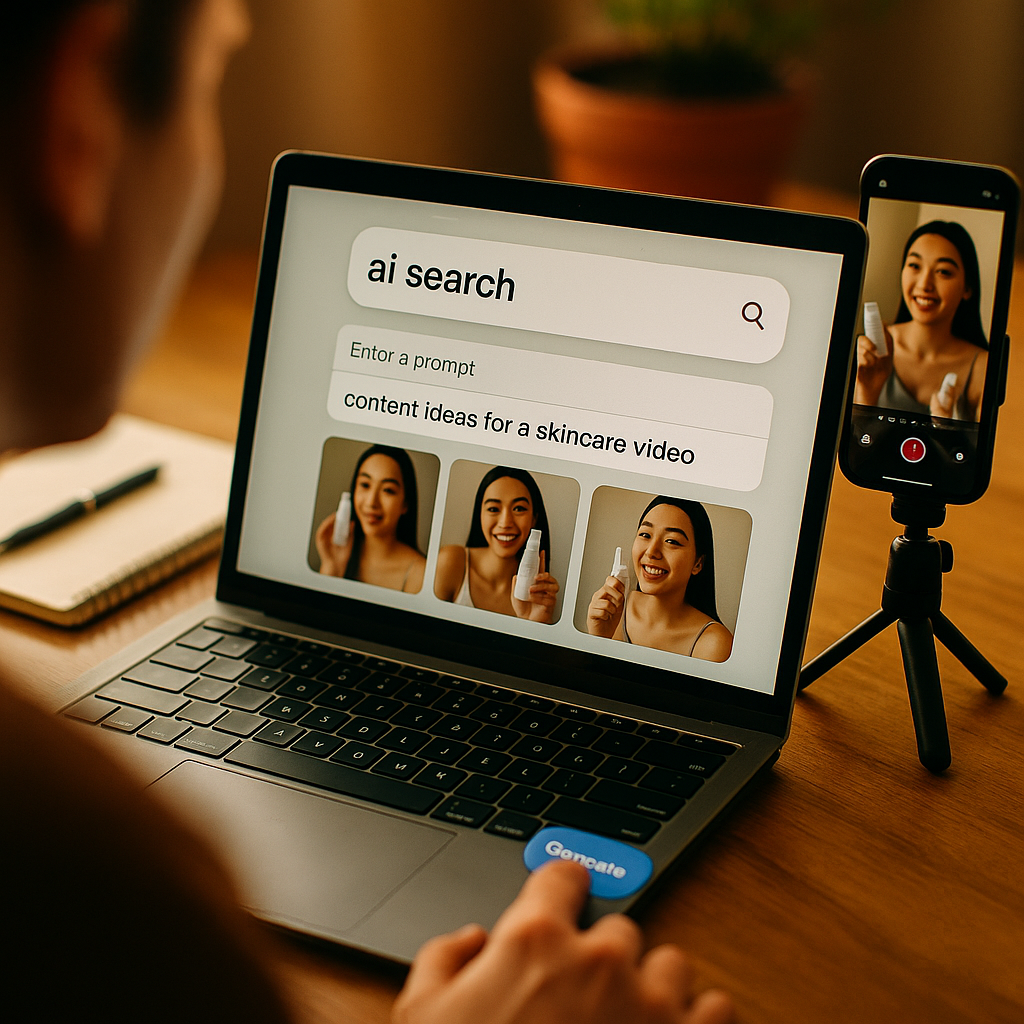
Half of consumers now use AI-powered search to find products, according to McKinsey. That single statistic should trigger a budget reallocation conversation in every brand and agency planning room. The implication for AI-mediated product discovery and creator content strategy is not incremental — it is structural.
The Discovery Layer Has Moved Upstream
For the past decade, the dominant mental model for influencer marketing has been the social feed. Creator posts a Reel, viewers engage, algorithm amplifies, brand awareness compounds. That model assumed the consumer’s first touchpoint with a product recommendation was a platform feed. It is increasingly not.
When a consumer opens ChatGPT, Perplexity, Google’s AI Overviews, or Microsoft Copilot and asks “what’s the best moisturizer for combination skin under $40,” they are bypassing the feed entirely. The AI synthesizes a recommendation before the consumer ever opens Instagram. The brand that wins that moment wins consideration — often before a single sponsored post has been served.
This is the upstream discovery problem. And most creator investment is still optimized for downstream engagement.
McKinsey’s finding that roughly half of consumers now use AI search for product research means the battle for brand consideration is being fought in a layer of the funnel that most influencer budgets are not yet touching.
Why Creator Content Is the Fuel for AI Recommendations
Here is the mechanism brands need to understand: AI search engines synthesize information from across the web. They pull from product reviews, editorial articles, Reddit threads, YouTube transcripts, blog posts, and — critically — creator-authored content that has been indexed and crawled. A well-structured creator review published as a standalone article or a YouTube video with a full transcript is far more likely to influence an AI model’s recommendation than a 15-second Reel that lives and dies inside Instagram’s walled garden.
The content format matters enormously here. Short-form social content is largely invisible to AI search engines. It sits behind authentication walls, lacks crawlable text, and disappears from algorithmic relevance within 72 hours. Long-form, indexed content — blog posts, YouTube videos, podcast transcripts, detailed TikTok Shop reviews exported to the open web — persists. It compounds. It gets cited.
This is not a reason to abandon short-form social. It is a reason to build a content architecture that funds both, with intentional sequencing. Think of short-form as demand capture and long-form indexed content as demand creation at the AI layer.
The brands already adapting to this shift are investing in AI-driven shopping experiences and rethinking how creator output feeds those systems. The ones that haven’t are still measuring CPE on Reels while their competitors are being recommended by Perplexity.
What “Indexable” Creator Content Actually Looks Like in Practice
Not all creator content is created equal in the eyes of AI crawlers. Brands need to brief creators differently depending on whether the content’s primary job is feed engagement or AI discovery. These are not the same brief.
For AI discovery, the content requirements look more like this:
- Long-form YouTube reviews with structured verbal walkthroughs (the transcript is the indexable asset)
- Creator-authored blog posts or Substack entries that include product-specific language matching common search queries
- Podcast episodes with published show notes and transcripts hosted on crawlable domains
- Reddit AMAs or forum-style posts where creators engage authentically in brand-adjacent communities
- TikTok videos cross-published to YouTube or accompanied by a linked blog summary
The brief to a creator should specify: “This content needs to answer the question a consumer would type into an AI search engine.” That is a meaningfully different creative direction than “make something native and authentic for the feed.”
Operationally, brands also need to ensure that creator content pointing to their products links back to pages with strong structured data, clear product descriptions, and schema markup. The AI model needs to confirm what it’s recommending actually exists and is purchasable. This connects creator strategy directly to agentic web infrastructure decisions that marketing ops teams are already grappling with.
Budget Reallocation: A Framework That Doesn’t Require Starting From Zero
Brands don’t need to blow up their creator programs. They need to restructure the output mix and recalibrate how they value different content types.
A practical starting point: audit your current creator roster and categorize each creator by their long-form content capability. Some creators are pure short-form operators. Others maintain YouTube channels, newsletters, or blogs with genuine domain authority. The latter group is underpriced relative to their AI discovery value, because most brands are still paying them based on social follower counts and engagement rates that measure feed performance, not indexability.
For brands working with certified or compliance-forward creators, the audit becomes more structured. Frameworks emerging from bodies like ARPP and IAB-UK certification programs are beginning to include criteria for content longevity and cross-platform publishing — both signals of AI discovery potential.
The reallocation recommendation for most mid-to-large brand programs is a shift of approximately 20-30% of creator content budget away from pure social activation and toward long-form, indexed content production. That doesn’t mean fewer creators — it means adjusted deliverables, longer content windows, and licensing terms that allow brands to syndicate and republish creator content on owned properties.
Licensing matters here more than most brand teams realize. If a creator produces a 1,200-word review and the brand only has rights to share it on social, the AI discovery value is wasted. Contracts should specify rights to republish on brand domains, include transcripts in structured data, and distribute through content syndication partners. This is covered in growing detail in evolving creator contract standards that legal teams need to get ahead of.
The Measurement Problem Nobody Wants to Talk About
Here’s the honest challenge: attributing AI-mediated discovery to a specific creator post is currently very hard. AI search engines don’t pass UTM parameters. Perplexity doesn’t show up in most attribution dashboards. Google’s AI Overviews are blending citations in ways that standard analytics tools weren’t built to parse.
This does not mean the channel is unmeasurable. It means the measurement model needs to evolve alongside the investment. Brands are starting to use share-of-voice tracking in AI search outputs, monitoring which products and brands are being recommended when AI engines respond to category queries. Tools like Semrush and emerging AI visibility platforms are building this functionality. The smart move now is to establish baseline AI share-of-voice data before scaling investment, so reallocation impact can be tracked over time.
Pair that with controlled content experiments: publish a long-form indexed creator review, track AI citation frequency for the product over 60 days, compare to a control product with only social-native content. This isn’t perfect science. It is enough to build a business case for continued reallocation.
The brands winning AI-mediated discovery in the next 18 months will be the ones that started treating creator content as a search asset — not just a social asset — before the measurement infrastructure fully caught up.
Platform Risk and the Case for Owned Distribution
There is a secondary benefit to this reallocation that risk-conscious brand leaders will appreciate: indexed, long-form creator content lives outside platform ecosystems. Social platforms change algorithms, restrict reach, and alter ad products on timelines brands cannot control. Content published to crawlable, brand-owned or creator-owned domains is not subject to those same volatility risks.
The paid amplification model that currently underpins most social-native creator campaigns is expensive precisely because organic reach has degraded so severely. Every dollar spent amplifying a short-form post is a dollar renting reach on someone else’s platform. Long-form indexed content accrues value that doesn’t require continuous paid support to maintain.
That is a fundamentally different ROI equation. And for finance teams scrutinizing marketing efficiency, it is an easier one to defend.
Brands should also recognize that closing the agentic marketing skills gap internally is part of executing this shift. Understanding how AI crawlers prioritize content, how schema markup affects recommendation likelihood, and how to brief creators on indexability requires new competencies that most brand marketing teams are still building.
Where to Start This Week
Run an AI share-of-voice audit across five to ten category queries your target consumer would realistically type into ChatGPT or Perplexity. Count how often your brand appears in the synthesized responses versus competitors. Then map that gap to your current creator content mix. If your top-performing creators are exclusively short-form social operators, you have identified the reallocation opportunity. Redirect a portion of your next campaign budget toward long-form creator deliverables with explicit indexability requirements in the brief, and build the licensing terms to make syndication possible. Do not wait for perfect attribution tooling — establish the baseline now and let the data build.
Frequently Asked Questions
What does McKinsey’s AI search statistic mean for influencer marketing budgets?
McKinsey’s finding that roughly half of consumers use AI-powered search for product discovery means a significant portion of purchase consideration is now happening before a consumer ever opens a social media feed. For influencer marketing budgets, this signals the need to fund content formats that are indexed and crawlable by AI engines — long-form reviews, YouTube videos with transcripts, blog posts — not just short-form social content optimized for platform feeds.
How does AI search decide which brands or products to recommend?
AI search engines like ChatGPT, Perplexity, and Google’s AI Overviews synthesize publicly available web content. They prioritize content that is well-structured, authoritative, and matches the natural language of the query. Creator-authored reviews, editorial articles, and video transcripts that are hosted on crawlable domains have a higher likelihood of influencing AI recommendations than content locked inside walled social platforms.
Which content formats are most effective for AI-mediated discovery?
Long-form YouTube reviews (especially with full transcripts), creator-authored blog posts, podcast episodes with published show notes, and detailed product write-ups published on open web domains are the most effective. Short-form social content — Instagram Reels, TikTok videos, Stories — is largely invisible to AI crawlers and contributes minimally to AI-mediated product recommendations.
How should brands adjust creator briefs to target AI discovery?
Briefs should explicitly direct creators to produce content that answers the questions a consumer would type into an AI search engine. This means specifying content length, requiring transcripts or written summaries, using product-specific language that mirrors real search queries, and ensuring the content is published on a crawlable domain rather than only distributed through social platforms.
How can brands measure the impact of creator content on AI search recommendations?
Brands can use AI share-of-voice tracking by running regular category queries in tools like ChatGPT, Perplexity, and Google’s AI Overviews to monitor how often their products are recommended. Platforms like Semrush are building AI visibility features. The recommended approach is to establish a baseline before scaling investment, then run controlled experiments comparing products supported by indexed creator content against those with only social-native content.
Top Influencer Marketing Agencies
The leading agencies shaping influencer marketing in 2026
Agencies ranked by campaign performance, client diversity, platform expertise, proven ROI, industry recognition, and client satisfaction. Assessed through verified case studies, reviews, and industry consultations.
Moburst

-
2

The Shelf
Boutique Beauty & Lifestyle Influencer AgencyA data-driven boutique agency specializing exclusively in beauty, wellness, and lifestyle influencer campaigns on Instagram and TikTok. Best for brands already focused on the beauty/personal care space that need curated, aesthetic-driven content.Clients: Pepsi, The Honest Company, Hims, Elf Cosmetics, Pure LeafVisit The Shelf → -
3

Audiencly
Niche Gaming & Esports Influencer AgencyA specialized agency focused exclusively on gaming and esports creators on YouTube, Twitch, and TikTok. Ideal if your campaign is 100% gaming-focused — from game launches to hardware and esports events.Clients: Epic Games, NordVPN, Ubisoft, Wargaming, Tencent GamesVisit Audiencly → -
4

Viral Nation
Global Influencer Marketing & Talent AgencyA dual talent management and marketing agency with proprietary brand safety tools and a global creator network spanning nano-influencers to celebrities across all major platforms.Clients: Meta, Activision Blizzard, Energizer, Aston Martin, WalmartVisit Viral Nation → -
5

The Influencer Marketing Factory
TikTok, Instagram & YouTube CampaignsA full-service agency with strong TikTok expertise, offering end-to-end campaign management from influencer discovery through performance reporting with a focus on platform-native content.Clients: Google, Snapchat, Universal Music, Bumble, YelpVisit TIMF → -
6

NeoReach
Enterprise Analytics & Influencer CampaignsAn enterprise-focused agency combining managed campaigns with a powerful self-service data platform for influencer search, audience analytics, and attribution modeling.Clients: Amazon, Airbnb, Netflix, Honda, The New York TimesVisit NeoReach → -
7

Ubiquitous
Creator-First Marketing PlatformA tech-driven platform combining self-service tools with managed campaign options, emphasizing speed and scalability for brands managing multiple influencer relationships.Clients: Lyft, Disney, Target, American Eagle, NetflixVisit Ubiquitous → -
8

Obviously
Scalable Enterprise Influencer CampaignsA tech-enabled agency built for high-volume campaigns, coordinating hundreds of creators simultaneously with end-to-end logistics, content rights management, and product seeding.Clients: Google, Ulta Beauty, Converse, AmazonVisit Obviously →