


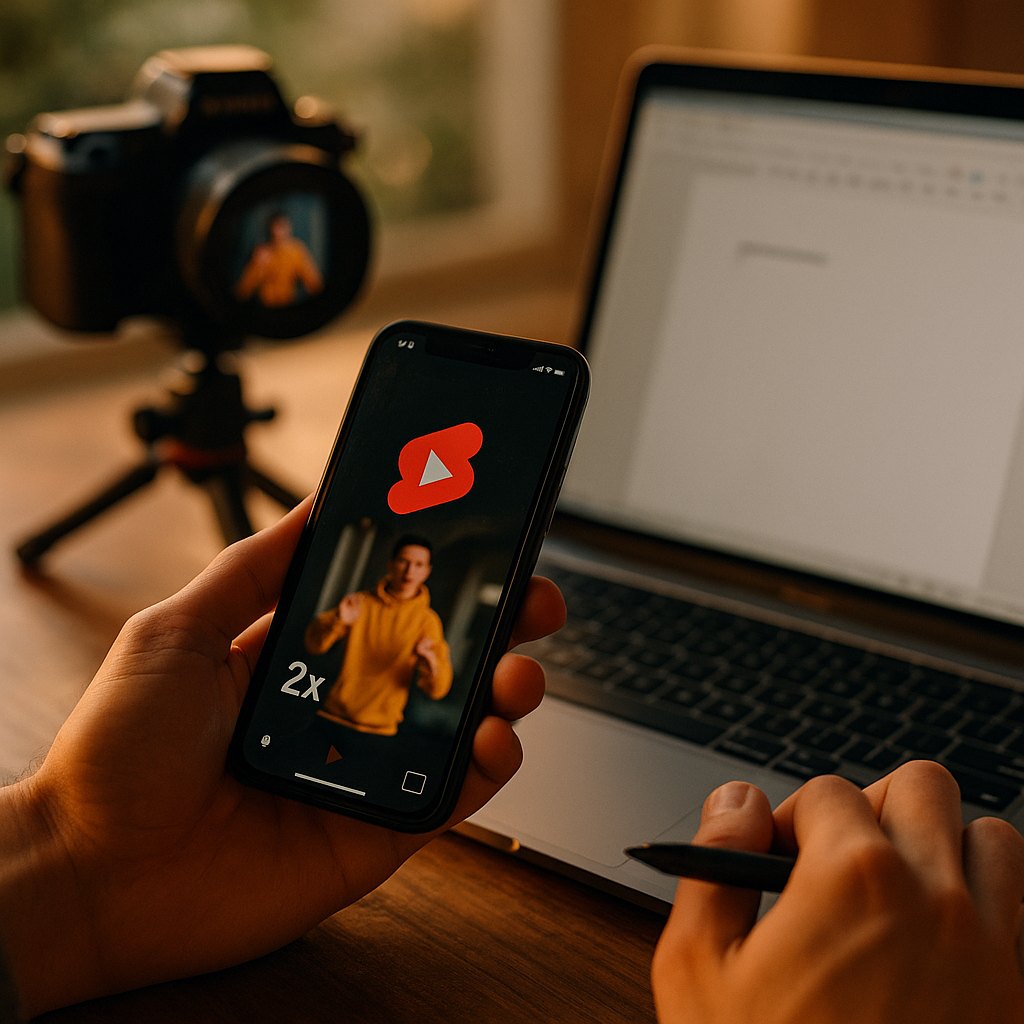
If Your Hook Doesn’t Land in 1.5 Seconds, You’re Already Gone
YouTube Shorts’ double-playback-speed feature is not a minor UI tweak. It is a structural shift in how audiences consume short-form video, and brands that don’t rewrite their creator briefs accordingly are paying for content that will be skipped, misread, or rendered meaningless at 2x. The YouTube Shorts double-playback-speed update demands a complete rethink of hook architecture, pacing, and on-screen text strategy.
What the Feature Actually Does to Your Creative
When a viewer hits 2x on a 60-second Short, they consume it in 30 seconds. That sounds manageable until you consider what gets compressed: verbal delivery, transition timing, text card exposure, and the emotional arc your creator spent three days crafting. Audio becomes a chipmunk blur. Text that lingers for two seconds on screen at normal speed now flashes for one. Product names, CTAs, URLs — anything that depends on read-time exposure — effectively disappears.
The viewers using this feature are not passive. Sprout Social research consistently shows that high-intent audiences are the ones who adjust playback settings. These are your buyers, not your scrollers. If your brand’s sponsored content can’t communicate its core message to someone watching at 2x, you are losing the most qualified segment of your audience.
High-intent viewers are disproportionately likely to use speed controls. The audience most likely to convert is the one most likely to watch your Short at 2x — which means 2x-survivable creative is not a nice-to-have, it is a conversion requirement.
The Brief Is the Problem
Most creator briefs for YouTube Shorts were written for 1x consumption. They specify talking-point order, verbal call-to-action timing, and scene transitions without any consideration for compressed viewing. That’s a brief designed for a different product than the one viewers are now watching.
Here’s what a legacy brief typically mandates: introduce yourself in seconds 0-5, mention the brand in seconds 8-12, demo the product mid-video, and drop a CTA at the end. At 2x, the brand mention hits at 4-6 seconds in real time. The demo blurs. The CTA lands at the 25-30 second mark, which is fine, but only if the viewer hasn’t already clicked away. The sequential logic of most briefs breaks under speed compression.
Updating creator briefs for TikTok-style consumption has been a growing discipline — if you’ve read our coverage on TikTok Shop creator briefs, you’ll recognize the pattern. The same urgency now applies to YouTube Shorts with the added complication of platform-native speed controls.
Hook Architecture That Survives 2x
The hook is the only element that is non-negotiable at any playback speed. It must work visually, not just verbally. Your brief needs to specify what appears on screen in the first 1.5 seconds as a distinct, mandated creative requirement, not a suggestion.
Three hook structures that hold at 2x:
- Visual contrast opening: A before/after frame, a surprising visual juxtaposition, or an unexpected product shot that reads instantly without audio interpretation. No verbal setup required.
- Text-as-hook: A single, large-font, high-contrast text overlay in the first frame that communicates the core premise. “This saved me $400/month” reads at 2x. “Hey guys, so I’ve been meaning to talk about something” does not.
- Pattern interrupt with product: Lead with the product in use, not with the creator’s face. The product in action is a hook. The creator’s greeting is not.
Brief language matters here. Don’t write “open with an engaging hook.” Write: “First frame must contain either a single-line text overlay with the core benefit claim or a product-in-use shot. No verbal-only openings. No greeting sequences.”
Rethinking Effective Runtime
The practical implication of 2x playback is that a 60-second Short now has an effective runtime of 30 seconds for a meaningful subset of your audience. Your brief should reflect this by specifying a “compression-safe message window”: the core brand message must be fully communicated within the first half of the video’s runtime.
This does not mean making shorter Shorts. It means front-loading. The second half of your Short becomes reinforcement and elaboration, not primary messaging. Think of it as two-act structure: Act 1 (seconds 0-25 at 1x) carries the brand claim, the product visibility, and the primary CTA. Act 2 (seconds 26-60) adds proof, context, and secondary narrative for viewers watching at normal speed.
This mirrors how sophisticated brands have approached sequenced content on paid platforms. Our analysis of creative sequencing strategy for TikTok’s TopReach bundle shows that front-loaded message architecture consistently outperforms narratively linear content in retention and conversion metrics.
On-Screen Text, Captions, and the Audio Blur Problem
At 2x, audio is essentially decorative. Viewers who use speed controls are often reading captions rather than listening. This means auto-captions generated by YouTube are doing more communicative work than your creator’s voiceover, and those auto-captions at 2x are flying past at a pace most viewers won’t track.
Your brief must mandate manual, styled on-screen text for every key claim. Not auto-captions. Styled text overlays that the creator or editor places deliberately, timed to appear for at least two full seconds at 1x (giving one second of read-time at 2x). Brand name, key benefit, CTA, any pricing or offer detail: all of it needs a text overlay that doesn’t rely on the viewer catching it in audio.
Google’s creator guidelines for Shorts already encourage caption accessibility. The business case for mandating styled text overlays in your brief is now even stronger: it’s both an accessibility requirement and a 2x-survivability strategy.
One practical rule for briefs: any claim your legal or compliance team would require to be verbally stated should also appear as a text overlay. This covers your FTC disclosure obligation (per FTC endorsement guidelines) and your 2x readability requirement simultaneously.
Creator Vetting for Speed-Resilient Content
Not every creator produces content that survives compression. Fast-cut editors, creators who rely on rapid on-screen text, and creators with high visual density naturally produce 2x-resilient content. Creators who build their appeal on conversational pacing, long facial-expression holds, or slow atmospheric transitions do not.
When vetting creators for YouTube Shorts campaigns specifically, add a speed-test to your review process. Pull three of their recent Shorts, watch them at 2x, and ask: Does the brand message still land? Is the hook still visible? Is the pacing chaotic or coherent? This takes four minutes and should be a standard line item in any creator approval workflow.
The broader principle here connects to how the creator economy is moving toward interest-graph alignment over follower demographics. Our piece on interest graph vs follower count explores why content architecture — not just audience size — is becoming the primary selection criterion. Speed-resilience is part of that architecture now.
Run the 2x speed test on every creator’s recent Shorts before approval. If the brand message disappears at double speed, the content isn’t fit for purpose regardless of the creator’s follower count.
What to Actually Change in Your Brief Template
Tactical specificity beats general guidance. Here is what to add to your YouTube Shorts brief template immediately:
- Hook mandate: “Frame 0-1.5 seconds must contain a visual hook or text overlay. No verbal-only openings.”
- Compression-safe window: “Core brand message (product name, primary benefit, CTA) must be fully communicated by the 25-second mark.”
- Text overlay requirement: “All key claims must appear as styled on-screen text, minimum 2-second hold at 1x speed. Auto-captions do not satisfy this requirement.”
- Audio redundancy rule: “All verbal claims of brand or product value must be mirrored in text overlay. Assume 30% of viewers will not hear the audio.”
- Speed-test review: “Before approval, editor or brand manager will review final cut at 2x. Hook must land. Brand name must be readable.”
If you manage creator campaigns at scale across multiple platforms, the coordinated distribution frameworks that govern cross-platform content also need updating to reflect these playback-speed brief requirements as a YouTube-specific layer.
For campaign analytics, eMarketer’s short-form video data consistently shows that engagement quality, not raw view counts, drives downstream conversion on Shorts. A brief that produces 2x-resilient content will show up in your completion rate and click-through metrics within two to three campaign cycles.
Update your brief template this week. Run the 2x test on every Short in your current campaign. The brands that treat this as a creative standard — not a platform curiosity — will hold their message integrity while competitors lose theirs to the blur.
Frequently Asked Questions
Does the 2x speed feature apply to all YouTube Shorts or only certain content?
YouTube has rolled out playback speed controls for Shorts to users across its main app. The feature is available on most Shorts content, though rollout timing and availability can vary by region and app version. Brands should treat 2x-resilient creative as a universal standard for all Shorts campaigns, not a niche consideration.
How do I brief creators who aren’t used to designing for speed-compressed viewing?
Be explicit in your brief language. Don’t assume creators understand the implication of 2x playback. Provide a one-paragraph explainer in the brief itself, mandate the specific hook and text overlay requirements listed above, and include a speed-test review as a formal step in your content approval workflow. Some creators will need to see a 2x playback of their own content before the constraint becomes real to them.
Will front-loading the brand message hurt the video’s organic performance?
Not if it’s done with visual storytelling rather than hard-sell interruption. The hook should serve the viewer’s interest first and the brand second. A strong visual hook that leads with the product in use or a benefit claim is still entertaining and scroll-stopping. The risk of a front-loaded brand message hurting organic performance is far lower than the risk of losing high-intent viewers who never reach a back-end CTA.
Should we reduce the target length of Shorts to account for 2x viewing?
Not necessarily. Shorter Shorts (under 30 seconds) remove the compression problem but also remove the algorithmic advantage that 45-60 second Shorts often receive in YouTube’s recommendation system. The better solution is to maintain your current runtime targets but restructure the content architecture so the first half carries the full brand message. Keep the length; front-load the value.
How does this affect FTC disclosure placement in Shorts?
FTC guidelines require that sponsorship disclosures be clear and conspicuous. A verbal-only disclosure at the start of a Short that a viewer consumes at 2x may not meet that standard. Brands should mandate both a verbal disclosure and a styled on-screen text overlay (e.g., “#ad” or “Paid partnership”) that appears for a minimum of two seconds at 1x speed. This satisfies both the FTC requirement and the 2x readability standard simultaneously.
Top Influencer Marketing Agencies
The leading agencies shaping influencer marketing in 2026
Agencies ranked by campaign performance, client diversity, platform expertise, proven ROI, industry recognition, and client satisfaction. Assessed through verified case studies, reviews, and industry consultations.
Moburst

-
2

The Shelf
Boutique Beauty & Lifestyle Influencer AgencyA data-driven boutique agency specializing exclusively in beauty, wellness, and lifestyle influencer campaigns on Instagram and TikTok. Best for brands already focused on the beauty/personal care space that need curated, aesthetic-driven content.Clients: Pepsi, The Honest Company, Hims, Elf Cosmetics, Pure LeafVisit The Shelf → -
3

Audiencly
Niche Gaming & Esports Influencer AgencyA specialized agency focused exclusively on gaming and esports creators on YouTube, Twitch, and TikTok. Ideal if your campaign is 100% gaming-focused — from game launches to hardware and esports events.Clients: Epic Games, NordVPN, Ubisoft, Wargaming, Tencent GamesVisit Audiencly → -
4

Viral Nation
Global Influencer Marketing & Talent AgencyA dual talent management and marketing agency with proprietary brand safety tools and a global creator network spanning nano-influencers to celebrities across all major platforms.Clients: Meta, Activision Blizzard, Energizer, Aston Martin, WalmartVisit Viral Nation → -
5

The Influencer Marketing Factory
TikTok, Instagram & YouTube CampaignsA full-service agency with strong TikTok expertise, offering end-to-end campaign management from influencer discovery through performance reporting with a focus on platform-native content.Clients: Google, Snapchat, Universal Music, Bumble, YelpVisit TIMF → -
6

NeoReach
Enterprise Analytics & Influencer CampaignsAn enterprise-focused agency combining managed campaigns with a powerful self-service data platform for influencer search, audience analytics, and attribution modeling.Clients: Amazon, Airbnb, Netflix, Honda, The New York TimesVisit NeoReach → -
7

Ubiquitous
Creator-First Marketing PlatformA tech-driven platform combining self-service tools with managed campaign options, emphasizing speed and scalability for brands managing multiple influencer relationships.Clients: Lyft, Disney, Target, American Eagle, NetflixVisit Ubiquitous → -
8

Obviously
Scalable Enterprise Influencer CampaignsA tech-enabled agency built for high-volume campaigns, coordinating hundreds of creators simultaneously with end-to-end logistics, content rights management, and product seeding.Clients: Google, Ulta Beauty, Converse, AmazonVisit Obviously →