


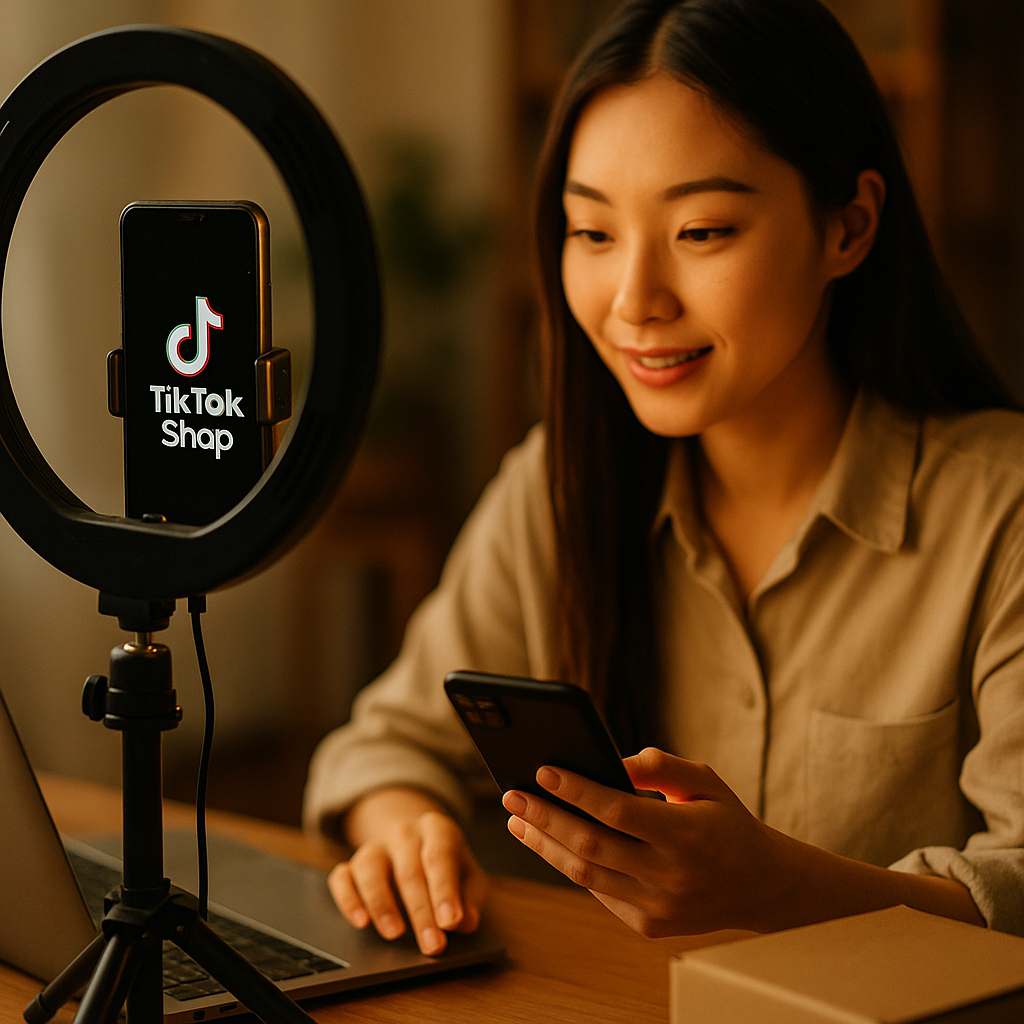
Most TikTok Shop Briefs Are Leaving Money in the Feed
Brands running TikTok Shop campaigns are still handing creators generic video briefs built for Instagram aesthetics. The result: content that looks polished but gets buried by the algorithm before a single product tap fires. Writing a platform-specific TikTok Shop creator commerce brief that accounts for AI discovery logic, checkout architecture, and retention mechanics is no longer optional — it is the operational baseline for 2026.
Why Generic Briefs Fail TikTok’s AI Recommendation Layer
TikTok’s recommendation engine does not rank content the way most brand managers assume. It does not start with followers. It starts with completion signals, re-watch loops, comment velocity, and product interaction data from the Shop tab. A brief that does not encode these mechanics into the production direction is essentially asking a creator to fly blind.
The platform’s TikTok for Business documentation confirms that videos surfaced to cold audiences via the For You Page are evaluated within the first 500 milliseconds of playback. That is not a metaphor for “grab attention.” It is a literal machine-scored event that determines whether your content gets distributed beyond the creator’s existing audience. Every brief should name this explicitly.
TikTok’s AI scores your content before most viewers consciously register what they are watching. Your brief has to engineer for the algorithm’s first half-second, not the human’s third.
For a deeper look at how creator briefs interact with TikTok’s recommendation logic, see our coverage of TikTok creator briefs for AI recommendation — the framing there applies directly to Shop-specific campaigns.
The Architecture of a Single-Document Brief That Does Three Jobs
The brief needs to serve three separate technical masters inside one document: the discovery algorithm, the in-app checkout UX, and the watch-time model. Trying to address all three in a prose narrative is how briefs become 12-page PDFs that creators ignore. Structure matters as much as content.
Here is a functional section breakdown that works in practice:
- Section 1 — Discovery Parameters: Hook window (frames 0–3 seconds), spoken keyword priority list for audio indexing, caption hashtag clusters aligned to active Shop subcategories, and content category signal (e.g., “Beauty Hack” vs. “Get Ready With Me” vs. “Product Demo”). The AI indexes audio transcripts, so the brief should list 3–5 seed phrases the creator must say naturally within the first 8 seconds.
- Section 2 — Checkout Architecture Alignment: Specify exactly where and how the product link appears in the video flow. TikTok Shop’s in-app checkout activates through a pinned product card that surfaces during playback. The brief should direct the creator to reference the product visually at the same moment it appears on-screen — typically between the 7- and 12-second mark. Misalignment between the spoken mention and the card display kills tap-through rates.
- Section 3 — Watch-Time Retention Direction: This is where most briefs are completely silent. Specify the narrative structure: open loop in seconds 0–3, value delivery in seconds 4–25, re-hook or pattern interrupt at second 26 (the average drop-off cliff for non-follower audiences), and close with a behavioral CTA tied to the checkout action, not a vague “link in bio.”
- Section 4 — Disclosure and Compliance Markers: FTC guidelines require clear material disclosure at the start of sponsored content. The brief should specify the exact disclosure language and timestamp for “Ad” or “Paid Partnership” labeling within TikTok’s native tagging tool, not just a verbal mention.
- Section 5 — Performance Benchmarks and Go/No-Go Criteria: State the minimum acceptable watch-time rate (industry baseline sits around 25–30% completion for cold audiences on Shop content, per eMarketer tracking), the target product card CTR, and the GMV threshold that triggers a repost or paid amplification decision.
This structure is deliberately modular. A creator can scan Section 1 before filming, reference Section 2 during editing, and your media buyer can use Sections 4 and 5 without reading the creative direction at all.
Engineering the Hook for Feed Survival
The hook is not an opener. It is a survival mechanism.
TikTok’s algorithm uses a “not-interested” signal aggressively — users swipe away and the platform learns fast. Your brief needs to specify hook type by audience temperature. For cold discovery audiences (the majority of Shop impressions), pattern-interrupt hooks outperform value-statement hooks by a significant margin. That means directing creators toward visual tension, unexpected sound design, or a counter-intuitive claim rather than leading with product benefits.
A brief that says “open with something attention-grabbing” is useless. A brief that says “open with a physical contrast shot (before/after or unexpected use case), spoken line must be a question or partial statement that creates an open information loop, no brand logo or product packaging visible in frame 1–2” is actionable. The difference is specificity.
Separately, the brief should distinguish between hooks designed for FYP cold discovery and hooks designed for Shop Browse (users already in a purchase-intent mindset). Shop Browse audiences tolerate a slightly longer setup — up to 5 seconds — before the core value proposition lands. Writing one hook direction for both contexts is a structural error that costs conversion rate.
In-App Checkout Is Not a Feature — It Is a Constraint
Every production decision in a TikTok Shop video needs to account for how the checkout overlay behaves during playback. The product card UI sits in the lower third of the screen. If a creator’s key visual moment — a close-up, a price callout, a reaction shot — lands in that zone, the UX competes with the content. Brief the creator to keep critical visual action in the upper two-thirds of the frame during the checkout CTA window.
Similarly, the checkout flow requires the viewer to stay inside the TikTok app. That sounds obvious, but it changes the CTA language entirely. Avoid directing creators to say anything that implies leaving the platform (“check it out,” “go to the website,” “find the link”). The brief should supply approved CTA scripts that reinforce in-app action: “tap the product below,” “it is pinned right here,” or “grab it without leaving this video.” This is not a minor copywriting tweak — it directly affects funnel completion rates.
For broader context on how TikTok’s scroll-to-checkout mechanics are reshaping paid placement strategy, the infrastructure decisions behind Shop are worth understanding at a campaign architecture level, not just a creative one.
Watch-Time Retention: The Metric Your Brief Should Be Optimizing For
Average watch time percentage is the most directly controllable metric in your brief. It is also the metric that most directly feeds the algorithm’s distribution decision for subsequent posts in a campaign. A video that retains 40% of cold viewers to the 20-second mark will be served to a dramatically larger second-wave audience than one that retains 18%. The brief is the lever.
Direct creators to build a mid-video re-hook. This is a deliberate narrative or visual reset at roughly the 50–60% mark of the video’s intended runtime. Think of it as a second open loop: a new question, a visual reveal, or a surprising data point that resets the viewer’s motivation to keep watching. Sprout Social‘s creator research consistently shows that videos with a structured mid-point re-hook outperform linear narratives on retention, regardless of category.
This is also where your brief should address video length explicitly. For TikTok Shop content, the 21–34 second range consistently produces the best combination of completion rate and checkout tap-through. Longer videos can work for high-consideration products, but the brief needs to justify the runtime with specific retention mechanics, not just creative preference.
Your brief’s watch-time direction is not a creative note — it is a media efficiency lever. Every percentage point of retention improvement directly reduces your effective CPM on the next distribution cycle.
Pairing strong retention mechanics with the right paid amplification approach matters equally. Our analysis of TikTok TopReach and creator brief design covers how organic retention scores influence paid distribution costs — a connection that belongs in your campaign planning conversation, not just your creative review.
Operationalizing the Brief Across a Creator Roster
If you are running five or more creators simultaneously on a TikTok Shop campaign, brief consistency becomes a workflow problem, not just a creative one. The solution is a brief template with locked sections (compliance language, checkout architecture direction, performance benchmarks) and variable sections (hook type, spoken keyword list, product demo angle) that get customized per creator.
Lock the structure. Customize the voice direction. That balance is what separates a scalable brief system from a document that gets rewritten from scratch every campaign cycle. Tools like HubSpot’s content operations infrastructure or dedicated influencer platforms with brief management modules can support version control across large creator rosters.
Also worth flagging: if any creators on your roster are using AI-assisted video generation or faceless formats, your brief needs an explicit authorship verification requirement. TikTok’s algorithm actively suppresses AI-generated content that lacks clear human creator signals, and the FTC’s disclosure requirements apply regardless of production method. Our reporting on AI faceless video suppression has practical guidance for how to handle this in brief language without alienating creators who use legitimate AI production tools.
For additional context on how sponsored video briefs should handle hooks, timing, and disclosure in a Shop-specific context, see our detailed breakdown of TikTok Shop sponsored video mechanics.
Start with the brief template. Audit one live campaign against the five-section structure above. The gap between what your current briefs specify and what the algorithm actually requires will tell you exactly where your GMV is leaking.
FAQs
What should a TikTok Shop creator brief include that a standard influencer brief does not?
A TikTok Shop brief needs three additional layers that standard influencer briefs omit: AI discovery parameters (spoken keyword list, content category signal, hook window timing), in-app checkout architecture alignment (product card placement, approved CTA scripts that keep users in-app), and watch-time retention mechanics (open loops, mid-video re-hooks, justified runtime with specific structural direction). These are not creative suggestions — they are technical requirements tied directly to algorithm distribution and checkout conversion.
How long should a TikTok Shop sponsored video be for best results?
For most product categories, the 21–34 second range produces the best combination of completion rate and product card tap-through. High-consideration or higher-priced products can support 45–60 seconds, but only if the brief includes explicit retention mechanics — a mid-video re-hook, structured narrative arc, and a clear behavioral CTA tied to the in-app checkout action before the final second.
How does TikTok’s AI discovery logic affect brief writing?
TikTok’s recommendation engine scores videos within the first 500 milliseconds of playback and indexes audio transcripts for keyword relevance. A brief should specify 3–5 seed phrases the creator must say naturally in the first 8 seconds, define the hook type by audience temperature (cold FYP vs. Shop Browse), and align the content category signal to active Shop subcategories. Without these parameters, the algorithm has no structured signal to surface the video to relevant non-followers.
Where should the product mention appear in a TikTok Shop video?
The product should be referenced both visually and verbally between the 7- and 12-second mark, aligned with when TikTok’s pinned product card typically surfaces during playback. Misalignment between the spoken mention and the card display reduces tap-through rate. Key visual moments should also be kept in the upper two-thirds of the frame to avoid competition with the checkout overlay UI in the lower third.
Can the same creator brief work across multiple TikTok Shop campaigns?
A brief template with locked structural sections (compliance language, checkout architecture direction, performance benchmarks) and variable sections (hook type, keyword list, demo angle) can be reused across campaigns and scaled across creator rosters. However, the spoken keyword list and hook type should be customized per creator to preserve authentic voice and avoid algorithmic pattern-matching penalties for templated content.
Top Influencer Marketing Agencies
The leading agencies shaping influencer marketing in 2026
Agencies ranked by campaign performance, client diversity, platform expertise, proven ROI, industry recognition, and client satisfaction. Assessed through verified case studies, reviews, and industry consultations.
Moburst

-
2

The Shelf
Boutique Beauty & Lifestyle Influencer AgencyA data-driven boutique agency specializing exclusively in beauty, wellness, and lifestyle influencer campaigns on Instagram and TikTok. Best for brands already focused on the beauty/personal care space that need curated, aesthetic-driven content.Clients: Pepsi, The Honest Company, Hims, Elf Cosmetics, Pure LeafVisit The Shelf → -
3

Audiencly
Niche Gaming & Esports Influencer AgencyA specialized agency focused exclusively on gaming and esports creators on YouTube, Twitch, and TikTok. Ideal if your campaign is 100% gaming-focused — from game launches to hardware and esports events.Clients: Epic Games, NordVPN, Ubisoft, Wargaming, Tencent GamesVisit Audiencly → -
4

Viral Nation
Global Influencer Marketing & Talent AgencyA dual talent management and marketing agency with proprietary brand safety tools and a global creator network spanning nano-influencers to celebrities across all major platforms.Clients: Meta, Activision Blizzard, Energizer, Aston Martin, WalmartVisit Viral Nation → -
5

The Influencer Marketing Factory
TikTok, Instagram & YouTube CampaignsA full-service agency with strong TikTok expertise, offering end-to-end campaign management from influencer discovery through performance reporting with a focus on platform-native content.Clients: Google, Snapchat, Universal Music, Bumble, YelpVisit TIMF → -
6

NeoReach
Enterprise Analytics & Influencer CampaignsAn enterprise-focused agency combining managed campaigns with a powerful self-service data platform for influencer search, audience analytics, and attribution modeling.Clients: Amazon, Airbnb, Netflix, Honda, The New York TimesVisit NeoReach → -
7

Ubiquitous
Creator-First Marketing PlatformA tech-driven platform combining self-service tools with managed campaign options, emphasizing speed and scalability for brands managing multiple influencer relationships.Clients: Lyft, Disney, Target, American Eagle, NetflixVisit Ubiquitous → -
8

Obviously
Scalable Enterprise Influencer CampaignsA tech-enabled agency built for high-volume campaigns, coordinating hundreds of creators simultaneously with end-to-end logistics, content rights management, and product seeding.Clients: Google, Ulta Beauty, Converse, AmazonVisit Obviously →