


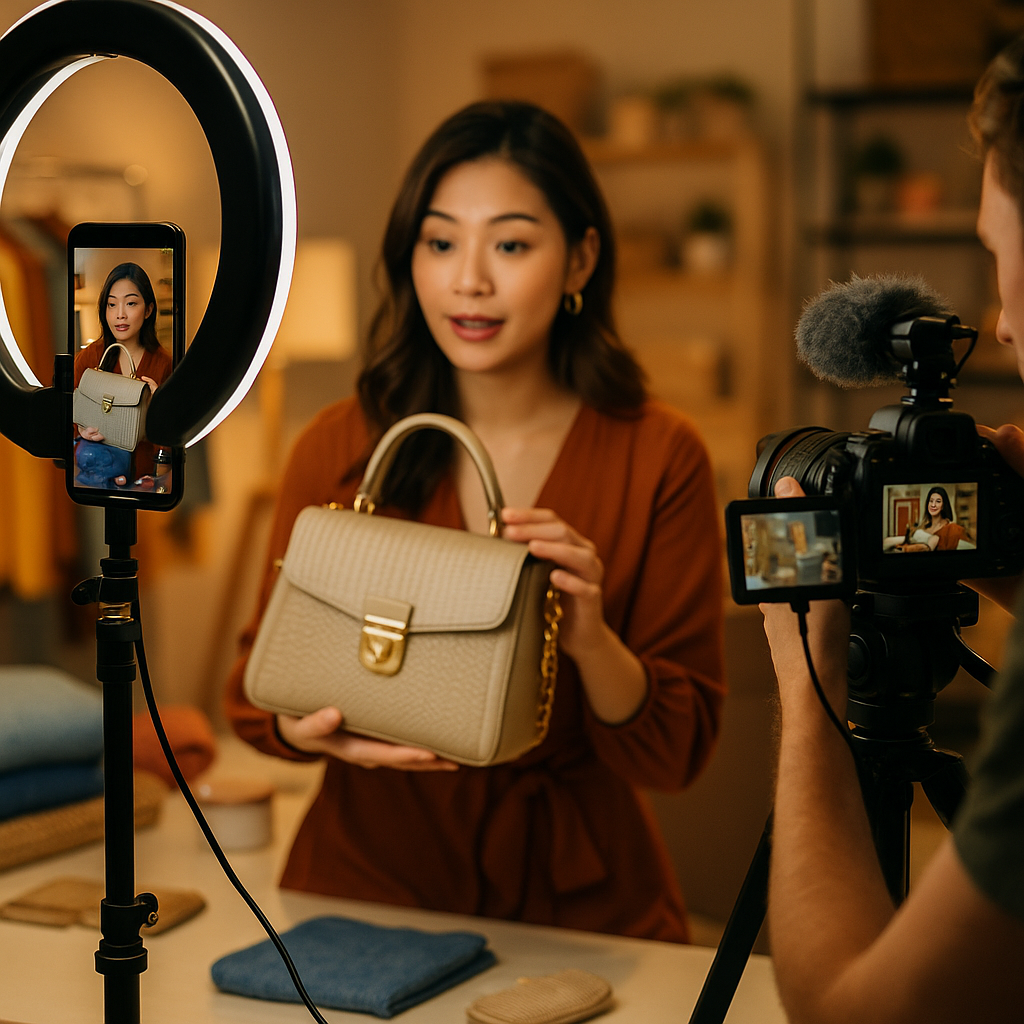
Zero hours of dead air. That’s the promise behind TikTok’s round-the-clock QVC livestream, and it’s forcing a question most brands haven’t had to answer since the early cable-shopping days: what does it actually cost to keep a shelf open forever? The TikTok 24/7 QVC livestream isn’t a novelty stunt. It’s a live-commerce infrastructure test, and the brands who treat it that way will be the ones still standing when the format matures.
Why This Isn’t Just Another Livestream Slot
TikTok Shop has spent two years training US shoppers to buy mid-scroll. QVC has spent five decades training households to buy mid-nap, mid-commute, mid-anything. Pairing the two isn’t a marketing gimmick — it’s a distribution merger. TikTok gets a partner that already knows how to produce continuous, broadcast-quality commerce content. QVC gets access to an audience and an algorithm that rewards watch time over reach, a shift we’ve already tracked in TikTok’s watch-time algorithm update.
The result is a channel that never closes. No prime-time slot, no dayparting, no “catch us at 8pm ET.” For brands used to booking a single livestream event and calling it a campaign, that’s a structural shift, not a scheduling tweak.
A 24/7 stream doesn’t just need more content. It needs a different operating model — staffing, inventory, and compliance all have to run on shift patterns, not campaign calendars.
We’ve covered the staffing implications in depth already — see TikTok QVC 24/7 live shopping forces brands to rethink staffing and the earlier integration mechanics in our brand playbook on the integration. This piece goes further: how do you actually build infrastructure — not just headcount — to sustain a live-commerce presence that never sleeps?
The Infrastructure Gap Most Brands Will Hit First
Ask any brand ops lead what breaks first in a 24/7 live-commerce model and you’ll get the same answer: inventory sync. A single livestream event lets you cap SKUs, pre-allocate stock, and manually adjust if something sells out. Continuous streaming removes that buffer. If your product page says “in stock” at 3am and it isn’t, that’s not a minor glitch — it’s a returned-customer, algorithm-penalized, trust-eroding problem, and it happens while your team is asleep.
This is the same operational lesson we saw with TikTok Shop verification issues: platforms move fast, and brands that treat back-office plumbing as an afterthought pay for it in suspended listings or, worse, suspended trust.
- Real-time inventory feeds: Your commerce stack needs to push stock updates to TikTok Shop in near real time, not batch-sync every few hours.
- Fallback SKUs: Build a rotation of backup products that hosts can pivot to on the fly when a hero item sells out mid-stream.
- Regional inventory splits: A 24/7 US stream crosses every time zone. Make sure fulfillment centers on both coasts are actually synced to the same feed.
None of this is glamorous. But it’s the difference between a channel that compounds and one that quietly erodes conversion rate every night between midnight and 6am.
Staffing for Shifts, Not Campaigns
Most influencer and livestream teams are built around campaign sprints: brief, shoot, launch, wrap. A continuous stream needs something closer to a newsroom rotation. That means:
Host coverage across time zones, ideally with regional accents and cultural fluency, not just an English-speaking host repeating scripts at odd hours. Moderation staff who can handle live chat and compliance flags around the clock — because FTC disclosure rules and platform community guidelines don’t pause at 2am. And a producer on rotation who can make real-time creative calls: swap a product, extend a segment, cut a dead moment.
This isn’t cheap, and it isn’t optional if you want the stream to actually perform. Brands underestimating this cost are the ones who’ll quietly pull out of the format within a quarter, having burned budget on a pilot that was never resourced to run continuously in the first place.
Compliance Doesn’t Take a Night Shift
Here’s the uncomfortable truth: a 24/7 stream multiplies your compliance surface area by roughly three, if you think in eight-hour blocks. Every claim a host makes, every price mentioned, every “limited time” framing needs the same FTC scrutiny at 4am as it does at 4pm. The FTC’s endorsement guidance doesn’t have a curfew, and neither should your legal review process.
We saw this play out already in beauty verticals — TikTok Shop beauty livestreams without FTC compliance risk lays out how quickly unscripted claims turn into liability. Add age-restricted categories into the mix, and the stakes climb further — our piece on age-gating alcohol-adjacent skincare is a good reference for how granular this gets in livestream contexts.
Practical fix: build a compliance runbook that lives with the production team, not just legal. Approved claim language, banned phrases, disclosure timing — all of it needs to be accessible to whoever’s hosting at 3am, not buried in a quarterly training deck nobody rewatches.
Budgeting: What “Continuous” Actually Costs
Brands love to ask “what’s the CPM on a 24/7 stream?” Wrong question. There is no single CPM, because a 24/7 stream isn’t one media buy — it’s an operating cost center with variable ROI by hour, day, and product category.
Think of it in three cost layers:
- Production floor cost: hosts, set, lighting, tech — largely fixed regardless of viewership at any given hour.
- Inventory carrying cost: stock held ready for a channel that could convert at any moment, which ties up working capital differently than a scheduled drop.
- Commission and platform fees: TikTok Shop’s affiliate and commission structures still apply, and tiering strategy matters here — see how brands are structuring this in TikTok Shop commission tiers for home goods creators and the competitive angle in commission tiers built to beat fast-fashion rivals.
The brands getting this right are running dayparted performance analysis — treating 2am-6am as a different inventory and creative strategy than 6pm-10pm, rather than assuming flat performance across 24 hours. That’s basic media planning discipline, just applied to a format that didn’t exist eighteen months ago.
What Actually Converts at 3am (And Why It’s Not What You’d Expect)
Late-night live-commerce audiences skew differently than prime time — more impulse-driven, often insomniac shoppers, disproportionately drawn to lower-consideration categories: beauty tools, home gadgets, novelty items. High-consideration purchases (electronics, big-ticket home goods) still cluster around evening hours when people are deliberately shopping, not scrolling to fall asleep.
This matters for creative briefing. A script optimized for engaged evening viewers will flop at 3am if it assumes active attention. Overnight segments need shorter pitches, punchier visuals, and price anchors repeated more frequently, because viewers are dipping in and out, not watching start to finish.
This is the same discovery-over-reach logic reshaping feeds broadly — worth revisiting why discovery-over-reach ranking works differently now if you’re still briefing creators against old reach-based assumptions.
Where This Fits Against Other Live-Commerce Bets
TikTok isn’t the only platform pushing brands toward always-on or creator-hosted commerce. Instagram’s creator-hosted checkout events and YouTube’s shopping affiliate model for UK retailers are both testing versions of continuous or semi-continuous commerce. The difference: TikTok-QVC is the first to fully commit to zero downtime, treating live commerce as infrastructure rather than event programming.
That’s a meaningful bet, and according to eMarketer’s live-commerce forecasts, US social commerce spend continues to climb well into double-digit annual growth, with livestream formats capturing a growing share. Brands sitting this out entirely risk ceding ground to competitors willing to build the operational muscle now, while the format is still forming its norms.
A Practical Rollout Sequence
If you’re considering a foothold in the TikTok-QVC continuous stream, don’t start with a 24/7 commitment. Start with a defined daypart — say, a six-hour evening block — and prove out inventory sync, host rotation, and compliance workflows at smaller scale. Expand hours only once those systems hold under real load.
Track performance the way you’d track a CRM funnel, not a campaign report: hourly conversion, return rate by daypart, and chat sentiment as a leading indicator of host performance. Tools like Sprout Social and TikTok’s native TikTok Ads Manager both offer dashboards that can be adapted for this, though neither was built with 24/7 streaming in mind — expect to stitch together custom reporting for a while.
FAQs
Frequently Asked Questions
What is the TikTok 24/7 QVC livestream partnership?
It’s a continuous, always-on live-commerce channel combining TikTok Shop’s audience and algorithm with QVC’s broadcast-style production and retail infrastructure, running commerce content around the clock rather than in scheduled slots.
How is a 24/7 livestream different from a scheduled TikTok Shop live event?
Scheduled events have fixed inventory allocation, a defined host window, and a clear start/end. A 24/7 stream requires real-time inventory syncing, rotating host staffing across time zones, and continuous compliance monitoring since there’s no downtime to catch errors.
What’s the biggest operational risk for brands joining this format?
Inventory desync is the most common failure point — stock showing available when it’s sold out, especially during overnight hours when teams aren’t actively monitoring. Compliance gaps during unstaffed or under-supervised shifts are a close second.
Do FTC disclosure rules apply differently to continuous livestreams?
No — the same FTC endorsement and disclosure standards apply regardless of time of day. The risk is operational, not regulatory: continuous streaming means more hours where a host could make an unreviewed claim without legal oversight present.
Should smaller brands attempt a 24/7 presence, or start smaller?
Start with a defined daypart, not full continuous coverage. Prove inventory sync, host rotation, and compliance workflows on a six- to eight-hour block before expanding, since the fixed costs of production and staffing don’t shrink with a smaller audience.
How should budgeting differ for continuous versus scheduled livestreams?
Continuous streams should be budgeted as an operating cost center — production floor costs, inventory carrying costs, and platform commissions — rather than a single campaign CPM, since performance and cost vary significantly by hour and day.
The brands that win this format won’t be the ones who show up first — they’ll be the ones who pilot small, prove their inventory and compliance systems hold under continuous load, and scale hours only when the operations actually work.
Top Influencer Marketing Agencies
The leading agencies shaping influencer marketing in 2026
Agencies ranked by campaign performance, client diversity, platform expertise, proven ROI, industry recognition, and client satisfaction. Assessed through verified case studies, reviews, and industry consultations.
Moburst

-
2

The Shelf
Boutique Beauty & Lifestyle Influencer AgencyA data-driven boutique agency specializing exclusively in beauty, wellness, and lifestyle influencer campaigns on Instagram and TikTok. Best for brands already focused on the beauty/personal care space that need curated, aesthetic-driven content.Clients: Pepsi, The Honest Company, Hims, Elf Cosmetics, Pure LeafVisit The Shelf → -
3

Audiencly
Niche Gaming & Esports Influencer AgencyA specialized agency focused exclusively on gaming and esports creators on YouTube, Twitch, and TikTok. Ideal if your campaign is 100% gaming-focused — from game launches to hardware and esports events.Clients: Epic Games, NordVPN, Ubisoft, Wargaming, Tencent GamesVisit Audiencly → -
4

Viral Nation
Global Influencer Marketing & Talent AgencyA dual talent management and marketing agency with proprietary brand safety tools and a global creator network spanning nano-influencers to celebrities across all major platforms.Clients: Meta, Activision Blizzard, Energizer, Aston Martin, WalmartVisit Viral Nation → -
5

The Influencer Marketing Factory
TikTok, Instagram & YouTube CampaignsA full-service agency with strong TikTok expertise, offering end-to-end campaign management from influencer discovery through performance reporting with a focus on platform-native content.Clients: Google, Snapchat, Universal Music, Bumble, YelpVisit TIMF → -
6

NeoReach
Enterprise Analytics & Influencer CampaignsAn enterprise-focused agency combining managed campaigns with a powerful self-service data platform for influencer search, audience analytics, and attribution modeling.Clients: Amazon, Airbnb, Netflix, Honda, The New York TimesVisit NeoReach → -
7

Ubiquitous
Creator-First Marketing PlatformA tech-driven platform combining self-service tools with managed campaign options, emphasizing speed and scalability for brands managing multiple influencer relationships.Clients: Lyft, Disney, Target, American Eagle, NetflixVisit Ubiquitous → -
8

Obviously
Scalable Enterprise Influencer CampaignsA tech-enabled agency built for high-volume campaigns, coordinating hundreds of creators simultaneously with end-to-end logistics, content rights management, and product seeding.Clients: Google, Ulta Beauty, Converse, AmazonVisit Obviously →