


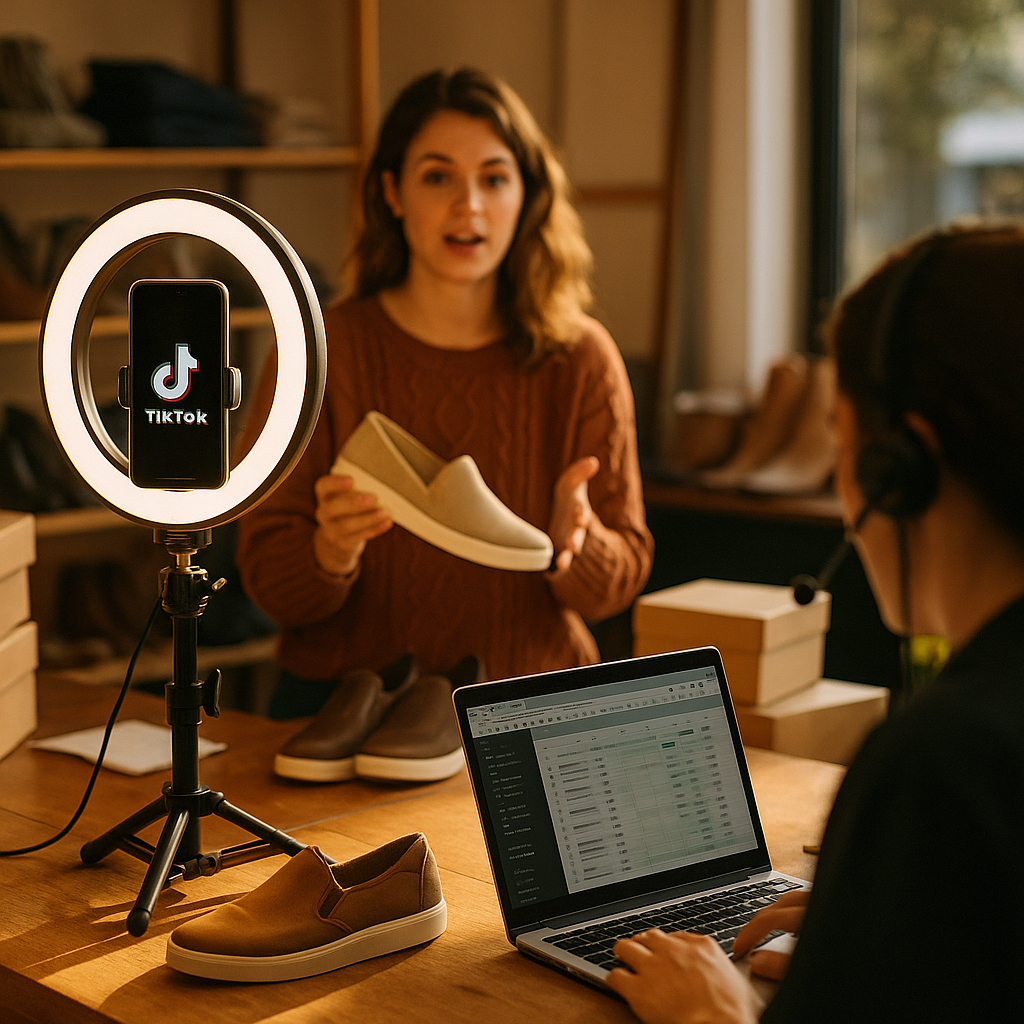
168 hours a week. That’s how much airtime brands now need to fill if they want a permanent slot on TikTok’s new QVC-powered shopping channel. TikTok’s 24/7 live-shopping model isn’t a feature update — it’s a staffing crisis wearing a partnership announcement. If your team plans creator livestreams like one-off events, this changes the math entirely.
TikTok and QVC’s tie-up effectively imports linear retail television’s always-on programming logic into a platform built on algorithmic virality. That’s a collision of two very different operating models. One runs on schedules, producers, and union talent. The other runs on trends, spikes, and creators who post when inspiration (or a brand deal) strikes. Brands sitting in the middle now have to decide: do we staff like a TV network, or do we keep gambling on sporadic creator drops?
Why This Isn’t Just Another Livestream Feature
TikTok Shop has been chasing live commerce dominance for a while, and the numbers justify the obsession. eMarketer estimates U.S. live commerce sales are climbing into the tens of billions annually, with TikTok positioned as the fastest-growing channel in that mix. QVC and its parent company bring something TikTok never had natively: decades of broadcast-grade production infrastructure and hosts who can sell for six hours straight without losing energy or coherence.
That’s the real unlock. TikTok gets always-on inventory and professional hosting. QVC gets access to a younger, mobile-native audience it’s been losing to Amazon and DTC brands for years. For brand marketers, it means a new distribution channel that behaves less like a creator campaign and more like a retail media buy with a live human face.
A 24/7 shopping channel doesn’t need viral moments to justify its existence — it needs consistent, sellable inventory and hosts who can perform on a schedule, not just when the algorithm smiles on them.
We covered the mechanics of this integration in detail in our TikTok-QVC livestream playbook, but the staffing implications deserve their own conversation, because this is where most brand commerce teams are underprepared.
The Staffing Math Nobody’s Budgeting For
Here’s the blunt version: running live commerce 24/7 requires either round-the-clock creator rotations or a hybrid model where QVC’s trained hosts handle baseline hours and creators fill premium slots. Most brands have budgeted for the latter without realizing how thin that premium inventory actually is.
Think about your current influencer roster. How many of them can hold a live audience for 45 minutes, hit sales targets, handle live objections about sizing or ingredients, and stay on-brand the entire time? Probably fewer than you think. Traditional livestream shopping — the kind we outlined in our Instagram live shopping playbook — trains for short, high-energy bursts. QVC-style programming trains for stamina and retail script discipline. Those are different skill sets, and most creator rosters are built for the former.
Brands need to start categorizing their creator bench into tiers:
- Broadcast-ready hosts: creators who can sustain multi-hour selling blocks with minimal script support, often trained through agency or QVC-adjacent programs.
- Segment specialists: creators who excel in 15-30 minute windows tied to product drops or restocks, ideal for slotting into a 24/7 grid without full-shift commitment.
- Guest spike talent: high-follower creators brought in for short, high-visibility appearances designed to drive traffic spikes into the always-on base programming.
That tiering isn’t cosmetic. It determines contract structure, pay rates, and how you forecast conversion across a 24-hour cycle rather than a single livestream event.
What Changes for Brand Commerce Integration
Integrating your product catalog into a channel that never goes dark means inventory and fulfillment planning can’t run on campaign cycles anymore. If a host mentions your product at 3 a.m. and it sells out, there’s no “we’ll restock for the next drop” grace period — the channel is still live, still selling, and your stockout is now visible to whoever’s watching.
This mirrors challenges we’ve flagged before around commission structures and operational readiness. Our piece on TikTok Shop commission tiers covers how payout structures need to flex with volume, and 24/7 programming multiplies that volume unpredictably. A product that does modest numbers in a scheduled evening livestream might behave completely differently when it’s part of rotating background inventory running continuously.
Brand teams should be asking their TikTok Shop reps and QVC liaison three questions before committing inventory:
- How is product rotation scheduled across the 24-hour grid, and can we control which dayparts feature our SKUs?
- What’s the reporting cadence for real-time sales and stock levels during unstaffed or host-transition hours?
- Who owns compliance review when a QVC-trained host makes claims about our product versus when our own creator does?
That last question matters more than it sounds. QVC hosts operate under broadcast standards; creators often don’t have the same institutional compliance training. Mixing the two on one shopping channel creates a patchwork risk profile that legal and marketing teams need to align on before launch, not after an FTC inquiry.
Compliance Doesn’t Sleep Either
Round-the-clock selling means round-the-clock claims exposure. The FTC’s endorsement guidelines don’t have off-hours, and neither does the ICO if you’re selling into UK audiences during a European daypart. Brands that have already tightened up beauty and skincare livestream compliance — as detailed in our FTC compliance guide for beauty livestreams — have a head start. Everyone else needs to catch up fast.
Age-gating is another wrinkle, especially for categories brushing up against regulated claims. We’ve written about how UK brands handle this for alcohol-adjacent skincare in livestream formats, and that same logic scales to a 24/7 grid where you can’t guarantee a human compliance reviewer is watching every segment in real time.
If your compliance review process assumes someone is awake and watching the livestream, a 24/7 channel just broke that assumption. Automated flagging and pre-approved claim libraries aren’t optional anymore — they’re the baseline.
Practically, this means brands should build a pre-approved claims library that any host — creator or QVC-trained — pulls from, rather than relying on live judgment calls at 4 a.m. Automated caption and audio monitoring tools, the kind referenced in Sprout Social’s social compliance tooling, can flag risky language for retroactive review even when no one caught it live.
Staffing Models That Actually Scale
Three approaches are emerging among brands piloting this integration:
The agency-managed rotation. Brands contract with talent agencies that maintain broadcast-trained creator pools specifically for extended live formats. This costs more per hour but reduces the brand’s internal staffing burden and compliance risk, since agencies typically build in claims review as part of the service.
The hybrid internal-external bench. Larger brands are training a small internal team of “always-ready” hosts — often junior marketing or customer success staff with on-camera comfort — to fill low-traffic overnight slots, while reserving paid creator talent for peak dayparts. It’s cheaper, but it requires real investment in on-camera training, which most marketing teams haven’t budgeted for.
The guest-spike model. Smaller brands without the volume to justify dedicated hours instead negotiate short guest appearances during someone else’s block, essentially treating the 24/7 channel like a syndicated ad slot rather than owned programming. This is the lowest-commitment option and probably the right starting point for brands still testing whether the channel drives incremental revenue.
None of these models are inherently better. The right one depends on SKU velocity, margin per unit, and whether your existing creator network has anyone capable of long-format hosting. Most mid-sized brands will land on the hybrid model out of necessity — full agency rotation is expensive, and guest spikes alone won’t build the channel presence needed to matter in a crowded grid.
The Discovery Layer Still Matters
Don’t assume 24/7 airtime automatically means 24/7 discoverability. TikTok’s ranking systems still prioritize engagement signals over raw watch-time inventory, a shift we broke down in our discovery-over-reach analysis. A product livestreaming continuously but generating no comments, shares, or shopping cart activity during off-peak hours won’t get algorithmic promotion just because it’s technically “live.”
That means staffing decisions and discovery strategy have to connect. The creators you slot into peak engagement windows should be the ones most likely to trigger the interaction signals TikTok rewards, while lower-stakes overnight hours can run leaner, script-heavy programming focused on catalog visibility rather than viral spikes.
Next Step
Before committing budget to 24/7 slots, audit your creator roster against the three-tier model above, and pressure-test your compliance workflow for hours when no one on your team is watching the stream live. That audit alone will tell you whether you’re ready to compete on this channel or whether a guest-spike test run makes more sense first.
FAQs
What is TikTok’s 24/7 live-shopping model with QVC?
It’s a continuous live commerce channel combining QVC’s broadcast production and hosting infrastructure with TikTok Shop’s platform and audience, running shopping livestreams around the clock rather than as scheduled one-off events.
How does this affect creator livestream staffing?
Brands need to build tiered creator rosters — broadcast-ready hosts for long shifts, segment specialists for shorter windows, and guest talent for spike appearances — instead of relying on single creators for occasional scheduled streams.
What compliance risks come with 24/7 live commerce?
Continuous programming increases exposure to unreviewed product claims, especially during off-hours when human compliance review may be absent. Brands should build pre-approved claims libraries and use automated monitoring tools to flag risky language after the fact.
Do smaller brands need to staff full-time for this channel?
No. Smaller brands can start with a guest-spike model, appearing briefly within existing programming blocks rather than committing to dedicated 24/7 hours, which limits cost and staffing risk while testing incremental sales.
Does more airtime guarantee more sales?
Not automatically. TikTok’s discovery algorithm still favors engagement signals like comments and shares over raw watch time, so unstaffed or low-engagement hours won’t get the same algorithmic boost as well-hosted, interactive segments.
FAQs
What is TikTok’s 24/7 live-shopping model with QVC?
It’s a continuous live commerce channel combining QVC’s broadcast production and hosting infrastructure with TikTok Shop’s platform and audience, running shopping livestreams around the clock rather than as scheduled one-off events.
How does this affect creator livestream staffing?
Brands need to build tiered creator rosters — broadcast-ready hosts for long shifts, segment specialists for shorter windows, and guest talent for spike appearances — instead of relying on single creators for occasional scheduled streams.
What compliance risks come with 24/7 live commerce?
Continuous programming increases exposure to unreviewed product claims, especially during off-hours when human compliance review may be absent. Brands should build pre-approved claims libraries and use automated monitoring tools to flag risky language after the fact.
Do smaller brands need to staff full-time for this channel?
No. Smaller brands can start with a guest-spike model, appearing briefly within existing programming blocks rather than committing to dedicated 24/7 hours, which limits cost and staffing risk while testing incremental sales.
Does more airtime guarantee more sales?
Not automatically. TikTok’s discovery algorithm still favors engagement signals like comments and shares over raw watch time, so unstaffed or low-engagement hours won’t get the same algorithmic boost as well-hosted, interactive segments.
Top Influencer Marketing Agencies
The leading agencies shaping influencer marketing in 2026
Agencies ranked by campaign performance, client diversity, platform expertise, proven ROI, industry recognition, and client satisfaction. Assessed through verified case studies, reviews, and industry consultations.
Moburst

-
2

The Shelf
Boutique Beauty & Lifestyle Influencer AgencyA data-driven boutique agency specializing exclusively in beauty, wellness, and lifestyle influencer campaigns on Instagram and TikTok. Best for brands already focused on the beauty/personal care space that need curated, aesthetic-driven content.Clients: Pepsi, The Honest Company, Hims, Elf Cosmetics, Pure LeafVisit The Shelf → -
3

Audiencly
Niche Gaming & Esports Influencer AgencyA specialized agency focused exclusively on gaming and esports creators on YouTube, Twitch, and TikTok. Ideal if your campaign is 100% gaming-focused — from game launches to hardware and esports events.Clients: Epic Games, NordVPN, Ubisoft, Wargaming, Tencent GamesVisit Audiencly → -
4

Viral Nation
Global Influencer Marketing & Talent AgencyA dual talent management and marketing agency with proprietary brand safety tools and a global creator network spanning nano-influencers to celebrities across all major platforms.Clients: Meta, Activision Blizzard, Energizer, Aston Martin, WalmartVisit Viral Nation → -
5

The Influencer Marketing Factory
TikTok, Instagram & YouTube CampaignsA full-service agency with strong TikTok expertise, offering end-to-end campaign management from influencer discovery through performance reporting with a focus on platform-native content.Clients: Google, Snapchat, Universal Music, Bumble, YelpVisit TIMF → -
6

NeoReach
Enterprise Analytics & Influencer CampaignsAn enterprise-focused agency combining managed campaigns with a powerful self-service data platform for influencer search, audience analytics, and attribution modeling.Clients: Amazon, Airbnb, Netflix, Honda, The New York TimesVisit NeoReach → -
7

Ubiquitous
Creator-First Marketing PlatformA tech-driven platform combining self-service tools with managed campaign options, emphasizing speed and scalability for brands managing multiple influencer relationships.Clients: Lyft, Disney, Target, American Eagle, NetflixVisit Ubiquitous → -
8

Obviously
Scalable Enterprise Influencer CampaignsA tech-enabled agency built for high-volume campaigns, coordinating hundreds of creators simultaneously with end-to-end logistics, content rights management, and product seeding.Clients: Google, Ulta Beauty, Converse, AmazonVisit Obviously →