


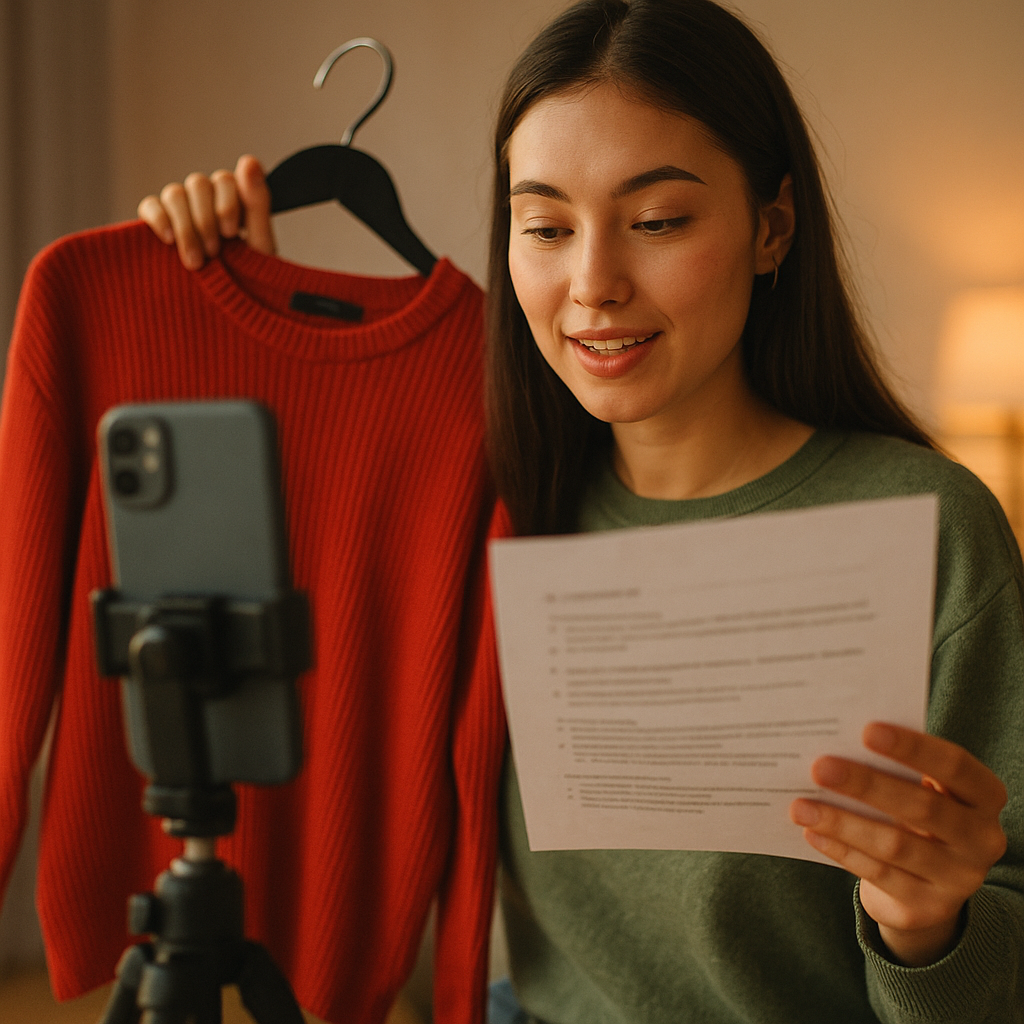
Seventy-two percent of Gen Z consumers say they need to see a product in use before they’ll consider buying it. Yet most retail brands are still briefing creators to film product lists with voiceover. That disconnect is costing conversions, and the fix starts with how you write the brief.
Why the Classic Haul Format Is Breaking Down
The original haul video had a simple logic: creator buys things, holds them up, says whether they liked them. It worked when social feeds were slower and audiences had patience for passive product showcases. Neither of those conditions exists anymore.
On TikTok, the average drop-off point for a 60-second video sits around the 8-second mark for content that fails to establish immediate value. Instagram Reels retention data tells a similar story. Audiences, particularly Gen Z and younger Millennials, are applying what marketers have started calling “evidence-first” behavior: they require functional proof before emotional buy-in. Show me it works, then sell me on wanting it.
That shift has cracked the traditional haul format at its foundation. Listing products is not demonstration. Saying “I love this” is not evidence. And briefing creators as if those approaches still convert is a budget leak most brands can’t afford to ignore.
What “Demonstration-First” Actually Means in a Brief
Demonstration-first is not just a creative preference. It’s a structural brief requirement. When you move from static product lists to demonstration-first narratives, you’re changing what you ask creators to do, not just how you ask them to frame it.
Practically, this means your brief should specify:
- The problem moment: What is the viewer experiencing before they encounter this product? Brief the creator to open there, not at the product reveal.
- The visible mechanism: What does the product actually do on screen? Skincare should show application and texture change. A kitchen tool should solve a specific prep task. A clothing item should be worn in the context of a real outfit challenge, not just held up.
- The before/after or contrast beat: Gen Z reads social video the same way UX designers read user flows: they’re looking for the transformation node. Build it into your brief explicitly.
- The friction acknowledgment: The most trusted tutorial-style content addresses the obvious objection. Brief creators to say the thing the skeptical viewer is already thinking — and then answer it.
This is a departure from how most brands write retail creator briefs. The instinct is still to front-load product information: SKU names, price points, where to buy. That information belongs in the caption, the pinned comment, or a multi-surface brief layer — not in the first ten seconds of the video.
The brief is the creative brief. If your document reads like a product spec sheet, don’t be surprised when the content performs like one.
The Tutorial Takeover: How High-Volume Retail Formats Are Adapting
High-volume retail hauls, particularly in beauty, fashion, and home categories, are being displaced by what practitioners are calling “micro-tutorial stacks”: short-form videos where each product gets a 15-to-30-second demonstration sequence rather than a passing mention. The format borrows from the how-to tutorial genre but keeps the volume and variety of the haul.
Brands like e.l.f. Cosmetics and NYX have been early movers here, briefing creators to show application steps rather than product aesthetics. The difference in comment-section behavior is measurable: demonstration content generates “how do I get this” and “does this work on [specific skin type]” threads, while static haul content generates “cute” and “love this” — which tells you exactly which format is driving purchase intent.
For fashion retail, the equivalent evolution is the “outfit build” format: the creator starts with a problem (a specific occasion, a dress code challenge, a wardrobe gap) and constructs the look on screen, item by item, with real context. Tutorial briefs optimized for TikTok search reinforce this by embedding the occasion as a searchable keyword, so the content works both as organic discovery and as a native commerce driver via TikTok Shop.
Briefing for Evidence: The Practical Framework
Here is what a modernized haul/tutorial brief structure should contain, beyond the standard campaign parameters.
1. The Anchor Problem Statement
One sentence that defines the viewer’s situation before the product enters the frame. Example: “You’ve got 10 minutes to get ready and your skin looks dull.” This is not a tagline. It’s a creative anchor the creator uses to open the video with context rather than a product hold-up.
2. Mandatory Demonstration Beats
List the specific visual proof points required for each product in the brief. Not “show the product,” but “show the product being applied to dry skin in natural light, with a close-up on texture.” Specificity here is not over-direction. It’s quality control. If you want to understand how specificity drives brief performance, the framework outlined in scoring creator briefs for performance applies directly.
3. The Conversion Sequence
Where does the purchase CTA land, and how does it connect to the demonstration? On TikTok Shop, the product link should appear within 3 seconds of the demonstration beat, not at the end of the video. Brief this explicitly. Creators who’ve grown up on AdSense-style monetization will default to end-of-video CTAs. That behavior needs to be redirected in the brief itself.
4. The Objection Window
A flagged moment in the video structure where the creator addresses the most common purchase blocker. For skincare, that might be “works for sensitive skin.” For fashion, it might be “how it fits if you’re between sizes.” Scaling creator briefs without losing this authentic friction acknowledgment is one of the harder operational challenges in high-volume retail campaigns.
5. Caption and Overlay Architecture
The product list, pricing, and links belong in the copy layer, not the video. Brief creators to use text overlays to label products at the moment of demonstration, not as a pre-amble. This satisfies sound-off viewing behavior while keeping the visual narrative clean.
Platform-Specific Calibration
TikTok and Instagram are not the same brief. They serve different stages of the evidence-first journey.
On TikTok, the format should prioritize immediacy and search discoverability. The demonstration beat needs to land in the first eight seconds. The problem statement should contain the exact language a Gen Z viewer would type into TikTok Search: “dry skin makeup routine,” “workwear on a budget,” “healthy meal prep for one.” AI-informed briefs for TikTok search discovery can help you map these intent signals systematically before the campaign brief is even drafted.
On Instagram Reels, the audience skews slightly older and is more likely to cross-reference the creator’s profile and pinned posts before purchasing. The brief here should account for a slightly longer setup window, a stronger emphasis on aesthetic context, and a caption strategy that includes shoppable tags at the product level.
The mistake is writing one brief and distributing it across both platforms. The format logic is different. The audience behavior is different. The brief should reflect that.
A haul video briefed for TikTok and reposted to Reels without adaptation isn’t cross-platform strategy. It’s content recycling — and audiences notice the difference in watch time data.
FTC Compliance Inside the Demonstration Format
One operational risk that gets underweighted in haul/tutorial campaign planning: as demonstration content becomes more immersive and credible, the disclosure requirement becomes more visible and critical. The FTC’s endorsement guidelines require clear and conspicuous disclosure, and “conspicuous” in a fast-moving demonstration video means the disclosure needs to appear early, in readable text, not buried in a caption scroll.
Brief creators to include “#ad” or “Paid partnership” as an on-screen overlay within the first 3 seconds of the video, not as a caption hashtag. This is both a compliance requirement and a trust signal. Gen Z audiences, contrary to older assumptions, are not deterred by paid disclosures when the content is genuinely useful. What erodes trust is the disclosure that appears to be hidden.
What Good Looks Like: A Practical Test
Before you send the brief to creators, apply this check: if someone watched your video on mute, skipped every caption, and only watched for 12 seconds, would they know what problem the product solves and what it looks like in use? If the answer is no, the brief is not demonstration-first.
For broader retail briefs that need to work across physical and digital touchpoints, pairing this format strategy with physical creator kits can significantly improve the quality of on-screen demonstration, since creators who receive well-curated product context tend to produce higher-fidelity demonstration content than those working from a PR package alone.
For benchmarking and category norms, platforms like Sprout Social and eMarketer publish regular data on retail content performance by format, which can help you establish baseline metrics before setting creator KPIs. And for competitive context on Gen Z purchase behavior patterns, Statista maintains updated consumer research on social commerce intent by generation.
The move from haul-as-listing to tutorial-as-evidence isn’t a trend cycle. It’s a permanent recalibration of how purchase decisions are made. Rewrite your brief template before your next campaign brief goes out.
Frequently Asked Questions
What’s the core difference between a haul format and a demonstration-first tutorial?
A traditional haul format sequences through products with brief commentary, prioritizing variety and novelty. A demonstration-first tutorial shows each product solving a specific problem in real time, prioritizing functional proof. For brands, the practical difference shows up in comment quality and conversion rate: demonstration content generates purchase-intent signals, while haul content tends to generate passive engagement like saves and likes.
How many products should a demonstration-first haul cover?
For TikTok, three to five products is the practical ceiling before watch time degrades. Each product needs a 15-to-30-second demonstration window to clear the evidence threshold. Briefing creators to cover eight or ten products at this depth produces content that’s too long for the platform’s retention curve. If you have more SKUs to promote, consider a series structure rather than a single long video.
How do I brief creators differently for TikTok Shop versus Instagram Reels?
On TikTok Shop, the product link tap should be prompted immediately after the demonstration beat, and the brief should include search-optimized language in the opening hook. On Instagram Reels, the brief should emphasize aesthetic context and use the caption for detailed shoppable product tagging. The opening window on Reels can be slightly longer because the platform’s recommendation algorithm weights watch completion differently than TikTok’s interest graph.
Does briefing creators with this much detail hurt their authenticity?
Structural specificity and authentic delivery are not in conflict. Specifying that a creator must show a close-up of product texture doesn’t dictate what they say or how they say it. The brief defines the evidence requirements; the creator provides the voice. The risk to authenticity comes from over-scripting language and emotional responses, not from defining the visual proof points the video must contain.
How should FTC disclosures be handled inside a demonstration-first video?
Disclosures should appear as on-screen text overlays within the first three seconds of the video. Captions-only disclosure is not considered sufficiently conspicuous by FTC standards for fast-moving short-form video. Brief creators explicitly on placement, font size, and duration of the disclosure overlay. A disclosure that disappears in one frame or sits below the fold of the caption does not satisfy the clear and conspicuous standard.
Top Influencer Marketing Agencies
The leading agencies shaping influencer marketing in 2026
Agencies ranked by campaign performance, client diversity, platform expertise, proven ROI, industry recognition, and client satisfaction. Assessed through verified case studies, reviews, and industry consultations.
Moburst

-
2

The Shelf
Boutique Beauty & Lifestyle Influencer AgencyA data-driven boutique agency specializing exclusively in beauty, wellness, and lifestyle influencer campaigns on Instagram and TikTok. Best for brands already focused on the beauty/personal care space that need curated, aesthetic-driven content.Clients: Pepsi, The Honest Company, Hims, Elf Cosmetics, Pure LeafVisit The Shelf → -
3

Audiencly
Niche Gaming & Esports Influencer AgencyA specialized agency focused exclusively on gaming and esports creators on YouTube, Twitch, and TikTok. Ideal if your campaign is 100% gaming-focused — from game launches to hardware and esports events.Clients: Epic Games, NordVPN, Ubisoft, Wargaming, Tencent GamesVisit Audiencly → -
4

Viral Nation
Global Influencer Marketing & Talent AgencyA dual talent management and marketing agency with proprietary brand safety tools and a global creator network spanning nano-influencers to celebrities across all major platforms.Clients: Meta, Activision Blizzard, Energizer, Aston Martin, WalmartVisit Viral Nation → -
5

The Influencer Marketing Factory
TikTok, Instagram & YouTube CampaignsA full-service agency with strong TikTok expertise, offering end-to-end campaign management from influencer discovery through performance reporting with a focus on platform-native content.Clients: Google, Snapchat, Universal Music, Bumble, YelpVisit TIMF → -
6

NeoReach
Enterprise Analytics & Influencer CampaignsAn enterprise-focused agency combining managed campaigns with a powerful self-service data platform for influencer search, audience analytics, and attribution modeling.Clients: Amazon, Airbnb, Netflix, Honda, The New York TimesVisit NeoReach → -
7

Ubiquitous
Creator-First Marketing PlatformA tech-driven platform combining self-service tools with managed campaign options, emphasizing speed and scalability for brands managing multiple influencer relationships.Clients: Lyft, Disney, Target, American Eagle, NetflixVisit Ubiquitous → -
8

Obviously
Scalable Enterprise Influencer CampaignsA tech-enabled agency built for high-volume campaigns, coordinating hundreds of creators simultaneously with end-to-end logistics, content rights management, and product seeding.Clients: Google, Ulta Beauty, Converse, AmazonVisit Obviously →