


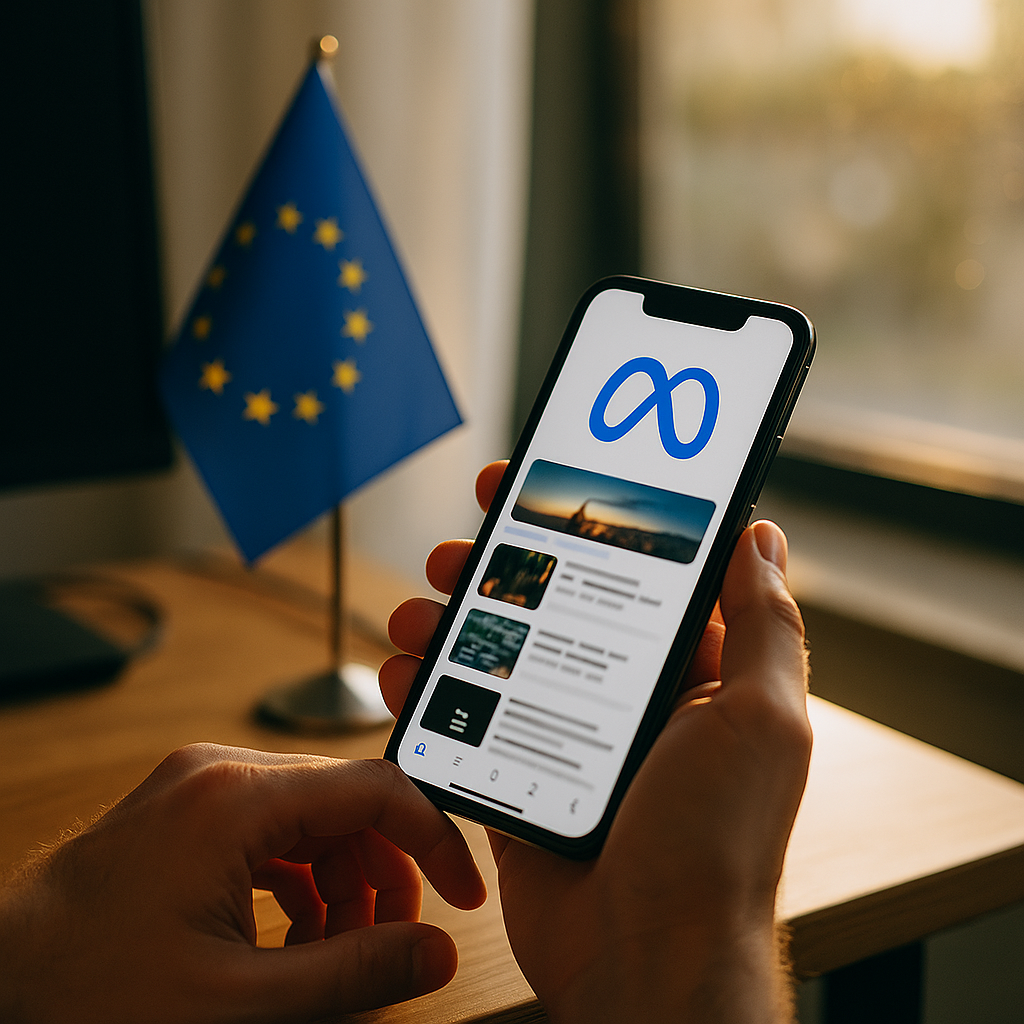
If Brussels gets its way, the endless feed you’ve built your entire content cadence around could carry a warning label by next year. The European Commission’s ongoing probe into Meta’s “addictive design” isn’t a fringe regulatory footnote — it’s a direct threat to the mechanics that make Instagram and Facebook effective media buys. EU pressure on Meta’s addictive design features is now serious enough that brands running always-on European campaigns need a contingency plan, not just a watching brief.
Why This Isn’t Just Another GDPR Headache
Regulators in Brussels have spent years chasing data privacy. This is different. The current scrutiny targets the behavioral architecture of the platforms themselves — autoplay video, infinite scroll, variable reward notifications, the stuff that keeps a fifteen-minute scroll session turning into ninety minutes. The European Commission has been examining whether these features breach the Digital Services Act’s provisions on protecting minors and preventing manipulative design, sometimes called “dark patterns.”
Meta already restructured teen accounts on Instagram in response to earlier pressure, adding default privacy settings and usage nudges. But the newer conversation goes further: some EU lawmakers and consumer groups want autoplay disabled by default for all users, not just minors, and want infinite scroll replaced with paginated or “load more” interactions that require deliberate action.
That would change engagement math for every brand advertising on the platform.
A feed that requires a tap instead of a swipe isn’t a cosmetic change — it’s a fundamental rewrite of how much inventory exists to sell, and how long users stay inside it.
The Compliance Pressure Stack, Not Just One Law
It helps to see this as one layer in a stack, not an isolated fight. The DSA already forces large platforms to conduct systemic risk assessments covering addictive design and mental health impacts. The EU’s proposed Digital Fairness Act, still moving through consultation, explicitly names infinite scroll and autoplay as candidate targets for restriction. Meanwhile, individual member states — France in particular — have shown appetite for going further than EU baseline requirements, similar to how France moved independently on fast fashion affiliate compliance ahead of broader EU consensus.
Brands that have already built compliance muscle around the DSA, the UK’s Online Safety Act, or Australia’s eSafety regime (see our breakdown of APAC compliance requirements) will recognize the pattern: regulation arrives in waves, and the brands caught flat-footed are the ones that treated the first wave as the last one.
What Meta Has Already Conceded
Worth noting: Meta hasn’t been purely defiant. The company has rolled out “Quiet Mode,” expanded parental supervision tools, and default time-limit reminders for teen users in the EU. These are real concessions, not just PR. But they’re scoped narrowly to minors. The bigger fight — whether adult engagement features get regulated as inherently manipulative — is unresolved, and that’s the scenario brands need to plan around.
Scenario One: Default Autoplay Gets Switched Off
Picture this: the Commission finalizes guidance requiring autoplay-off as the EU default setting, with users required to opt in. What happens to your video completion rates?
- Reach drops for passive video formats. Reels and in-feed video that currently benefit from momentum-driven views would see immediate declines in impressions, because fewer users would be swept into content they didn’t actively choose.
- Thumbnail and hook quality becomes existential. If users must tap to start a video, the first frame and caption do all the work that autoplay currently does for free.
- Budget reallocation toward static and carousel formats. Expect media planners to hedge by shifting spend toward formats less dependent on momentum, at least until performance data on the new mechanics stabilizes.
This isn’t hypothetical panic. eMarketer’s ad spend forecasting already flags video as the fastest-growing format in EU social budgets — a regulatory shock to autoplay would ripple through planning assumptions built on current completion-rate benchmarks.
Scenario Two: Infinite Scroll Gets Paginated
This is the more disruptive scenario, and arguably the one regulators are more serious about. If feeds require a “load more” tap every 10-15 posts, average session length falls — and so does the number of ad impressions available per user, per day.
For brands running frequency-dependent campaigns (retargeting sequences, sequential storytelling ads), this changes the shape of the funnel. Fewer natural scroll cycles mean fewer opportunities to serve the second or third ad in a sequence within a single session. Expect:
- CPMs to rise as available inventory per session shrinks.
- Greater reliance on Stories and DMs as alternative always-on surfaces.
- Renewed brand interest in owned channels — email, SMS, loyalty apps — as insurance against feed volatility.
Sprout Social’s engagement benchmarking (see Sprout Social’s platform data) already shows session-length variance across platforms; a regulatory cap on scroll depth would introduce a new, EU-specific variable that global campaigns haven’t had to model before.
Scenario Three: A Patchwork, Not a Single Rule
The messiest — and honestly most probable — outcome is fragmentation. The EU sets a baseline, France or Germany layers on stricter national rules, and Meta ends up running different default settings by member state. Brands with pan-European campaigns would need to:
- Segment creative and bidding strategy by country, not just language.
- Build compliance documentation showing awareness of jurisdiction-specific defaults, similar to how brands now track TikTok’s GDPR obligations on a market-by-market basis.
- Coordinate with legal and media teams earlier in the campaign planning cycle to avoid last-minute creative pivots.
A patchwork regime rewards brands that already run modular, market-adaptable creative. It punishes brands still running one-size-fits-all EU campaigns built off a single UK or German template.
What Brand Teams Should Actually Do Now
Waiting for final legislative text is a losing strategy. Regulatory timelines are slow; platform product changes in response to proposed rules often move faster, because Meta would rather ship a compliant default than risk a fine. Here’s a practical checklist:
- Audit your funnel’s dependency on session length. If your EU campaigns lean heavily on multi-touch sequential ads within a single scroll session, model what happens if average session time drops 20-30%.
- Diversify format mix now, not later. Static, carousel, and Stories formats are less exposed to autoplay/scroll rule changes than pure video-in-feed placements.
- Build a first-party data bridge. Owned audiences don’t care whether Meta’s feed is infinite or paginated. This is the same logic driving brands toward direct creator relationships — see our guide on direct creator partnership contracts as a hedge against platform-level disruption.
- Loop compliance into media planning, not just legal review. The brands handling AI disclosure well — see our audit guide on Meta’s AI disclosure requirements — succeeded because compliance sat inside the planning process, not bolted on afterward.
- Track Meta’s own regulatory disclosures. Meta for Business publishes policy updates well ahead of enforcement dates; subscribing to these directly beats relying on secondhand trade coverage.
Brands that model a 20-30% session-length drop now will price and plan far better than those who wait for the Commission’s final ruling to start reacting.
Will This Spread Beyond Meta?
Almost certainly. TikTok’s feed mechanics are arguably more “addictive” by design than Instagram’s, and EU regulators know it. The Commission has already opened parallel inquiries touching TikTok’s recommendation systems. If Meta is forced to change defaults, expect TikTok, Snapchat, and even YouTube Shorts to face copycat scrutiny within the same regulatory cycle. Brands treating this as a Meta-only problem are underestimating how fast DSA precedent gets applied across platforms.
This also connects to the platform accountability conversation already playing out around AI content labeling. If you’ve built compliance workflows around TikTok’s AI label rules, you already have the internal muscle memory for platform-specific EU compliance shifts — apply the same rigor here.
FAQs
Frequently Asked Questions
What exactly does the EU mean by “addictive design” features?
It refers to interface mechanics engineered to maximize time-on-platform — autoplay video, infinite scroll, variable-ratio notifications, and streak mechanics. EU regulators, under the Digital Services Act and the proposed Digital Fairness Act, classify these as potentially manipulative “dark patterns” when they exploit psychological triggers rather than serve genuine user choice.
Has Meta already made changes because of this pressure?
Yes, though mostly scoped to teen accounts. Meta introduced Quiet Mode, default time-limit reminders, and stricter parental supervision tools for under-18 users in the EU. Broader changes affecting all adult users — like default-off autoplay — have not been finalized but remain under active discussion.
How would autoplay restrictions affect video ad performance?
If autoplay defaults to off, video completion and impression volume would likely drop because passive, momentum-driven views disappear. Brands would need stronger opening hooks and thumbnails to earn the tap-to-play action that autoplay currently provides automatically.
Should brands pause EU video campaigns until rules are finalized?
No. Pausing wastes time better spent preparing. Diversify format mix, strengthen first-party data capture, and build creative that performs well with or without autoplay. Waiting for final legislative text means reacting after competitors have already adjusted.
Will restrictions apply uniformly across all EU member states?
Probably not immediately. Expect a baseline EU standard with individual countries, particularly France and Germany, layering stricter national requirements — similar to the fragmented pattern already seen in fast fashion and creator disclosure regulation across the bloc.
Does this affect influencer and creator content, or just paid ads?
Both. Organic creator content distributed through algorithmic, autoplay-driven feeds benefits from the same mechanics regulators are targeting. If discovery surfaces change, creator partnership strategies and content formats will need to adapt alongside paid media plans.
The brands that treat this as a media-planning exercise today, not a legal footnote for later, will be the ones still hitting reach targets when the Commission’s ruling finally lands. Start the format-diversification audit this quarter, not after enforcement begins.
Top Influencer Marketing Agencies
The leading agencies shaping influencer marketing in 2026
Agencies ranked by campaign performance, client diversity, platform expertise, proven ROI, industry recognition, and client satisfaction. Assessed through verified case studies, reviews, and industry consultations.
Moburst

-
2

The Shelf
Boutique Beauty & Lifestyle Influencer AgencyA data-driven boutique agency specializing exclusively in beauty, wellness, and lifestyle influencer campaigns on Instagram and TikTok. Best for brands already focused on the beauty/personal care space that need curated, aesthetic-driven content.Clients: Pepsi, The Honest Company, Hims, Elf Cosmetics, Pure LeafVisit The Shelf → -
3

Audiencly
Niche Gaming & Esports Influencer AgencyA specialized agency focused exclusively on gaming and esports creators on YouTube, Twitch, and TikTok. Ideal if your campaign is 100% gaming-focused — from game launches to hardware and esports events.Clients: Epic Games, NordVPN, Ubisoft, Wargaming, Tencent GamesVisit Audiencly → -
4

Viral Nation
Global Influencer Marketing & Talent AgencyA dual talent management and marketing agency with proprietary brand safety tools and a global creator network spanning nano-influencers to celebrities across all major platforms.Clients: Meta, Activision Blizzard, Energizer, Aston Martin, WalmartVisit Viral Nation → -
5

The Influencer Marketing Factory
TikTok, Instagram & YouTube CampaignsA full-service agency with strong TikTok expertise, offering end-to-end campaign management from influencer discovery through performance reporting with a focus on platform-native content.Clients: Google, Snapchat, Universal Music, Bumble, YelpVisit TIMF → -
6

NeoReach
Enterprise Analytics & Influencer CampaignsAn enterprise-focused agency combining managed campaigns with a powerful self-service data platform for influencer search, audience analytics, and attribution modeling.Clients: Amazon, Airbnb, Netflix, Honda, The New York TimesVisit NeoReach → -
7

Ubiquitous
Creator-First Marketing PlatformA tech-driven platform combining self-service tools with managed campaign options, emphasizing speed and scalability for brands managing multiple influencer relationships.Clients: Lyft, Disney, Target, American Eagle, NetflixVisit Ubiquitous → -
8

Obviously
Scalable Enterprise Influencer CampaignsA tech-enabled agency built for high-volume campaigns, coordinating hundreds of creators simultaneously with end-to-end logistics, content rights management, and product seeding.Clients: Google, Ulta Beauty, Converse, AmazonVisit Obviously →