


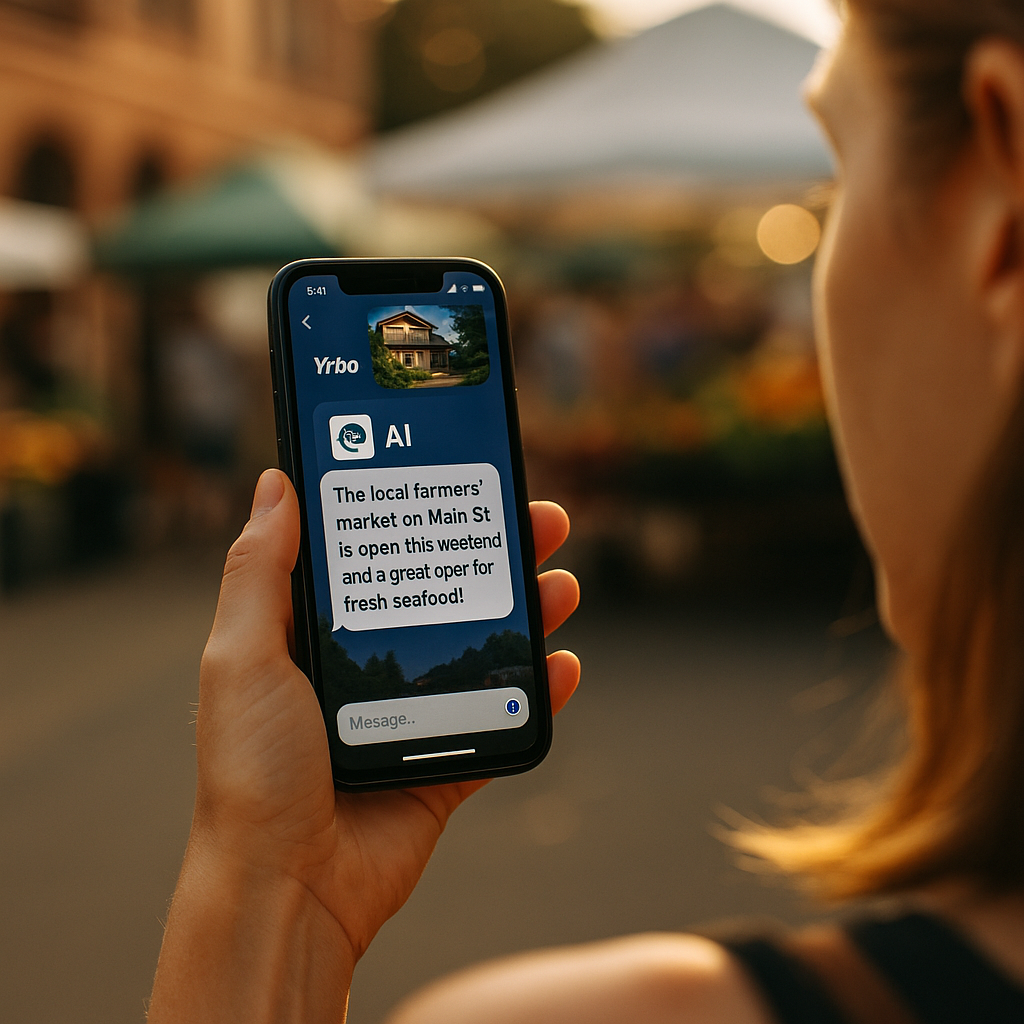
One listing photo. Twenty-five thousand destinations. Zero manual production hours. That’s the arithmetic Vrbo bet on when it rebuilt its marketing engine around AI-driven local messaging, and the results are forcing brand teams everywhere to rethink what “creative at scale” actually means. If you’re still hand-building campaigns city by city, this Vrbo AI-driven local messaging case study should make you uncomfortable.
Why Vrbo Needed a New Playbook
Vrbo competes in a brutal space. Airbnb owns the cultural narrative around short-term rentals, Booking.com owns the ad budget, and regional players undercut both on price in specific markets. Vrbo’s differentiator has always been whole-home rentals for families and groups — but that message doesn’t land the same way in a ski town in Colorado as it does in a beach community in Florida or a lake house market in Michigan.
Traditional marketing would solve this with regional agencies, localized shoots, and market-by-market media plans. Expensive. Slow. Nearly impossible to update in real time when demand shifts or a competitor drops pricing. Vrbo’s marketing team, working with Expedia Group’s internal data and media capabilities, decided the old model couldn’t keep pace with how fragmented travel search had become.
So they leaned into generative AI and dynamic creative optimization to produce locally relevant ad variants at a volume no human team could match manually. The goal wasn’t novelty. It was relevance, delivered faster and cheaper than the old localization model allowed.
What “AI-Driven Local Messaging” Actually Means Here
Strip away the buzzwords and the mechanics are straightforward. Vrbo combined first-party booking data, destination-level search trends, and creative templates, then used AI tools to auto-generate thousands of ad variations tailored to specific locations, traveler intents, and even seasonal triggers.
- Dynamic copy generation: Headlines and body copy referencing specific destinations, property types, and trip occasions (family reunions, ski weekends, lake trips) generated programmatically instead of written one-by-one.
- Visual personalization: Creative assets swapped or adapted based on destination imagery, seasonality, and device context.
- Signal-based targeting: Messaging tied to real search and booking signals rather than static personas built months earlier.
- Rapid iteration: Creative refreshed on a cadence closer to weeks than quarters, allowing the brand to react to shifting demand.
This isn’t the same as slapping a city name into a template — that trick is old and audiences see through it instantly. The Vrbo approach paired AI-generated variation with a strong underlying data layer, so the message actually reflected what travelers in that market were searching for.
The shift isn’t from “no personalization” to “personalization.” It’s from personalization as a manual, quarterly project to personalization as a continuous, automated system.
The Business Case: Why Brands Should Care
Marketing leaders don’t fund AI experiments for the sake of innovation theater. They fund them when the math works. Here’s where the math works for Vrbo, and where it likely works for any brand managing multi-market or multi-SKU campaigns.
Production cost collapse. Traditional localized campaigns require separate creative builds per market — copywriters, designers, sometimes local photography. AI-assisted generation compresses that into a templated system with human oversight, not human authorship of every variant. That’s a direct line-item reduction in production spend, not just a productivity anecdote.
Speed to market. When a destination sees a sudden demand spike (a wildfire closes one region, travelers pivot to another; a viral TikTok puts a small town on the map), brands with static creative calendars miss the window. AI-driven systems can spin up relevant messaging in days.
Media efficiency. More relevant ads typically mean better quality scores and lower cost-per-click across platforms like TikTok Ads and Meta’s ad ecosystem, since relevance is baked directly into ranking algorithms. Generic creative gets penalized by the auction; hyper-relevant creative gets rewarded.
According to eMarketer, marketers increasingly cite creative production speed and personalization as top priorities for AI adoption in advertising — not just cost-cutting. Vrbo’s approach sits squarely at that intersection.
Where Creator Content Fits Into the Model
Here’s the part brand strategists should pay closest attention to. AI-generated ad copy and dynamic creative solve the paid media problem. They don’t solve the trust problem. Travelers researching a destination still want to see real people, real trips, real proof that a property delivers what the listing promises.
That’s where creator partnerships become the connective tissue. Vrbo has increasingly paired its AI-driven paid creative with destination-specific creator content — travel creators documenting actual stays in specific markets, which then feeds back into the data loop informing what messaging resonates. It’s a flywheel: creator content generates authentic destination signal, AI systems analyze what’s working, and paid creative gets sharper as a result.
This mirrors a pattern showing up across other travel and DTC marketers. Destination marketing organizations have been building tiered creator programs specifically to generate localized, authentic content at volume — a strategy explored in depth in this tourism creator ROI breakdown. The lesson is consistent: AI can scale distribution and messaging, but it still needs a steady supply of real, trustworthy content to personalize around.
Brands treating AI creative and creator content as separate budget lines are missing the point. They’re the same system now.
The Risk Side Nobody Talks About Enough
Scale amplifies mistakes as fast as it amplifies wins. A few risk vectors brand teams need to plan for before copying this playbook:
- Factual accuracy at volume. AI-generated copy referencing thousands of destinations creates real risk of hallucinated details — wrong amenities, incorrect distances, outdated pricing. Human QA checkpoints are non-negotiable, not optional.
- Brand voice drift. When creative is generated programmatically across thousands of variants, tone can degrade or feel robotic without strong prompt engineering and style guardrails.
- Authenticity backlash. Travel is an emotional, high-trust category. If audiences sense AI is faking a personal connection to their destination, trust erodes fast. The authenticity risk lesson from a recent AI-driven beer campaign backlash is a useful cautionary reference for any brand leaning hard into automated creative.
- Regulatory exposure. Localized claims about pricing, availability, and property features fall under standard advertising disclosure rules. The FTC doesn’t care whether a human or an algorithm wrote the misleading claim — the liability sits with the brand either way.
Vrbo’s advantage here is data depth. Because messaging is grounded in real booking and search signals rather than pure generative guesswork, the risk of hallucinated or tone-deaf output is lower than for brands trying this without a comparable data foundation. That’s an important caveat for anyone tempted to copy the model without the underlying data infrastructure to support it.
Operational Lessons for Marketing Teams Building This Now
Most brands don’t have Expedia Group’s data assets. But the operational structure behind this approach is replicable at smaller scale. A few practical takeaways:
- Start with a data layer, not a creative tool. AI-generated personalization is only as good as the signal feeding it. Search trends, first-party purchase data, and regional demand patterns should come before you touch a generative copy tool.
- Template the brand voice first. Build strict style guides and prompt frameworks before scaling output. Guardrails prevent drift; they don’t need to be built after the fact.
- Keep a human review layer at volume. Spot-check a statistically meaningful sample of generated variants before launch, and continue sampling post-launch. This is quality control, not bureaucracy.
- Pair automation with authentic proof. AI creative needs real content behind it. Creator partnerships, UGC, and reviews should feed the system, not sit outside it.
- Measure relevance, not just volume. More ad variants isn’t automatically better. Track engagement and conversion by variant cluster to confirm personalization is actually improving performance, not just multiplying output.
Marketing teams exploring similar AI-driven attribution and personalization models should also look at how CRM-level data feeds creative decisions — the approach detailed in this AI CRM attribution playbook offers a parallel framework for connecting data signal to creative output, even outside travel.
It’s also worth studying how other category leaders have paired AI tooling with content strategy for search visibility, as covered in this look at AI visibility and creator strategy — the underlying discipline of aligning automated systems with authentic content applies well beyond retail.
What This Signals for the Next Wave of Travel Marketing
Vrbo isn’t the only travel brand racing toward this model, but it’s one of the clearest public examples of AI-driven localization done with real data discipline behind it. Expect competitors to follow, and expect the bar for “personalized” creative to rise fast. Generic geo-tagged ads won’t read as personalized anymore — they’ll read as lazy.
The brands that win this next phase won’t be the ones with the flashiest AI tools. They’ll be the ones with the cleanest data pipelines, the tightest brand guardrails, and the discipline to keep human judgment in the loop at scale. Tools from platforms like HubSpot and analytics providers tracked by Statista increasingly show marketers investing heavily in exactly this kind of infrastructure, not just generative novelty.
Frequently Asked Questions
What is AI-driven local messaging in marketing?
It’s the use of AI tools combined with location-specific data to automatically generate advertising copy, imagery, and offers tailored to individual markets or destinations, rather than relying on generic, one-size-fits-all creative across all regions.
How did Vrbo use AI for creative production?
Vrbo combined first-party booking and search data with generative AI tools to produce thousands of localized ad variants, adjusting copy, imagery, and messaging based on destination, seasonality, and traveler intent, rather than building separate campaigns manually for each market.
Does AI-generated creative hurt brand authenticity?
It can, if used without safeguards. Audiences respond negatively to creative that feels robotic or fake, particularly in trust-driven categories like travel. Brands mitigate this by pairing AI-driven messaging with authentic creator content and human review of tone and accuracy.
What data do brands need before attempting this approach?
A strong first-party data foundation is essential: search behavior, booking or purchase history, regional demand signals, and customer feedback. Without this layer, AI-generated personalization risks becoming generic or, worse, factually inaccurate.
Is this approach only relevant for travel brands?
No. Any brand operating across multiple markets, regions, or product lines can apply the same principles: data-driven creative generation, strict brand guardrails, and human quality control at scale.
Next step: before greenlighting an AI creative-at-scale initiative, audit your first-party data infrastructure first. The tooling is the easy part; the data foundation is what determines whether personalization feels relevant or reads as noise.
Frequently Asked Questions
What is AI-driven local messaging in marketing?
It’s the use of AI tools combined with location-specific data to automatically generate advertising copy, imagery, and offers tailored to individual markets or destinations, rather than relying on generic, one-size-fits-all creative across all regions.
How did Vrbo use AI for creative production?
Vrbo combined first-party booking and search data with generative AI tools to produce thousands of localized ad variants, adjusting copy, imagery, and messaging based on destination, seasonality, and traveler intent, rather than building separate campaigns manually for each market.
Does AI-generated creative hurt brand authenticity?
It can, if used without safeguards. Audiences respond negatively to creative that feels robotic or fake, particularly in trust-driven categories like travel. Brands mitigate this by pairing AI-driven messaging with authentic creator content and human review of tone and accuracy.
What data do brands need before attempting this approach?
A strong first-party data foundation is essential: search behavior, booking or purchase history, regional demand signals, and customer feedback. Without this layer, AI-generated personalization risks becoming generic or, worse, factually inaccurate.
Is this approach only relevant for travel brands?
No. Any brand operating across multiple markets, regions, or product lines can apply the same principles: data-driven creative generation, strict brand guardrails, and human quality control at scale.
Top Influencer Marketing Agencies
The leading agencies shaping influencer marketing in 2026
Agencies ranked by campaign performance, client diversity, platform expertise, proven ROI, industry recognition, and client satisfaction. Assessed through verified case studies, reviews, and industry consultations.
Moburst

-
2

The Shelf
Boutique Beauty & Lifestyle Influencer AgencyA data-driven boutique agency specializing exclusively in beauty, wellness, and lifestyle influencer campaigns on Instagram and TikTok. Best for brands already focused on the beauty/personal care space that need curated, aesthetic-driven content.Clients: Pepsi, The Honest Company, Hims, Elf Cosmetics, Pure LeafVisit The Shelf → -
3

Audiencly
Niche Gaming & Esports Influencer AgencyA specialized agency focused exclusively on gaming and esports creators on YouTube, Twitch, and TikTok. Ideal if your campaign is 100% gaming-focused — from game launches to hardware and esports events.Clients: Epic Games, NordVPN, Ubisoft, Wargaming, Tencent GamesVisit Audiencly → -
4

Viral Nation
Global Influencer Marketing & Talent AgencyA dual talent management and marketing agency with proprietary brand safety tools and a global creator network spanning nano-influencers to celebrities across all major platforms.Clients: Meta, Activision Blizzard, Energizer, Aston Martin, WalmartVisit Viral Nation → -
5

The Influencer Marketing Factory
TikTok, Instagram & YouTube CampaignsA full-service agency with strong TikTok expertise, offering end-to-end campaign management from influencer discovery through performance reporting with a focus on platform-native content.Clients: Google, Snapchat, Universal Music, Bumble, YelpVisit TIMF → -
6

NeoReach
Enterprise Analytics & Influencer CampaignsAn enterprise-focused agency combining managed campaigns with a powerful self-service data platform for influencer search, audience analytics, and attribution modeling.Clients: Amazon, Airbnb, Netflix, Honda, The New York TimesVisit NeoReach → -
7

Ubiquitous
Creator-First Marketing PlatformA tech-driven platform combining self-service tools with managed campaign options, emphasizing speed and scalability for brands managing multiple influencer relationships.Clients: Lyft, Disney, Target, American Eagle, NetflixVisit Ubiquitous → -
8

Obviously
Scalable Enterprise Influencer CampaignsA tech-enabled agency built for high-volume campaigns, coordinating hundreds of creators simultaneously with end-to-end logistics, content rights management, and product seeding.Clients: Google, Ulta Beauty, Converse, AmazonVisit Obviously →