


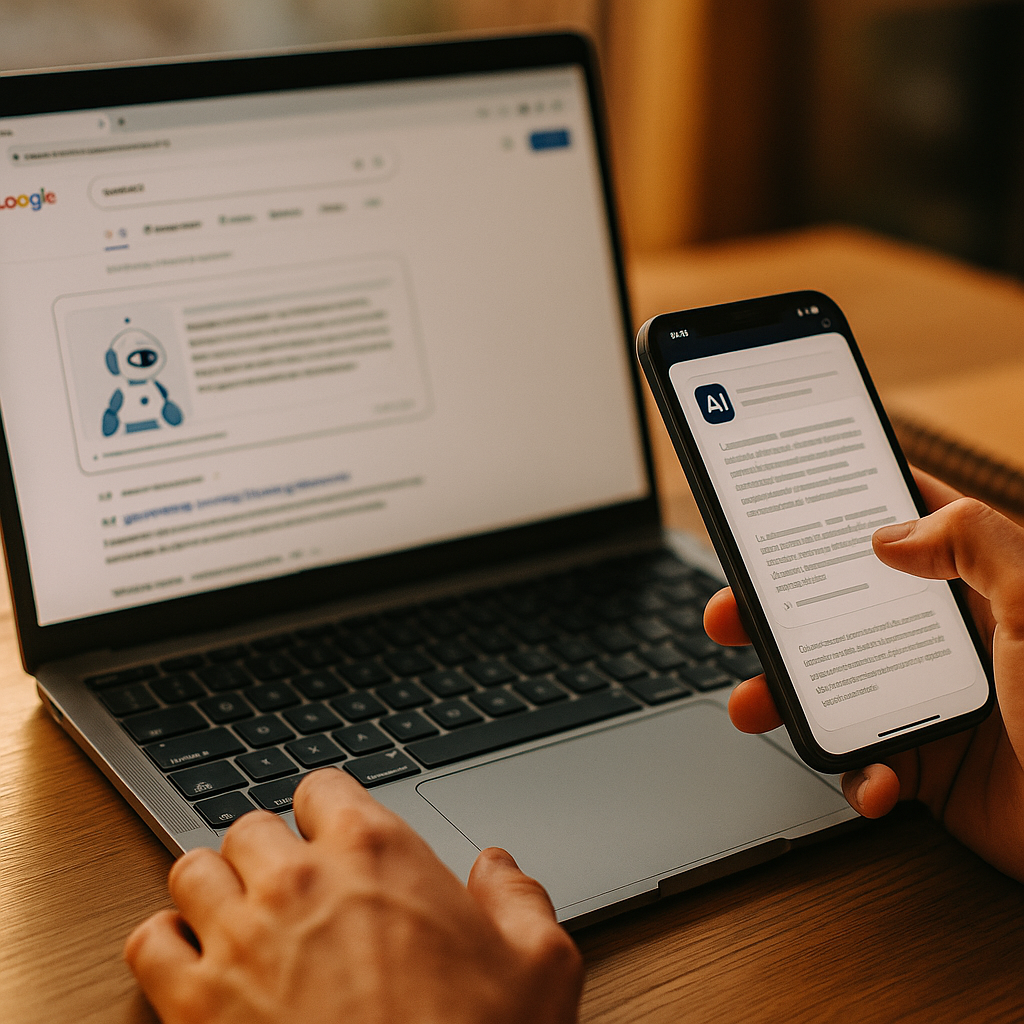
Google now answers roughly six in ten queries without a single click to a website, according to eMarketer’s latest search behavior estimates. If your SEO playbook still treats rankings as the finish line, you’re optimizing for a race that’s already changed shape. Generative search marketing isn’t replacing classic SEO in 2026 — it’s forcing a merger, and Google’s newest AI search guidance is the closest thing to a rulebook we’ve gotten yet.
This piece breaks down what that guidance actually says, where it overlaps with old-school SEO fundamentals, and how brand teams should restructure content operations to win visibility in both blue links and AI overviews.
What Google’s Guidance Actually Changed
Google’s updated documentation for AI Overviews and AI Mode consolidates a handful of signals it had previously scattered across separate help pages. The headline shift: Google now explicitly states that content structured for “clear, self-contained answers” performs better across both traditional search and generative surfaces. That’s not a subtle nudge. It’s an admission that the ranking systems feeding classic search and the retrieval systems feeding AI summaries are converging on shared quality signals.
Three things stand out in the updated guidance:
- Passage-level clarity now matters as much as page-level authority. Google’s systems extract discrete chunks of content to populate AI answers, meaning a buried paragraph can outperform a beautifully optimized headline.
- Source attribution signals — author credentials, organizational backing, publication history — feed directly into whether content gets cited in AI-generated responses, not just whether it ranks.
- Structured data expectations have tightened. Schema markup isn’t decorative anymore; it’s functioning as a machine-readable trust layer.
None of this discards traditional SEO. It reframes it. Technical hygiene, backlinks, and keyword relevance still matter for crawlability and indexing. But they’re now table stakes for a game where the real prize is citation, not just ranking position.
Google isn’t asking you to abandon SEO fundamentals — it’s asking you to prove your content deserves to be quoted, not just crawled.
Why “Rank #1” Is No Longer the Right KPI
Here’s the uncomfortable truth for brand teams still reporting on position tracking: a page can rank first and generate zero AI citations. Conversely, a page ranking eighth can become the dominant source quoted in an AI Overview because it answered the query with more precision.
This is the operational blind spot most marketing teams have right now. Rank tracking tools weren’t built to monitor whether ChatGPT, Gemini, or Perplexity are citing your brand. That requires a different measurement layer entirely — one built around LLM brand tracking rather than SERP position.
If your dashboards still center exclusively on rankings and organic sessions, you’re missing the metric that increasingly determines whether prospects ever hear your brand name during their research phase. We covered this measurement gap in depth in our piece on zero-click AI attribution, and the pattern holds: brands still using last-click models are systematically undercounting AI-driven influence.
The Overlap Nobody Talks About
Here’s what’s genuinely underappreciated: the technical foundations of good SEO and good generative search marketing are nearly identical. Fast page loads, clean HTML, logical heading hierarchy, internal linking that establishes topical relationships — these help both a Googlebot crawler and an LLM retrieval system understand your content.
The divergence happens at the content layer, not the technical layer. Classic SEO rewarded keyword density and comprehensive “ultimate guide” formats. Generative search rewards precision, extractability, and answer completeness within a tight scope. A 4,000-word pillar page stuffed with every conceivable subtopic might rank well historically, but it’s a poor candidate for AI extraction because the system can’t isolate a clean, quotable answer.
This is why brands rebuilding their content strategy around rebuilding brand blogs for GEO are seeing faster citation gains than those simply publishing more volume. Depth still matters. But depth organized around distinct, self-contained answer units beats depth organized around comprehensive keyword coverage.
A Practical Framework: The Three-Layer Content Stack
Forget rewriting your entire content strategy from scratch. Most brands don’t have the budget or bandwidth for that, and honestly, they don’t need it. What works better is layering generative-search optimization onto existing SEO infrastructure. Three layers:
- Foundation layer (classic SEO): Technical crawlability, site speed, mobile performance, backlink profile, keyword-mapped page architecture. This hasn’t changed. Google Search Central still publishes the baseline technical requirements, and ignoring them tanks visibility in both search environments.
- Extraction layer (GEO-specific): Restructuring key passages so they function as standalone answers. Think definition boxes, numbered steps, direct-answer opening sentences under each subheading. This is where most legacy content fails — it buries the answer three paragraphs deep in narrative setup.
- Trust layer (EEAT signals): Author bios with verifiable credentials, organizational schema, citations to primary sources, transparent methodology when reporting data. Google’s guidance increasingly treats this layer as a gating factor for AI citation eligibility, not just a ranking booster.
Brands that skip the trust layer are leaving citation opportunities on the table regardless of how well-structured their content is. We saw this play out clearly in the discussion around optimizing content for generative AI, where source credibility repeatedly outweighed pure content structure in citation frequency.
Machine Readability Is Now a Brand Safety Issue
Here’s a stat that should reframe how your team thinks about site infrastructure: bots now account for the majority of web traffic hitting most brand domains, and a growing share of that is AI crawlers indexing content for retrieval systems, not just search engines. We broke this down in detail in our machine-readability analysis, and the implication for brand teams is direct: if your CMS renders critical content via JavaScript that crawlers struggle to parse, you’re invisible to a growing share of the discovery layer, regardless of how good the writing is.
This isn’t hypothetical. Agencies running audits for enterprise clients are finding that content behind client-side rendering, paywalled excerpts, or aggressive bot-blocking rules is simply absent from AI Overview citations, even when it ranks well organically. Fix the technical access layer before investing more in content quality. It’s the cheaper problem and the one most likely to be silently costing you visibility right now.
Where Compliance and Attribution Risk Creep In
Marketing leaders evaluating generative search marketing tend to focus on visibility gains and skip the governance conversation. That’s a mistake. A few risk areas deserve explicit attention:
Attribution ambiguity. When AI Overviews summarize your content without a click-through, proving ROI to finance stakeholders gets harder. Build proxy metrics now — branded search lift, direct traffic increases, share-of-voice in AI answers — rather than waiting until a budget review forces the question.
Content licensing exposure. As AI platforms train on and retrieve from public web content, questions around usage rights and compensation remain unsettled in most jurisdictions. Keep an eye on regulatory movement through bodies like the FTC, particularly around disclosure requirements if your brand starts publishing AI-assisted content at scale.
Governance drift. Teams adopting agentic tools to auto-generate and auto-optimize content for AI retrieval need clear decision boundaries, similar to the governance checklists brands are already building for agentic media buying. The same discipline applies to agentic content optimization: define what the system can change autonomously versus what needs human sign-off.
Treat AI citation the way you’d treat a new distribution channel: measure it, govern it, and don’t assume the metrics that worked for organic search automatically transfer.
Building the Cross-Functional Workflow
The teams getting this right aren’t treating generative search marketing as a bolt-on SEO task. They’re building cross-functional workflows where content strategists, technical SEOs, and data teams collaborate on a shared visibility roadmap. That typically means:
- Weekly monitoring of AI citation frequency alongside traditional rank tracking, using tools that specifically flag when brand content appears in AI search workflows.
- Quarterly content audits that score existing pages against the extraction-layer criteria (standalone answers, clear headings, scannable structure) rather than just keyword coverage.
- A standing process for updating author bios and schema markup as EEAT signals, treated as ongoing maintenance rather than a one-time setup task.
- Shared reporting that gives CMOs visibility into both channels, following the model outlined in approaches to AI data foundations for CMO reporting.
This cross-functional model matters because generative search marketing sits at the intersection of content, technical SEO, and brand measurement — three functions that historically operated in separate silos with separate KPIs. Merging them isn’t optional anymore. It’s the operational requirement Google’s guidance is quietly forcing on every brand still treating search as a single-channel discipline.
FAQs
Frequently Asked Questions
What is generative search marketing, and how is it different from traditional SEO?
Generative search marketing focuses on optimizing content for citation within AI-generated answers (like Google’s AI Overviews, ChatGPT, or Perplexity), rather than solely for ranking position in traditional search results. Traditional SEO still matters as the technical foundation, but generative search marketing adds a layer focused on extractability, answer precision, and source trust signals.
Does ranking well in Google still matter if AI Overviews are becoming dominant?
Yes. Ranking well remains important because Google’s AI systems still draw heavily from indexed, well-ranked content when generating overviews. Ranking and citation aren’t mutually exclusive, but they’re no longer guaranteed to correlate, which is why brands need to track both metrics separately.
How can brands measure ROI from generative search marketing efforts?
Since AI Overviews often reduce click-throughs, brands should track proxy metrics like branded search volume lift, direct traffic increases, share-of-voice in AI-generated answers, and citation frequency across major AI platforms, alongside traditional organic traffic and conversion metrics.
What role does EEAT play in AI citation eligibility?
Google’s guidance increasingly treats Experience, Expertise, Authoritativeness, and Trustworthiness signals as gating factors for whether content gets cited in AI-generated responses, not just as ranking boosters. Author credentials, organizational transparency, and sourcing to primary data all strengthen citation eligibility.
Do we need separate content for AI search versus traditional search?
Not necessarily separate content, but restructured content. The same page can serve both purposes if it combines strong technical SEO fundamentals with clearly structured, self-contained answer sections that AI systems can easily extract and quote.
What’s the biggest technical mistake brands make with generative search optimization?
Relying on client-side rendering or JavaScript-heavy content delivery that AI crawlers struggle to parse. If crawlers can’t access your content cleanly, no amount of content quality improvement will help your citation visibility.
Next step: Audit your top twenty organic landing pages this quarter, score them against extraction-layer criteria, and fix the three or four with the highest traffic but weakest answer structure first. That’s where the fastest citation gains typically show up.
Frequently Asked Questions
What is generative search marketing, and how is it different from traditional SEO?
Generative search marketing focuses on optimizing content for citation within AI-generated answers (like Google’s AI Overviews, ChatGPT, or Perplexity), rather than solely for ranking position in traditional search results. Traditional SEO still matters as the technical foundation, but generative search marketing adds a layer focused on extractability, answer precision, and source trust signals.
Does ranking well in Google still matter if AI Overviews are becoming dominant?
Yes. Ranking well remains important because Google’s AI systems still draw heavily from indexed, well-ranked content when generating overviews. Ranking and citation aren’t mutually exclusive, but they’re no longer guaranteed to correlate, which is why brands need to track both metrics separately.
How can brands measure ROI from generative search marketing efforts?
Since AI Overviews often reduce click-throughs, brands should track proxy metrics like branded search volume lift, direct traffic increases, share-of-voice in AI-generated answers, and citation frequency across major AI platforms, alongside traditional organic traffic and conversion metrics.
What role does EEAT play in AI citation eligibility?
Google’s guidance increasingly treats Experience, Expertise, Authoritativeness, and Trustworthiness signals as gating factors for whether content gets cited in AI-generated responses, not just as ranking boosters. Author credentials, organizational transparency, and sourcing to primary data all strengthen citation eligibility.
Do we need separate content for AI search versus traditional search?
Not necessarily separate content, but restructured content. The same page can serve both purposes if it combines strong technical SEO fundamentals with clearly structured, self-contained answer sections that AI systems can easily extract and quote.
What’s the biggest technical mistake brands make with generative search optimization?
Relying on client-side rendering or JavaScript-heavy content delivery that AI crawlers struggle to parse. If crawlers can’t access your content cleanly, no amount of content quality improvement will help your citation visibility.
Top Influencer Marketing Agencies
The leading agencies shaping influencer marketing in 2026
Agencies ranked by campaign performance, client diversity, platform expertise, proven ROI, industry recognition, and client satisfaction. Assessed through verified case studies, reviews, and industry consultations.
Moburst

-
2

The Shelf
Boutique Beauty & Lifestyle Influencer AgencyA data-driven boutique agency specializing exclusively in beauty, wellness, and lifestyle influencer campaigns on Instagram and TikTok. Best for brands already focused on the beauty/personal care space that need curated, aesthetic-driven content.Clients: Pepsi, The Honest Company, Hims, Elf Cosmetics, Pure LeafVisit The Shelf → -
3

Audiencly
Niche Gaming & Esports Influencer AgencyA specialized agency focused exclusively on gaming and esports creators on YouTube, Twitch, and TikTok. Ideal if your campaign is 100% gaming-focused — from game launches to hardware and esports events.Clients: Epic Games, NordVPN, Ubisoft, Wargaming, Tencent GamesVisit Audiencly → -
4

Viral Nation
Global Influencer Marketing & Talent AgencyA dual talent management and marketing agency with proprietary brand safety tools and a global creator network spanning nano-influencers to celebrities across all major platforms.Clients: Meta, Activision Blizzard, Energizer, Aston Martin, WalmartVisit Viral Nation → -
5

The Influencer Marketing Factory
TikTok, Instagram & YouTube CampaignsA full-service agency with strong TikTok expertise, offering end-to-end campaign management from influencer discovery through performance reporting with a focus on platform-native content.Clients: Google, Snapchat, Universal Music, Bumble, YelpVisit TIMF → -
6

NeoReach
Enterprise Analytics & Influencer CampaignsAn enterprise-focused agency combining managed campaigns with a powerful self-service data platform for influencer search, audience analytics, and attribution modeling.Clients: Amazon, Airbnb, Netflix, Honda, The New York TimesVisit NeoReach → -
7

Ubiquitous
Creator-First Marketing PlatformA tech-driven platform combining self-service tools with managed campaign options, emphasizing speed and scalability for brands managing multiple influencer relationships.Clients: Lyft, Disney, Target, American Eagle, NetflixVisit Ubiquitous → -
8

Obviously
Scalable Enterprise Influencer CampaignsA tech-enabled agency built for high-volume campaigns, coordinating hundreds of creators simultaneously with end-to-end logistics, content rights management, and product seeding.Clients: Google, Ulta Beauty, Converse, AmazonVisit Obviously →